Within Authority
How Advice Pages Become Buying Paths
Helpful troubleshooting and education pages can create buying intent before a reader reaches a product review.
On this page
- Problems that attract readers before purchase intent
- How to move from diagnosis to decision criteria
- Where affiliate links feel useful rather than forced
Page outline Jump by section
Introduction
Advice pages are often the first point of contact between a reader and an affiliate website. Instead of targeting people who have already decided to buy, these pages solve the practical problems that arise beforehand: diagnosing faults, understanding terminology, avoiding mistakes, or choosing between different approaches. When the advice genuinely helps, a later product recommendation feels like the logical next step rather than an interruption.
 For niche authority blogs, this creates a powerful commercial pathway. A visitor who arrives because they searched for “why is my espresso sour?” or “how do I stop my tent leaking?” may not have intended to shop. However, once they understand the cause of the problem, they are in a much better position to evaluate whether a grinder, water filter, seam sealer, replacement part or another product is the appropriate solution. This aligns with Google’s emphasis on people-first content that demonstrates real experience, original insight and genuine usefulness rather than pages created primarily to rank for commercial keywords.[Google for Developers]developers.google.comGoogle for DevelopersCreating Helpful, Reliable, People-First ContentGoogle's ranking systems are designed to present helpful, reliable i…
Problems That Attract Readers Before Purchase Intent
The highest-value advice content usually begins with a problem rather than a product.
Instead of asking “Which coffee grinder should I buy?”, readers often search for:
- Why does my coffee taste bitter?
- Why is my bike chain skipping?
- Why won’t my router reach upstairs?
- How do I stop weeds returning?
- Why are my photos blurry?
At this stage the reader wants an explanation, not a shopping list. If the article immediately pushes products, it risks appearing unhelpful because it has skipped the diagnosis.
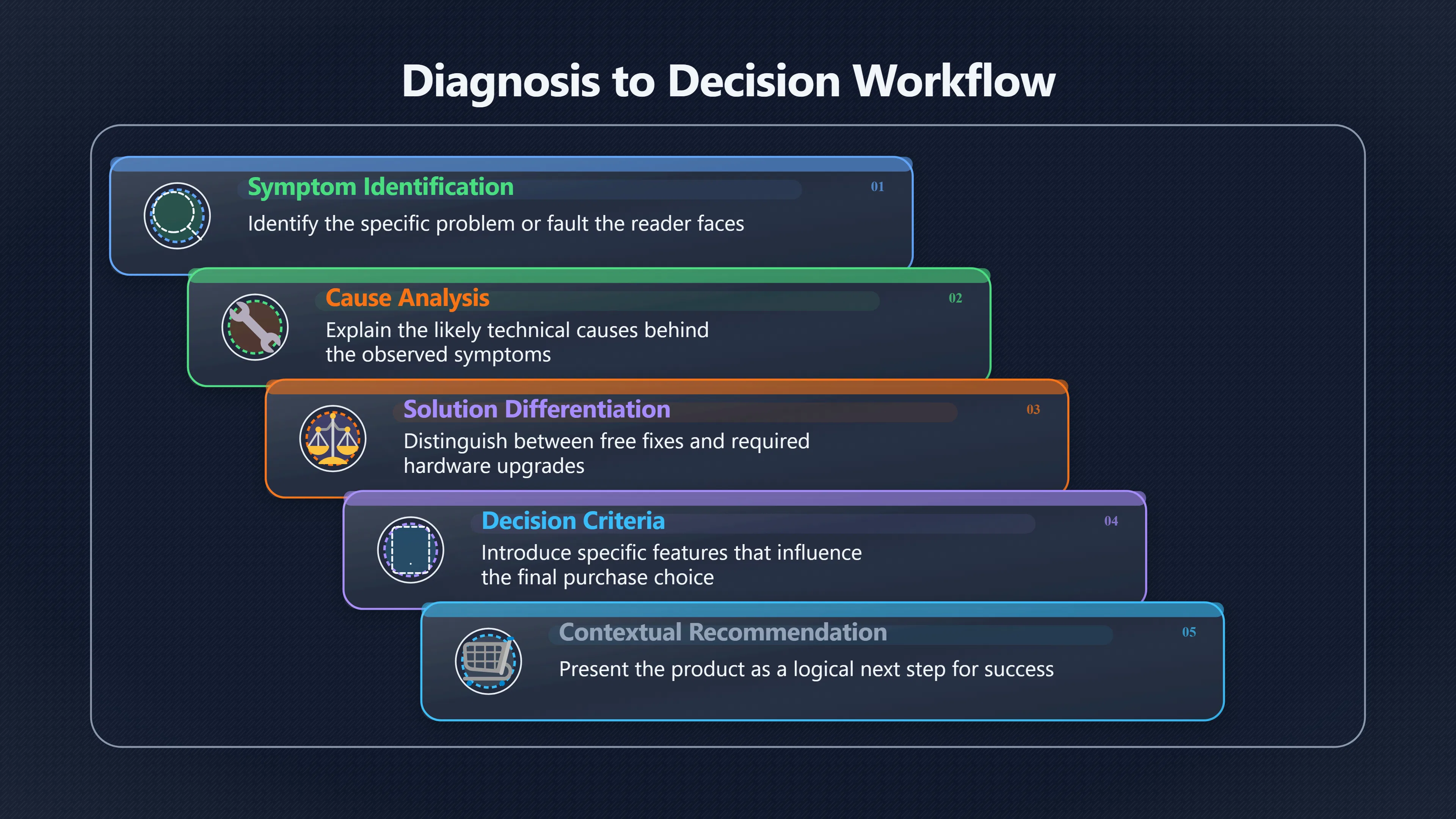
A stronger structure is to explain:
- the symptoms,
- the likely causes,
- how to distinguish between them,
- which causes can be fixed without spending money,
- which situations genuinely require new equipment.
This approach increases trust because the recommendation is conditional rather than predetermined. Sometimes the best advice is not to buy anything. Ironically, that restraint often makes later recommendations more persuasive.
For example, an article about poor espresso extraction might explain grind size, coffee freshness, water temperature and distribution technique before concluding that an inconsistent blade grinder is limiting results. Only then does recommending a quality burr grinder become a natural continuation of the advice rather than an obvious sales pitch.
How to Move from Diagnosis to Decision Criteria
The transition from educational content to affiliate recommendations should happen through decision-making, not promotion.
Readers usually reach a point where they understand the problem but still need help answering questions such as:
- Which solution fits my situation?
- Which features actually matter?
- Which trade-offs are worth paying for?
- Which specifications can I ignore?
This is where advice pages become buying paths.
Rather than inserting a “Best Products” section halfway through an article, guide readers through the criteria that should influence a purchase. For example:
Reader problemDecision criteria introducedSour espressoBurr quality, grind consistency, adjustment rangeWet camping gearHydrostatic head, seam construction, ventilationIndoor plant pestsType of infestation, treatment safety, application methodSlow home Wi-FiHouse layout, device count, wireless standards
Once readers understand these criteria, product recommendations have context. Instead of saying “Buy Product X”, the article can explain why Product X matches the needs that have just been established.
This mirrors the way knowledgeable people give advice in real life: they first understand the problem before recommending a solution.
Where Affiliate Links Feel Useful Rather Than Forced
Readers rarely object to affiliate links when those links remove friction.[gen3marketing.com]gen3marketing.comaffiliate links seoAffiliate Links & SEO: A Complete Guide17 Jan 2025 — What are affiliate links? How do they work? Do they help or hurt SEO? Get answers to…
Useful placements include:
- after explaining why a specific tool solves a diagnosed problem;
- beside a checklist of equipment needed for a repair;
- within comparison tables organised around use cases rather than price alone;
- after discussing situations where upgrading makes sense;
- alongside maintenance guides where replacement parts are genuinely required.
Forced placements look different. Common examples include recommending expensive products before explaining the problem, inserting unrelated offers into every section, or linking nearly every mention of a product category regardless of relevance.
A useful test is simple: if the affiliate links disappeared, would the article still solve the reader’s problem? If the answer is yes, the commercial links are supporting the content rather than replacing it.
Build Advice Around Real Decision Points
Many successful authority sites organise their educational content around moments where readers naturally reassess their options.
These moments include:
- Failure: something stops working.
- Frustration: current equipment delivers poor results.
- Growth: beginners outgrow entry-level tools.
- Maintenance: replacement parts become necessary.
- Comparison: readers struggle to understand competing specifications.
Each stage represents a different type of buying intent.
Someone asking how to sharpen kitchen knives probably does not need a completely new knife. However, after explaining sharpening techniques and stone selection, it may become clear that severely damaged blades or low-quality steel justify replacement. The purchase recommendation follows evidence, not assumption.
This sequence also creates opportunities for internal linking. A troubleshooting article can naturally point readers towards a more detailed buyer’s guide once replacement becomes one of several reasonable options.
Educational Content Often Converts Better Than Direct Sales Pages
Readers who arrive through advice content have already invested attention in solving a problem.
By the time they encounter a product recommendation they often understand:
- why the problem occurs;
- which solutions are ineffective;
- which features matter;
- how to compare alternatives.
This reduces uncertainty, which is frequently the biggest obstacle to purchasing.
Commercial pages that start with “Top 10 Products” often have to teach all of this from scratch. Advice pages accomplish much of the education beforehand, making the buying recommendation feel like the final step in a completed thought process rather than the beginning of a sales conversation.
Google’s guidance for helpful content and product-focused pages similarly emphasises original analysis, genuine experience and content created primarily to help users rather than to manipulate search rankings. Advice pages that solve real problems before introducing commercial recommendations naturally fit this model better than thin review pages built around affiliate links alone.[Google for Developers]developers.google.comGoogle for DevelopersCreating Helpful, Reliable, People-First ContentGoogle's ranking systems are designed to present helpful, reliable i…
Transparency Strengthens Rather Than Weakens Recommendations
Readers are increasingly familiar with affiliate marketing. Attempting to hide commercial relationships can undermine trust far more than openly acknowledging them.
Clear disclosures placed where readers will actually see them help establish transparency and satisfy regulatory expectations. In the UK, affiliate content must be obviously identifiable as advertising where required under advertising rules, while similar disclosure expectations exist under US Federal Trade Commission guidance.[ASA]asa.org.ukaffiliate marketingOnline Affiliate Marketing22 Mar 2023 — Affiliate marketing is a type of performance-based marketing where an affiliate is rewarded by…
Transparency also complements the educational approach. A straightforward statement that commissions help support independent testing or free guides is generally more credible than disguising commercial intent.
When readers believe that recommendations follow from careful diagnosis, practical experience and honest disclosure, affiliate links become part of the solution rather than a distraction from it.
Amazon book picks
Further Reading
Books and field guides related to How Advice Pages Become Buying Paths. Use these as the next step if you want deeper reading beyond the article.
They Ask, You Answer
Focuses on answering customer questions with helpful content that leads to confident buying decisions.
Everybody Writes
Helps create useful advice content that builds authority before introducing recommendations.
Content Inc
Shows how valuable content attracts audiences and supports sustainable monetization.
Influence: The Psychology of Persuasion
Explains how trust and persuasion help readers move naturally from advice to purchasing decisions.
eBay marketplace picks
Marketplace Samples
Live-tested eBay searches with available results related to this page.


Endnotes
1.
Source: developers.google.com
Link:https://developers.google.com/search/docs/fundamentals/creating-helpful-content
Source snippet
Google for DevelopersCreating Helpful, Reliable, People-First ContentGoogle's ranking systems are designed to present helpful, reliable i...
2.
Source: asa.org.uk
Title: affiliate marketing
Link:https://www.asa.org.uk/advice-online/affiliate-marketing.html
Source snippet
Online Affiliate Marketing22 Mar 2023 — Affiliate marketing is a type of performance-based marketing where an affiliate is rewarded by...
3.
Source: support.google.com
Title: low [traffic]({{ ‘traffic/’ | relative_url }}) affiliate site what can i do better
Link:https://support.google.com/webmasters/thread/112211009/low-traffic-affiliate-site-what-can-i-do-better?hl=en
Source snippet
Traffic Affiliate Site - What Can I Do Better?3 Jun 2021 — I launched a review based website early last year with the objective of helpin...
4.
Source: developers.google.com
Title: search and ai content
Link:https://developers.google.com/search/blog/2023/02/google-search-and-ai-content
Source snippet
Search's guidance about AI-generated contentIn this post, we'll share more about how AI-generated content fits into our long-standing app...
5.
Source: gen3marketing.com
Title: affiliate links seo
Link:https://gen3marketing.com/blog/affiliate-links-seo/
Source snippet
Affiliate Links & SEO: A Complete Guide17 Jan 2025 — What are affiliate links? How do they work? Do they help or hurt SEO? Get answers to...
Additional References
6.
Source: linkedin.com
Link:https://www.linkedin.com/posts/weence_wordpress-affiliate-compliance-in-2026-how-activity-7450578874175787008-68QF
Source snippet
{"title": "WordPress Affiliate Compliance: FTC Disclosures...It's aligning tightly with what Google actually documents about helpful con...
7.
Source: tricia.me
Title: ftc [updates]({{ ‘updates/’ | relative_url }}) disclosure guidelines affiliates influencers
Link:https://www.tricia.me/2023/06/29/ftc-updates-disclosure-guidelines-affiliates-influencers/
Source snippet
FTC Updates Disclosure Guidelines for Affiliates and Influencers29 Jun 2023 — The FTC has updated its Endorsement Guides, which are the s...
8.
Source: gsqi.com
Link:https://www.gsqi.com/marketing-blog/google-product-reviews-algorithm-update/
Source snippet
G-Squared InteractiveGoogle's Product Reviews Update – Analysis and findings22 Apr 2021 — On April 8, 2021 Google announced a new algorit...
Published: April 8, 2021
9.
Source: getaawp.com
Title: Does Using Affiliate Links Affect SEO?
Link:https://getaawp.com/blog/does-using-affiliate-links-affect-seo/
Source snippet
Here's The Answer29 Jul 2024 — In this post, you'll discover everything about affiliate links and SEO – and how to use them safely to sta...
10.
Source: annsmarty.com
Title: helpful content as defined by googles
Link:https://www.annsmarty.com/p/helpful-content-as-defined-by-googles
Source snippet
Helpful Content as Defined by Google's Quality Guidelines26 Feb 2025 — Google's quality guidelines include some important information on...
11.
Source: wecantrack.com
Title: What Is an Affiliate Disclosure?
Link:https://wecantrack.com/insights/affiliate-disclosure/
Source snippet
Why You Need OneAn affiliate disclosure, or disclaimer, states that certain links on a website are affiliate links, informing users of yo...
12.
Source: impact.com
Title: affiliate link disclosure
Link:https://impact.com/influencer/affiliate-link-disclosure/
Source snippet
s: 2025 Compliance Guide (+...Learn how to craft clear affiliate link disclosures to build trust and stay FTC-compliant. This guide cove...
13.
Source: termly.io
Title: ftc affiliate disclosure
Link:https://termly.io/resources/articles/ftc-affiliate-disclosure/
Source snippet
26-Feb-2026 — An FTC affiliate disclosure is a statement explaining your relationship to companies that pay you to sponsor or otherwise p...
14.
Source: elementor.com
Link:https://elementor.com/blog/affiliate-marketing-seo/
Source snippet
Affiliate Marketing SEO: 10 Actionable Tips to Drive Real...12 Feb 2026 — Google's “Helpful Content” updates and E-E-A-T guidelines have...
15.
Source: youtube.com
Link:https://www.youtube.com/watch?v=khLXlseXffs
Source snippet
e, get clicks AND convert visitors to customers...
Topic Tree