Within Spam Risk
Can Coupon Sections Borrow Too Much Authority?
Hosted coupon and shopping sections can become risky when they appear to rent a strong domain's reputation for unrelated affiliate search traffic.
On this page
- What makes third party commercial pages risky
- Why oversight may not solve reputation abuse
- Safer tests for topical fit and reader value
Page outline Jump by section
Introduction
Hosted coupon and shopping sections have become one of the clearest examples of how affiliate monetisation can cross into Google’s site reputation abuse policy. The issue is not that coupon pages, affiliate links, or commercial partnerships are prohibited. Instead, Google targets situations where a trusted website hosts commercial content primarily so that it can benefit from the site’s existing search authority, even though that content has little connection to the site’s editorial purpose or receives minimal meaningful oversight. This policy became a major part of Google’s anti-spam efforts during the March 2024 Search update and has since been clarified through additional guidance and enforcement.[blog.google+2Google for Developers]blog.googlegoogle search update march 2024New ways we're tackling spammy, low-quality content on…5 Mar 2024 — New and improved spam policies: We're updating our spam policies t…
 For anyone earning money from affiliate websites, this distinction matters because large, authoritative domains no longer provide a safe shortcut for ranking commercial content. Whether the content appears in a subdirectory, subdomain or partner-operated section, Google increasingly evaluates whether users are seeing genuinely valuable material or simply a commercial section attempting to “borrow” the host site’s reputation.
Can Coupon Sections Borrow Too Much Authority?
Google defines site reputation abuse as publishing third-party pages with little or no first-party involvement where the primary purpose is to manipulate search rankings by taking advantage of the host site’s existing ranking signals. The concern is not the affiliate relationship itself but the attempt to leverage trust earned in one subject area to rank unrelated commercial pages.[Google for Developers]developers.google.comGoogle for DevelopersSpam Policies for Google Web SearchSpam policies for Google web search · Cloaking · Doorway abuse · Expired domain a…
Historically, many newspapers, magazines and large publishers licensed their domains to specialist companies that created coupon directories, voucher portals, buying guides or product recommendation sections. These arrangements were commercially attractive because the publisher already possessed strong domain authority, while the specialist managed the affiliate operation and shared revenue.
From Google’s perspective, problems arise when:
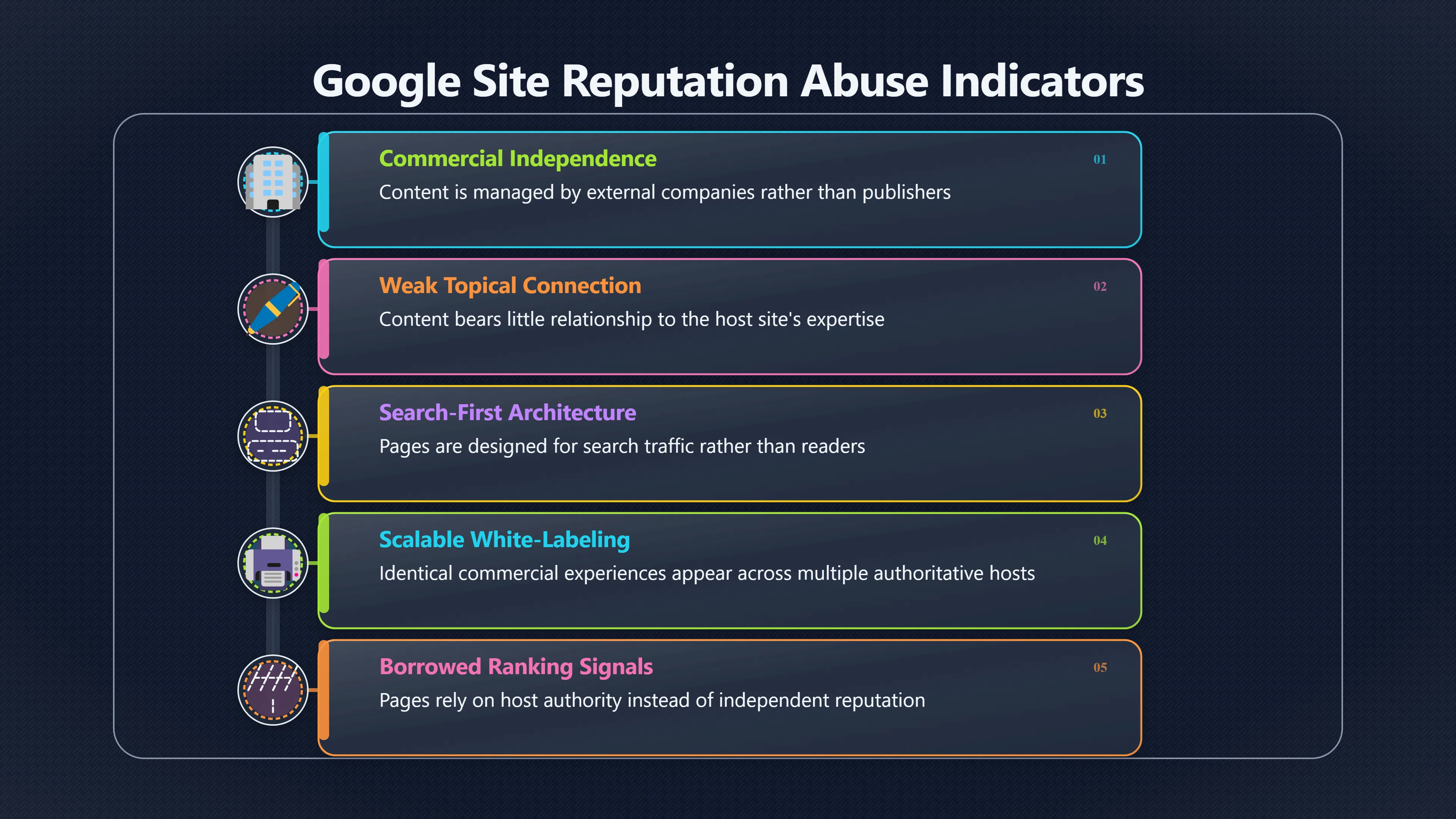
- users discover coupon pages almost exclusively through search rather than through the site’s normal navigation;
- the commercial content is substantially produced or managed by another company;
- the pages rely on the host domain’s authority instead of their own reputation;
- the material has little relationship to the site’s main editorial expertise; and
- the primary objective appears to be capturing search traffic rather than serving existing readers.[Google for Developers+2Google for Developers]developers.google.comGoogle for DevelopersSpam Policies for Google Web SearchSpam policies for Google web search · Cloaking · Doorway abuse · Expired domain a…
The policy therefore focuses on why the content exists and how it gains visibility, not merely whether affiliate links are present.
What Makes Third-Party Commercial Pages Risky?
The highest-risk situations share several characteristics that distinguish them from ordinary editorial commerce.
Commercial independence from the publisher. A publisher may license part of its website to an external affiliate company that creates thousands of coupon pages, merchant profiles or shopping articles. Even if branding remains consistent, the commercial operation functions largely independently from the editorial organisation. Google has repeatedly highlighted these arrangements as examples of the behaviour the policy intends to address.[Google for Developers]developers.google.comGoogle for DevelopersUpdating our site reputation abuse policyEarlier this year, as part of our work to fight spam and deliver a great Se…
Weak topical connection. A respected news organisation may suddenly rank for retailer discount codes, casino promotions or financial offers that bear little relationship to its journalism. Google considers these mismatched subject areas a sign that ranking signals, rather than topical authority, are doing most of the work.[Google for Developers]developers.google.comGoogle for DevelopersSpam Policies for Google Web SearchSpam policies for Google web search · Cloaking · Doorway abuse · Expired domain a…
Search-first architecture. Many hosted coupon sections historically generated large numbers of pages targeting individual retailer names or promotional searches. Users often reached these pages directly from Google instead of navigating through the publisher’s homepage. This pattern reinforced Google’s concern that the content existed primarily for search acquisition rather than the publisher’s readership.[Junction]junction.cj.comHow Google's New Site Reputation Abuse Policy Affects…May 14, 2024 — How Google's New Site Reputation Abuse Policy Affects Aff…
Scalable white-label production. Coupon platforms commonly power similar sections across many publisher domains using comparable technology, templates and merchant databases. While scale alone is not prohibited, repeating essentially the same commercial experience across numerous authoritative hosts increases the appearance that domain reputation is being rented rather than earned.[impact.com]impact.comGoogle's New Site Reputation Policy: Impact on AffiliateMay 5, 2024 — In March 2024, Google updated its Search Console guidelines to include a section under Spam Policies focused on site reputa…

Why Editorial Oversight May Not Solve Reputation Abuse
When Google introduced the policy, many publishers argued that they reviewed, approved or supervised partner-produced content. Google subsequently clarified that editorial involvement alone does not necessarily remove the underlying concern.
In November 2024, Google’s Search team explained that it had examined arrangements involving licensing agreements, white-label providers, partial ownership structures and varying degrees of publisher participation. Its conclusion was that increasing first-party involvement does not automatically change the fundamental nature of content whose purpose remains exploiting the host site’s ranking signals.[Google for Developers]developers.google.comGoogle for DevelopersUpdating our site reputation abuse policyEarlier this year, as part of our work to fight spam and deliver a great Se…
This clarification is significant because earlier discussions often assumed that stronger editorial review would make hosted affiliate sections compliant. Google’s updated explanation suggests that the central question is broader:
- Would this content naturally belong on this website?
- Is it primarily serving the site’s audience?
- Would it deserve to rank on its own merits without relying on the host domain’s reputation?
If the answer is largely “no”, adding editorial approval may not eliminate the policy concern. Google has also updated examples within its spam documentation to reduce emphasis on oversight alone and instead focus on whether coupon information comes directly from merchants or forms part of a genuine consumer service rather than an outsourced ranking strategy.[Google for Developers]developers.google.comGoogle for DevelopersUpdating our site reputation abuse policyEarlier this year, as part of our work to fight spam and deliver a great Se…
What Enforcement Has Looked Like
Google initially enforced the policy through manual actions rather than purely algorithmic ranking systems. Sites receiving these actions could see affected directories, subdomains or commercial sections lose visibility even if the remainder of the website continued ranking normally. Google’s Search Console includes a dedicated manual action category for site reputation abuse.[Google Help]support.google.comHelp Manual actions reportGoogle HelpManual actions report - Search Console HelpSite reputation abuse. Google has detected that a portion of your site is violating…
Industry observers noted that hosted coupon directories attached to major publishers became some of the earliest visible targets. These cases demonstrated that large brands were not automatically protected by their authority if commercial sections appeared designed to exploit that authority for unrelated affiliate traffic.[gsqi.com+2Awin]gsqi.comA Nightmare on Affiliate Street – How Google is picking off…24 Oct 2024 — After announcing the new 'Site reputation abuse” spam policy…
The policy has also influenced publisher business models. Several large media companies have reportedly restructured affiliate operations, reduced reliance on outsourced commercial content or brought product-review work under closer internal control following Google’s clarifications.[The Verge]theverge.comThis policy targets content aimed at exploiting a site’s ranking power and reputation by publishing irrelevant or low-quality material. F…
Safer Tests for Topical Fit and Reader Value
Affiliate publishers do not need to avoid coupons or commercial recommendations altogether. Instead, the safest approach is to evaluate whether the content genuinely belongs within the site’s broader editorial mission.
Useful questions include:
- Does the commercial content naturally follow the site’s subject matter? A technology publication covering software discounts fits more comfortably than an unrelated entertainment site hosting thousands of voucher codes.
- Would regular readers expect to find this material? Commercial pages should support the site’s existing audience rather than chase unrelated search demand.
- Does the page offer independent value beyond the affiliate link? Original explanations, comparisons, buying advice and context remain more defensible than thin merchant listings.
- Could the content establish authority if published on its own domain? If ranking depends almost entirely on the host’s reputation, the arrangement deserves closer scrutiny.
- Is the affiliate relationship transparent and integrated into normal publishing workflows? Hidden or isolated commercial sections increase the appearance of operating separately from the site’s editorial identity.[Google for Developers+2Google for Developers]developers.google.comGoogle for DevelopersSpam Policies for Google Web SearchSpam policies for Google web search · Cloaking · Doorway abuse · Expired domain a…
These questions do not create a guaranteed compliance checklist, but they align more closely with Google’s stated objective of rewarding pages that earn visibility because they are genuinely useful rather than because they inherit authority from an unrelated host.

What This Means for Affiliate Publishers
The site reputation abuse policy represents a shift away from judging affiliate content solely by page quality and towards evaluating the relationship between the content, the publisher and the domain itself.
For independent affiliate websites, the lesson is not that affiliate marketing is inherently risky. Rather, long-term search visibility increasingly depends on building topical authority within a coherent subject area instead of attaching commercial content to an already powerful domain. Publishers that develop affiliate pages as a natural extension of their expertise are in a stronger position than those relying on hosted coupon portals or outsourced commercial directories whose principal advantage is borrowed search authority.[Google for Developers+2blog.google]developers.google.comGoogle for DevelopersSpam Policies for Google Web SearchSpam policies for Google web search · Cloaking · Doorway abuse · Expired domain a…
Amazon book picks
Further Reading
Books and field guides related to Can Coupon Sections Borrow Too Much Authority?. Use these as the next step if you want deeper reading beyond the article.
Everybody Writes
Supports the creation of useful, trustworthy editorial content instead of thin commercial pages.
The Art of SEO
Explains search quality, authority, and sustainable SEO practices that relate directly to Google's stance on reputation abuse.
Content Inc
Encourages audience-first publishing and topical authority over shortcut monetisation tactics.
Trust Me, I'm Lying
Provides context on manipulative online promotion and incentives, complementing discussions of search spam and reputation abuse.
eBay marketplace picks
Marketplace Samples
Live-tested eBay searches with available results related to this page.


Endnotes
1.
Source: blog.google
Title: google search update march 2024
Link:https://blog.google/products-and-platforms/products/search/google-search-update-march-2024/
Source snippet
New ways we're tackling spammy, low-quality content on...5 Mar 2024 — New and improved spam policies: We're updating our spam policies t...
Published: march 2024
2.
Source: developers.google.com
Link:https://developers.google.com/search/docs/essentials/spam-policies
Source snippet
Google for DevelopersSpam Policies for Google Web SearchSpam policies for Google web search · Cloaking · Doorway abuse · Expired domain a...
3.
Source: developers.google.com
Link:https://developers.google.com/search/blog/2024/11/site-reputation-abuse
Source snippet
Google for DevelopersUpdating our site reputation abuse policyEarlier this year, as part of our work to fight spam and deliver a great Se...
4.
Source: impact.com
Title: Google’s New Site Reputation Policy: Impact on Affiliate
Link:https://impact.com/affiliate/googles-updated-site-reputation-abuse-policy-on-affiliate-marketers/
Source snippet
May 5, 2024 — In March 2024, Google updated its Search Console guidelines to include a section under Spam Policies focused on site reputa...
Published: May 5, 2024
5.
Source: support.google.com
Title: Help Manual actions report
Link:https://support.google.com/webmasters/answer/9044175?hl=en
Source snippet
Google HelpManual actions report - Search Console HelpSite reputation abuse. Google has detected that a portion of your site is violating...
6.
Source: gsqi.com
Link:https://www.gsqi.com/marketing-blog/a-nightmare-on-affiliate-street/
Source snippet
A Nightmare on Affiliate Street – How Google is picking off...24 Oct 2024 — After announcing the new 'Site reputation abuse” spam policy...
7.
Source: awin.com
Title: insight of the month google site reputation update
Link:https://www.awin.com/gb/affiliate-marketing/insight-of-the-month-google-site-reputation-update
Source snippet
Google's Site Reputation Abuse Update: Early Impact &...6 Aug 2024 — Explore the early impact and insights of Google's Site Reputati...
8.
Source: developers.google.com
Link:https://developers.google.com/search/docs/appearance/structured-data/product
Source snippet
Google for DevelopersIntro to Product Structured Data on GoogleWhen you add structured data to your product pages, your product informati...
9.
Source: google.com
Link:https://www.google.com/
Source snippet
Search the world's information, including webpages, images, videos and more. Google has many special features to help you find exac...
10.
Source: support.google.com
Title: site reputation abuse clarification
Link:https://support.google.com/webmasters/thread/273834835/site-reputation-abuse-clarification?hl=en
Source snippet
Reputation Abuse Clarification10-May-2024 — Can Google clarify the specific benchmarks that coupons content must meet to avoid being flag...
11.
Source: junction.cj.com
Link:https://junction.cj.com/article/how-googles-new-site-reputation-abuse-policy-affects-affiliate
Source snippet
How Google's New Site Reputation Abuse Policy Affects...May 14, 2024 — How Google's New Site Reputation Abuse Policy Affects Aff...
Published: May 14, 2024
12.
Source: ignitevisibility.com
Title: site reputation abuse
Link:https://ignitevisibility.com/site-reputation-abuse/
Source snippet
Google Site Reputation Abuse: Warnings About Third Party...23 May 2024 — Google defines site reputation abuse as the process of a websit...
Published: May 2024
13.
Source: theverge.com
Link:https://www.theverge.com/2024/12/17/24322485/forbes-vetted-freelance-google-search-parasite-seo
Source snippet
This policy targets content aimed at exploiting a site’s ranking power and reputation by publishing irrelevant or low-quality material. F...
14.
Source: seosly.com
Title: site reputation abuse policy
Link:https://seosly.com/blog/site-reputation-abuse-policy/
Source snippet
Regularly review your website for third-party content that could be considered Site Reputation Abuse. Pay close...
Additional References
15.
Source: linkedin.com
Title: googles site reputation abuse policy crackdown sunil ramlochan enfpe
Link:https://www.linkedin.com/pulse/googles-site-reputation-abuse-policy-crackdown-sunil-ramlochan-enfpe
Source snippet
Google's Site Reputation Abuse Policy CrackdownThe Site Reputation Abuse update, announced in 2023 and now rolling out, specifically targ...
16.
Source: businessinsider.com
Link:https://www.businessinsider.com/google-spam-crackdown-digital-media-hurting-freelancers
Source snippet
Google targets content that exploits reputable outlets' search authority. Consequently, companies are cutting ties with freelancers, assi...
17.
Source: youtube.com
Title: Google March Core Update Done, HCU Recoveries, Site Reputation Abuse & AI Topics
Link:https://www.youtube.com/watch?v=ClSeS3VbTxU
Source snippet
Google site reputation abuse coupon parasite SEO SEO Surprise: Site Reputation Abuse, Parasite SEO, and Coupons Optimist - Growth-Focused...
18.
Source: newpathweb.com.au
Title: Google’s Site Reputation Abuse Policy rollout began May 5th
Link:https://www.newpathweb.com.au/blog/googles-site-reputation-abuse-policy-starting-rolling-out-on-may-5th/
Source snippet
May 15, 2024 — The site reputation abuse policy applies to all third-party content on websites, including sponsored, advertising, and par...
Published: May 15, 2024
19.
Source: linkedin.com
Title: Look for partner-authored articles, white-label city pages,
Link:https://www.linkedin.com/posts/weence_google-site-reputation-abuse-manual-actions-activity-7450533626024460288-WEHz
Source snippet
Google Site Reputation Abuse Manual Actions ExplainedApr 16, 2026 — In many cases, the visible section (for example, /coupons/) is only p...
20.
Source: anotherconcept.co.uk
Title: googles site reputation abuse policy rolls out manual actions hit big sites
Link:https://anotherconcept.co.uk/insights/googles-site-reputation-abuse-policy-rolls-out-manual-actions-hit-big-sites
Source snippet
It was introduced as part of Google's March 2024 Core Update and it details prohibited practices...Read more...
Published: March 2024
21.
Source: propelbon.com
Title: googles new policy on discount code and coupon websites
Link:https://propelbon.com/en/googles-new-policy-on-discount-code-and-coupon-websites/
Source snippet
Google's New Policy on Coupon and Discount Websites12 Jun 2024 — Learn how Google's new "site reputation abuse" policy is impacting coupo...
22.
Source: reddit.com
Link:https://www.reddit.com/r/SEO/comments/1fpbw9l/weekly_discussion_google_updated_spam_policy/
Source snippet
ed Content, Coupons - Sept 25th · Do these changes help SEOs and...Read more...
23.
Source: youtube.com
Link:https://www.youtube.com/watch?v=rhoRyQSki-U
Source snippet
NEW Spam Policies for Google Web Search: How To Avoid...A new site hosting coupons provided by third party with little to no oversite or...
24.
Source: reddit.com
Link:https://www.reddit.com/r/SEO/comments/1ckfohi/google_algorithm_rolls_out_tomorrow_site/
Source snippet
tes just for a backlink. People sell links in Forbes, Entrepreneur...
Topic Tree