Within Disclosures
How Templates Stop Affiliate Disclosure Mistakes
Built-in templates make affiliate disclosure a routine part of review pages, comparison tables, and product blocks.
On this page
- Reusable review page disclosure blocks
- Product cards and comparison tables
- Publishing checks before pages go live
Page outline Jump by section
Introduction
Affiliate disclosure failures are often caused by process rather than intent. Publishers know they should tell readers when they may earn a commission, yet notices are forgotten during updates, omitted from new comparison pages, or accidentally removed when content is redesigned. The most reliable solution is not asking writers to remember every time—it is building disclosure templates directly into the publishing workflow.
 This approach reflects the direction taken by regulators. The US Federal Trade Commission (FTC) focuses on whether disclosures are clear, conspicuous and placed where consumers will notice them, while UK advertising guidance stresses that affiliate content should be recognisable as advertising where required and that vague abbreviations such as “Aff” are unlikely to be understood by readers.[Federal Trade Commission+2ASA]ftc.govFederal Trade Commission FTC's Endorsement Guides: What People Are AskingFederal Trade CommissionFTC's Endorsement Guides: What People Are AskingSeptember 7, 2017 — 29 Jun 2023 — Here are answers to some of the…
Why Templates Reduce Disclosure Mistakes
Historically, many affiliate websites relied on editorial guidelines or staff training. That worked reasonably well for small blogs with a handful of articles but became unreliable as websites expanded to hundreds or thousands of product pages.
Modern publishing systems increasingly treat affiliate disclosure as a required page component rather than optional text. Instead of expecting every author to remember where and how to write a notice, the content management system inserts an approved disclosure automatically into predefined page types.
This shift offers several practical advantages:
- Every review begins with consistent wording.
- New writers cannot accidentally invent weaker language.
- Site redesigns preserve disclosure placement.
- Editors only need to maintain one approved version instead of checking hundreds of pages individually.
- Regulatory wording can be updated centrally if guidance changes.[Federal Trade Commission+2ASA]ftc.govFederal Trade Commission FTC's Endorsement Guides: What People Are AskingFederal Trade CommissionFTC's Endorsement Guides: What People Are AskingSeptember 7, 2017 — 29 Jun 2023 — Here are answers to some of the…
The principle is simple: automation is usually more reliable than memory.
Reusable Review-Page Disclosure Blocks
Review articles benefit from a standard disclosure block positioned before the first affiliate recommendation or purchase link.
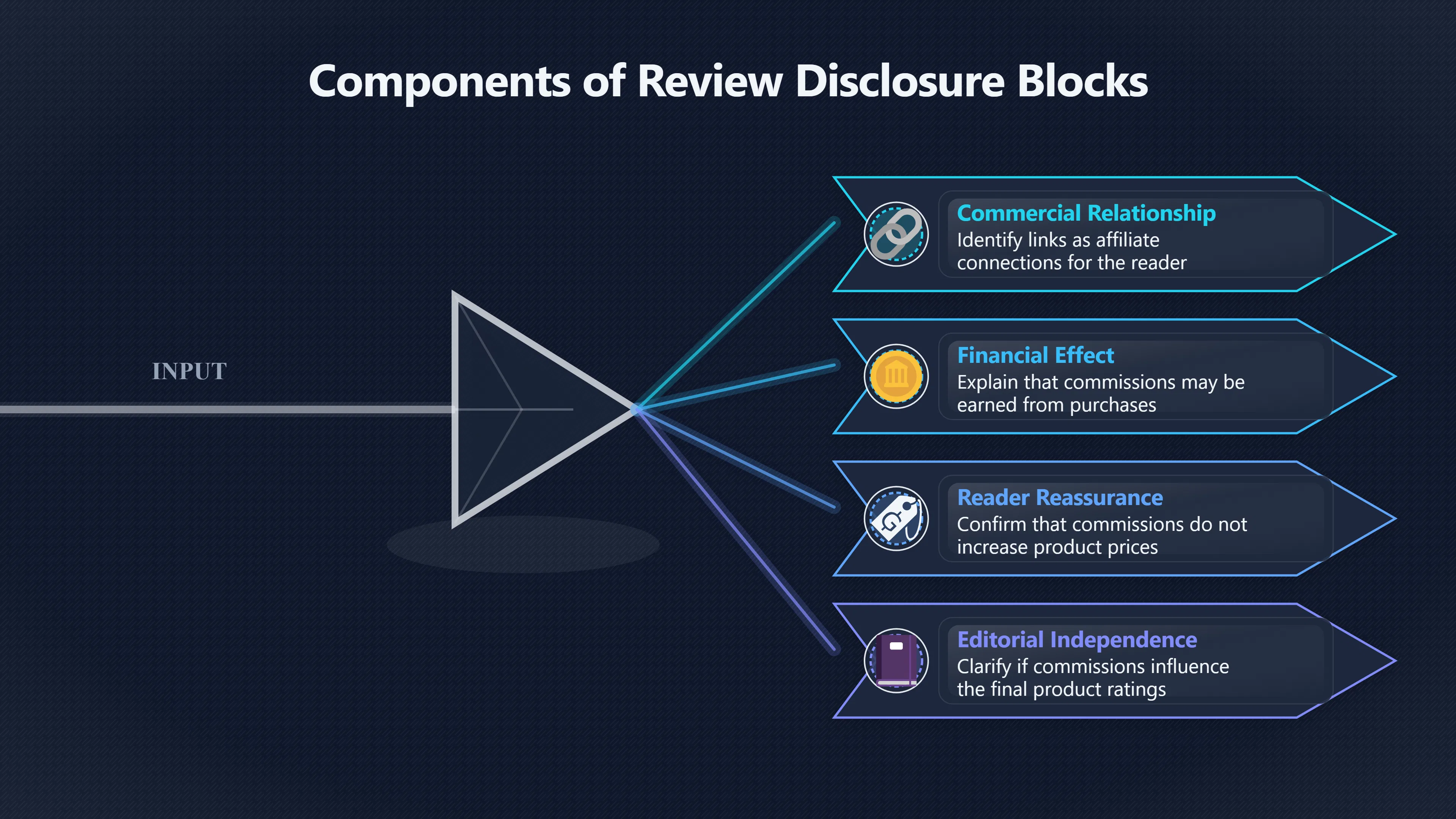
A reusable block typically contains three separate ideas:
- The commercial relationship “Some links on this page are affiliate links.”
- The financial effect “If you purchase through them, we may earn a commission.”
- Reader reassurance (where true) “This does not increase the price you pay.”
Many publishers also include a short editorial independence statement explaining whether commissions influence ratings. While this does not replace the disclosure itself, it answers the question many readers naturally have: “Are these rankings being bought?” The FTC has repeatedly indicated that consumers need to understand material connections that could affect how they evaluate endorsements.[Federal Trade Commission]ftc.govFederal Trade Commission FTC's Endorsement Guides: What People Are AskingFederal Trade CommissionFTC's Endorsement Guides: What People Are AskingSeptember 7, 2017 — 29 Jun 2023 — Here are answers to some of the…
A good review-page template therefore becomes a permanent component of every product review rather than a paragraph copied manually.
Product Cards and Comparison Tables
Comparison pages create a different problem because readers frequently skip introductions and scroll directly to product tables.
If the only disclosure appears several paragraphs above the table, many visitors may never see it before clicking an affiliate link. Regulators evaluate disclosures from the perspective of ordinary consumers, making proximity to purchasing decisions an important consideration.[Federal Trade Commission]ftc.govFederal Trade Commission FTC's Endorsement Guides: What People Are AskingFederal Trade CommissionFTC's Endorsement Guides: What People Are AskingSeptember 7, 2017 — 29 Jun 2023 — Here are answers to some of the…
For this reason, many affiliate sites now build disclosure fields directly into reusable comparison components.
Examples include:
- A short disclosure immediately above every comparison table.
- A notice built into reusable “Best Product” boxes.
- Product card templates that automatically display a disclosure before “Check Price” buttons.
- Mobile layouts that preserve the disclosure when tables collapse into stacked cards.
This component-based approach reduces the risk that a designer or editor accidentally removes disclosures while updating page layouts.
Publishing Checks Before Pages Go Live
Templates work best when combined with publishing safeguards.
Rather than relying on a final visual inspection, many editorial workflows include automated checks before publication. These are policy controls rather than legal guarantees, but they dramatically reduce accidental omissions.
Typical publishing rules include:
- Prevent publication if a review template lacks its disclosure block.
- Flag affiliate links appearing before the disclosure.
- Require editors to confirm disclosure placement during review.
- Include disclosure verification in quality assurance checklists after major theme or template updates.
- Recheck archived articles after bulk content migrations.
This approach mirrors broader publishing practice in which required legal notices become mandatory fields rather than optional editorial content.
Historical Change: From Manual Notes to System Design
Early affiliate blogs commonly placed a generic disclaimer in a footer or on a separate disclosure page. That reflected an era when websites were smaller and affiliate marketing operated with relatively informal publishing practices.
Regulatory expectations gradually shifted towards disclosures that readers actually notice when making purchasing decisions. The FTC’s updated guidance reinforces that disclosures should be difficult to miss and understandable in context rather than hidden elsewhere on the site. UK guidance has similarly emphasised that affiliate advertising should be clearly identified where appropriate and warns against abbreviations that consumers may not recognise.[Federal Trade Commission+2ASA]ftc.govFederal Trade Commission FTC's Endorsement Guides: What People Are AskingFederal Trade CommissionFTC's Endorsement Guides: What People Are AskingSeptember 7, 2017 — 29 Jun 2023 — Here are answers to some of the…
As a result, modern affiliate publishers increasingly embed disclosure into page architecture itself:
Earlier practiceTemplate-driven practiceFooter disclaimerDisclosure near the first recommendationSeparate disclosure pageDisclosure appears on every relevant pageWriter remembers manuallyCMS inserts automaticallyDifferent wording across authorsStandard approved languageVisual checks onlyAutomated publication rules
The change is less about new wording than about making omission technically difficult.
What Research Suggests About Standardised Disclosures
Academic research into affiliate marketing disclosures has shown that disclosure rates have historically been low and that short or unexplained statements often fail to communicate the commercial relationship effectively. Studies examining YouTube and Pinterest found that only a small proportion of affiliate content contained disclosures, while explanatory wording helped users understand the nature of affiliate marketing more successfully than brief labels alone.[arXiv]arxiv.orgOpen source on arxiv.org.
That finding supports the use of standard templates containing plain-language explanations instead of cryptic labels.
For example, a disclosure such as:
“We may earn a commission if you buy through links on this page.”
is generally more informative than simply marking a link “Affiliate” or “Aff”, particularly because UK advertising guidance notes that many consumers are unlikely to understand abbreviated labels.[ASA]asa.org.ukget yourself affiliated with the rules on affiliate marketingGet yourself affiliated with the rules on affiliate marketing10 Oct 2024 — This CAP Advice explains the circumstances under which diff…

Designing Templates That Survive Site Growth
The most durable disclosure systems share several characteristics:
- Central management: one approved disclosure maintained across the entire website.
- Automatic insertion: page templates include disclosures by default.
- Context-specific variants: separate versions for reviews, buying guides, comparison tables and product cards while keeping the same core message.
- Responsive design: disclosures remain visible on desktop and mobile layouts.
- Editorial governance: updates to disclosure wording occur centrally rather than requiring manual edits to every article.
As affiliate websites expand, these design choices become less about convenience and more about consistency. By making disclosure an inherent feature of the publishing system instead of an author’s memory task, templates substantially reduce the likelihood that affiliate notices are accidentally omitted while helping readers recognise commercial relationships before they make purchasing decisions.
Amazon book picks
Further Reading
Books and field guides related to How Templates Stop Affiliate Disclosure Mistakes. Use these as the next step if you want deeper reading beyond the article.
Affiliate Program Management
Covers affiliate program operations, compliance, and professional publishing practices relevant to disclosure workflows.
Everybody Writes
Supports creating consistent editorial processes, templates, and publishing standards.
The Checklist Manifesto
Reinforces the value of standardized checklists and workflows to prevent avoidable publishing mistakes.
Epic Content Marketing
Provides broader content governance and publishing strategy that complements disclosure template practices.
eBay marketplace picks
Marketplace Samples
Live-tested eBay searches with available results related to this page.


Endnotes
1.
Source: ftc.gov
Title: Federal Trade Commission FTC’s Endorsement Guides: What People Are Asking
Source snippet
Federal Trade CommissionFTC's Endorsement Guides: What People Are AskingSeptember 7, 2017 — 29 Jun 2023 — Here are answers to some of the...
Published: September 7, 2017
2.
Source: asa.org.uk
Title: get yourself affiliated with the rules on affiliate marketing
Link:https://www.asa.org.uk/news/get-yourself-affiliated-with-the-rules-on-affiliate-marketing.html
Source snippet
Get yourself affiliated with the rules on affiliate marketing10 Oct 2024 — This CAP Advice explains the circumstances under which diff...
3.
Source: arxiv.org
Link:https://arxiv.org/abs/1809.00620
5.
Source: arxiv.org
Link:https://arxiv.org/abs/1803.08488
6.
Source: youtube.com
Title: How to add affiliate disclosure on Word Press? | With Examples + FREE Template
Link:https://www.youtube.com/watch?v=05Og3iF8IgA
Source snippet
How To Add an Affiliate Disclosure to Your WordPress Posts...
7.
Source: youtube.com
Title: How To Add an Affiliate Disclosure to Your Word Press Posts
Link:https://www.youtube.com/watch?v=mTeXb1DXKs4
Source snippet
Automatic Affiliate Disclosures in WordPress: How to Add Them in Minutes...
8.
Source: youtube.com
Title: Automatic Affiliate Disclosures in Word Press: How to Add Them in Minutes
Link:https://www.youtube.com/watch?v=3Jx3uwe_xq8
Source snippet
Setup Affiliate Disclaimer on Wordpress + FTC Affiliate Link Disclosure Examples...
9.
Source: youtube.com
Title: Setup Affiliate Disclaimer on Wordpress + FTC Affiliate Link Disclosure Examples
Link:https://www.youtube.com/watch?v=IaYqlvor_qM
Source snippet
How to Write an Affiliate Disclosure for Your Blog [with EXAMPLES]...
10.
Source: youtube.com
Title: How to Write an Affiliate Disclosure for Your Blog [with EXAMPLES]
Link:https://www.youtube.com/watch?v=ALoStY4WAvs
Source snippet
How to add affiliate disclosure template website wordpress blog How To Add an Affiliate Disclosure to Your WordPress Posts Tony Teaches Tech...
Additional References
11.
Source: federal-lawyer.com
Link:https://federal-lawyer.com/ftc-defense/affiliate-disclosure/
Source snippet
Understanding the FTC's Affiliate Disclosure RulesLearn what affiliate marketers and companies need to know about the FTC's affiliate dis...
12.
Source: postaffiliatepro.com
Link:https://www.postaffiliatepro.com/blog/how-to-write-affiliate-disclaimer/
Source snippet
Write an Affiliate Disclaimer: Compliance GuideThe FTC's Endorsement Guides specifically state that any material connection between an en...
13.
Source: consultantlm.com
Link:https://consultantlm.com/consultant-article/ftc-affiliate-disclosure-rules-2025-how-to-avoid-lawsuits-and-legal-penalties-for-your-website
Source snippet
FTC Affiliate Disclosure Rules 2025 How to Avoid Lawsuits...16 Nov 2025 — The FTC mandates full disclosure of any paid promotions, affil...
14.
Source: theapma.co.uk
Title: what the latest asa rulings mean for affiliate marketing
Link:https://theapma.co.uk/what-the-latest-asa-rulings-mean-for-affiliate-marketing/
Source snippet
4 Dec 2024 — The Advertising Standards [Authority]({{ 'authority/' | relative_url }}) (ASA) has upheld five separate complaints against affiliate marketing ads on Instagram...
15.
Source: iubenda.com
Link:https://www.iubenda.com/en/blog/affiliate-disclosure/
Source snippet
isitors that you earn a commission when they purchase a product or...Read more...
16.
Source: stalirov.lawyer
Link:https://stalirov.lawyer/en/posts/ftc-affiliate-marketing-compliance
Source snippet
FTC Affiliate Marketing & Compliance: Disclosure Rules...7 May 2025 — The FTC views most affiliate marketing activities as endorsements...
Published: May 2025
17.
Source: manatt.com
Title: an in depth look at the ftcs updates 2
Link:https://www.manatt.com/insights/newsletters/advertising-law/an-in-depth-look-at-the-ftcs-updates-2
Source snippet
An In-Depth Look at the FTC's Updates to the Endorsement...30 Jul 2023 — The phrase “clear and conspicuous” is generally used in the End...
18.
Source: lawyerlessdocs.com
Title: Do You Need an Affiliate Disclosure?
Link:https://lawyerlessdocs.com/blog/news/do-you-need-an-affiliate-disclosure-what-the-ftc-actually-requires-and-what-a-footer-link-doesn-t-cover
Source snippet
What the FTC Actually...2 days ago — Not for most standard affiliate content — a clear, consistently-placed disclosure covering the elem...
19.
Source: postaffiliatepro.nl
Link:https://www.postaffiliatepro.nl/faq/do-i-have-to-disclose-affiliate-links/
Source snippet
links, FTC-compliance regels en best practices voor 2025...
20.
Source: clarigital.com
Title: Affiliate Compliance & FTC Disclosure: The Legal
Link:https://www.clarigital.com/codex/affiliate-marketing/affiliate-compliance-regulation/
Source snippet
The disclosure must be placed where consumers will see it before engaging with the affiliate content —...Read more...
Topic Tree