Within Communities
Use Threads to Beat Thin Reviews
Community research can help replace thin merchant-copy pages with original comparisons, cautions, and buyer-focused explanations.
On this page
- Patterns worth turning into original content
- How community evidence strengthens comparisons
- Avoiding copied merchant claims and empty roundups
Page outline Jump by section
Introduction
Community threads are not a substitute for product testing or original expertise, but they are one of the best ways to discover what a useful affiliate page is missing. Reddit discussions, specialist forums, and other user communities expose the questions buyers ask after reading polished marketing copy: what failed after six months, which accessories are actually necessary, what compatibility problems appear in practice, and whether a supposedly “best” product is worth its premium.
 That matters because search engines increasingly distinguish between affiliate pages that merely repeat merchant descriptions and those that add genuine value. Google’s spam policies specifically warn against thin affiliate pages that provide little or no original benefit beyond information already supplied by merchants.[Google for Developers]developers.google.comGoogle for DevelopersSpam Policies for Google Web SearchThe spam policies detail the behaviors and tactics that can lead to a page or an… Instead of copying community opinions, the goal is to use recurring discussion patterns as research inputs that lead to stronger comparisons, clearer explanations, and better purchasing guidance.
Patterns Worth Turning Into Original Content
Individual Reddit comments are rarely reliable enough to become article content. Hundreds of similar discussions, however, often reveal recurring themes that deserve investigation.
Useful patterns include:
- Questions that appear repeatedly across many threads.
- Common ownership frustrations that official product pages ignore.
- Features that experienced users value more than advertised specifications.
- Situations where different buyer types recommend different products.
- Long-term reliability reports that only emerge after months or years of ownership.
For example, a merchant page may claim that two coffee grinders are suitable for espresso. Community discussions may repeatedly explain that one model requires constant adjustment while another maintains calibration more consistently. Rather than quoting anonymous users as proof, the affiliate page can investigate the issue, explain why calibration matters, identify who would notice the difference, and include supporting evidence from manufacturer documentation, professional reviews, or independent testing where available.
The community discussion becomes the starting point rather than the finished content.
This approach produces information that cannot be generated simply by rewriting manufacturer specifications.
Use Community Questions to Build Better Comparisons
Many comparison pages follow the same predictable format:
- Specifications
- Pros
- Cons
- Price
- Verdict
Readers often leave without having their real concerns answered.
Community research reveals the questions that actually determine purchasing decisions, such as:
- Which product lasts longer with daily use?
- Which is easier for beginners?
- Which has the better warranty experience?
- Which replacement parts are difficult to source?
- Which model becomes noisy after prolonged use?
- Which software receives better long-term updates?
Instead of adding another generic comparison table, structure sections around these genuine buying decisions.
For example, rather than writing:
“Product A has 12 GB of RAM while Product B has 16 GB.”
A stronger section might answer:
“Why experienced users often recommend Product B despite its higher price.”
That explanation can discuss upgrade paths, thermal performance, customer support history, or compatibility issues discovered during research rather than simply repeating specifications.
The comparison becomes decision-focused instead of specification-focused.
Turn Complaints Into Buyer Guidance
Negative experiences are especially valuable because they often expose limitations hidden by promotional material.
Repeated complaints should not automatically be treated as facts. Instead, they should trigger further investigation.
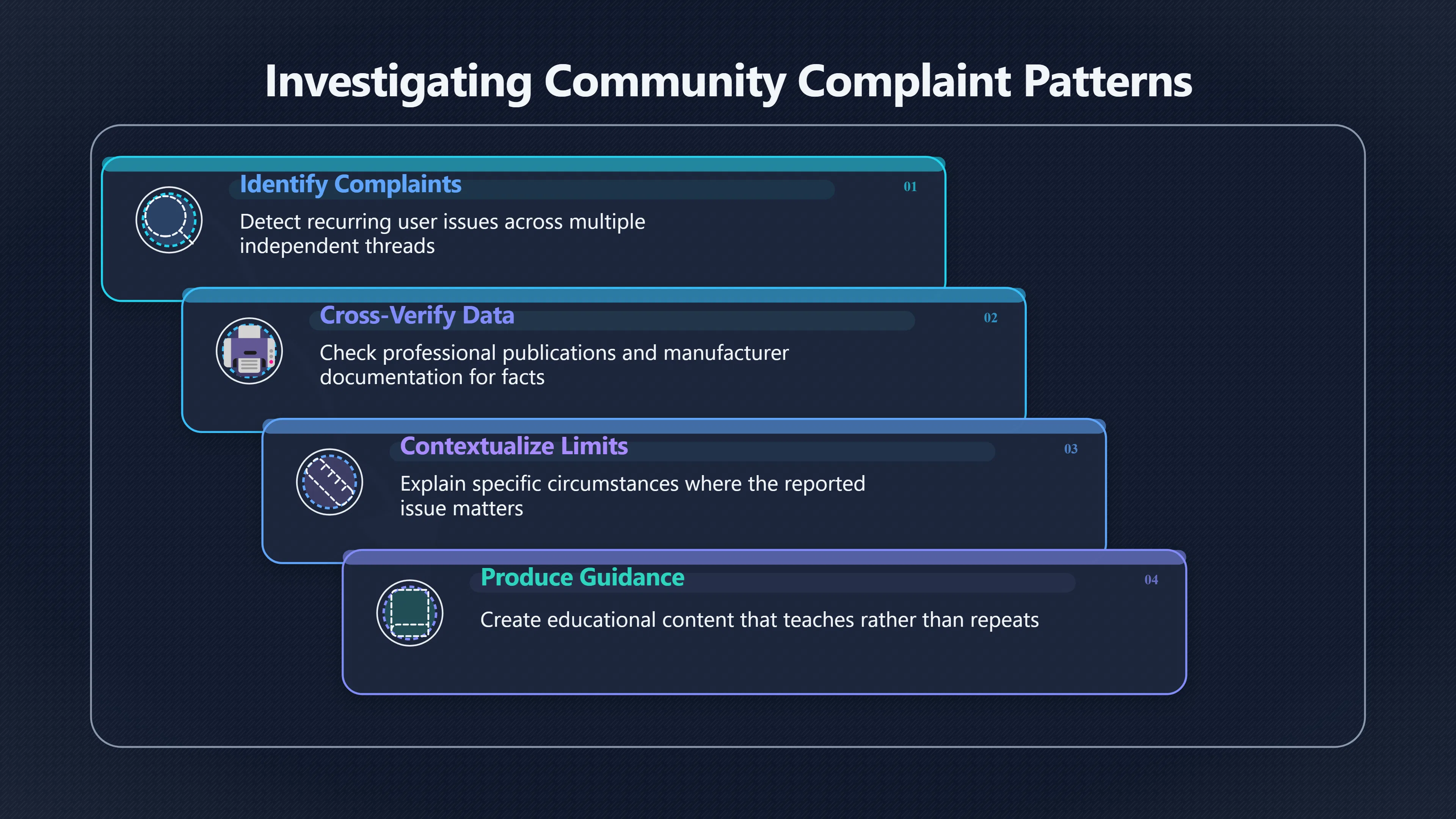
A practical workflow looks like this:
- Notice repeated complaints across multiple independent discussions.
- Check whether reviewers or professional publications observed the same issue.
- Confirm whether manufacturers acknowledge the limitation.
- Explain the circumstances under which the issue matters.
- Identify who should care and who probably should not.
Suppose dozens of users complain that a particular camping stove struggles in cold weather.
Rather than simply repeating those complaints, the affiliate page can explain:
- why cold temperatures affect fuel pressure;
- whether this behaviour is expected for that fuel type;
- which competing models handle the problem differently;
- which users are unlikely to encounter the limitation.
The finished article teaches rather than merely repeating opinions.
Community Evidence Improves Original Comparisons
Communities frequently expose comparison criteria that ordinary affiliate sites overlook.
Examples include:
Thin comparisonCommunity-informed comparisonPriceLifetime ownership cost including replacement partsWeightReal carrying comfort during long tripsBattery lifeBattery performance after months of regular chargingSoftware featuresUpdate reliability and bug historyWarranty lengthActual customer support experiencePerformancePerformance under realistic everyday workloads
These dimensions help readers choose products according to their own priorities instead of assuming everyone wants the same “best” option.
The resulting page contains interpretation rather than copied product data.
Replace Merchant Claims With Independent Explanations
Manufacturers understandably describe products in the most favourable way possible.
Community research helps identify where readers remain unconvinced.
For example, if a merchant advertises:
- “Professional quality”
- “Military-grade materials”
- “Fast charging”
- “Lifetime durability”
community discussions often reveal what buyers actually want to know:
- What does “professional” mean in daily use?
- Which material fails first?
- How fast is charging with the supplied charger?
- What typically breaks after two years?
The affiliate page should answer those questions directly.
Rather than challenging marketing claims without evidence, explain the underlying mechanism, reference independent testing where available, and describe realistic expectations.
This creates genuinely useful editorial content instead of another version of the manufacturer’s brochure.
Avoid Copying Community Discussions
The purpose of thread research is idea generation, not content extraction.
Poor practice includes:
- paraphrasing popular Reddit comments;
- collecting anonymous opinions into list articles;
- copying phrases that appear repeatedly;
- presenting forum anecdotes as established facts.
Besides ethical concerns, copied discussions rarely produce distinctive pages.
Instead:
- identify recurring themes;
- investigate why they occur;
- verify with additional sources;
- explain the issue in your own words;
- provide balanced guidance.
This transformation—from anecdote to explanation—is where the editorial value is created.
Recognise Bias Before Treating Consensus as Truth
Communities are useful, but they have predictable weaknesses.
Some discussions become dominated by:
- early adopters;
- loyal brand communities;
- highly technical enthusiasts;
- people motivated to report problems rather than routine satisfaction.
An affiliate publisher should therefore ask:
- Does this complaint appear across multiple communities?
- Is the discussion several years old?
- Has the manufacturer released updated hardware or firmware?
- Are owners disagreeing because they have different use cases?
Sometimes a product develops a poor reputation based on an older version even after later revisions solve the original problem.
Treat recurring discussion as a research lead rather than definitive evidence.
Build Pages Around Real Buying Decisions
Community research is most valuable when it changes the structure of an article rather than merely adding quotations.
Instead of creating another generic “Top 10” roundup, sections can answer questions such as:
- Which option is easiest to maintain?
- Which upgrade offers the biggest improvement?
- Which buyers should avoid this entirely?
- What unexpected costs appear after purchase?
- Which features matter less than marketing suggests?
These are the questions that repeatedly appear in community discussions because they reflect genuine uncertainty before spending money.
Answering them with verified, well-organised analysis produces pages that are substantially more useful than thin affiliate content assembled from merchant descriptions alone. That aligns with Google’s long-standing guidance that affiliate pages should contribute meaningful original value rather than simply reproducing information already available elsewhere.[Google for Developers]developers.google.comGoogle for DevelopersSpam Policies for Google Web SearchThe spam policies detail the behaviors and tactics that can lead to a page or an…
Amazon book picks
Further Reading
Books and field guides related to Use Threads to Beat Thin Reviews. Use these as the next step if you want deeper reading beyond the article.
Everybody Writes
Shows how to create genuinely useful, original content instead of thin, repetitive pages.
Content Strategy for the Web
Helps readers turn audience research into structured, useful website content.
They Ask, You Answer
Encourages using authentic buyer concerns as the basis for stronger comparison and buying guides.
The Art of SEO
Covers high-quality search optimization principles that align with creating better affiliate content.
eBay marketplace picks
Marketplace Samples
Live-tested eBay searches with available results related to this page.




Endnotes
1.
Source: developers.google.com
Link:https://developers.google.com/search/docs/essentials/spam-policies
Source snippet
Google for DevelopersSpam Policies for Google Web SearchThe spam policies detail the behaviors and tactics that can lead to a page or an...
2.
Source: reddit.com
Title: Thin Content Explained
Link:https://www.reddit.com/r/SEMrush/comments/1leadrk/thin_content_explained_how_to_identify_and_fix_it/
Source snippet
How to Identify and Fix It Before...Thin content is defined as “low-quality or shallow pages that offer little to no added value for use...
3.
Source: reddit.com
Link:https://www.reddit.com/r/Affiliatemarketing/comments/1t2jg6q/google_and_other_search_engines_censorship/
Source snippet
engines, towards some affiliate pages and posts of mine. Do...
4.
Source: reddit.com
Link:https://www.reddit.com/r/Affiliatemarketing/comments/1tnjyv0/did_google_basically_ended_seodriven_affiliate_as/
Source snippet
Search built around AI answers, autonomous agents that shop on your behalf...
5.
Source: reddit.com
Title: affiliate site started ranking on google after
Link:https://www.reddit.com/r/SEO/comments/1ueel40/affiliate_site_started_ranking_on_google_after/
Source snippet
Then in 2025 I had the idea of creating a fake forum with fake users to mimic Reddit...Read more...
6.
Source: reddit.com
Link:https://www.reddit.com/r/SEO/comments/1btv45m/the_greatest_trick_google_ever_pulled_was/
Source snippet
The reason your [rankings]({{ 'rankings/' | relative_url }}) tanked is because your content is bad, but that content is good once...Read more...
7.
Source: reddit.com
Link:https://www.reddit.com/r/Affiliatemarketing/best/
Source snippet
EAD OUR WIKI…...
8.
Source: reddit.com
Link:https://www.reddit.com/r/SEO/comments/18w07x6/specific_google_spam_penalties_list_google_spam/
Source snippet
Specific Google Spam Penalties listAffiliate pages can be considered thin if they are a part of a program that distributes its content ac...
Additional References
9.
Source: searchengineland.com
Title: Google’s spam update vs
Link:https://searchengineland.com/google-spam-update-ai-affiliate-sites-seo-experiment-470168
Source snippet
AI affiliate sites: An SEO...26 Feb 2026 — An experiment with AI affiliate sites shows how Google's spam systems treat low-trust, progra...
10.
Source: youtube.com
Title: The Reddit Effect: Driving Brand Awareness with Affiliate Marketing
Link:https://www.youtube.com/watch?v=C2qZxdwA-qQ
Source snippet
Reddit & Review Sites: The Pipeline Shift...
11.
Source: youtube.com
Title: How to Write an Affiliate Marketing Blog Article
Link:https://www.youtube.com/watch?v=pUYHfQuw8H4
Source snippet
Google's Helpful Content Update DESTROYED the Internet...
12.
Source: youtube.com
Title: Google’s Helpful Content Update DESTROYED the Internet
Link:https://www.youtube.com/watch?v=3YLUFjYrIEA
Source snippet
How to Write Content for Affiliate Sites...
13.
Source: youtube.com
Title: Reddit & Review Sites: The Pipeline Shift
Link:https://www.youtube.com/watch?v=_CFw1RQdRPQ
Source snippet
How to Write an Affiliate Marketing Blog Article...
14.
Source: youtube.com
Title: How to Write Content for Affiliate Sites
Link:https://www.youtube.com/watch?v=HR8YSVw338o
Topic Tree