Within Software
Why Software Review Trust Is Harder to Earn
Software reviews need stronger evidence because a bad recommendation can disrupt data, workflows, staff training, and customer systems.
On this page
- Why software mistakes cost more than product returns
- Workflow evidence that proves real use
- Trust signals readers need before clicking
Page outline Jump by section
Introduction
Software reviews carry more responsibility than most affiliate content because choosing the wrong application can affect far more than a single purchase. A disappointing keyboard can be returned. A disappointing accounting platform, customer relationship management (CRM) system, email service, or project management tool may require months of migration work, employee retraining, integration rebuilding, contract renegotiation, and data validation before a business can recover. These switching costs fundamentally change what readers expect from software reviewers.
 For affiliate publishers, this creates both an opportunity and a challenge. Readers who are making high-value software decisions often spend longer researching and are willing to follow detailed comparisons. However, they are also far less likely to trust reviews that appear superficial, promotional, or copied from vendor marketing. Trust is earned by demonstrating real use, acknowledging trade-offs, and showing evidence that the reviewer understands the practical consequences of adopting—and eventually leaving—a piece of software.[ResearchGate+2eprints.bournemouth.ac.uk]researchgate.netA Holistic Decision Framework to Avoid Vendor Lock-in for…July 31, 2017 — This paper proposes a holistic 6-step decision f…
Why software mistakes cost more than product returns
Software purchases frequently create investments that extend well beyond the subscription fee. Once a business configures workflows, imports historical records, trains staff, connects third-party services, and builds internal processes around one platform, changing suppliers becomes increasingly expensive.
These costs usually appear in several forms:
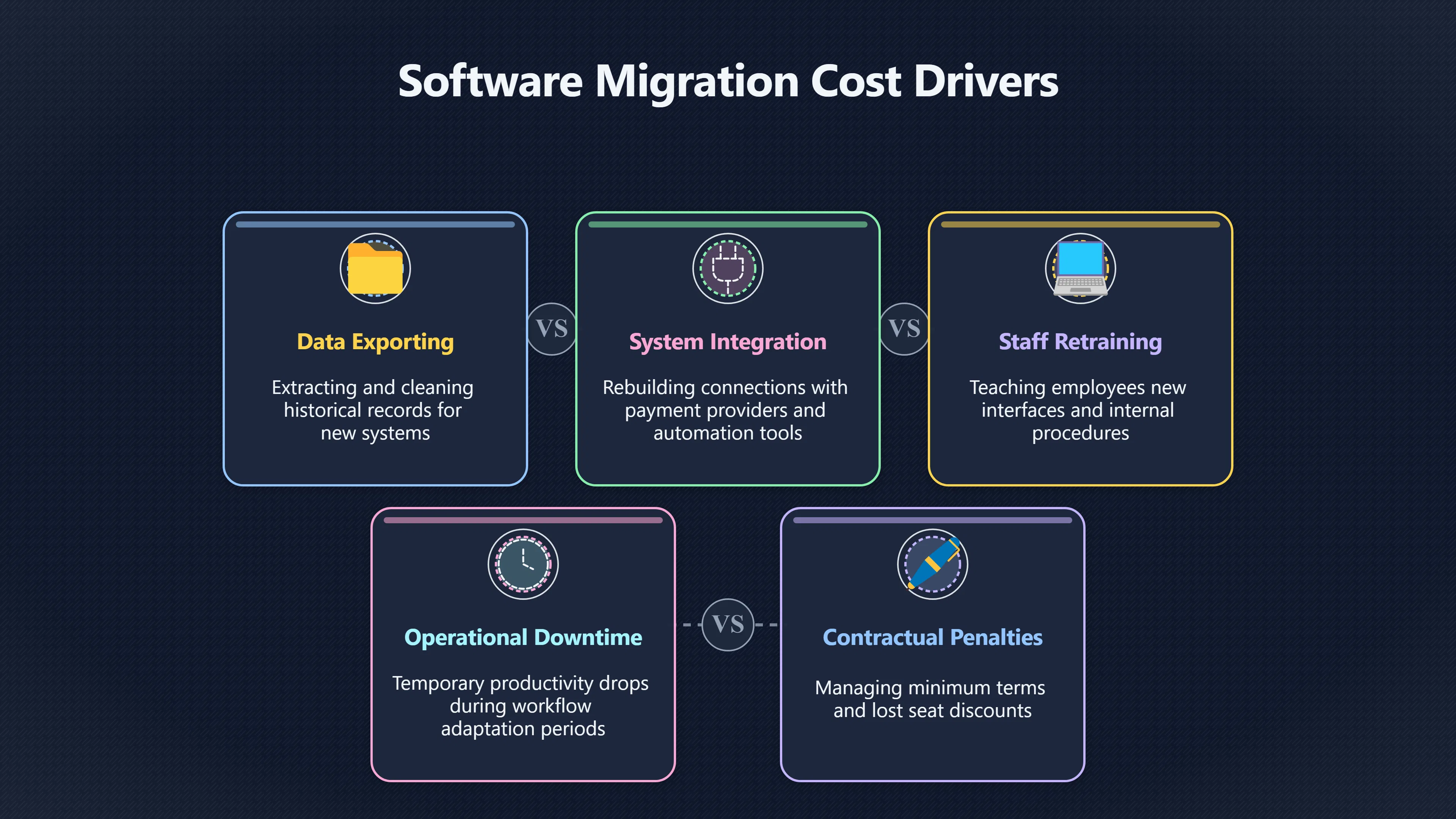
- Migration costs such as exporting data, cleaning records, and importing them into a new system.
- Integration costs from rebuilding connections with accounting software, customer databases, payment providers, or automation tools.
- Training costs as staff learn new interfaces, terminology, and procedures.
- Operational disruption while teams adapt to unfamiliar workflows and temporary productivity falls.
- Contractual costs, including minimum terms, seat commitments, or lost discounts.
Research into SaaS vendor lock-in consistently identifies technical integration, proprietary formats, operational dependency, and retraining as major contributors to switching costs. Academic work on cloud migration similarly notes that organisations should evaluate portability and interoperability before adoption because migration complexity often becomes visible only after implementation.[ResearchGate+2eprints.bournemouth.ac.uk]researchgate.netA Holistic Decision Framework to Avoid Vendor Lock-in for…July 31, 2017 — This paper proposes a holistic 6-step decision f…
For affiliate sites, this means readers are rarely asking only, “Is this software good?” Instead, they are asking questions such as:
- Will this still suit us in two years?
- How difficult would it be to leave?
- What happens if prices increase?
- Can our existing data be exported?
- Will this integrate with the rest of our business?
A review that ignores these questions appears incomplete because it overlooks the real financial risk facing buyers.
Workflow evidence that proves real use
Readers increasingly recognise software reviews that simply recycle feature lists from vendor websites. The strongest trust signal is evidence that the reviewer has actually completed meaningful work inside the application.
That evidence is rarely about polished screenshots alone. It comes from demonstrating the practical realities that only become obvious during use.
Show the workflow, not just the dashboard
A credible software review follows a realistic task from beginning to end rather than displaying isolated interface images.
For example, instead of writing that a CRM has “excellent automation”, a stronger review explains:
- how a lead entered the system;
- how automation rules behaved;
- whether notifications arrived correctly;
- what required manual intervention;
- how reporting reflected those actions.
This type of workflow demonstrates familiarity with everyday usage rather than first impressions.
It also reveals usability problems that marketing pages rarely mention, including hidden settings, confusing permissions, awkward navigation, or limitations that only appear after extended use.
Discuss onboarding friction honestly
Many software decisions fail during implementation rather than evaluation.
Useful reviews explain:
- how long initial setup required;
- whether documentation was sufficient;
- where customer support became necessary;
- which integrations worked immediately;
- what unexpectedly delayed deployment.
Even academic work examining onboarding in software environments notes that onboarding remains a lengthy, costly process with significant barriers despite growing technological support. That reinforces why implementation experience is often more valuable than simply listing features.[arXiv]arxiv.orgSoftware Solutions for Newcomers' Onboarding in Software Projects: A Systematic Literature ReviewAugust 28, 2024…
Test migration as well as adoption
An unusually powerful trust signal is showing how data leaves a platform, not only how it enters.
Few affiliate reviews investigate:
- export quality;
- available file formats;
- preservation of metadata;
- API access;
- backup options;
- documentation for moving elsewhere.
Yet these directly affect switching costs. Reviews that address exit paths demonstrate independence because they acknowledge that readers may eventually leave the recommended product.
Trust signals readers need before clicking
When software affiliate commissions can continue for months or even years, readers naturally question whether recommendations are influenced by recurring revenue. Reviewers cannot eliminate this concern, but they can reduce it through transparent editorial practices.
The most persuasive trust signals include:
Clear affiliate disclosure. Readers should understand that commission may be earned without feeling that the disclosure is hidden. Regulatory guidance from the US Federal Trade Commission requires material relationships affecting endorsements to be disclosed clearly and conspicuously.[eCFR]ecfr.govOpen source on ecfr.gov.
Evidence of independent testing. Reviews become more credible when they include original observations, practical examples, performance measurements, or documented limitations that are absent from vendor marketing.
Acknowledged weaknesses. Every software product involves compromises. Reviews that identify genuine drawbacks generally appear more trustworthy than those claiming every feature performs exceptionally well.
Appropriate recommendations. Not every tool fits every organisation. Trust increases when reviewers explicitly state who should avoid a product as well as who benefits most.
Transparent update history. Software changes rapidly. Reviews that record when testing occurred and when content was last substantially updated help readers judge whether findings remain relevant.
What weakens credibility fastest
Readers making expensive software decisions often compare multiple review sites before clicking an affiliate link. Certain patterns quickly undermine confidence because they suggest the reviewer has not used the product.
Common warning signs include:
- identical screenshots appearing across unrelated review websites;
- descriptions copied closely from vendor feature pages;
- praise without measurable examples;
- no discussion of implementation or migration;
- ranking dozens of products despite providing little practical detail on any of them;
- declaring one tool “best for everyone” regardless of business size or use case.
These weaknesses become particularly noticeable for experienced buyers who have previously implemented enterprise software. They know that every platform contains limitations, configuration trade-offs, and learning curves.
Why honest uncertainty often builds more trust
One of the strongest indicators of an independent review is acknowledging uncertainty where evidence is genuinely mixed.
For example, customer support quality often varies between regions, subscription tiers, or implementation partners. Long-term reliability may depend on company size, product maturity, or changing development priorities. Rather than presenting absolute verdicts, trustworthy reviewers explain where experiences differ and why.
Similarly, reviewers should distinguish between observations made during testing and claims that require longer-term customer experience to verify, such as multi-year scalability or enterprise support responsiveness.
This approach may appear less definitive, but it aligns more closely with the complex reality of software purchasing.
Better trust produces better affiliate outcomes
Software affiliate marketing benefits from long buying cycles because readers invest significant effort before committing to subscriptions. That same caution means superficial content struggles to convert.
Reviews that acknowledge switching costs, demonstrate real workflows, explain onboarding experience, discuss migration risks, and disclose commercial relationships clearly are more likely to become trusted decision resources. They also attract the type of reader who is prepared to commit to a subscription after careful evaluation rather than making an impulsive purchase.
In software affiliate publishing, credibility is not simply an ethical advantage. It directly supports long-term performance because recommendations that help readers avoid costly implementation mistakes are more likely to generate satisfied customers who remain subscribed, benefiting both the buyer and, where applicable, the affiliate programme.[ResearchGate+2nedigital.com]researchgate.netA Holistic Decision Framework to Avoid Vendor Lock-in for…July 31, 2017 — This paper proposes a holistic 6-step decision f…
Amazon book picks
Further Reading
Books and field guides related to Why Software Review Trust Is Harder to Earn. Use these as the next step if you want deeper reading beyond the article.
Obviously Awesome
Provides context for evaluating software products beyond marketing claims, helping reviewers understand meaningful differentiation.
Don't Make Me Think, Revisited
Helps reviewers evaluate software from real user workflow and usability perspectives instead of feature checklists.
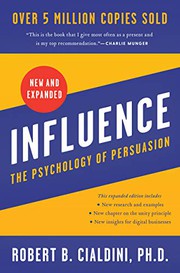
Influence, New and Expanded
Explains the psychology behind credibility, persuasion, and why readers trust or distrust recommendations.
The Mom Test
Highlights techniques for uncovering genuine user experience rather than relying on biased or promotional feedback.
eBay marketplace picks
Marketplace Samples
Example marketplace items related to this page. Use the search link to explore similar finds on eBay.




Endnotes
1.
Source: researchgate.net
Link:https://www.researchgate.net/publication/318880729_A_Holistic_Decision_Framework_to_Avoid_Vendor_Lock-in_for_Cloud_SaaS_Migration
Source snippet
A Holistic Decision Framework to Avoid Vendor Lock-in for...July 31, 2017 — This paper proposes a holistic 6-step decision f...
Published: July 31, 2017
2.
Source: eprints.bournemouth.ac.uk
Title: Critical Review of Vendor Lock in and Its Impact on Adoption of Cloud Computing
Link:https://eprints.bournemouth.ac.uk/22467/1/Critical%20Review%20of%20Vendor%20Lock-in%20and%20Its%20Impact%20on%20Adoption%20of%20Cloud%20Computing.pdf
Source snippet
more...
3.
Source: ecfr.gov
Link:https://www.ecfr.gov/current/title-16/chapter-I/subchapter-B/part-255
4.
Source: nedigital.com
Link:https://www.nedigital.com/en/blog/assessing-vendor-lock-in-and-exit-costs-in-saas-centric-it-environments
Source snippet
Assessing Vendor Lock-in and Exit Costs in SaaS-Centric...This article explores how to assess vendor lock-in risks, identify hidden exit...
5.
Source: arxiv.org
Link:https://arxiv.org/abs/2408.15989
Source snippet
Software Solutions for Newcomers' Onboarding in Software Projects: A Systematic Literature ReviewAugust 28, 2024...
Published: August 28, 2024
6.
Source: researchgate.net
Link:https://www.researchgate.net/publication/327435272Endorsements_on_Social_Media_An_Empirical_Study_of_Affiliate_Marketing_Disclosures_on_YouTube_and[Pinterest
Source snippet
ment-based advertising strategy used by social media content creators.Read more...
7.
Source: assets.publishing.service.gov.uk
Link:https://assets.publishing.service.gov.uk/media/5329db41e5274a226800002b/switching_costs.pdf
Source snippet
on switching costs (and implications for barriers...Switching costs are likely to affect a company's willingness to change auditor, and...
Additional References
8.
Source: federalregister.gov
Title: guides concerning the use of endorsements and testimonials in advertising
Link:https://www.federalregister.gov/documents/2023/07/26/2023-14795/guides-concerning-the-use-of-endorsements-and-testimonials-in-advertising
Source snippet
Guides Concerning the Use of Endorsements and...26 Jul 2023 — The Federal Trade Commission (FTC or Commission) is adopting revised Guide...
9.
Source: medium.com
Link:https://medium.com/design-bootcamp/vendor-lock-in-in-saas-trap-or-strategy-fbac1369d201
Source snippet
Vendor Lock-In in SaaS: Trap or Strategy?Economic: Migration costs, retraining staff, and the learning curve for new software. Not all lo...
10.
Source: medium.com
Link:https://medium.com/management-matters/the-real-cost-of-software-beyond-the-price-tag-7410c38822bc
11.
Source: craftindustryalliance.org
Link:https://craftindustryalliance.org/five-common-mistakes-involving-ftc-disclosures-for-affiliates-and-how-to-avoid-them/
Source snippet
5 Common Mistakes Involving FTC Disclosures for...24 Jun 2024 — Learn the common mistakes involving FTC disclosures for affiliates and h...
12.
Source: blogs.lse.ac.uk
Link:https://blogs.lse.ac.uk/businessreview/2019/09/24/how-digital-businesses-can-leverage-the-high-cost-for-consumers-to-switch-platforms/
Source snippet
digital businesses can leverage the high cost for...24 Sept 2019 — The Digital Lock-in/VEIF model outlines two main types of digital swi...
13.
Source: ftc.gov
Title: s endorsement guides what people are asking
Source snippet
FTC's Endorsement Guides: What People Are Asking29 Jun 2023 — Even an incentive with no financial value might affect the weight or credib...
14.
Source: softwareadvice.com
Title: Learn how to identify and avoid unnecessary costs with our expert tips
Link:https://www.softwareadvice.com/resources/how-to-avoid-software-switching-costs/
Source snippet
How To Avoid Unnecessary Costs When Switching Software26 Oct 2023 — Switching software can be expensive, but it doesn't have to be...
15.
Source: linkedin.com
Title: synthetic endorsements affiliate links ftcs quiet phil gcose
Link:https://www.linkedin.com/pulse/synthetic-endorsements-affiliate-links-ftcs-quiet-phil-gcose
Source snippet
On synthetic endorsements, affiliate links, and the FTC's...In June 2023, the FTC finalised its first material update to the Guides Conc...
Published: June 2023
16.
Source: propeltech.co.uk
Title: the cost of software migration is it worth the investment
Link:https://propeltech.co.uk/insight/the-cost-of-software-migration-is-it-worth-the-investment/
Source snippet
The cost of software migration: Is it worth the investment?27 Aug 2024 — In this blog, we'll explore the costs involved in supplier and s...
17.
Source: martech.org
Title: ftc disclosure guidelines affiliates merchants need know
Link:https://martech.org/ftc-disclosure-guidelines-affiliates-merchants-need-know/
Source snippet
The FTC disclosure guidelines: An in-depth exploration of...9 Aug 2016 — The goal of this article is to help affiliates and merchants be...
Topic Tree
Follow this branch
Parent topic
Software Why Software Affiliates Can Outearn Product ReviewsRelated pages 5
- AI Discovery Will AI Search Change Software Affiliate Pages?
- Buyer Intent Why Low Traffic Software Pages Can Earn More
- Payout Duration How Long Do Saa S Commissions Really Last?
- Terms Risk The Fine Print That Shrinks Saa S Affiliate Income
- Trial Credit Should Software Affiliates Chase Trials or Sales?