Within Hiking Gear
What Should a Field Tested Review Reveal?
A credible field-tested review tells readers what was tested, where, for how long, in what weather, and whether the product was supplied.
On this page
- Listing route, mileage, terrain, and carried load
- Explaining bought, borrowed, or supplied products
- Stating evidence limits without sounding evasive
Page outline Jump by section
Introduction
A field-tested hiking gear review is only as trustworthy as the information it reveals about the test itself. Readers should not have to guess whether a backpack was worn for a full-day hike or carried around a car park, whether waterproof boots faced steady rain or dry summer paths, or whether the reviewer bought the product, borrowed it, or received it from a manufacturer. Those details allow readers to judge how much weight to give the recommendation and whether the conditions match their own use.
 For affiliate publishers, these disclosures also support transparency. They distinguish genuine first-hand experience from marketing copy, help readers understand the limits of the evidence, and complement affiliate disclosures by explaining how the review was produced. Regulators and search quality guidance alike emphasise that endorsements should reflect honest experience and that material relationships should be disclosed clearly.[Federal Trade Commission]ftc.govs endorsement guides what people are askingFederal Trade CommissionFTC's Endorsement Guides: What People Are Asking29 Jun 2023 — The Guides, at their core, reflect the basic truth…
What Should a Field-Tested Review Reveal?
A useful trail-test disclosure answers practical questions before the reader has to ask them. Rather than relying on broad claims such as “tested extensively”, explain the circumstances of the testing in enough detail that another hiker could picture the conditions.
A concise disclosure should normally cover:
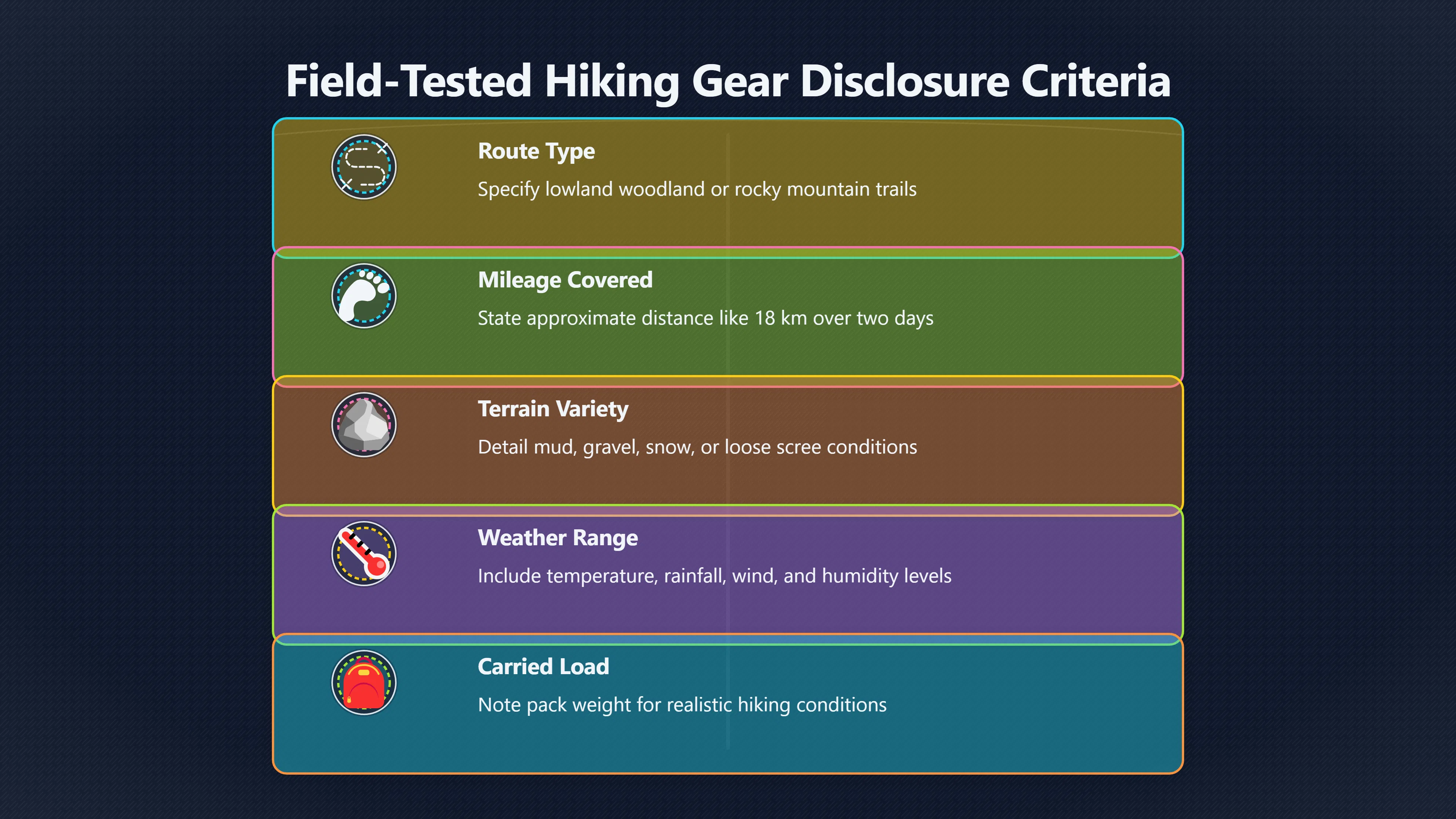
- Route: the general location or type of walk, such as lowland woodland, rocky mountain trail, coastal path, or boggy moorland.
- Mileage: approximate distance covered, for example 18 km over two day hikes rather than simply “multiple walks”.
- Terrain: mud, gravel, exposed rock, snow, wet roots, loose scree, steep descents, or mixed surfaces.
- Weather: temperature range, rainfall, wind, humidity, or prolonged dry conditions.
- Carried load: the approximate pack weight when reviewing backpacks, footwear, or clothing under realistic hiking conditions.
- Duration: whether the assessment reflects a first outing, several weeks of use, or many months of repeated trips.
These details prevent readers from overgeneralising. Boots praised after a 6 km woodland walk should not automatically be assumed suitable for multi-day mountain trekking with a 16 kg pack. Likewise, a rain jacket tested during brief showers has not necessarily demonstrated long-term performance in sustained bad weather.
Listing Route, Mileage, Terrain, and Carried Load
The most valuable disclosures are specific without becoming travel diaries. Readers usually need enough information to understand the testing environment rather than every turn taken on the route.
For example:
Tested over approximately 75 km across four hikes on rocky upland paths and muddy woodland trails. Temperatures ranged from 6°C to 18°C with one full day of persistent rain. Backpack weight varied between 9 kg and 13 kg.
This style of disclosure helps readers decide whether the experience resembles their own hiking. Someone preparing for lightweight summer day walks can immediately recognise that the conditions differ from winter hillwalking with a heavier load.
Where relevant, explain any unusual circumstances that affected the results, such as exceptionally deep mud, river crossings, prolonged snow cover, or unusually hot weather. These contextual details are more useful than vague statements like “performed brilliantly in all conditions”, which few products genuinely achieve.
Explain Whether the Product Was Bought, Borrowed, or Supplied
Readers also deserve to know how the reviewer obtained the product. This is separate from an affiliate disclosure.
A review should clearly state whether the item was:
- purchased at full retail price;
- purchased using the reviewer’s own discount;
- borrowed from another hiker;
- loaned temporarily by a retailer or manufacturer; or
- supplied free for review.
Receiving a product does not automatically invalidate a review, but failing to disclose that relationship can undermine credibility. Material relationships—including free products, discounts, and affiliate commissions—should be disclosed clearly because they may affect how readers evaluate an endorsement.[Federal Trade Commission]ftc.govs endorsement guides what people are askingFederal Trade CommissionFTC's Endorsement Guides: What People Are Asking29 Jun 2023 — The Guides, at their core, reflect the basic truth…
A straightforward statement is usually sufficient:
The manufacturer supplied this jacket for testing but had no editorial control over this review.
Or:
This backpack was purchased with personal funds. Affiliate links may generate a commission if you buy through them.
These disclosures address different questions. One explains the reviewer’s relationship with the manufacturer; the other explains the website’s commercial relationship with the retailer.

State the Limits of the Evidence Without Sounding Evasive
Readers generally accept limitations when they are explained honestly.
Good examples include:
- “This is based on approximately three weeks of use, so I cannot yet comment on long-term sole wear.”
- “The jacket has only been tested in autumn rain and not in freezing winter conditions.”
- “I have not yet used this pack on multi-day backpacking trips.”
These statements increase confidence because they separate direct observation from speculation. By contrast, claiming outstanding durability after a single weekend hike weakens credibility.
A useful approach is to distinguish clearly between:
- Observed facts – what actually happened during testing.
- Reasonable interpretation – what those observations suggest.
- Unknowns – aspects that require longer-term use before reaching a conclusion.
Readers are usually more persuaded by measured confidence than by sweeping claims.
Keep Trail-Test Disclosures Close to the Claims They Support
Disclosures are most useful when readers encounter them alongside the relevant recommendation rather than hidden elsewhere on the site.
For example, if a review praises waterproof performance, include the testing context near that section:
Waterproof performance was assessed during roughly five hours of continuous rainfall rather than through laboratory testing.
Similarly, if comfort is described under load, state the approximate carried weight in the same section.
Regulatory guidance on endorsements consistently stresses that disclosures should be clear, conspicuous, and difficult to miss rather than hidden behind separate pages or distant links.[Federal Trade Commission]ftc.govs endorsement guides what people are askingFederal Trade CommissionFTC's Endorsement Guides: What People Are Asking29 Jun 2023 — The Guides, at their core, reflect the basic truth…
A Practical Disclosure Template
Many hiking affiliate reviews can communicate everything readers need in a brief summary placed near the beginning of the article.
A practical format includes:
ItemExampleTest periodFive weeksTotal distanceApproximately 82 kmTerrainRocky trails, woodland paths, muddy sectionsWeatherDry, light rain, one day of heavy rainCarried load8–14 kg backpackProduct sourcePurchased personally / supplied for reviewEvidence limitsNo winter snow testing; durability assessment ongoing
This format gives readers immediate context without interrupting the flow of the review.

Why These Disclosures Strengthen Affiliate Trust
Readers rarely expect perfect testing, but they increasingly expect honest testing. A review that openly explains where the product was used, how long it was tested, what conditions it faced, how it was obtained, and what remains unknown allows readers to judge the recommendation for themselves.
For hiking affiliate sites, these disclosures do more than satisfy transparency expectations. They make recommendations easier to trust because they reveal the evidence behind the opinion rather than asking readers to accept unsupported claims. That transparency becomes part of the review’s value, especially when comparing equipment intended for demanding outdoor use.
Amazon book picks
Further Reading
Books and field guides related to What Should a Field-Tested Review Reveal?. Use these as the next step if you want deeper reading beyond the article.

Mountaineering The Freedom of the Hills
Demonstrates rigorous evaluation of equipment, terrain, weather, and real-world outdoor conditions.
The Backpacker's Field Manual
Explains how hiking conditions, loads, routes, and environment affect gear performance.
How to shit in the woods
Illustrates practical, experience-based outdoor advice built on real field use rather than marketing claims.
The Ultimate Hiker's Gear Guide
Shows how to evaluate, select, and discuss hiking gear using real-world performance criteria.
eBay marketplace picks
Marketplace Samples
Live-tested eBay searches with available results related to this page.
Endnotes
1.
Source: ftc.gov
Title: s endorsement guides what people are asking
Source snippet
Federal Trade CommissionFTC's Endorsement Guides: What People Are Asking29 Jun 2023 — The Guides, at their core, reflect the basic truth...
Additional References
2.
Source: ecfr.gov
Link:https://www.ecfr.gov/current/title-16/chapter-I/subchapter-B/part-255
Source snippet
16 CFR Part 255 -- Guides Concerning Use of...The Guides address the application of section 5 of the FTC Act, 15 USC 45, to the use of e...
3.
Source: federalregister.gov
Title: guides concerning the use of endorsements and testimonials in advertising
Link:https://www.federalregister.gov/documents/2023/07/26/2023-14795/guides-concerning-the-use-of-endorsements-and-testimonials-in-advertising
Source snippet
Guides Concerning the Use of Endorsements and...26 Jul 2023 — The Federal Trade Commission (FTC or Commission) is adopting revised Guide...
4.
Source: business.cch.com
Link:https://business.cch.com/ald/TheFTCsEndorsementGuides_WhatPeopleAreAsking_FederalTradeCommission.pdf
Source snippet
The FTC's Endorsement Guides: What People Are AskingOne factor the FTC will look to is [placement]({{ 'placement/' | relative_url }}). The disclosure should catch users' atte...
5.
Source: dglaw.com
Link:https://www.dglaw.com/the-deep-dive-ftc-updates-endorsement-guides-for-modern-marketing-and-advertising/
Source snippet
The Deep Dive: FTC Updates Endorsement Guides...11 Jul 2023 — On June 29, the FTC announced new Endorsement Guides (Endorsement Guides)...
6.
Source: swlaw.com
Title: truth or consequences ftc revised endorsement guides class action risk
Link:https://www.swlaw.com/publication/truth-or-consequences-ftc-revised-endorsement-guides-class-action-risk/
Source snippet
FTC Revised Endorsement Guides & Class Action Risk8 Aug 2023 — The FTC has updated its guidance on endorsement and testimonial advertisin...
7.
Source: wardandsmith.com
Title: the ad vantage point navigating the ftc endorsement guides part iii
Link:https://www.wardandsmith.com/article/the-ad-vantage-point-navigating-the-ftc-endorsement-guides-part-iii
Source snippet
The #AD Vantage Point: Navigating the FTC Endorsement...24 Jan 2024 — FTC Endorsement Guides describe how the FTC evaluates whether cert...
8.
Source: kelleydrye.com
Title: new endorsement guides include big changes but few surprises
Link:https://www.kelleydrye.com/viewpoints/blogs/ad-law-access/new-endorsement-guides-include-big-changes-but-few-surprises
Source snippet
New Endorsement Guides Include Big Changes, But Few...29 Jun 2023 — The new Guides address so-called “independent review sites” that hav...
9.
Source: allaboutadvertisinglaw.com
Title: ftc finalizes updated endorsement and testimonial guides
Link:https://www.allaboutadvertisinglaw.com/2023/07/ftc-finalizes-updated-endorsement-and-testimonial-guides.html
Source snippet
5 Jul 2023 — The Guides reiterate the FTC's position that material connections between endorser and advertiser should be disclosed but cl...
10.
Source: youtube.com
Title: FTC Compliant | How To Play It Safe for Beginner Affiliate Marketing
Link:http://www.youtube.com/watch?v=EJWC8jVfIko
Source snippet
Gear reviewer transparency disclosure sponsored gear review Sponsored Reviews and Videos Are ALWAYS Biased (But I'm Doing them Anyway...)...
11.
Source: partnercentric.com
Title: how to properly disclose ftc endorsements
Link:https://partnercentric.com/blog/how-to-properly-disclose-ftc-endorsements/
Source snippet
17 Jun 2024 — The FTC requires that any material connection between an endorser and the marketer of a product must be disclosed clearly a...
Topic Tree