Within Income Math
Why Affiliate Clicks Still Fail to Pay
A merchant page can turn strong affiliate traffic into weak earnings if too few clickers complete the paid action.
On this page
- What conversion rate means after the affiliate click
- Why sector, price, and trust change outcomes
- How to model conservative and optimistic conversion rates
Page outline Jump by section
Introduction
A visitor clicking an affiliate link is not the moment revenue is earned. It is simply the point where control passes from the publisher to the merchant. From that point onward, the merchant’s website, pricing, checkout process, reputation and offer determine whether the visitor completes the action that generates an affiliate commission. This is why two websites sending the same number of qualified clicks can earn dramatically different amounts from different merchants.
 For affiliate publishers, merchant conversion rate is therefore a major source of uncertainty. It sits outside the publisher’s direct control, yet it has a direct effect on earnings. Understanding what influences post-click conversion—and modelling it realistically—helps avoid overly optimistic income projections and encourages better merchant selection.
What conversion rate means after the affiliate click
Within affiliate marketing, merchant conversion rate measures the proportion of tracked affiliate clicks that become a qualifying conversion, such as a completed purchase, paid subscription or approved lead. Networks such as Awin and Impact use this metric to evaluate programme performance, although exact definitions can differ depending on whether they count unique clicks, sessions or approved transactions.[Awin+2Awin]awin.comAffiliate Marketing: How to Boost Conversion Rate I AwinOctober 30, 2019 — 7 Sept 2022 — The average conversion rate for affiliate ma…
This distinction matters because the affiliate has already succeeded in persuading someone to leave their own website. Every failure after that point occurs inside the merchant’s sales funnel rather than the publisher’s content.
A simplified example illustrates the impact:
- 1,000 readers click affiliate links.
- Merchant A converts 2% of those visitors into sales.
- Merchant B converts 6%.
If commission and order value are identical, Merchant B generates three times the revenue from exactly the same affiliate traffic.
This explains why experienced affiliates often evaluate programmes using earnings per click (EPC) rather than commission percentage alone. A lower commission from a merchant with consistently high conversion can outperform a generous commission attached to a poor checkout experience. Awin even exposes conversion rate alongside approval rate, validation period and EPC to help publishers compare advertisers before promoting them.[Awin]awin.comAffiliate Marketing: How to Boost Conversion Rate I AwinOctober 30, 2019 — 7 Sept 2022 — The average conversion rate for affiliate ma…
Why sector, price and trust change outcomes
Merchant conversion rates vary enormously because buyers behave differently across products and industries.
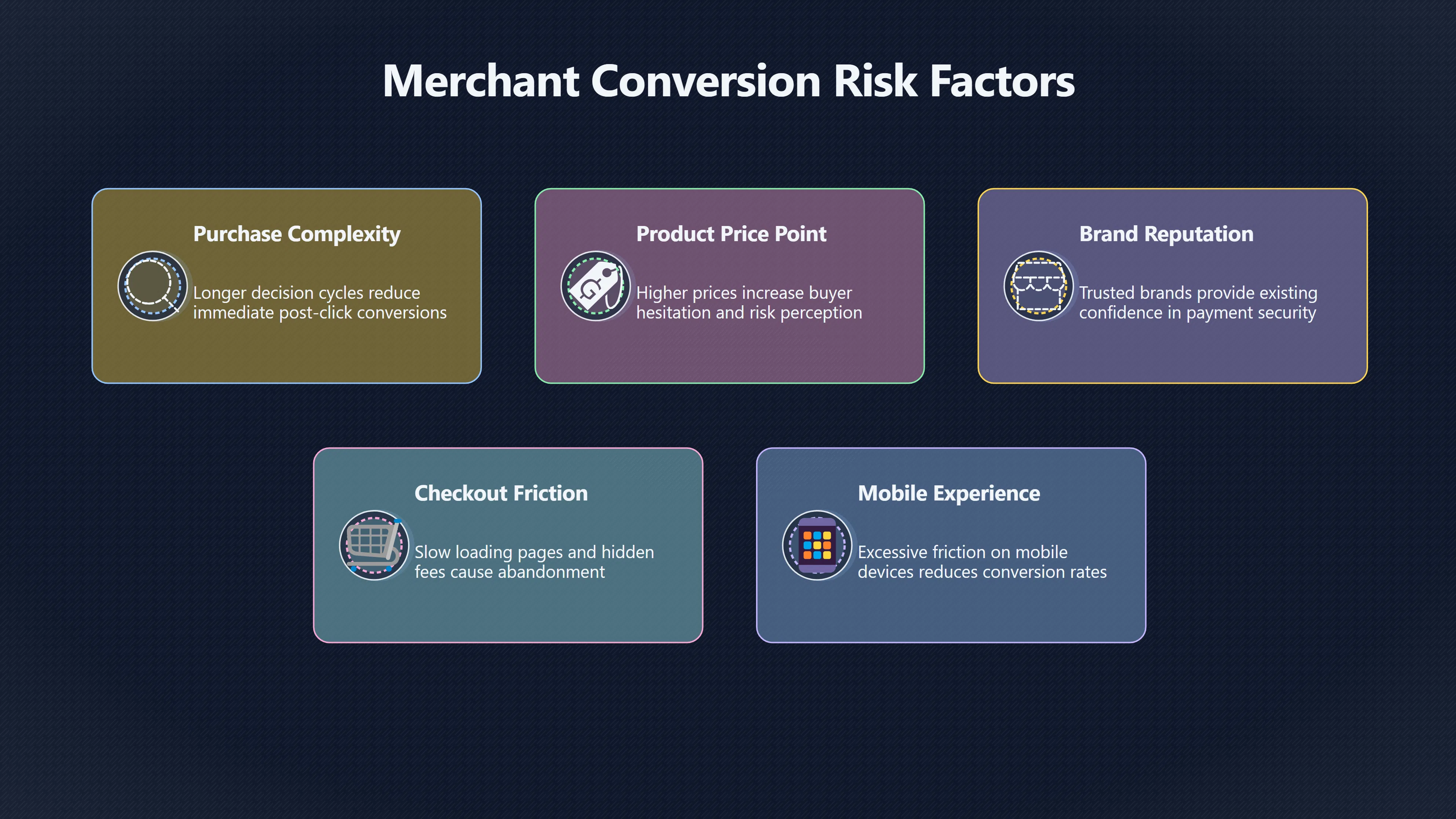
Purchase complexity
An inexpensive household item may be purchased within minutes, while a mortgage application, enterprise software subscription or luxury holiday can involve days or weeks of research.
Longer decision cycles naturally reduce the proportion of visitors who convert immediately after an affiliate click. This does not necessarily indicate poor marketing; it reflects the complexity and financial risk of the purchase.
Product price
Higher prices generally increase buyer hesitation.
Someone considering a £15 accessory faces relatively little financial risk compared with someone evaluating a £2,000 camera or an annual software contract. Higher-priced products usually require stronger product pages, clearer guarantees and greater customer confidence before conversion occurs.
For affiliates, this creates an important trade-off:
- Low-priced products often convert more frequently but generate smaller commissions.
- High-priced products may convert less often while producing much larger commissions per successful sale.
Neither model is automatically superior because revenue depends on both conversion rate and commission value.
Brand reputation and trust
Affiliate publishers frequently underestimate the influence of merchant reputation.
A reader may trust the publisher’s recommendation yet abandon the purchase because they:
- do not recognise the retailer;
- question payment security;
- cannot find delivery information;
- encounter poor reviews;
- discover unexpected fees during checkout.
Conversely, well-known brands often convert better because buyers arrive with existing confidence in payment security, returns policies and customer service.
Trust is therefore transferred twice: first from publisher to merchant, then from merchant to buyer.
Why good affiliate traffic still fails to convert
Many publishers assume that low earnings indicate weak content. In reality, highly qualified traffic can underperform because of problems that occur entirely on the merchant’s side.
Common causes include:
- Slow-loading landing pages that increase abandonment before shoppers engage.
- Landing pages that do not match the promise made by the affiliate content.
- Mobile checkout experiences with excessive friction.
- Hidden delivery charges or taxes appearing late in the purchase journey.
- Mandatory account creation before checkout.
- Limited payment options for international visitors.
- Stock shortages or unavailable product variations.
- Weak product photography or incomplete product information.
Even relatively small sources of friction can compound across hundreds or thousands of affiliate clicks.
Impact notes that advertisers benefit from improving landing pages, message consistency and checkout optimisation because better post-click experiences increase affiliate conversions without requiring additional traffic.[impact.com]impact.comaffiliate marketing benchmarkAffiliate Benchmark 2025: Fewer Buys, Higher Order ValueLonger research, shorter purchase windows. Discover how 2025 shopper behavior imp…
Why published conversion benchmarks require caution
Affiliate marketers often search for an “average conversion rate”, but published figures should be treated as broad reference points rather than reliable forecasting tools.
Industry sources publish different benchmark ranges because they measure different populations and use different methodologies. Awin has described 3–4% as a practical target for many programmes while also noting that performance varies substantially by network and sector. Other guidance places broad affiliate averages around 0.5% to 1% across mixed programmes, reflecting the inclusion of many lower-performing campaigns. Recent industry summaries frequently cite overall cross-industry ranges of roughly 1% to 3%, again with substantial variation by niche and purchase intent.[IREV+3Awin+3Awin]awin.comAffiliate Marketing: How to Boost Conversion Rate I AwinOctober 30, 2019 — 7 Sept 2022 — The average conversion rate for affiliate ma…
Several factors explain these differences:
- Some figures include only completed purchases.
- Others count lead-generation actions.
- Networks contain different mixes of industries.
- Mobile-heavy programmes behave differently from desktop-heavy ones.
- Mature merchants typically outperform newly launched programmes.
The useful lesson is not that one benchmark is “correct”, but that conversion rate is highly context-dependent.

How to model conservative and optimistic conversion rates
Because merchant performance is uncertain, affiliate income forecasts should use multiple scenarios rather than a single assumed conversion rate.
A practical approach is to model three cases:
ScenarioMerchant conversionMeaningConservative1%New website, uncertain merchant performance, colder trafficExpected3%Established merchant with relevant commercial-intent visitorsOptimistic5% or higherStrong merchant, trusted brand, highly qualified buying traffic
For example, if a website sends 2,000 affiliate clicks per month:
- At 1% conversion: 20 sales.
- At 3% conversion: 60 sales.
- At 5% conversion: 100 sales.
The difference between conservative and optimistic assumptions is a five-fold change in commission volume despite identical traffic.
Scenario modelling prevents publishers from building business plans that rely on unusually favourable merchant performance.
Choosing merchants with conversion risk in mind
Affiliate publishers cannot redesign a merchant’s checkout, but they can reduce conversion risk by selecting programmes more carefully.
Useful indicators include:
- Historical EPC reported by the affiliate network.
- Published advertiser conversion rate where available.[awin.com]awin.comconversion rate optimisationWhat is conversion rate optimisation?6 Jan 2022 — What is a good conversion rate? As a general guideline, conversion rates of 0.5% to 1%…
- Approval or validation percentage.
- Consistency between affiliate messaging and merchant landing pages.
- Strong brand recognition.
- Clear pricing and transparent delivery information.
- Fast, mobile-friendly checkout.
- Positive customer reputation.
These indicators are imperfect, but together they provide a better picture than commission percentage alone.
A programme offering a lower headline commission can produce higher long-term revenue if it consistently converts affiliate visitors more effectively.
The practical takeaway
Merchant conversion rate is the stage of the affiliate income equation that publishers influence only indirectly. Once a visitor leaves the affiliate website, earnings depend on the merchant’s ability to complete the sale.
That makes merchant quality just as important as traffic quality. Strong content can deliver highly qualified visitors, but poor landing pages, weak trust signals, high prices relative to competitors or inefficient checkout processes can erase much of that value before a commission is ever recorded. Successful affiliate publishers therefore evaluate merchants not only by how much they pay, but by how reliably they turn qualified clicks into completed conversions.
Amazon book picks
Further Reading
Books and field guides related to Why Affiliate Clicks Still Fail to Pay. Use these as the next step if you want deeper reading beyond the article.
Affiliate Program Management
Directly explains affiliate programs, merchant performance, and improving conversion outcomes.
The Complete Guide to Affiliate Marketing on the Web
Covers affiliate business models, tracking, merchant selection, and realistic earnings.
Don't Make Me Think, Revisited
Helps readers understand why merchant usability and checkout experience affect post-click conversion.
Making Websites Win
Focuses on conversion rate optimization, testing, and modeling improvements relevant to merchant performance.
eBay marketplace picks
Marketplace Samples
Live-tested eBay searches with available results related to this page.



Endnotes
1.
Source: awin.com
Link:https://www.awin.com/gb/affiliate-marketing/7-tips-for-boosting-your-affiliate-conversions
Source snippet
Affiliate Marketing: How to Boost Conversion Rate I AwinOctober 30, 2019 — 7 Sept 2022 — The average conversion rate for affiliate ma...
Published: October 30, 2019
2.
Source: awin.com
Title: conversion rate optimisation
Link:https://www.awin.com/gb/affiliate-marketing/conversion-rate-optimisation
Source snippet
What is conversion rate optimisation?6 Jan 2022 — What is a good conversion rate? As a general guideline, conversion rates of 0.5% to 1%...
3.
Source: impact.com
Title: affiliate marketing benchmark
Link:https://impact.com/affiliate/affiliate-marketing-benchmark/
Source snippet
Affiliate Benchmark 2025: Fewer Buys, Higher Order ValueLonger research, shorter purchase windows. Discover how 2025 shopper behavior imp...
4.
Source: awin.com
Title: how to use affiliate marketing to drive low cost conversions for your brand
Link:https://www.awin.com/us/how-to-use-awin/how-to-use-affiliate-marketing-to-drive-low-cost-conversions-for-your-brand
Source snippet
As a general guideline, conversion rates of 0.5% to 1% are considered average.Read more...
5.
Source: irev.com
Title: affiliate marketing statistics 2026 industry size growth and benchmarks
Link:https://irev.com/blog/affiliate-marketing-statistics-2026-industry-size-growth-and-benchmarks/
Source snippet
Affiliate Marketing Statistics 2026: Industry Size & Trends - IREVTraffic, Conversion, and Revenue Benchmarks; Metric, Indicative level...
Additional References
6.
Source: elitewealthplan.com
Link:https://elitewealthplan.com/awin-vs-impact/
Source snippet
Awin vs Impact: Which Affiliate Network Has Better Brands?Average conversion rate: 1.5%; Average commission rate: 4%; Average earnings pe...
7.
Source: digitalapplied.com
Title: affiliate marketing statistics 2026 data points
Link:https://www.digitalapplied.com/blog/affiliate-marketing-statistics-2026-data-points
Source snippet
Affiliate Marketing Statistics 2026: 130+ Data PointsAffiliate marketing statistics for 2026: 130+ data points on program revenue, commis...
8.
Source: floatingcta.com
Title: affiliate marketing conversion rate
Link:https://floatingcta.com/insights/affiliate-marketing-conversion-rate/
Source snippet
s: 2026 Benchmarks by...Awin's published guidance puts the typical affiliate conversion rate at 0.5-1%, while [Authority]({{ 'authority/' | relative_url }}) Hacker's affilia...
9.
Source: youtube.com
Title: Digital Marketing Metrics & KPI’s Explained (With Examples)
Link:https://www.youtube.com/watch?v=mPiWWnJsVGw
Source snippet
Merchant conversion rate affiliate marketing clicks epc The best affiliate marketing training platforms Product Review Geeks...
10.
Source: growsurf.com
Title: affiliate program benchmarks
Link:https://growsurf.com/statistics/affiliate-program-benchmarks/
Source snippet
(2026)Conversion rates vary significantly by industry and offer type. The overall average is 1-5%. E-commerce programs average 2.8%, SaaS...
11.
Source: youtube.com
Link:https://www.youtube.com/watch?v=R5bLNShul8w
Source snippet
What is conversion rate? Affiliate Marketing FAQ's with MoreNiche...
12.
Source: youtube.com
Link:https://www.youtube.com/watch?v=JJHPMam8-6I
Source snippet
Digital Marketing Metrics & KPI's Explained (With Examples)...
13.
Source: youtube.com
Title: What is EPC? Affiliate Marketing FAQ’s with More Niche
Link:https://www.youtube.com/watch?v=ilcA9i21efY
Source snippet
Analyzing Affiliate Marketing Metrics: Unleashing the Power of Tracking and Optimization...
14.
Source: youtube.com
Title: What is conversion rate? Affiliate Marketing FAQ’s with More Niche
Link:https://www.youtube.com/watch?v=yD_WtQoOMeQ
Source snippet
What is EPC? Affiliate Marketing FAQ's with MoreNiche...
Topic Tree