Within Email
How Affiliate Newsletters Lose Reader Trust
Too many sales-heavy emails can reduce opens, increase unsubscribes, and weaken the trust affiliate income depends on.
On this page
- Why constant urgency damages opens
- How spam complaints can hurt deliverability
- Setting a commercial intensity readers expect
Page outline Jump by section
Introduction
An email list can reduce dependence on search engines by bringing readers back to an affiliate website without relying on rankings. That advantage disappears, however, if subscribers begin to view every message as a sales pitch. Over-promoting affiliate offers reduces open rates, increases unsubscribes, encourages spam complaints, and gradually weakens the trust that makes affiliate recommendations valuable in the first place.
 The risk is rarely one aggressive email in isolation. It is the cumulative effect of repeatedly asking readers to buy, using artificial urgency, or sending promotions that do not match the expectations set when they subscribed. Successful affiliate newsletters protect long-term relationships by treating promotions as one part of a useful editorial product rather than the entire product.
Why Constant Urgency Damages Opens
Affiliate marketers often face a temptation to maximise short-term commissions by promoting every sale, coupon, or product launch. While this may generate occasional revenue spikes, readers quickly learn what to expect from the newsletter. If nearly every subject line promises a “last chance”, “today only”, or “must-buy” deal, genuine urgency loses credibility.
This creates several reinforcing problems:
- Readers become less curious because every email appears similar.
- Promotions begin to feel predictable rather than valuable.
- Subscribers delay opening messages because they assume another offer will arrive soon.
- People who originally joined for advice or expertise stop seeing the newsletter as a trusted source.
In behavioural terms, urgency works because it is unusual. When scarcity is manufactured repeatedly, readers adapt to it. Instead of encouraging action, constant promotional pressure trains subscribers to ignore future messages.
Affiliate publishers also need to remember that many purchases require research. Someone comparing cameras, insurance policies, web hosting, or fitness equipment may spend weeks evaluating options. During that period, educational content often builds more confidence than repeated purchase reminders.
How Spam Complaints Can Hurt Deliverability
Low engagement does more than reduce clicks. Modern mailbox providers use many signals to determine whether future emails belong in the inbox, promotions tab, or spam folder.
Although providers do not publish complete ranking systems, they consistently emphasise positive engagement and low complaint rates. When recipients frequently delete messages without reading them, ignore them for long periods, or actively mark them as spam, sender reputation can deteriorate over time.
For affiliate newsletters, this creates a damaging feedback loop:
- Promotional emails become more frequent.
- Subscribers engage less.
- More recipients unsubscribe or report messages as spam.
- Deliverability declines.
- Even interested subscribers become less likely to see future emails.
Once deliverability suffers, simply sending more promotions rarely solves the problem. Instead, it often reinforces negative engagement signals.
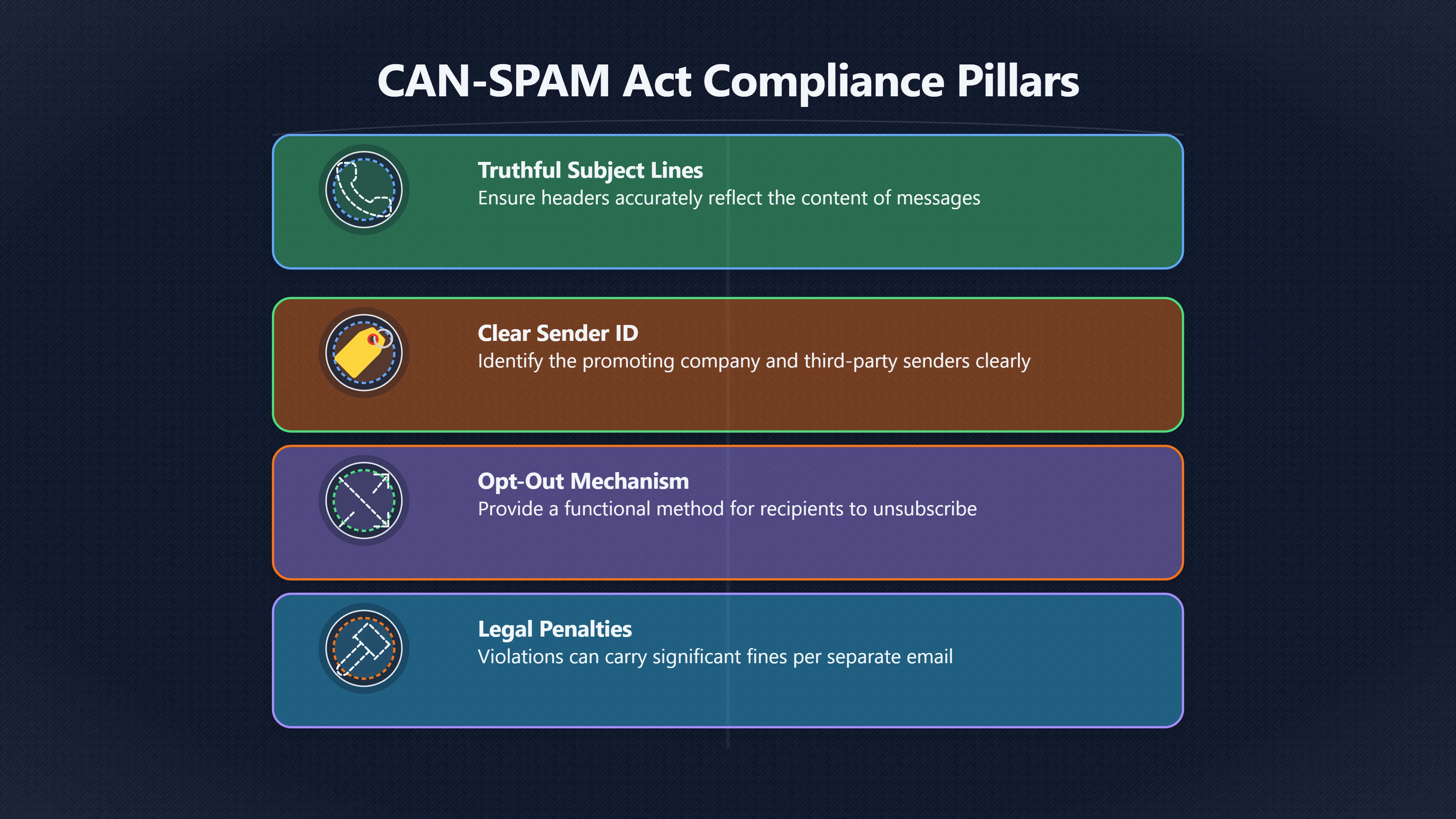
Legal compliance also matters. Commercial email regulations such as the US CAN-SPAM Act require truthful subject lines, clear sender identification, and functioning unsubscribe mechanisms. Even when an affiliate newsletter complies with the law, respecting subscriber expectations remains essential because legal compliance alone does not create trust.[Federal Trade Commission]ftc.govFederal Trade Commission CAN-SPAM Act: A Compliance Guide for BusinessFederal Trade CommissionCAN-SPAM Act: A Compliance Guide for BusinessAugust 9, 2023 — The CAN-SPAM Act, a law that sets the rules for com…
Commercial Intensity Should Match Reader Expectations
The safest commercial strategy is not avoiding affiliate promotions altogether. It is creating a level of commercial activity that subscribers expect from the beginning.
Expectation is shaped by several factors:
- How the newsletter was described at sign-up. A subscriber who joins for weekly buying advice expects product recommendations. Someone promised educational tutorials may react negatively if every message becomes a sales email.
- The balance between advice and promotion. Practical guides, comparisons, maintenance tips, and product updates make promotional recommendations feel more credible because they solve genuine problems.
- Consistency. Readers generally tolerate commercial recommendations when they fit an established editorial pattern instead of appearing as sudden sales pushes.
Many successful affiliate publishers naturally blend editorial and commercial content. A camping equipment newsletter, for example, might explain how to choose a sleeping bag for winter conditions before recommending suitable products. The educational content gives context for the affiliate links instead of forcing the promotion to carry the entire email.

Trust Is Easier to Lose Than Rebuild
Affiliate marketing depends heavily on credibility because readers usually have many alternative sources of product recommendations.
Trust can erode through patterns such as:
- Recommending products with little explanation.
- Promoting items that obviously do not fit the audience.
- Repeating identical offers every week.
- Using exaggerated claims or misleading subject lines.
- Sending emails noticeably more frequently than subscribers expected.
Once readers begin questioning a publisher’s motives, every future recommendation faces greater scepticism. Even genuinely useful products may receive fewer clicks because confidence in the sender has weakened.
Transparency also supports trust. Readers are generally more accepting of affiliate recommendations when publishers clearly explain why products are recommended and disclose affiliate relationships appropriately. Research into affiliate marketing disclosures has shown that clear explanations help audiences better recognise commercial relationships than vague or abbreviated disclosures.[arXiv]arxiv.orgEndorsements on Social Media: An Empirical Study of Affiliate Marketing Disclosures on YouTube and PinterestSeptember 3, 2018…
Finding a Sustainable Promotional Balance
There is no universal ratio between editorial and promotional emails because different niches attract different expectations. A deals newsletter naturally contains more commercial content than a specialist educational publication.
Instead of following a fixed percentage, affiliate publishers can monitor whether readers continue behaving like an engaged audience:
- Open rates remain relatively stable rather than steadily declining.
- Unsubscribe rates stay low after promotional campaigns.
- Spam complaints remain minimal.
- Readers continue replying, forwarding emails, or clicking informational content as well as commercial recommendations.
When engagement falls mainly after sales-heavy campaigns, the problem is often not email itself but the intensity of promotion.
A useful principle is that every promotional email should still deliver standalone value. Product recommendations become more persuasive when accompanied by original testing, comparisons, buying advice, maintenance guidance, or explanations of who should—and should not—buy the featured products. This reinforces the newsletter’s role as a trusted source rather than simply another advertising channel.

Long-Term Revenue Depends on Reader Confidence
Affiliate newsletters succeed because they transform occasional search visitors into a loyal audience. Over-promotion undermines that advantage by replacing trusted recommendations with predictable sales messages.
Publishers who maintain realistic commercial intensity, reserve urgency for genuinely limited opportunities, respect unsubscribe choices, and consistently provide useful editorial content are more likely to preserve both deliverability and subscriber confidence. That trust is a durable business asset: it supports repeated visits, stronger affiliate conversions, and a mailing list that continues generating traffic even when search rankings fluctuate.[Federal Trade Commission]ftc.govFederal Trade Commission CAN-SPAM Act: A Compliance Guide for BusinessFederal Trade CommissionCAN-SPAM Act: A Compliance Guide for BusinessAugust 9, 2023 — The CAN-SPAM Act, a law that sets the rules for com…
Amazon book picks
Further Reading
Books and field guides related to How Affiliate Newsletters Lose Reader Trust. Use these as the next step if you want deeper reading beyond the article.
Everybody Writes
Helps marketers produce valuable emails that readers want to open instead of constant promotional messages.
Building a StoryBrand 2.0
Encourages customer-focused communication that strengthens long-term audience relationships rather than short-term sales pressure.
Email Marketing Rules
Covers subscriber trust, engagement, deliverability, and sustainable email marketing practices.
Permission Marketing
Explains why earning and maintaining audience permission is essential instead of overwhelming readers with promotions.
eBay marketplace picks
Marketplace Samples
Live-tested eBay searches with available results related to this page.



Endnotes
1.
Source: ftc.gov
Title: Federal Trade Commission CAN-SPAM Act: A Compliance Guide for Business
Link:https://www.ftc.gov/business-guidance/resources/can-spam-act-compliance-guide-business
Source snippet
Federal Trade CommissionCAN-SPAM Act: A Compliance Guide for BusinessAugust 9, 2023 — The CAN-SPAM Act, a law that sets the rules for com...
Published: August 9, 2023
2.
Source: arxiv.org
Link:https://arxiv.org/abs/1809.00620
Source snippet
Endorsements on Social Media: An Empirical Study of Affiliate Marketing Disclosures on YouTube and PinterestSeptember 3, 2018...
Published: September 3, 2018
Additional References
3.
Source: fairfield.edu
Link:https://www.fairfield.edu/about/offices-and-departments/marketing-and-communications/anti-spam-guidance/
Source snippet
Anti-Spam GuidanceWhat is the CAN-SPAM Act? The CAN-SPAM Act, a law that sets the rules for commercial email, establishes requirements fo...
4.
Source: joinbreaker.ai
Link:https://joinbreaker.ai/blog-posts/can-spam-act-requirements-b2b-marketers-know
Source snippet
CAN-SPAM Act Requirements: What B2B Marketers Must KnowThe CAN-SPAM Act holds both the promoting company and the third-party email sender...
5.
Source: optizmo.com
Link:https://optizmo.com/resources/email-compliance/
Source snippet
Email ComplianceThe CAN-SPAM Act is built on the principle of providing all commercial email recipients with a method to Opt-Out or Unsub...
6.
Source: loeb.com
Link:https://www.loeb.com/en/insights/publications/2005/05/ftc-proposes-rule-clarifications-for-can-spam
Source snippet
FTC Proposes Rule Clarifications for CAN-SPAMThe FTC proposed modifying the definition of “sender” to make it clear which advertiser must...
7.
Source: youtube.com
Title: The complete guide to troubleshooting email deliverability issues
Link:https://www.youtube.com/watch?v=c9Tr_xTMEZs
Source snippet
This guide on fixing low marketing email open rates explores how poor audience management and spam [placement]({{ 'placement/' | relative_url }}) can kill campaign performanc...
8.
Source: youtube.com
Link:https://www.youtube.com/watch?v=V8XGgBGA8bM
Source snippet
We Did It All Wrong... Why I'd Use a Separate Domain for Email Marketing...
9.
Source: youtube.com
Link:https://www.youtube.com/watch?v=JYIES5s0kD8
Source snippet
The complete guide to troubleshooting email deliverability issues...
10.
Source: instantly.ai
Title: what are the legal requirements for follow up emails
Link:https://instantly.ai/blog/what-are-the-legal-requirements-for-follow-up-emails/
Source snippet
Each separate email in violation carries penalties up to $53,088. The law makes...Read more...
11.
Source: usercentrics.com
Title: can spam compliance
Link:https://usercentrics.com/knowledge-hub/can-spam-compliance/
Source snippet
The CAN-SPAM Act: Compliance Guide with Best Practices31 Jul 2025 — In this guide, you'll learn about the CAN-SPAM Act and how to achieve...
12.
Source: youtube.com
Title: Complying with the CAN SPAM Act
Link:https://www.youtube.com/watch?v=31bX_i9p8pc
Source snippet
Business Tips | Federal...If you use email to promote your products or services, there are seven things you need to know to comply with...
Topic Tree