Within SEO Guides
Where Should Proof Appear in a Review?
Testing notes, photos, measurements, and expert input are most persuasive when they appear beside the claim they support.
On this page
- Evidence at the point of decision
- Photos, measurements, and expert input as trust signals
- Avoiding the token how we tested paragraph
Page outline Jump by section
Introduction
Readers decide whether to trust an affiliate recommendation in seconds, not after reaching the end of a review. The strongest evidence therefore belongs beside the claim it supports, exactly where the buying decision is being made. If you recommend a vacuum because it is quieter than its rivals, the noise measurements should appear with that statement. If you claim a backpack fits under an airline seat, show the photograph and dimensions immediately below the claim. This approach helps readers verify assertions without hunting through the page and aligns with Google’s guidance that high-quality reviews should demonstrate first-hand experience, original content, quantitative measurements where appropriate, and meaningful comparisons rather than unsupported opinions.[Google for Developers]developers.google.comproduct reviews updateGoogle for DevelopersWhat creators should know about Google's April 2021…8 Apr 2021 — We're sharing an improvement to our ranking syst…
 For affiliate websites, good evidence placement is more than a credibility tactic. It reduces friction at the point of purchase, makes recommendations easier to evaluate, and distinguishes genuinely useful reviews from pages that simply recycle manufacturer specifications.
Evidence at the Point of Decision
A common mistake in affiliate buying guides is separating all proof into a dedicated “How We Tested” section while leaving individual recommendations supported only by marketing language. Readers rarely interrupt their decision-making to cross-reference another part of the page.
Instead, every important recommendation should carry its own supporting evidence.
For example:
- Claim: “Best for small kitchens.” Include the folded dimensions, a photograph beside a standard chair or cupboard, and a note explaining where the measurement was taken.
- Claim: “Excellent battery life.” Show the measured runtime under realistic use, alongside the manufacturer’s quoted figure if they differ.
- Claim: “Comfortable for long sessions.” Explain how long it was actually used, under what conditions, and whether any pressure points or fatigue developed.
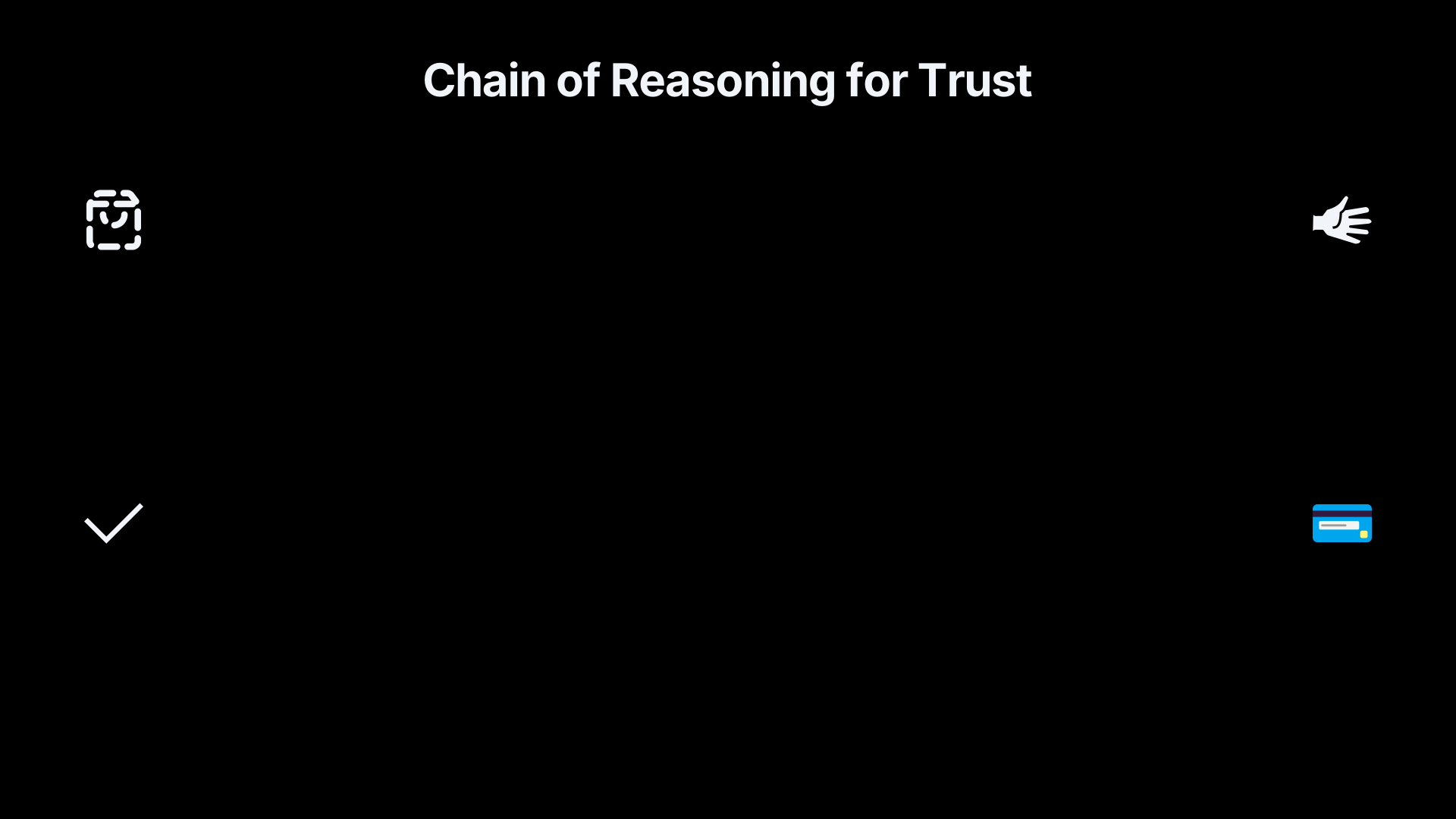
This creates a direct chain of reasoning:
Recommendation → Evidence → Buying decision.
Readers no longer have to trust the reviewer simply because they sound confident. They can see why the recommendation exists.
Google’s review guidance consistently encourages original evidence, explanations of performance differences, quantitative measurements where appropriate, and discussion of what distinguishes one product from another. Placing this information immediately beside the recommendation makes those signals visible to both readers and search quality systems.[Google for Developers]developers.google.comproduct reviews updateGoogle for DevelopersWhat creators should know about Google's April 2021…8 Apr 2021 — We're sharing an improvement to our ranking syst…
Photos, Measurements and Expert Input Build Trust
Different forms of evidence answer different doubts. The most persuasive reviews combine several forms naturally rather than relying on one type alone.
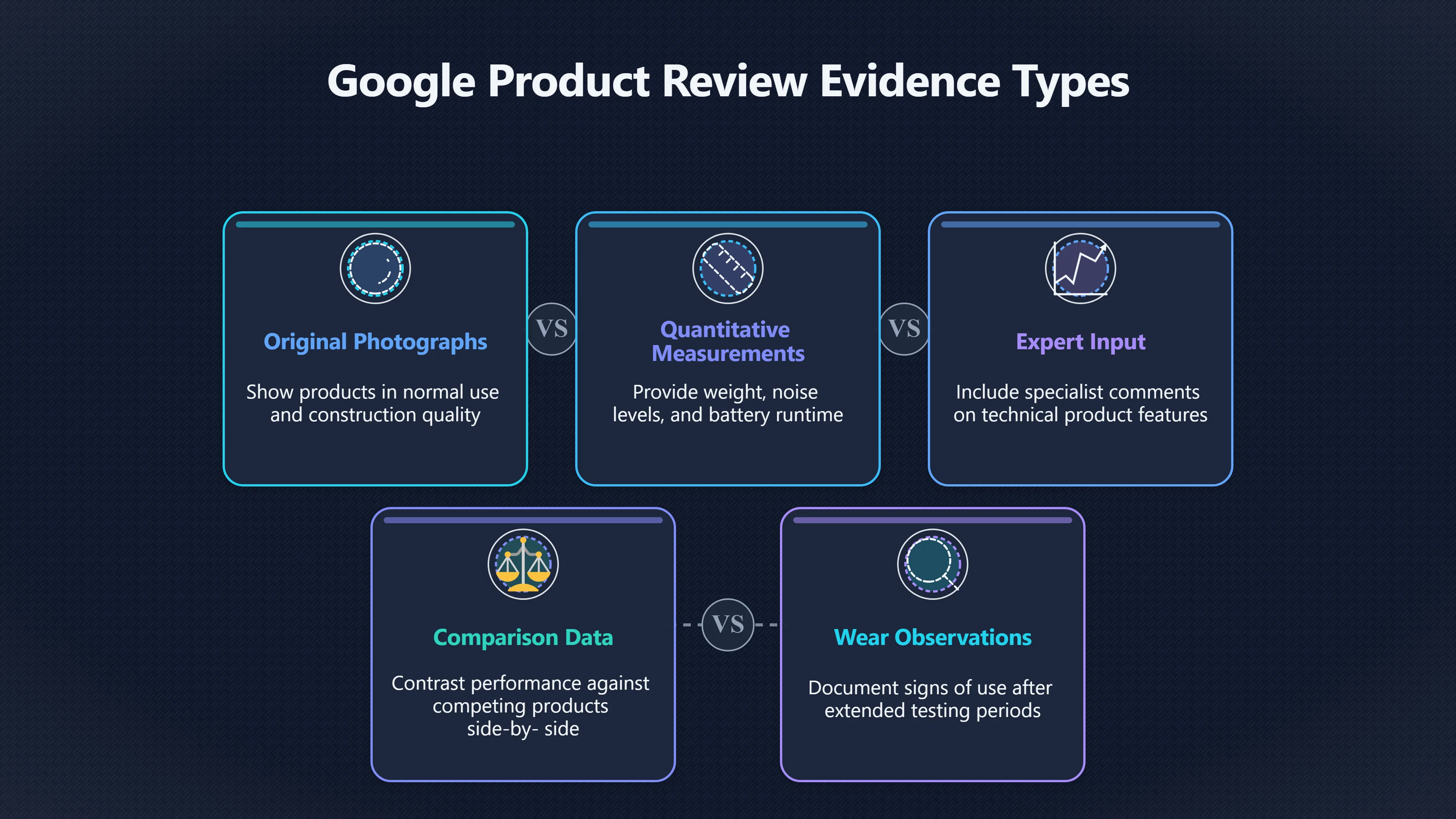
Original photographs
Original photographs answer questions that stock images cannot.
Useful examples include:
- the product in normal use
- close-ups of construction quality
- comparison with everyday objects for scale
- signs of wear after extended use
- packaging contents
- awkward design details that promotional images hide
A photograph becomes substantially more valuable when it directly illustrates the point being discussed instead of appearing in a gallery detached from the text.
For example, if mentioning that a coffee grinder retains grounds internally, show the retained grounds immediately after making that statement.
Google has repeatedly highlighted unique photos and other original content as indicators of richer review experiences.[Google for Developers]developers.google.comproduct reviews updateGoogle for DevelopersWhat creators should know about Google's April 2021…8 Apr 2021 — We're sharing an improvement to our ranking syst…
Measurements that answer buying questions
Numbers are persuasive only when they solve real purchase uncertainty.
Useful measurements include:
- weight
- operating noise
- charging time
- water consumption
- internal storage capacity
- cooking temperature accuracy
- screen brightness
- actual versus advertised battery life
Whenever possible, explain briefly how the measurement was obtained. A simple note such as “measured at one metre using a sound meter in a quiet room” makes the figure far more credible than presenting a number without context.
Measurements should also appear next to competing products where comparison matters. Readers care less that Product A weighs 2.1 kg than that it weighs 700 g less than Product B.
Expert input
Not every recommendation requires specialist expertise, but when technical questions arise, expert comments carry greatest weight when attached to the relevant claim rather than collected in an isolated interview section.
Examples include:
- a physiotherapist commenting beside an ergonomic chair recommendation
- an electrician explaining surge protection beside a power strip review
- a photographer discussing autofocus behaviour within a camera recommendation
The expert contribution should clarify a specific buying decision, not merely provide authority for the page as a whole.
Avoid the Token “How We Tested” Paragraph
A testing methodology section still has value. It explains overall consistency and helps readers understand the review process.
Problems arise when it becomes the only location containing genuine evidence.
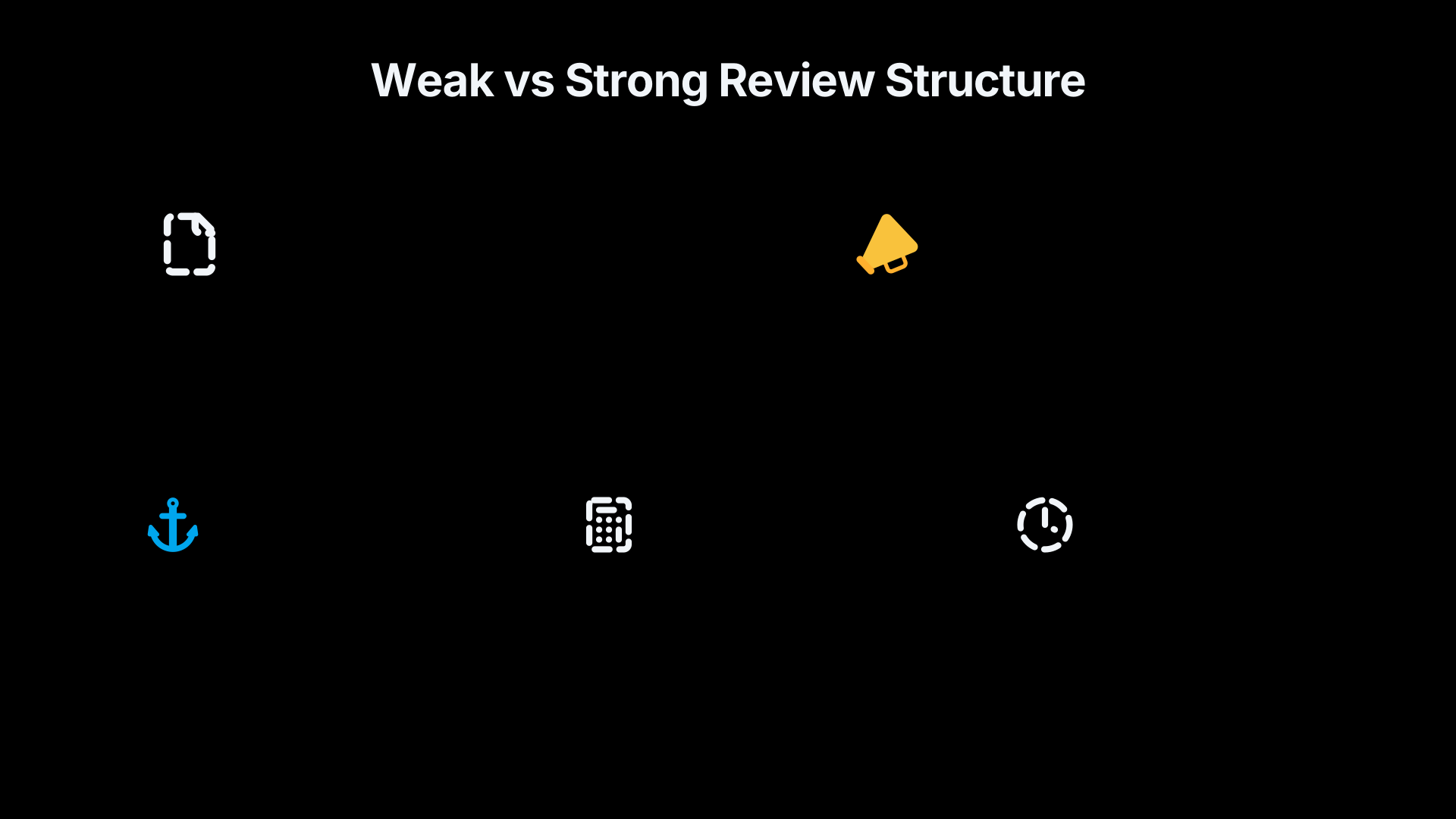
A weak structure often looks like this:
- 300-word testing methodology
- ten recommendations
- generic pros and cons
- affiliate buttons
In that layout, the recommendations themselves remain unsupported.
A stronger structure uses the methodology section only as background. It explains:
- how products were selected
- testing duration
- consistent scoring criteria
- important limitations
Each recommendation then links back to that process by presenting its own relevant observations.
For example:
Methodology
“We measured operating noise for every vacuum using the same meter positioned one metre from the machine.”
Product recommendation
“Measured at 67 dB in our test, this was the quietest model we examined, making it a strong choice for flats or households with sleeping children.”
The reader does not have to remember methodology from several screens earlier because the supporting evidence appears exactly where it influences the purchasing decision.
Match Evidence to the Reader’s Question
Different buying questions require different proof.
Reader concernStrong evidence beside the recommendationIs it durable?Long-term use photos, wear observations, material detailsIs it worth paying more?Side-by-side comparison, measurable performance differencesWill it fit?Dimensions, comparison photographs, installation notesIs it comfortable?Hours of use, pressure points, adjustment rangeIs it fast?Timed tests under realistic conditionsIs it quiet?Measured noise levels with testing context
This matching process prevents evidence becoming decorative. Every supporting item exists because it answers a likely objection before the reader asks it.
Evidence Placement Improves Recommendation Quality
Evidence positioned beside recommendations naturally changes how reviews are written.
Unsupported statements such as:
- “Excellent build quality.”
- “Very comfortable.”
- “Outstanding value.”
become more specific because they require accompanying proof.
Instead, the review evolves into statements like:
- “The aluminium hinge showed no measurable looseness after repeated opening and closing during testing.”
- “After four hours of continuous office use, none of our testers reported pressure on the top of the head.”
- “It completed the same benchmark within 3% of a model costing £180 more.”
These statements are harder to fabricate, easier for readers to verify, and substantially more useful during purchase decisions.
For affiliate publishers, the objective is not to accumulate as much evidence as possible. It is to place each photograph, measurement, observation and expert comment where it resolves uncertainty at the exact moment a reader decides whether to trust the recommendation. That proximity turns evidence into decision support rather than background decoration and produces buying guides that are both more convincing to readers and better aligned with Google’s expectations for genuinely helpful review content.[Google for Developers]developers.google.comproduct reviews updateGoogle for DevelopersWhat creators should know about Google's April 2021…8 Apr 2021 — We're sharing an improvement to our ranking syst…
Amazon book picks
Further Reading
Books and field guides related to Where Should Proof Appear in a Review?. Use these as the next step if you want deeper reading beyond the article.
Everybody Writes
Promotes trustworthy writing practices that reinforce evidence beside key claims.
Don't Make Me Think, Revisited
Explains reducing reader friction by presenting information where decisions are made.
The Copywriter's Handbook
Rating: 4.0/5 from 5 Google Books ratings
Shows how to support persuasive claims with credible, reader-focused evidence.
eBay marketplace picks
Marketplace Samples
Live-tested eBay searches with available results related to this page.




Endnotes
1.
Source: developers.google.com
Title: product reviews update
Link:https://developers.google.com/search/blog/2021/04/product-reviews-update
Source snippet
Google for DevelopersWhat creators should know about Google's April 2021...8 Apr 2021 — We're sharing an improvement to our ranking syst...
Published: April 2021
2.
Source: support.google.com
Link:https://support.google.com/merchants/answer/6098512?hl=en-GB
Source snippet
rating policies - Google Merchant Center HelpTo participate in product ratings by uploading a feed of reviews, you must have a minimum of...
Additional References
3.
Source: amsive.com
Title: googles newest reviews update elevates real life experience
Link:https://www.amsive.com/insights/seo/googles-newest-reviews-update-elevates-real-life-experience/
Source snippet
Google's Newest Reviews Update Elevates Real-Life...27 Apr 2023 — Google recently published a new April 2023 update to its Reviews Syste...
Published: April 2023
4.
Source: seozoom.com
Title: google reviews system the algorithm on product reviews
Source snippet
Google Reviews System: the algorithm on product reviews17 Apr 2023 — Guide to Reviews system, the Google algorithm evaluating reviews, an...
5.
Source: youtube.com
Title: 3 Things You Need to Know About Google’s SEO Product Review Update
Link:https://www.youtube.com/watch?v=DKW2G8cj3sA
Source snippet
How to write product reviews affiliate marketing google review update How To Write Product Reviews For Affiliate Marketing Digital Wealth...
6.
Source: susodigital.com
Title: SUSOHow to Write Product Reviews: The Google Way
Link:https://susodigital.com/thoughts/how-to-write-product-reviews-the-google-way/
Source snippet
How to Write Product Reviews: The Google Way - SUSO Digital28 Mar 2023 — Use [real photos]({{ 'real-photos/' | relative_url }}) taken while reviewing the product, instead of st...
7.
Source: productrise.app
Title: product reviews google shopping how they work
Link:https://productrise.app/blog/product-reviews-google-shopping-how-they-work
Source snippet
How to Get Product Reviews Showing in Google Shopping...4 Jan 2026 — Step-by-step guide to getting product reviews in Google Shopping. L...
8.
Source: wiserreview.com
Title: google product reviews update
Link:https://wiserreview.com/blog/google-product-reviews-update/
Source snippet
Full history (2026)20 Oct 2025 — Discover Google Product Reviews update from 2021 to 2025, what changed, and what the continuous reviews...
9.
Source: youtube.com
Title: How To Write Product Reviews (For Affiliate Websites) That Convert Like Crazy
Link:https://www.youtube.com/watch?v=PKSQrwDXFgQ
Source snippet
Google Product Review Update: How Bloggers Can Get REAL Product Photos...
10.
Source: ilanadavis.com
Title: googles product [review rules]({{ ‘review-rules/’ | relative_url }}) you have to follow for rich results
Link:https://www.ilanadavis.com/blogs/articles/googles-product-review-rules-you-have-to-follow-for-rich-results?srsltid=AfmBOopyaUQd5YB_YPOqwqHFn_QRiG2SfqxBO4mX5xH7wNOxFzzmw1dQ
Source snippet
It should be immediately obvious to users...Read more...
11.
Source: youtube.com
Title: How I Write Product Reviews That Rank on Google and Convert Readers
Link:https://www.youtube.com/watch?v=VDSphJeM-k8
Source snippet
How To Write Product Reviews (For Affiliate Websites) That Convert Like Crazy...
12.
Source: youtube.com
Title: Google Product Review Update: How Bloggers Can Get REAL Product Photos
Link:https://www.youtube.com/watch?v=723nu3E0iQI
Source snippet
How to Capitalize on Google's New Product Reviews Algorithm Update...
Topic Tree