Within Wirecutter
Can Affiliate Reviews Stay Editorially Honest?
Wirecutter's model depends on readers believing that editors choose products before commissions enter the decision.
On this page
- Why affiliate links create a built in conflict
- How editorial and commerce roles can be separated
- What smaller publishers can do without a large staff
Page outline Jump by section
Introduction
Affiliate review sites make money when readers buy products through tracked links, creating an unavoidable tension: every recommendation has the potential to generate revenue. The central question is therefore not whether a financial conflict exists—it does—but whether the publisher has built credible safeguards that prevent commercial incentives from influencing editorial judgement. Wirecutter has become one of the best-known examples because it argues that editors choose products first and that affiliate monetisation is added only after those decisions are complete. That separation is not simply a public relations message; it is a governance model designed to preserve reader trust while allowing affiliate commissions to fund expensive product journalism.[cjr.org]cjr.orgproduct review verticals strategist wirecutterUnder ReviewOct 16, 2023 — At Wirecutter, editorial independence is paramount: “We don't want any of our writers and editors making any d…
 For anyone building an affiliate website, the lesson is less about copying Wirecutter’s scale than about copying its decision-making structure. Readers cannot see internal meetings or financial arrangements, so credibility depends on visible policies, consistent behaviour and transparent disclosures.
Why affiliate links create a built-in conflict
Affiliate marketing rewards successful recommendations rather than page views alone. This creates incentives that can subtly distort editorial decisions even when nobody explicitly orders a writer to promote a particular product.
Common pressure points include:
- favouring retailers or brands with higher commission rates;
- avoiding products that lack affiliate programmes even if they are objectively better;
- delaying negative reviews of commercially valuable products;
- expanding “best of” lists to include products that increase earning opportunities rather than improve reader choice.
These risks are often described as conflicts of interest rather than evidence of misconduct. A publisher can genuinely believe it is acting independently while still allowing commercial information to influence editorial judgement unconsciously. That possibility explains why serious review organisations focus on organisational structure rather than relying solely on individual integrity.
Wirecutter executives have repeatedly described this distinction. According to the publication’s leadership, writers and editors should not even know whether a commercial relationship exists with a retailer while making recommendations, reducing the chance that financial considerations shape editorial choices.[cjr.org]cjr.orgproduct review verticals strategist wirecutterUnder ReviewOct 16, 2023 — At Wirecutter, editorial independence is paramount: “We don't want any of our writers and editors making any d…
How editorial and commerce roles can be separated
The strongest protection is often called a “church and state” model, borrowing a long-standing newsroom principle that separates editorial work from advertising sales.
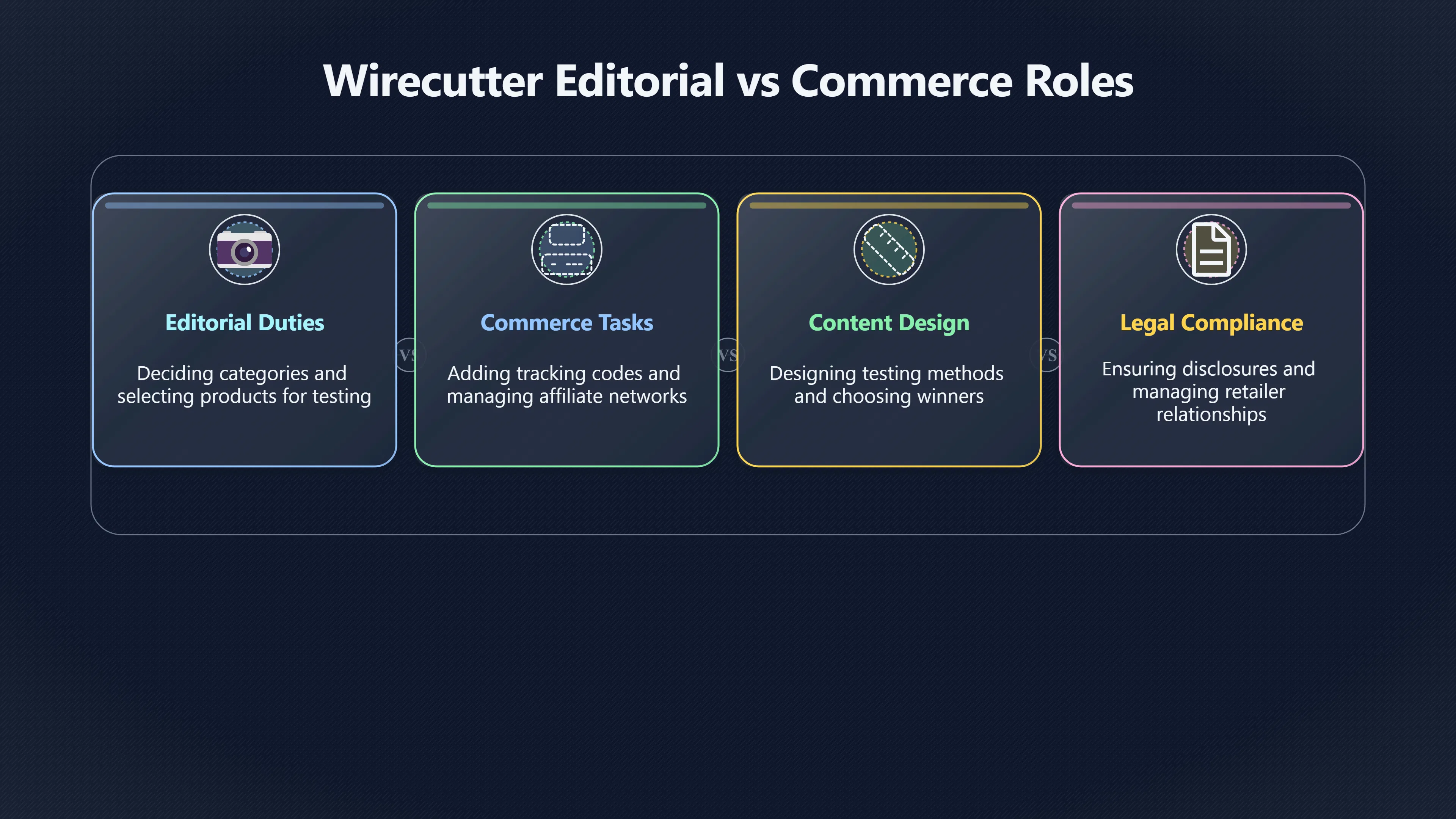
In affiliate publishing, that separation generally means the editorial team is responsible for:
- deciding which categories deserve coverage;
- selecting products to test;
- designing testing methods;
- choosing winners and explaining trade-offs;
- updating recommendations when evidence changes.
A separate commerce or business team then handles activities such as:
- adding affiliate tracking codes;
- negotiating retailer relationships;
- managing affiliate networks;
- analysing commercial performance;
- ensuring legal compliance and disclosures.
The critical point is the order of operations. Editorial decisions come first. Commercial implementation follows afterwards.
Wirecutter has publicly described this workflow as one in which product selections are made independently before affiliate links or commercial partnerships are added. Senior management has characterised the process as a strict separation between editorial and commercial functions to prevent even subconscious influence over recommendations.[The Drum]thedrum.comThe DrumDanielle Betras of Wirecutter on why commerce journalism…Apr 30, 2026 — Product picks are made independently; only then does t…
This governance model also answers a practical question readers increasingly ask: “Would this recommendation still appear if it earned no commission?” A credible separation policy aims to make the answer “yes”.
Transparency is part of the policy, not an afterthought
Structural separation works best when readers understand it.
A simple affiliate disclosure stating that commissions may be earned satisfies important legal obligations in many jurisdictions, but transparency can go further by explaining:
- how products are selected;
- whether companies can pay for inclusion;
- who controls final recommendations;
- whether retailers receive advance review approval;
- how free review samples are handled;
- how corrections and recommendation changes are made.
Wirecutter has increasingly explained these processes publicly, including that editorial picks are based on product quality while commercial teams manage affiliate implementation separately. Making those internal rules visible allows readers to judge whether the publication’s governance deserves trust rather than asking them to accept broad claims of independence.[Affiverse]affiversemedia.comAffiverse Wirecutter Just Made the Case for Radical Transparency11 Mar 2026 — It is a clean, plainly written explanation of how affiliate revenue works at the publication: editors pick products based s…
Transparency also creates accountability. Once policies are public, readers can identify inconsistencies between stated principles and observed behaviour.
What smaller publishers can do without a large staff
Most affiliate publishers do not have separate editorial departments, commercial managers and standards teams. That does not mean meaningful safeguards are impossible.
Smaller operations can still adopt governance practices that reduce conflicts:
- Write a public editorial policy. Explain how products are chosen and when affiliate links are added.
- Decide recommendations before checking commissions. Record the preferred products first, then determine which retailers provide affiliate links.
- Recommend non-affiliate products when appropriate. Sometimes the best product earns nothing. Publishing that recommendation demonstrates that editorial judgement comes first.
- Separate performance metrics from editorial success. Evaluate articles using reader satisfaction, updates and accuracy rather than commission income alone.
- Document testing methods. Showing how products were evaluated makes recommendations easier to verify and harder to manipulate.
- Disclose commercial relationships clearly. Readers should not have to search for affiliate disclosures or guess how the site is funded.
These practices cannot eliminate conflicts of interest, but they make editorial decisions more resistant to commercial pressure and easier for readers to assess.

Separation is valuable because trust compounds
Affiliate commissions can be earned repeatedly from readers who return because previous recommendations proved reliable. That makes long-term trust economically valuable in its own right.
A publisher that consistently recommends the best product—even when it produces lower short-term revenue—can strengthen its reputation over years. By contrast, steering readers towards higher-paying products that disappoint customers may increase immediate commissions while steadily eroding credibility.
Recent changes to search quality expectations have also reinforced this incentive. Publishers that invest in genuine editorial processes, permanent staff and documented testing have generally been more resilient than operations built around thin affiliate content, illustrating that commercial success increasingly depends on demonstrating authentic editorial value rather than simply inserting affiliate links.[The Wall Street Journal]wsj.comThe Wall Street Journal Google Tweak Creates Crisis for Product-Review SitesWebsites like CNN Underscored, Forbes Vetted, and others have experienced dramatic drops in traffic following Google's implementation of…
For affiliate websites, editorial and commerce separation is therefore more than an ethical aspiration. It is a governance choice that aligns the publication’s financial future with the reader’s interest. When recommendations remain independent of commission decisions, affiliate revenue becomes the consequence of trusted journalism rather than its driving force.
Amazon book picks
Further Reading
Books and field guides related to Can Affiliate Reviews Stay Editorially Honest?. Use these as the next step if you want deeper reading beyond the article.
The Elements of Journalism
Provides foundational principles for maintaining editorial independence and serving readers.
Trust Me, I'm Lying
Explores how commercial incentives can shape editorial decisions and why trust safeguards matter.
Influence: The Psychology of Persuasion
Helps readers understand persuasive techniques that intersect with affiliate marketing and product recommendations.
eBay marketplace picks
Marketplace Samples
Live-tested eBay searches with available results related to this page.


Endnotes
1.
Source: cjr.org
Title: product review verticals strategist wirecutter
Link:https://www.cjr.org/business_of_news/product-review-verticals-strategist-wirecutter.php
Source snippet
Under ReviewOct 16, 2023 — At Wirecutter, editorial independence is paramount: “We don't want any of our writers and editors making any d...
2.
Source: cjr.org
Link:https://www.cjr.org/
Source snippet
Columbia Journalism ReviewThe Trump administration is helping a white, male editor sue the New York Times for discrimination. By Jem Bart...
3.
Source: cjr.org
Link:https://www.cjr.org/special_report/digital-age-the-new-york-times-slippery-path-news-advertising.php/
Source snippet
In the digital age, The New York Times treads an...28 Jun 2017 — The arrangement is problematic because of the way Wirecutter works...
4.
Source: thedrum.com
Link:https://www.thedrum.com/opinion/cha
Source snippet
The DrumDanielle Betras of Wirecutter on why commerce journalism...Apr 30, 2026 — Product picks are made independently; only then does t...
5.
Source: affiversemedia.com
Title: Affiverse Wirecutter Just Made the Case for Radical Transparency
Link:https://www.affiversemedia.com/wirecutter-just-made-the-case-for-radical-transparency-most-publishers-wont-follow-it/
Source snippet
11 Mar 2026 — It is a clean, plainly written explanation of how affiliate revenue works at the publication: editors pick products based s...
6.
Source: wsj.com
Title: The Wall Street Journal Google Tweak Creates Crisis for Product-Review Sites
Link:https://www.wsj.com/business/media/google-search-change-product-recommendation-websites-02394b79
Source snippet
Websites like CNN Underscored, Forbes Vetted, and others have experienced dramatic drops in [traffic]({{ 'traffic/' | relative_url }}) following Google's implementation of...
7.
Source: support.google.com
Link:https://support.google.com/news/publisher-center/thread/281234003/googlle-news-publishers-promoting-affiliate-products-allowed-like-nyt-wirecutter?hl=en
Source snippet
news publishers promoting affiliate products...Jun 22, 2024 — We don't allow content that conceals or misrepresents sponsored content as...
Additional References
8.
Source: asbpe.org
Link:https://asbpe.org/code-of-journalism-ethics/
Source snippet
ASBPE Code of Journalism EthicsContextual links within editorial content should not be sold. If an editor allows a link, it generally sho...
9.
Source: ideastream.org
Link:https://www.ideastream.org/editorial-ethics-and-guidelines
Source snippet
Editorial Ethics and GuidelinesWe will operate ethically, with independence and impartiality. Content creators devote resources and skill...
10.
Source: apmreports.org
Link:https://www.apmreports.org/news-ethics-guidelines
Source snippet
News Ethics GuidelinesThe agendas of people or companies that financially support our organizations do not influence the journalism we pr...
11.
Source: michaelschmitt.co.uk
Link:https://michaelschmitt.co.uk/ethics-of-monetising-reach-and-integrity-2/
Source snippet
The ethics of monetising reach while staying editorially cleanDiversify revenue streams-[subscriptions]({{ 'subscriptions/' | relative_url }}), memberships, events, affiliate pro...
12.
Source: brookekroeger.com
Link:https://brookekroeger.com/columbia-journalism-review-what-do-journalists-owe-their-sources-and-their-audiences-by-julie-gerstein-and-margaret-sullivan/
Source snippet
Columbia Journalism Review: "What Do Journalists Owe...25 Jul 2025 — Columbia Journalism Review: “What Do Journalists Owe Their Sources—...
13.
Source: job-boards.greenhouse.io
Link:https://job-boards.greenhouse.io/thenewyorktimes/jobs/4695487005
Source snippet
greenhouse.ioDirector, Licensing, NYT WirecutterPartner closely with Wirecutter editorial leadership and Standards & Ethics to ensure all...
14.
Source: advertisinglaw.fkks.com
Link:https://advertisinglaw.fkks.com/post/102f2b9/use-of-affiliate-links-does-not-necessarily-transform-editorial-content-into-adve
Source snippet
of Affiliate Links Does Not Necessarily Transform Editorial...Sep 19, 2018 — It argued that the decision as to which products to include...
15.
Source: prweek.com
Link:https://www.prweek.com/article/1231527/analysis-media-relations-policies-mistakes-need-correction-a-recent-survey-reporters-columbia-journalism-review-found-room-improvement-news-outlets
Source snippet
Policies on mistakes in need of correction/...ANALYSIS: Media Relations - Policies on mistakes in need of correction/A recent survey of...
16.
Source: voices.media
Title: columbia journalism reviews mathew ingram publishers get wrong trust
Link:https://voices.media/columbia-journalism-reviews-mathew-ingram-publishers-get-wrong-trust/
Source snippet
Columbia Journalism Review's Mathew Ingram on what...10 Sept 2018 — Mathew Ingram, media writer for the Columbia Journalism Review, expl...
17.
Source: growth-memo.com
Title: did the wirecutter migrate because of affiliate commissions
Link:https://www.growth-memo.com/p/did-the-wirecutter-migrate-because-of-affiliate-commissions
Source snippet
?Jun 25, 2020 — The Wirecutter recently went from wirecutter.com to nytimes.com/wirecutter. Was the motivator lower affiliate commissions?...
Topic Tree