Within Hiking Gear
Why Side by Side Gear Testing Beats Guesswork
Comparison tests make affiliate roundups stronger by showing how similar boots, packs, headlamps, or poles perform under the same conditions.
On this page
- Choosing comparable routes, loads, and weather
- Scoring comfort, traction, weight, and usability
- Turning test differences into best for recommendations
Page outline Jump by section
Introduction
Side-by-side testing is one of the most convincing ways to strengthen a hiking gear roundup. Instead of reviewing each boot, backpack, headlamp, or trekking pole in isolation, the reviewer compares similar products under the same conditions. That approach makes differences easier to see, produces recommendations that match real hiking needs, and gives readers confidence that rankings reflect genuine experience rather than marketing claims or manufacturer specifications.
 For affiliate websites, comparison testing also creates more useful buying guidance. Rather than declaring a single universal winner, a well-designed roundup can explain why one boot excels on wet rock, another carries heavy loads more comfortably, or a lighter headlamp is the better choice for summer day hikes. This kind of evidence aligns with the broader shift towards first-hand, experience-based product reviews encouraged by search engines and increasingly expected by outdoor readers.[GearLab]outdoorgearlab.comGearLabHiking & Camping | Tested & RankedWhether you love hiking, backpacking, or camping, our team of backcountry experts has been testi…
Why comparing products together produces better recommendations
A hiking product rarely succeeds or fails in absolute terms. Performance depends on terrain, weather, walking pace, carried weight, foot shape and intended use. Testing products one after another, weeks apart and on different routes, introduces too many changing variables to make fair comparisons.
Side-by-side testing controls those variables. Two or more comparable products are used under nearly identical conditions so that the differences come from the equipment rather than from changing weather or trail conditions.
Outdoor testing organisations increasingly structure their reviews this way. OutdoorGearLab, for example, purchases groups of competing products within a category, tests them for months in varied field conditions, scores them across consistent performance metrics, and then recommends products according to different user priorities rather than relying on a single overall winner.[GearLab]outdoorgearlab.comGearLabHiking & Camping | Tested & RankedWhether you love hiking, backpacking, or camping, our team of backcountry experts has been testi…
The practical result is that affiliate recommendations become much more specific:
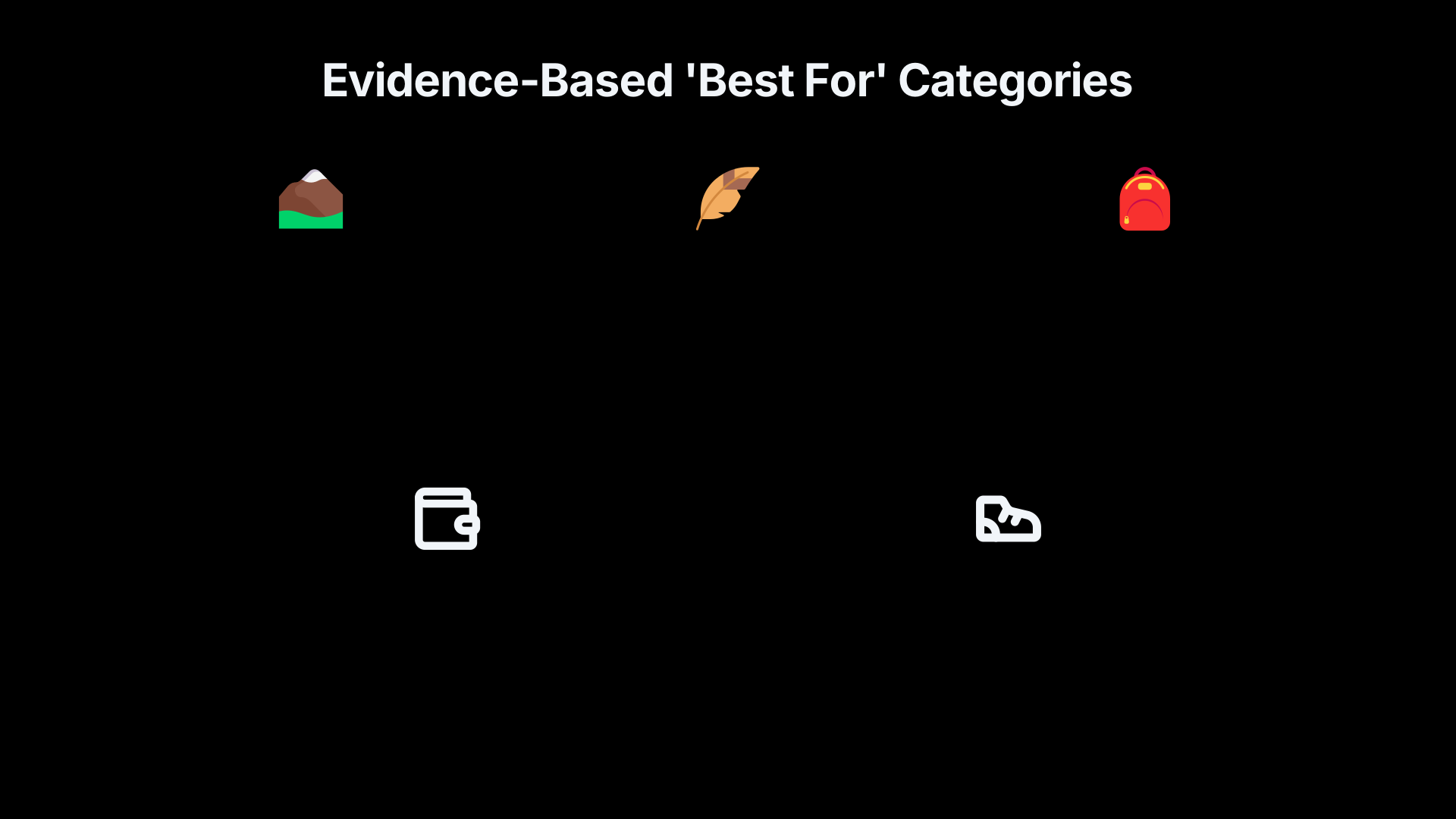
- Best for wet, rocky mountain trails.
- Best for lightweight summer walking.
- Best for carrying 18–20 kg.
- Best value for occasional hikers.
- Best option for wide feet.
Those recommendations emerge from observed differences instead of marketing language.
Choosing comparable routes, loads and weather
A useful comparison starts long before anyone steps onto the trail. The testing conditions should match the products being compared.
Keep the route consistent
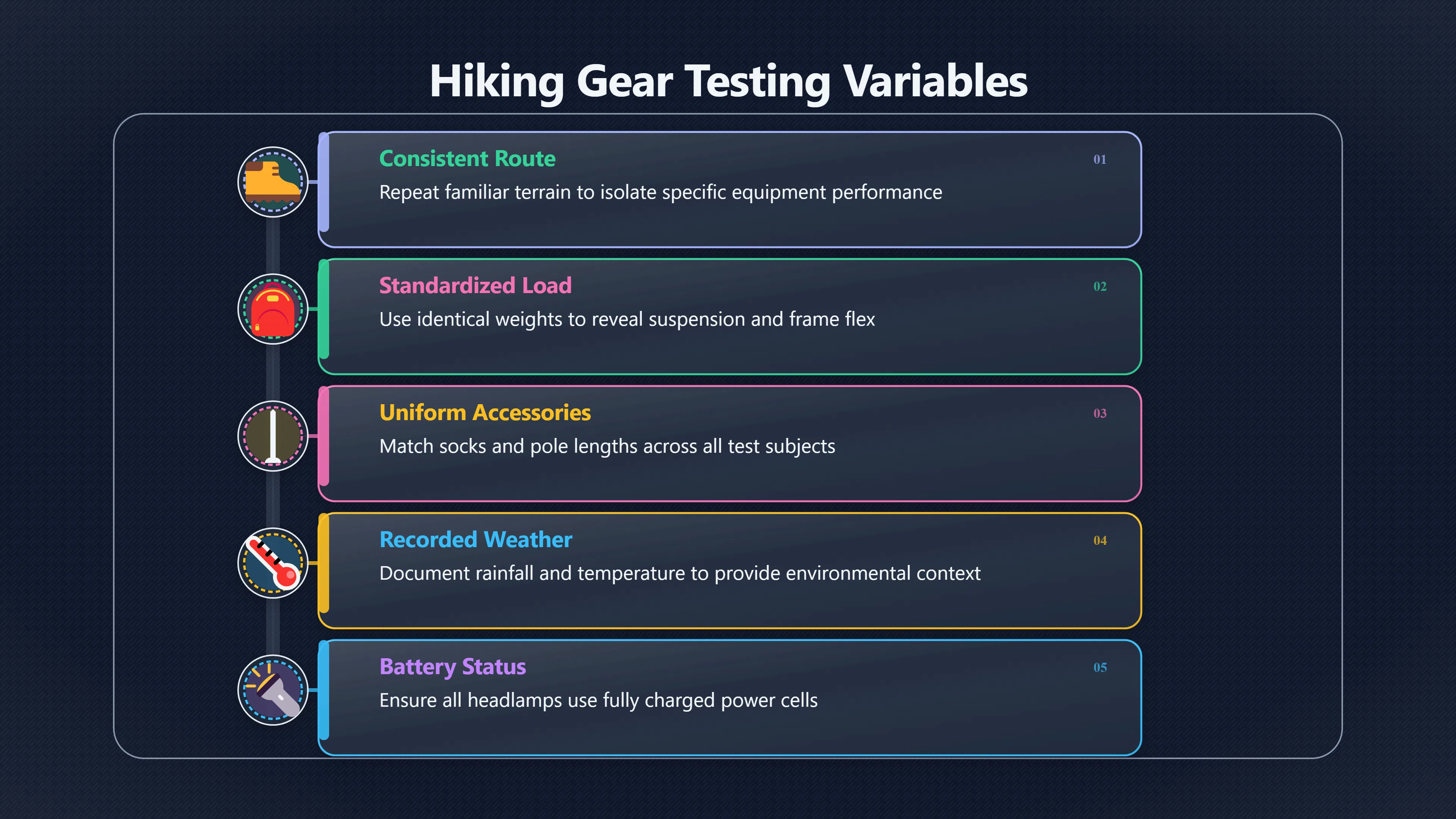
When comparing hiking boots, each pair should experience similar terrain:
- rocky ascents
- muddy woodland paths
- gravel tracks
- wet roots
- moderate descents
Changing from a dry local trail to an alpine ridge halfway through testing makes traction comparisons far less meaningful.
Many professional reviewers deliberately repeat familiar routes because they already understand where particular challenges occur, making changes in equipment performance easier to notice.[GearLab]outdoorgearlab.comGearLabHiking & Camping | Tested & RankedWhether you love hiking, backpacking, or camping, our team of backcountry experts has been testi…
Control carried weight
Backpacks illustrate why load consistency matters.
A pack carrying 8 kg will often feel excellent regardless of its suspension system. The same pack at 18 kg may reveal shoulder pressure, poor hip-belt transfer or frame flex.
Keeping food, water, clothing and camera equipment consistent across tests allows comfort differences to become obvious.
Similarly:
- trekking poles should be adjusted to identical lengths
- boots should be tested with the same socks where possible
- headlamps should use fully charged batteries
- rain jackets should carry similar base layers underneath
Small variables accumulate into misleading conclusions if they are not controlled.
Accept natural weather—but record it
Unlike laboratory work, outdoor testing cannot control rain or temperature.
Instead, experienced reviewers document conditions:
- air temperature
- rainfall
- ground conditions
- wind
- trail distance
- elevation gain
Recording these details gives readers context.
For example, excellent waterproof performance during two hours of continuous rain provides much stronger evidence than simply stating that a boot “kept my feet dry.”
Outside’s collaboration with the University of Colorado Denver has similarly highlighted the importance of pairing controlled testing with real outdoor environments because laboratory results alone cannot fully represent changing field conditions.[Outside Online]outsideonline.comwhat the lab learned in 2025Outside OnlineWhat We Learned from Testing 150 Pieces of Gear27 Dec 2025 — After a round of lab testing, we like to compare the results w…

Scoring comfort, traction, weight and usability
The most credible roundups compare products using the same evaluation criteria throughout the test.
Rather than producing one vague overall score, separate the performance categories.
CategoryWhat to evaluateComfortHot spots, pressure points, cushioning after several hoursTractionWet rock, loose gravel, mud, steep descentsStabilityFoot support or load transfer under fatigueWeightPerceived effort over long distances, not just manufacturer figuresWeather protectionWaterproofing, breathability, drying speedUsabilityLace systems, pocket access, adjustment mechanisms, glove-friendly controlsDurability observationsAbrasion, sole wear, stitching, hardware reliability during testing
Separate scoring makes trade-offs visible.
For example:
- Boot A may offer the best grip but feel noticeably heavier.
- Boot B may ventilate well but lose traction on slick rock.
- Pack C may carry 20 kg comfortably while weighing considerably more than minimalist alternatives.
Readers generally make better purchasing decisions when they understand these compromises rather than seeing a single composite score.
Turning differences into “best for” recommendations
The greatest value of comparison testing is that it supports multiple winners.
Instead of forcing every product into a single ranking, differences become recommendations for different hikers.
A comparison might conclude:
Best for long-distance backpacking
Excellent load transfer, stable suspension and durable fabrics, despite higher weight.
Best for fast day hikes
Lower overall weight, better ventilation and greater agility, although less comfortable under heavy loads.
Best budget choice
Solid all-round performance despite fewer premium materials.
Best for wet conditions
Superior grip and waterproof performance observed during repeated rainy walks.
These distinctions are far more believable than claiming every category has one universally superior product.
Professional reviewers increasingly avoid “best overall” as the only recommendation because real users have different priorities, budgets and environments.[GearLab]outdoorgearlab.comGearLabHiking & Camping | Tested & RankedWhether you love hiking, backpacking, or camping, our team of backcountry experts has been testi…
Building trust through transparent comparisons
Readers quickly recognise when a roundup consists mainly of rewritten manufacturer specifications.
Comparison testing creates evidence that cannot easily be copied because it includes observations unique to the reviewer.
Examples include:
- one boot consistently slipped on polished wet rock while another remained stable
- one backpack caused shoulder fatigue after six hours whereas another transferred more weight to the hips
- two headlamps with identical quoted brightness produced noticeably different beam patterns on narrow woodland paths
- one trekking pole adjustment system loosened repeatedly during steep descents
These practical observations are exactly the details shoppers cannot obtain from product pages.
Experienced outdoor writers often keep detailed testing notes covering conditions, durability, comfort and long-term impressions so that comparisons remain consistent across multiple reviews rather than relying on memory alone.[unpublishableandunedited.substack.com]unpublishableandunedited.substack.coming links to REI and Amazon, and how to tell if you can trust what you…
Common mistakes that weaken comparison roundups
Several practices reduce the credibility of side-by-side testing even when products have genuinely been used.
- Comparing products from entirely different categories, such as ultralight trail shoes against heavy backpacking boots.
- Testing products months apart under completely different conditions.
- Allowing manufacturer specifications to outweigh observed field performance.
- Giving identical weight to every scoring category regardless of intended use.
- Declaring a single winner without explaining who benefits from its strengths.
- Hiding limitations instead of acknowledging where a competing product performed better.
Readers generally value transparent trade-offs more than exaggerated certainty.
Where evidence is limited—for example, on long-term durability after only a few weeks—the review should distinguish first impressions from extended testing rather than presenting both as equally established findings. Professional outdoor testing increasingly combines repeatable comparison methods with ongoing long-term field use because neither approach alone captures every aspect of real hiking performance.[Outside Online]outsideonline.comwhat the lab learned in 2025Outside OnlineWhat We Learned from Testing 150 Pieces of Gear27 Dec 2025 — After a round of lab testing, we like to compare the results w…
Amazon book picks
Further Reading
Books and field guides related to Why Side-by-Side Gear Testing Beats Guesswork. Use these as the next step if you want deeper reading beyond the article.

Mountaineering The Freedom of the Hills
Explains how equipment performs in real conditions and supports evidence-based gear evaluation.
The Backpacker's Field Manual
Provides practical context for judging gear performance across different trips, loads, and environments.

Trail Tested
Emphasizes practical comparison of equipment choices under realistic hiking conditions.
The Ultimate Hiker's Gear Guide
Focuses on selecting and evaluating hiking gear using practical field experience rather than marketing claims.
eBay marketplace picks
Marketplace Samples
Live-tested eBay searches with available results related to this page.
Endnotes
1.
Source: outdoorgearlab.com
Link:https://www.outdoorgearlab.com/camping-and-hiking
Source snippet
GearLabHiking & Camping | Tested & RankedWhether you love hiking, backpacking, or camping, our team of backcountry experts has been testi...
2.
Source: unpublishableandunedited.substack.com
Link:https://unpublishableandunedited.substack.com/p/affiliate-links-commerce-writing
Source snippet
ing links to REI and [Amazon]({{ 'amazon/' | relative_url }}), and how to tell if you can trust what you...
3.
Source: outsideonline.com
Title: what the lab learned in 2025
Link:https://www.outsideonline.com/outdoor-gear/what-the-lab-learned-in-2025/
Source snippet
Outside OnlineWhat We Learned from Testing 150 Pieces of Gear27 Dec 2025 — After a round of lab testing, we like to compare the results w...
Additional References
4.
Source: reddit.com
Link:https://www.reddit.com/r/CampingGear/comments/oq5963/are_beta_testing_gear_companies_legit/
Source snippet
Are beta testing gear companies legit?: r/CampingGearI've been seeing loads of ads recently for beta testing companies for backpacking g...
5.
Source: youtube.com
Link:https://www.youtube.com/watch?v=F57WEh0RGts
Source snippet
Field Testing REI's Best-Selling Backpacking GearThis [video]({{ 'video/' | relative_url }}) is especially helpful if you are new to backpacking and are looking for guida...
6.
Source: facebook.com
Link:https://www.facebook.com/outsidemagazine/posts/outside-lab-gear-test-editor-adam-trenkamp-explains-the-scientific-methods-behin/1205678661425957/
Source snippet
ind his backpack testing. Read on in the comments...
7.
Source: youtube.com
Link:http://www.youtube.com/watch?v=EtPUyDYmqNI
Source snippet
I Tried 8 Hiking Water Filters From REI.. Here's My Honest Review and Comparison...
8.
Source: youtube.com
Title: I Tried 8 Hiking Water Filters From REI.. Here’s My Honest Review and Comparison
Link:http://www.youtube.com/watch?v=9w0SHGIh9jM
Source snippet
The Best Backpacking Stoves, Tested in Cold Wind...
9.
Source: youtube.com
Link:http://www.youtube.com/watch?v=EChyckS67GM
Source snippet
Hiking gear comparison roundup review side by side Watch This BEFORE you buy a backpack...
10.
Source: rei.com
Title: magnusson lab
Link:https://www.rei.com/blog/camp/magnusson-lab
Source snippet
Step into Gear Testing at the REI Co-op Magnusson Lab20 May 2026 — Get a peek inside the facility affectionally called the Mag Lab, where...
Published: May 2026
11.
Source: backpackinglight.com
Link:https://backpackinglight.com/forums/topic/91090/
Source snippet
"Gear reviews and comparisons' online websites13 May 2014 — Another good site for long term gear views is [http://www.backpackgeartest.org/..."](http://www.backpackgeartest.org/...")...
Published: May 2014
12.
Source: youtube.com
Title: The Best Backpacking Stoves, Tested in Cold Wind
Link:http://www.youtube.com/watch?v=X3txRmPRD4w
Source snippet
The Best Backpacking Sleeping Pads of 2026 (Tested)...
13.
Source: youtube.com
Link:https://www.youtube.com/watch?v=WmFNA8_Ln5w&vl=en
Source snippet
ff. Worth Recommending?...
Topic Tree