Within Testing
The Ownership Problems Reviews Should Not Hide
Instruction gaps, missing adapters, confusing apps, weak hinges, and hard-to-clean parts often reveal more than a perfect unboxing.
On this page
- Why first use friction matters to affiliate trust
- Examples of awkward moments across physical and digital products
- How to separate minor annoyance from deal breaking flaw
Page outline Jump by section
Introduction
The first genuinely useful thing a reviewer often discovers is not a benchmark score or headline feature. It is the first awkward moment of ownership: the point where a new buyer hesitates, gets confused, becomes mildly frustrated, or has to improvise. That moment frequently determines whether a product feels polished or merely impressive in marketing photographs.
 For affiliate websites, documenting these early friction points is one of the strongest ways to demonstrate first-hand experience. Manufacturer specifications rarely mention awkward setup steps, confusing software, awkward cleaning, or poorly designed accessories. Google’s guidance for high-quality product reviews encourages publishers to go beyond feature lists by showing real use, discussing trade-offs, and explaining how a product performs in situations buyers actually face.[ClickBank]clickbank.comhow to write a product review for affiliate marketingLet them know what you like and dislike about it and invite them to reach…Read more…
The goal is not to exaggerate minor flaws. It is to prepare readers for the ownership experience they cannot discover until after buying, making recommendations more trustworthy and more useful.
Why first-use friction builds affiliate trust
Most products work well during a carefully staged demonstration. The more revealing question is what happens when someone uses them without instructions from a salesperson or promotional video.
That first awkward moment often exposes qualities that determine long-term satisfaction:
- Whether instructions are clear enough for an ordinary buyer.
- Whether accessories fit together naturally.
- Whether software setup creates unnecessary delays.
- Whether maintenance feels realistic rather than theoretical.
- Whether everyday tasks become easier or unexpectedly complicated.
These observations are difficult to fake because they arise from actual use. A reviewer who writes, “The hinge feels sturdy,” could simply be repeating marketing material. A reviewer who writes, “Opening the lid with one hand causes the base to lift off the table until the rubber feet wear in,” is describing an experience that usually only appears after handling the product.
This type of detail aligns with guidance encouraging reviewers to explain how products behave in practice, identify meaningful design choices, include original observations, and discuss both strengths and weaknesses.[ClickBank]clickbank.comhow to write a product review for affiliate marketingLet them know what you like and dislike about it and invite them to reach…Read more…
The ownership problems reviews should not hide
The most valuable awkward moments tend to appear within the first hour, first day, or first week of ownership.
Physical products
Many frustrations have little to do with core performance.
Examples include:
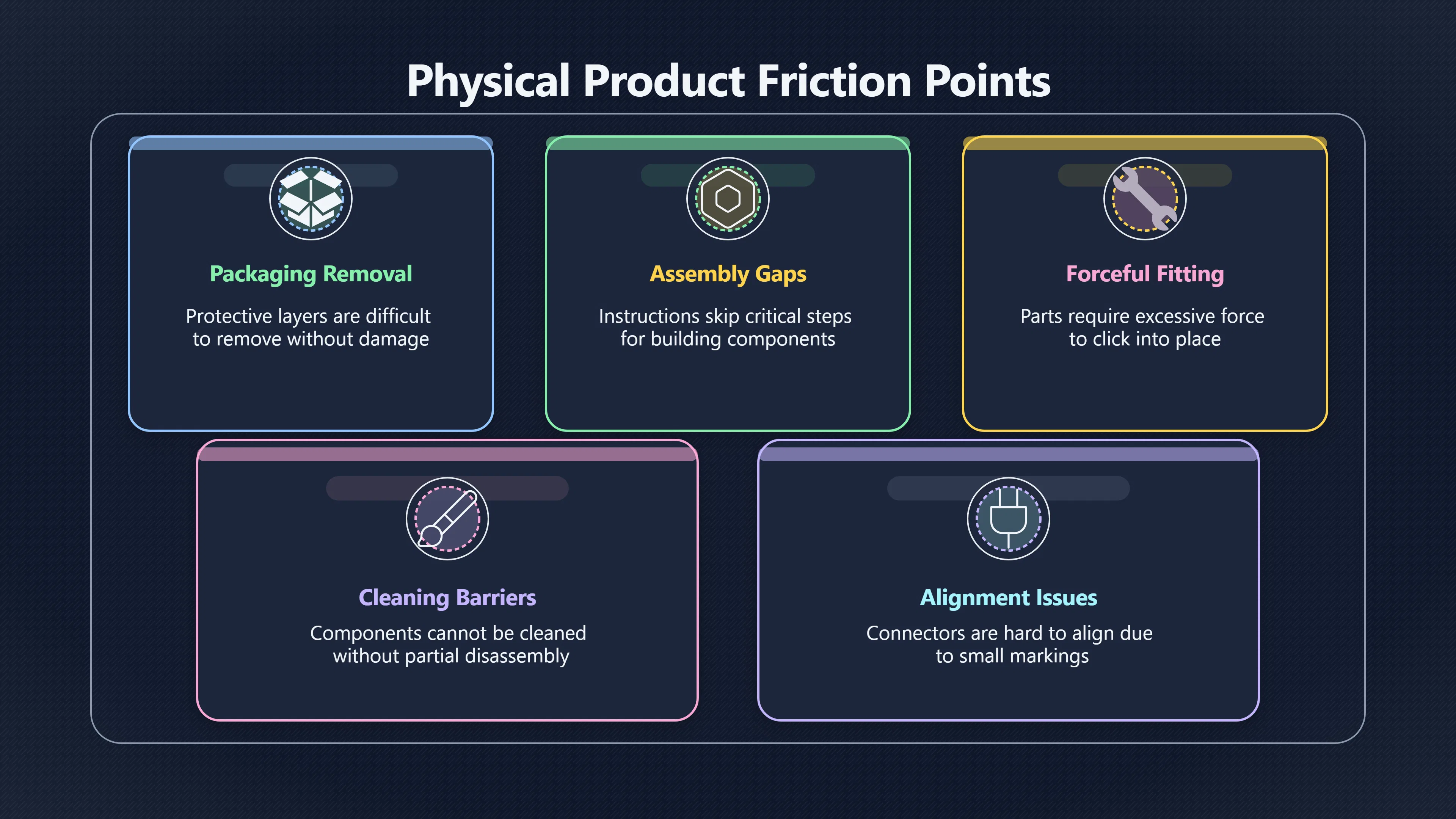
- Protective packaging that is surprisingly difficult to remove without damaging the product.
- Batteries or chargers that are not included despite customer expectations.
- Assembly instructions that skip important steps.
- Parts that require excessive force before they click into place.
- Lids or compartments that are difficult to open with wet hands.
- Products that wobble because adjustable feet are poorly explained.
- Fabrics or plastics that attract fingerprints immediately.
- Components that cannot be cleaned without partial disassembly.
- Connectors that are difficult to align because markings are too small.
- Hinges that require two-handed operation despite advertising convenience.
These are rarely deal-breakers individually, but together they define how refined a product feels.
For example, a coffee grinder may produce excellent grounds yet scatter retained coffee during emptying. A travel backpack may have outstanding storage but awkward zip placement that requires removing the bag to reach a passport pocket. Neither issue appears in a specification sheet, yet both affect daily ownership.
Digital products
Software often creates different forms of early friction.
Common examples include:
- Mandatory account creation before basic functions work.
- Multi-factor authentication during initial setup without warning.
- Confusing subscription prompts before users understand the product.
- Permissions requests that seem unrelated to advertised features.
- Settings spread across several menus.
- Poor onboarding that assumes prior knowledge.
- Data import failures caused by undocumented formatting requirements.
- Mobile and desktop versions behaving differently.
An affiliate review gains credibility by documenting where setup becomes confusing rather than simply stating that installation was “easy” or “simple.”

How to recognise the first awkward moment during testing
Finding these moments requires observing ownership rather than trying to produce dramatic failures.
Useful review techniques include:
- Avoid practising first. Record the experience exactly as a typical buyer encounters it.
- Use only the supplied instructions initially. If you immediately search online for help, note the point where that became necessary.
- Keep a running log. Small frustrations are easy to forget after familiarity develops.
- Measure delays. “Wi-Fi setup took 18 minutes because firmware updated twice” is more informative than “setup was slow.”
- Notice repeated interruptions. If something annoys you three separate times in one week, readers will probably experience the same thing.
- Test routine maintenance early. Emptying, washing, charging, updating software, replacing filters or packing away often reveals more than the initial demonstration.
These observations are difficult for AI-generated or rewritten reviews to reproduce convincingly because they emerge from direct interaction rather than documentation.
Separate inconvenience from genuine buying risk
One of the biggest mistakes in affiliate reviews is treating every annoyance as equally important.
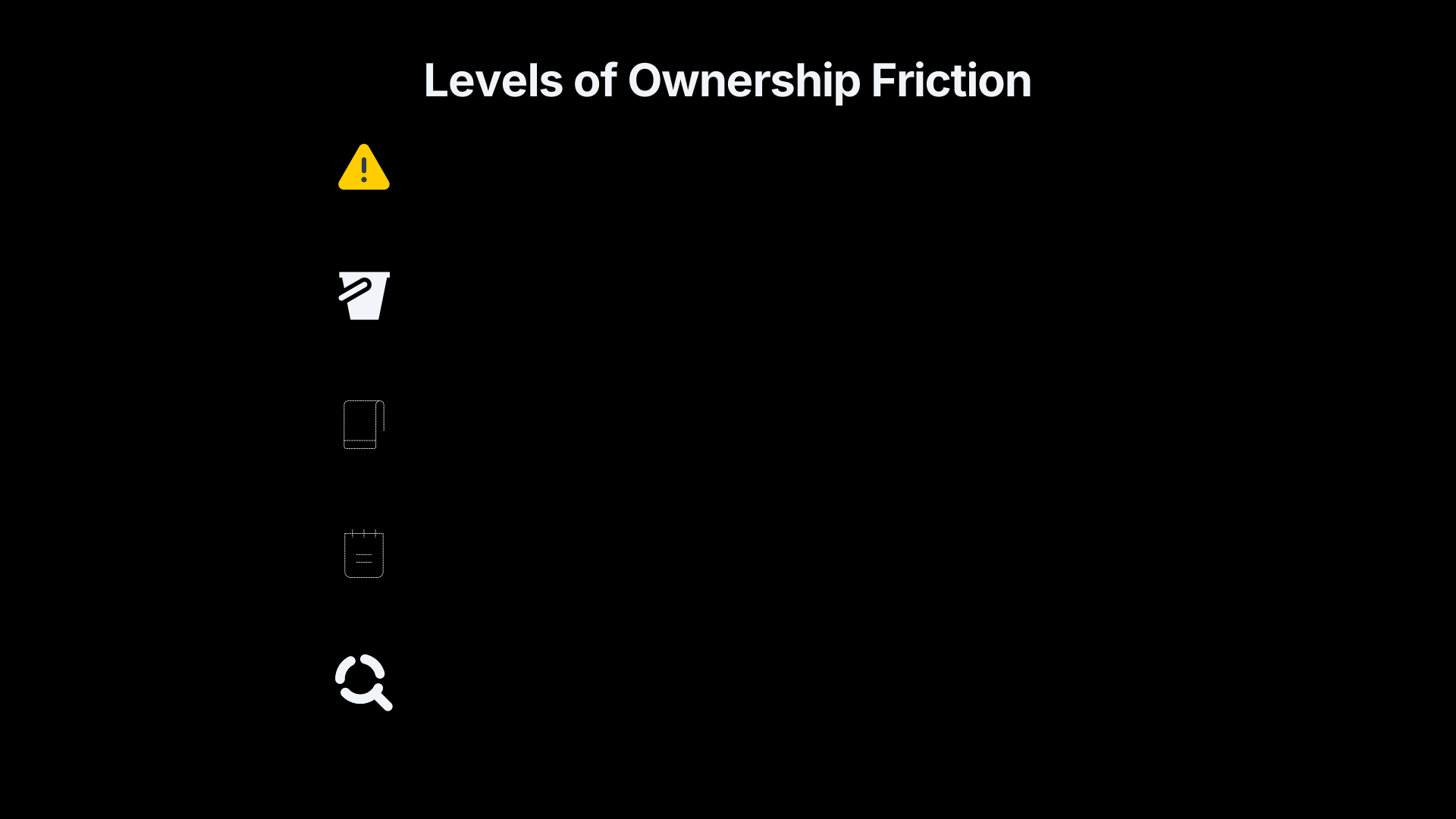
A useful review distinguishes between three levels of friction.
TypeTypical exampleImpact on buyerMinor annoyanceSlightly awkward packaging or fingerprintsWorth mentioning but unlikely to affect purchaseRecurring frictionCleaning requires removing several parts every weekMay influence buyers who value convenienceDeal-breaking flawFrequent connection failures, unsafe design, incompatible accessoriesCould justify recommending an alternative
This distinction prevents reviews from becoming either overly positive or unfairly negative.
Readers generally appreciate balanced judgement. A sentence such as, “The water tank is fiddly to remove for the first few days, but after a week it became second nature,” is more believable than claiming the design is either perfect or unusable.
Explain why the awkward moment happens
The strongest reviews move beyond describing frustration to explaining its cause.
Instead of writing:
The app is confusing.
Explain:
- Navigation hides the pairing option under device settings rather than setup.
- Permission requests appear before explaining why they are needed.
- Error messages give no recovery instructions.
- Firmware updates interrupt onboarding without warning.
Likewise, instead of saying a product is “hard to clean”, explain whether:
- narrow openings prevent brushes reaching debris;
- dishwasher-safe parts still require hand cleaning first;
- removable seals trap moisture;
- textured surfaces collect dirt more quickly than smooth ones.
Understanding the reason behind the awkward moment helps buyers decide whether they personally would care.
Turn awkward moments into better buying advice
The purpose of highlighting ownership friction is not to reduce affiliate conversions. It is to improve purchase decisions.
Often the most useful recommendation is conditional:
- “Worth buying if you’ll assemble it once and leave it in place.”
- “Excellent for experienced users, but beginners should expect a longer setup.”
- “Ideal if weekly cleaning is not a concern.”
- “Choose the larger version if you expect frequent travel.”
This context transforms criticism into practical guidance.
Reviews that acknowledge realistic ownership compromises also tend to appear more trustworthy because they mirror how real customers think. Regulators have repeatedly emphasised that consumers should be able to rely on honest, experience-based reviews rather than manipulated or misleading endorsements.[Federal Trade Commission]ftc.govFederal Trade Commission Soliciting and Paying for Online Reviews: A GuideFederal Trade CommissionSoliciting and Paying for Online Reviews: A Guide…January 25, 2022 — 25 Jan 2022 — When soliciting reviews or…
For affiliate publishers, the first awkward moment is often where genuine expertise becomes visible. Specifications describe what a product is designed to do. Ownership friction reveals what it is actually like to live with. That difference is precisely the kind of original insight readers remember, trust, and return for.
Amazon book picks
Further Reading
Books and field guides related to The Ownership Problems Reviews Should Not Hide. Use these as the next step if you want deeper reading beyond the article.
The Design of Everyday Things
Shows why products create confusion, errors, and frustrating first-use experiences.
Don't Make Me Think, Revisited
Explains how confusing interactions and unnecessary friction affect real user experience.
The Mom Test
Helps reviewers identify genuine ownership friction through better user conversations and observation.
Hooked: How to Build Habit-Forming Products
Provides a framework for evaluating product engagement alongside usability and ownership experience.
eBay marketplace picks
Marketplace Samples
Live-tested eBay searches with available results related to this page.
Endnotes
1.
Source: clickbank.com
Title: how to write a product review for affiliate marketing
Link:https://www.clickbank.com/blog/how-to-write-a-product-review-for-affiliate-marketing/
Source snippet
Let them know what you like and dislike about it and invite them to reach...Read more...
2.
Source: support.google.com
Link:https://support.google.com/webmasters/thread/302446608/provide-details-about-the-affiliate-products-review-guidelines-and-can-we-used-more-than-ads-network?hl=en
Source snippet
For example a website used a ad network...
3.
Source: ftc.gov
Title: Federal Trade Commission Soliciting and Paying for Online Reviews: A Guide
Link:https://www.ftc.gov/business-guidance/resources/soliciting-paying-online-reviews-guide-marketers
Source snippet
Federal Trade CommissionSoliciting and Paying for Online Reviews: A Guide...January 25, 2022 — 25 Jan 2022 — When soliciting reviews or...
Published: January 25, 2022
Additional References
4.
Source: scribd.com
Link:https://www.scribd.com/document/442801192/Template-5-Product-Review
Source snippet
introduction, who is it for/not for, demo, what I like, what I don't like...Read more...
5.
Source: youtube.com
Title: How to write product reviews when you don’t own the product?
Link:https://www.youtube.com/watch?v=NWJqYCxSS5g
Source snippet
How to write product reviews affiliate marketing honest trade offs How to start affiliate marketing without spending money Jacob Mitchell...
6.
Source: nichesiteproject.com
Title: The title is the first thing that the readers can see.Read more
Link:https://nichesiteproject.com/product-review/
Source snippet
How to Write a Product Review: 4 Golden Rules in WritingThe first section of your affiliate product review includes two main points: titl...
7.
Source: digistore24.com
Title: affiliate marketing product reviews
Link:https://www.digistore24.com/en/blog/affiliate-marketing-product-reviews/
Source snippet
How to Write Product Reviews for Affiliate Marketing25 Feb 2026 — Google has explicitly prioritized reviews that show first-hand experien...
8.
Source: yotpo.com
Title: collect product reviews strategies
Link:https://www.yotpo.com/blog/collect-product-reviews-strategies/
Source snippet
7 Best Strategies To Collect Product Reviews (2026)15 Jan 2026 — Friction is the Enemy: This allows customers to rate and write their rev...
9.
Source: youtube.com
Link:https://www.youtube.com/watch?v=FHufhlV2sLw
Source snippet
How To Write Product Reviews (For Affiliate Websites) That Convert Like Crazy...
10.
Source: youtube.com
Title: How to Create An Affiliate Product Review Template with Kadence
Link:https://www.youtube.com/watch?v=WlZSzjpHj4E
Source snippet
How to Create a WordPress Affiliate Product Review That Sells With Start Blogging Blocks...
11.
Source: youtube.com
Title: Google Product Reviews Update Explained
Link:https://www.youtube.com/watch?v=0CR9Nbn6L7o
Source snippet
How to write product reviews when you don't own the product?...
12.
Source: youtube.com
Title: How To Write Product Reviews (For Affiliate Websites) That Convert Like Crazy
Link:https://www.youtube.com/watch?v=PKSQrwDXFgQ
Source snippet
Google Product Reviews Update Explained...
13.
Source: mattmcwilliams.com
Title: succeed affiliate marketing using product reviews
Link:https://www.mattmcwilliams.com/succeed-affiliate-marketing-using-product-reviews/
Source snippet
more...
Topic Tree