Within Comparisons
When Is Best Overall Actually Useful?
A useful best-overall pick explains the trade-offs behind the label instead of pretending one option is best for everyone.
On this page
- What a best overall label should prove
- How to separate universal strengths from buyer fit
- Common ranking claims that weaken trust
Page outline Jump by section
Introduction
A “Best Overall” label can help readers make a faster decision, but only when it is used as a conclusion rather than a marketing slogan. On affiliate comparison websites, the strongest overall recommendation is not the product that wins every category. It is the option that delivers the best balance of price, features, reliability, ease of use, and long-term value for the largest share of the intended audience. Making that distinction clear improves both credibility and conversions.
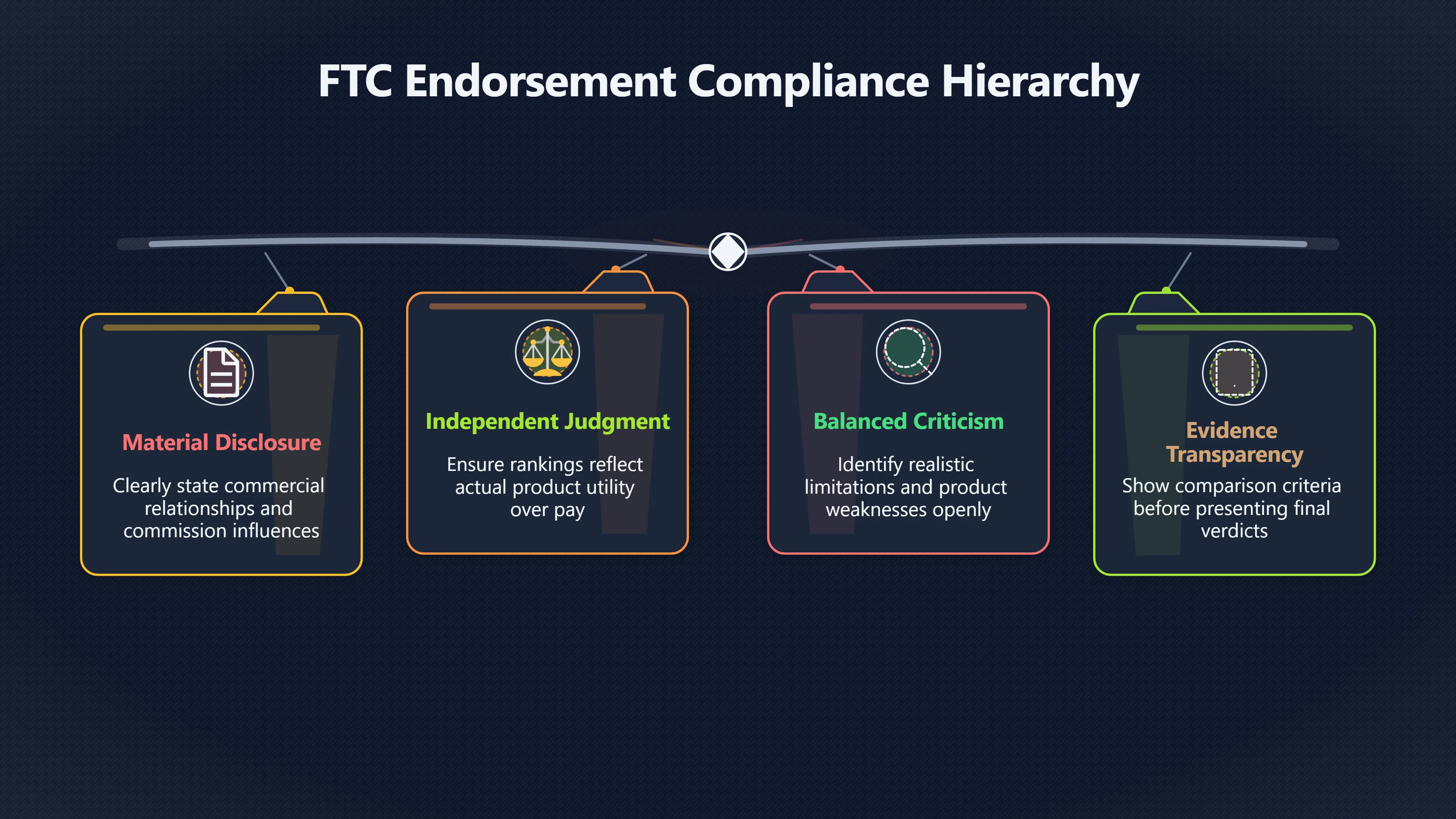
 The problem begins when publishers present a universal winner without showing how they reached that judgement. Readers increasingly recognise affiliate business models, and regulators expect commercial influence to be disclosed rather than hidden. A comparison page that explains why one product is the best default choice, while openly identifying where competitors outperform it, is more persuasive than one that claims every visitor should buy the same product.[Federal Trade Commission]ftc.govFederal Trade CommissionEndorsements, Influencers, and ReviewsFTC's Endorsement Guides: This brochure from FTC staff gives tips on when a…
When does a “Best Overall” label actually help?
A useful best-overall recommendation answers a practical question:
“If most readers arrived with no unusual requirements, which option would satisfy the greatest number of them with the fewest compromises?”
That is a narrower claim than saying a product is objectively the best.
For example, a web hosting provider might earn “Best Overall” because it combines competitive pricing, dependable uptime, straightforward setup, responsive customer support, and enough performance for most small websites. Another provider may offer faster enterprise infrastructure or lower introductory prices, but those strengths serve narrower audiences.
The label therefore reflects balance rather than dominance.
Readers generally understand that products involve trade-offs. What undermines trust is pretending those trade-offs do not exist.
What a best-overall label should prove
A convincing recommendation should demonstrate visible reasoning instead of relying on adjectives such as “ultimate”, “perfect”, or “number one”.
A credible explanation normally shows that the recommended option performs consistently well across the factors that matter most, including:
- Value over the full ownership period rather than only the introductory price.
- Features that cover the needs of typical buyers.
- Good usability for newcomers.
- Reliable customer support.
- Strong reputation for stability and customer satisfaction.
- Few major weaknesses compared with close competitors.
The page does not need a mathematical scoring formula, but readers should be able to understand why the recommendation emerged.
If the explanation could be removed without changing the ranking, the ranking probably lacks enough justification.
Separate universal strengths from buyer fit
The easiest way to avoid misleading readers is to distinguish between general strengths and specific suitability.
Instead of writing:
“Product A is the best.”
A comparison page becomes more trustworthy when it explains:
- Best Overall – the strongest balance for most readers.
- Best Budget Option – lowest cost with acceptable compromises.
- Best Premium Choice – highest performance for larger budgets.
- Best for Beginners – easiest to learn.
- Best for Power Users – advanced capabilities despite greater complexity.
This approach recognises that buying decisions depend on circumstances rather than absolutes.
It also prevents the common affiliate mistake of forcing every recommendation towards the highest-paying merchant. Readers who quickly recognise that they belong to a different category are more likely to trust recommendations throughout the rest of the page.
Explain why competitors did not win
A “Best Overall” recommendation becomes substantially more believable when competing products receive genuine credit.
For example:
- A cheaper option may lose because renewal pricing becomes expensive after the first year.
- A feature-rich alternative may require technical expertise that most readers do not have.
- A premium service may outperform the winner but cost twice as much.
- A newcomer may offer attractive pricing but lack an established support record.
Acknowledging these strengths reduces the appearance that rankings exist solely to promote one affiliate partner.
Ironically, explaining why a competitor is excellent for some buyers often strengthens confidence in the overall recommendation because it demonstrates independent judgement.
Common ranking claims that weaken trust
Several patterns make “Best Overall” labels appear promotional rather than editorial.
Declaring every product “best”
Many affiliate pages award nearly every product a winning badge:
- Best Overall
- Editor’s Choice
- Top Pick
- Recommended
- Number One
- Most Popular
- Best Value
If every option appears to be the winner, the labels lose meaning.
Readers quickly recognise this inflation and may stop treating the rankings as genuine comparisons.
Ignoring obvious weaknesses
No product is perfect.
When a review mentions only advantages, experienced readers often assume important disadvantages have been omitted.
A balanced recommendation should identify at least a few realistic limitations, even if they are relatively minor for the target audience.
Ranking by commission instead of usefulness
The greatest credibility risk occurs when affiliate commissions appear to influence rankings.
Consumer protection authorities have repeatedly stressed that material commercial relationships should be disclosed clearly and that endorsements must not mislead consumers about their independence. Simply publishing an affiliate disclosure does not justify recommendations that are presented as impartial if commercial incentives materially shape the rankings.[Federal Trade Commission+2Federal Trade Commission]ftc.govFederal Trade CommissionEndorsements, Influencers, and ReviewsFTC's Endorsement Guides: This brochure from FTC staff gives tips on when a…
Readers may never know the commission structure, but they often notice indirect signals such as:
- consistently placing one merchant first regardless of comparison topic;
- avoiding products without affiliate programmes even when they are competitive;
- giving minimal criticism to the highest-paying brands; or
- changing rankings without explaining why.
These patterns erode confidence far more quickly than openly acknowledging affiliate relationships.
Show the reasoning before the recommendation
One effective structure is to let readers see the evidence before they reach the final verdict.
Rather than beginning with “This is the best product,” consider leading readers through:
- The comparison criteria.
- The meaningful differences.
- The trade-offs.
- The final recommendation.
This mirrors how buyers naturally make decisions.
Instead of asking readers to trust the publisher’s authority, it allows them to verify whether the conclusion matches the evidence presented.
Why honesty often improves affiliate performance
Some publishers worry that acknowledging limitations will reduce conversions.
In practice, realistic criticism often increases confidence because readers know they are unlikely to find a flawless product. A recommendation that openly states who should not buy the top-ranked option feels more independent than one that attempts to persuade everyone.
For affiliate websites, trust compounds over time. Readers who believe rankings are based on genuine buyer fit are more likely to return for future comparisons, recommend the site to others, and treat affiliate links as useful guidance rather than disguised advertising.
A “Best Overall” label therefore works best when it is presented as a carefully justified default recommendation—not as a universal truth. The recommendation earns credibility by making its reasoning visible, separating broad appeal from individual needs, and showing enough balance that readers can see the ranking was designed to help them choose, not simply to maximise affiliate revenue.
Amazon book picks
Further Reading
Books and field guides related to When Is Best Overall Actually Useful?. Use these as the next step if you want deeper reading beyond the article.
Everybody Writes
Supports writing transparent, reader-focused comparison content that builds trust.
Building a StoryBrand 2.0
Helps publishers communicate product recommendations clearly instead of relying on vague 'best overall' claims.
The Copywriter's Handbook
Rating: 4.0/5 from 5 Google Books ratings
Covers persuasive yet credible product evaluation and recommendation techniques.
Influence: The Psychology of Persuasion
Explains how trustworthy recommendations and credible decision-making influence buyer behaviour.
eBay marketplace picks
Marketplace Samples
Live-tested eBay searches with available results related to this page.

Endnotes
Source snippet
Federal Trade CommissionEndorsements, Influencers, and ReviewsFTC's Endorsement Guides: This brochure from FTC staff gives tips on when a...
2.
Source: ftc.gov
Title: s endorsement guides what people are asking
Source snippet
Federal Trade CommissionFTC's Endorsement Guides: What People Are Asking29 Jun 2023 — Here are answers to some of the most frequently ask...
Additional References
3.
Source: researchgate.net
Link:https://www.researchgate.net/publication/373735682_Social_Media_and_the_Mediating_Role_of_Perceived_Authenticity_in_Covert_Celebrity_Endorsement_Influencing_Factors
Source snippet
(PDF) Social Media and the Mediating Role of Perceived...7 Sept 2023 — This thesis analyses the factors that influence the celebrity end...
4.
Source: bakerbotts.com
Link:https://www.bakerbotts.com/thought-leadership/publications/2023/december/ftc-new-guidelines-for-endorsements-and-testimonials
Source snippet
Advertising Update: The FTC's New Guidelines for...The FTC's new Guides are intended to protect consumers and businesses alike from dece...
5.
Source: facebook.com
Link:https://www.facebook.com/exchange4media/posts/ccpa-action-on-100-claims-revives-debate-over-criminal-liability-for-deceptive-a/1043352211577646/
Source snippet
CCPA action on '100%' claims revives debate over criminal...The FTC has put the digital marketing world on notice that the use of fake r...
6.
Source: cris.maastrichtuniversity.nl
Link:https://cris.maastrichtuniversity.nl/ws/portalfiles/portal/225628423/c8496.pdf
Source snippet
Arms for Digital Consumer HarmsPlease check the document version of this publication: • A submitted manuscript is the version of the arti...
7.
Source: business.cch.com
Title: The FTCs Endorsement Guides What People Are Asking Federal Trade Commission
Link:https://business.cch.com/ald/TheFTCsEndorsementGuides_WhatPeopleAreAsking_FederalTradeCommission.pdf
Source snippet
FTC's Endorsement Guides: What People Are AskingThe FTC conducts investigations and brings cases involving endorsements made on behalf of...
8.
Source: youtube.com
Title: How To Make An Affiliate Marketing Website | [Traffic]({{ ‘traffic/’ | relative_url }}) Basics That Work
Link:https://www.youtube.com/watch?v=B6wcYhLk44o
Source snippet
How to rank products honestly affiliate marketing Iman Gadzhi make $40,000/month from Affiliate Marketing Iman Gadzhi Motivation...
9.
Source: lawyerlessdocs.com
Title: Do You Need an Affiliate Disclosure?
Link:https://lawyerlessdocs.com/blog/news/do-you-need-an-affiliate-disclosure-what-the-ftc-actually-requires-and-what-a-footer-link-doesn-t-cover
Source snippet
What the FTC Actually...2 days ago — The FTC considers commission-influenced rankings deceptive if that influence isn't itself disclosed...
10.
Source: youtube.com
Link:https://www.youtube.com/watch?v=FHufhlV2sLw
Source snippet
How to Make an Affiliate Marketing Website | Passive Income Blueprint 2026...
11.
Source: youtube.com
Link:https://www.youtube.com/watch?v=HkYQ6qc56hI
Source snippet
Make An Affiliate Marketing Website 2025 ~ A Passive Income For Beginners Tutorial...
12.
Source: youtube.com
Link:https://www.youtube.com/watch?v=gO9Drf_Dg1Q
Source snippet
How To Make An Affiliate Marketing Website | Traffic Basics That Work...
Topic Tree