Within Do Not Buy
Why Honest Warnings Beat Fake Praise
Regulators target fake and misleading reviews, so visible bad-fit advice can help affiliate pages look more independent.
On this page
- What regulators say about fake reviews
- Why disclosure is not enough on its own
- How warnings support independent judgement
Page outline Jump by section
Introduction
Affiliate websites earn trust when they help readers avoid unsuitable purchases rather than pushing every visitor towards a sale. That editorial approach is increasingly aligned with how regulators view online reviews. In both the United States and the United Kingdom, enforcement has moved beyond hidden affiliate links to focus on fake reviews, manipulated ratings, undisclosed incentives and practices that distort consumer judgement. Simply adding an affiliate disclosure does not excuse misleading review practices. Instead, regulators expect reviews and recommendations to reflect genuine, independent assessments that help consumers make informed decisions. For affiliate publishers, visible “who should not buy this” guidance can therefore support credibility because it demonstrates balanced judgement rather than one-sided promotion.
Why Honest Warnings Beat Fake Praise
Trust warnings are valuable because they encourage readers to think about whether a product genuinely fits their needs instead of assuming that every featured item deserves a recommendation.
This matters because both the US Federal Trade Commission (FTC) and the UK’s Competition and Markets Authority (CMA) increasingly target practices that artificially inflate consumer confidence. Those practices include fake testimonials, concealed paid reviews, misleading star ratings and suppressing genuine negative experiences. The common principle is straightforward: consumers should not be misled into believing that praise represents independent customer opinion when it does not.[GOV.UK]GOV.UKfake reviews4 Apr 2025 — How businesses should comply with consumer protection law on consumer reviews…
A practical “not recommended if…” section supports that principle by showing that the reviewer has considered limitations, trade-offs and unsuitable use cases rather than presenting universal approval.
What Regulators Say About Fake Reviews
The FTC’s approach
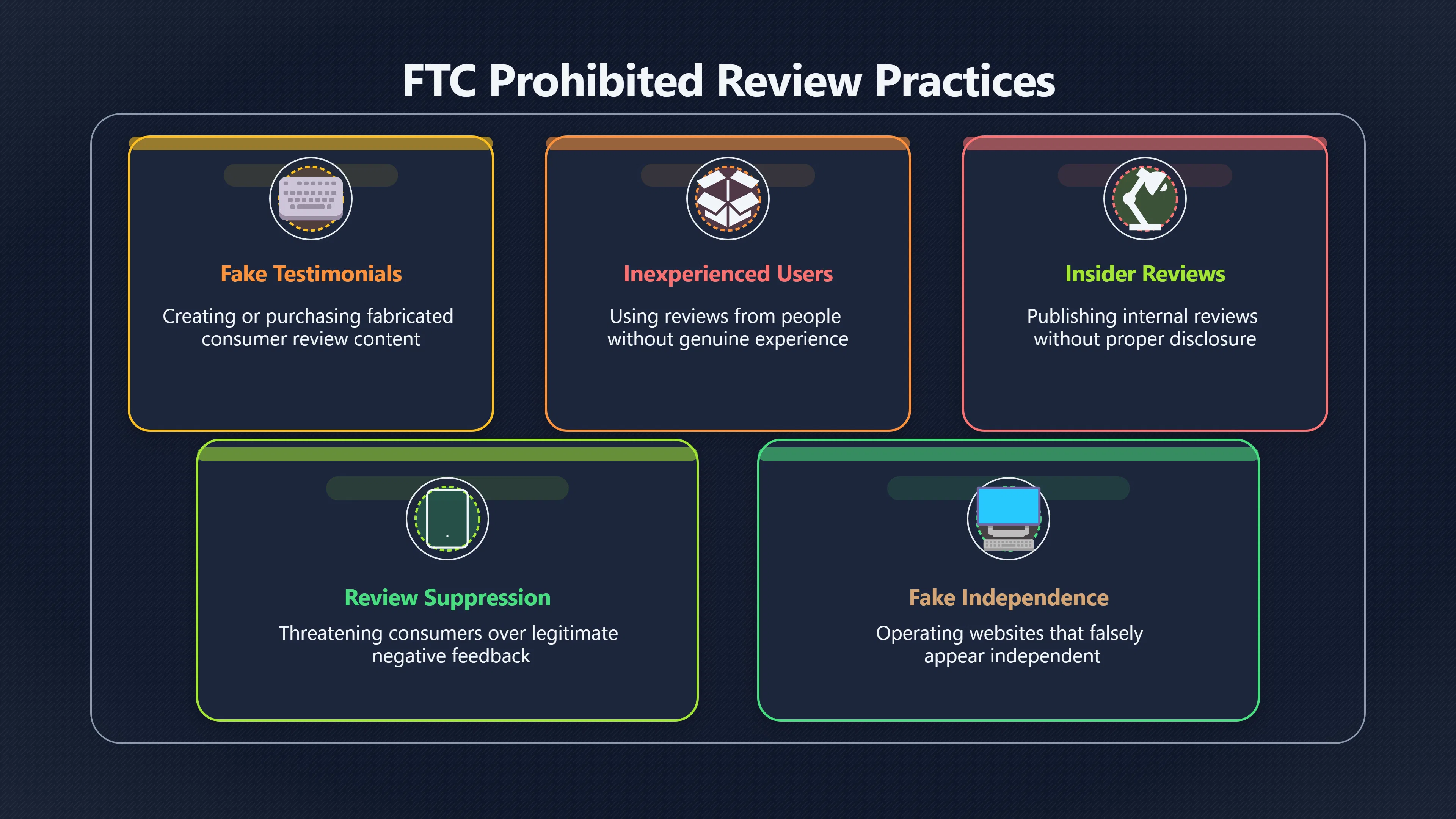
The FTC has long required endorsements to reflect honest opinions and genuine experiences, while material relationships between reviewers and advertisers must be clearly disclosed. More recently, the FTC strengthened its position through its Rule on Fake Reviews and Testimonials, which prohibits practices including:
- creating or purchasing fake consumer reviews;[assets.publishing.service.gov.uk]assets.publishing.service.gov.ukGOV.UKCMA208 - Fake reviews guidance4 Apr 2025 — It covers fake reviews, concealed incentivised reviews and requires traders not to publi…
- using reviews from people without genuine experience;
- publishing insider reviews without proper disclosure;
- suppressing or threatening consumers over legitimate negative reviews;
- operating review websites that falsely appear independent.
The rule recognises that deceptive reviews distort purchasing decisions regardless of whether affiliate commissions are disclosed. A page filled with exaggerated praise or fabricated testimonials remains misleading even if an affiliate disclosure appears at the top of the article.[The Verge]theverge.comScheduled to take effect this fall, this rule allows the FTC to take legal action against companies that violate the new guidelines. The…
The CMA’s approach
The CMA has adopted a similarly broad view. Under the UK’s newer consumer protection framework, fake reviews, concealed incentivised reviews and misleading presentation of review information are treated as prohibited commercial practices.
Its guidance makes clear that businesses should not:
- publish fake consumer reviews;[GOV.UK]GOV.UKfake reviews4 Apr 2025 — How businesses should comply with consumer protection law on consumer reviews…
- hide that reviewers received incentives;
- remove or suppress genuine negative reviews in a misleading way;
- manipulate aggregate ratings so they no longer represent genuine customer opinion.
The CMA also expects businesses that publish reviews to have reasonable procedures for detecting and preventing fake review activity rather than simply reacting after problems emerge.[GOV.UK]assets.publishing.service.gov.ukGOV.UKCMA208 - Fake reviews guidance4 Apr 2025 — It covers fake reviews, concealed incentivised reviews and requires traders not to publi…
For affiliate publishers, this reinforces the importance of presenting balanced product evaluations rather than selectively highlighting only favourable evidence.

Why Disclosure Is Not Enough on Its Own
Affiliate marketers sometimes assume that a prominent statement such as “This page contains affiliate links” solves regulatory concerns. It does not.
Disclosure addresses one question: whether readers understand the financial relationship between the publisher and the merchant.
Review integrity addresses another: whether the recommendation itself accurately represents genuine judgement.
A page can fully disclose affiliate commissions yet still become misleading if it:
- ignores obvious product limitations;
- presents advertising claims as established facts;
- exaggerates benefits without evidence;
- recommends every product to every reader regardless of suitability;
- hides meaningful drawbacks that would influence a purchasing decision.
Both the FTC and CMA distinguish between transparency about commercial relationships and honesty about the underlying recommendation. One does not replace the other.[GOV.UK]assets.publishing.service.gov.ukGOV.UKCMA208 - Fake reviews guidance4 Apr 2025 — It covers fake reviews, concealed incentivised reviews and requires traders not to publi…
How Warnings Support Independent Judgement
A visible “Who should not buy this” section helps demonstrate editorial independence because it asks a different question from sales copy.
Instead of asking, “How do I persuade someone to buy?”, it asks, “Under what circumstances would this be the wrong purchase?”
That shift naturally produces content regulators generally want consumers to receive:
- clear limitations rather than blanket approval;
- realistic expectations instead of exaggerated claims;
- alternative products where appropriate;
- explanations tied to specific use cases rather than vague praise.
For example, saying that a premium camera is unsuitable for someone who only wants casual holiday photographs shows an assessment based on user needs rather than commission value. Likewise, explaining that a budget software subscription lacks features required by professional users helps readers avoid poor purchasing decisions.
These warnings become even more credible when supported by testing, specifications, pricing comparisons or verified user experience instead of generic opinion.
Practical Editorial Habits That Reduce Regulatory Risk
For affiliate review sites, trust warnings work best when they form part of a broader editorial process rather than appearing as token disclaimers.
Useful practices include:
- matching recommendations to clearly defined user types;
- explaining both strengths and weaknesses with equal specificity;
- distinguishing verified testing from manufacturer claims;
- identifying situations where competitors provide a better fit;
- avoiding manipulated review scores or selective quotation of customer feedback;
- making affiliate disclosures clear without treating them as a substitute for balanced analysis.
These habits improve both reader confidence and regulatory resilience because they show that recommendations are intended to inform purchasing decisions rather than simply maximise conversions.
Trust Is Built Through Balanced Advice
Regulators increasingly judge review practices by their effect on consumer decision-making, not merely by whether commercial relationships have been disclosed. The FTC’s action against deceptive testimonials and the CMA’s crackdown on fake and misleading reviews both reflect the same underlying expectation: recommendations should help consumers make informed choices rather than artificially steering them towards a purchase. For affiliate websites, openly identifying who should avoid a product is therefore more than good editorial practice. It demonstrates independent judgement, reduces the appearance of promotional bias and strengthens the credibility on which long-term affiliate businesses depend.[GOV.UK+2GOV.UK]assets.publishing.service.gov.ukGOV.UKCMA208 - Fake reviews guidance4 Apr 2025 — It covers fake reviews, concealed incentivised reviews and requires traders not to publi…
Amazon book picks
Further Reading
Books and field guides related to Why Honest Warnings Beat Fake Praise. Use these as the next step if you want deeper reading beyond the article.
The (Honest) Truth about Dishonesty
Explores why people rationalize misleading behavior, complementing discussion of fake reviews and consumer trust.
The Checklist Manifesto
Supports systematic, balanced evaluation methods that align with structured, trustworthy product reviews.
Trust Me, I'm Lying
Examines manipulation in modern media, reinforcing the importance of authentic reviews and transparency.
eBay marketplace picks
Marketplace Samples
Live-tested eBay searches with available results related to this page.
Endnotes
1.
Source: GOV.UK
Title: fake reviews
Link:https://www.gov.uk/government/publications/fake-reviews
Source snippet
4 Apr 2025 — How businesses should comply with consumer protection law on consumer reviews...
2.
Source: assets.publishing.service.gov.uk
Link:https://assets.publishing.service.gov.uk/media/67eeb64fe9c76fa33048c790/CMA208_-_Fake_reviews_guidance.pdf
Source snippet
GOV.UKCMA208 - Fake reviews guidance4 Apr 2025 — It covers fake reviews, concealed incentivised reviews and requires traders not to publi...
3.
Source: GOV.UK
Link:https://www.gov.uk/government/publications/reviews-and-social-media-endorsements-guidance-for-businesses-and-brands/reviews-guidance-for-businesses-and-agencies
Source snippet
www.gov.ukReviews: guidance for businesses and agencies28 Aug 2025 — Writing or commissioning fake reviews could lead to a substantial pe...
4.
Source: GOV.UK
Title: fake and misleading reviews 5 businesses under cma investigation
Link:https://www.gov.uk/government/news/fake-and-misleading-reviews-5-businesses-under-cma-investigation
Source snippet
and misleading reviews: 5 businesses under CMA...27 Mar 2026 — Fake and misleading reviews: 5 businesses under CMA investigation · Five...
5.
Source: GOV.UK
Title: online consumer reviews
Link:https://www.gov.uk/cma-cases/online-consumer-reviews
Source snippet
consumer reviews25 Jul 2025 — It is writing to those 54 firms highlighting that businesses must have measures in place to prevent fake re...
6.
Source: theverge.com
Link:https://www.theverge.com/2024/8/14/24220536/ftc-fake-review-rule-ai-generated
Source snippet
Scheduled to take effect this fall, this rule allows the FTC to take legal action against companies that violate the new guidelines. The...
Additional References
7.
Source: businesscompanion.info
Link:https://www.businesscompanion.info/en/quick-guides/fair-trading/reviews-and-endorsements
Source snippet
Reviews and endorsementsThe practice listed in paragraph 13 of Schedule 20 concerns fake consumer reviews and consumer reviews that do no...
8.
Source: uk.practicallaw.thomsonreuters.com
Link:https://uk.practicallaw.thomsonreuters.com/w-046-5309?contextData=%28sc.Default%29&transitionType=Default
Source snippet
on fake and misleading consumer reviewsThis note examines the prohibition on publishing consumer review information in a misleading way a...
9.
Source: traverssmith.com
Title: fake or misleading consumer reviews times running out to put your house in order
Link:https://www.traverssmith.com/knowledge/knowledge-container/fake-or-misleading-consumer-reviews-times-running-out-to-put-your-house-in-order/
Source snippet
Fake or misleading consumer reviews: time's running out to...8 Jul 2025 — The new rules on fake and misleading reviews came into force o...
10.
Source: pmc.ncbi.nlm.nih.gov
Title: Among other actions, the CMA urged Facebook and e Bay to act
Link:https://pmc.ncbi.nlm.nih.gov/articles/PMC8294234/
Source snippet
reviews on online platforms: perspectives from the US...by JMM Otero · 2021 · Cited by 42 — In June 2019, the CMA launched a work progra...
Published: June 2019
11.
Source: aoshearman.com
Title: cma targets fake online reviews in expanding consumer enforcement programme
Link:https://www.aoshearman.com/en/insights/cma-targets-fake-online-reviews-in-expanding-consumer-enforcement-programme
Source snippet
CMA targets fake online reviews in expanding consumer...31 Mar 2026 — The UK Competition and Markets Authority (CMA) has opened five con...
12.
Source: keystonelaw.com
Title: what does the cma crackdown on fake online reviews mean for businesses
Link:https://keystonelaw.com/keynotes/what-does-the-cma-crackdown-on-fake-online-reviews-mean-for-businesses/
Source snippet
What does the CMA crackdown on fake online reviews...1 Jul 2025 — New law gives the Competition and Markets Authority (CMA) direct power...
13.
Source: hsfkramer.com
Title: cma launches first investigations into fake and misleading reviews
Link:https://www.hsfkramer.com/notes/crt/2026-03/cma-launches-first-investigations-into-fake-and-misleading-reviews
Source snippet
CMA launches first investigations into fake and misleading...27 Mar 2026 — The CMA has today launched five new consumer law investigatio...
14.
Source: scl.org
Title: cma issues guidance on reviews and social media endorsements
Link:https://www.scl.org/cma-issues-guidance-on-reviews-and-social-media-endorsements/
Source snippet
CMA issues guidance on reviews and social media...23 Sept 2025 — In addition, the CMA has issued further updated guidance on fake review...
15.
Source: osborneclarke.com
Title: cma puts fake reviews and endorsements uk under spotlight
Link:https://www.osborneclarke.com/insights/cma-puts-fake-reviews-and-endorsements-uk-under-spotlight
Source snippet
CMA puts fake reviews and endorsements in UK under...18 Sept 2025 — Regulator issues businesses with further guidance on fake reviews, h...
16.
Source: emlaw.co.uk
Title: cma begins to crack down on fake website reviews
Link:https://emlaw.co.uk/cma-begins-to-crack-down-on-fake-website-reviews/
Source snippet
The DMCCA makes it unlawful for businesses to create, solicit, or display fake reviews, or to mislead consumers...Read more...
Topic Tree