Within Reviews
Why Review Criteria Must Fit the Buyer
A trusted ranking explains why each criterion matters for a specific buyer, not just which product scored highest.
On this page
- Universal criteria versus use case criteria
- How vague best overall labels mislead
- Turning criteria into buying decisions
Page outline Jump by section
Introduction
Readers do not visit a product review site simply to discover which product came first. They visit because they want to know which product is right for their budget, experience level, priorities and risks. A review that ranks products without explaining the criteria behind the ranking forces readers to guess whether the recommendation matches their own situation.
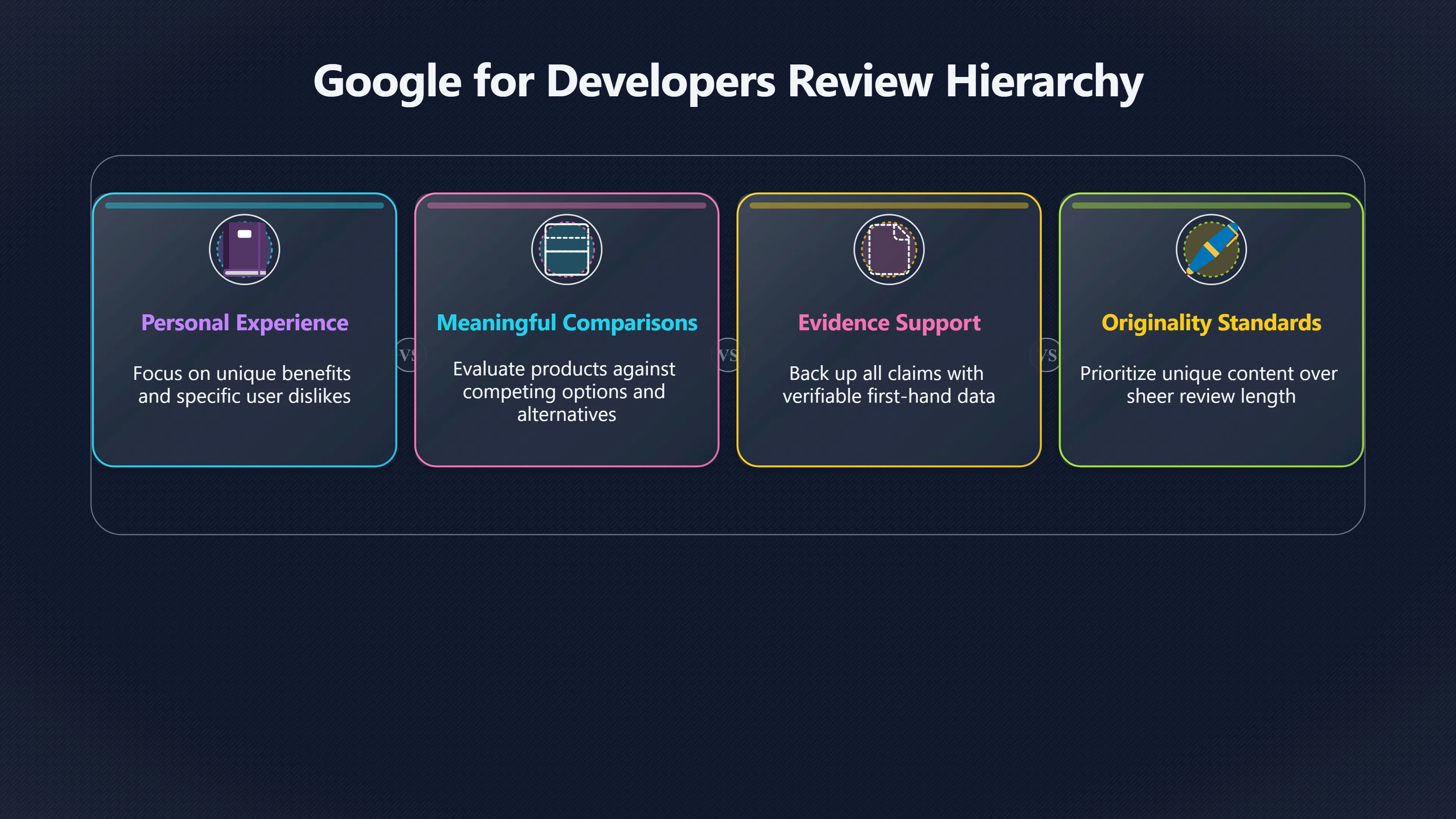
 For affiliate websites, this distinction is critical. Trust grows when review criteria are tied to genuine buyer scenarios rather than a generic score. Google explicitly recommends explaining why a product is “best” for a particular purpose, supporting recommendations with first-hand evidence and evaluating products from the user’s perspective rather than relying on manufacturer claims.[Google for Developers]developers.google.comGoogle for DevelopersWrite high quality reviewsWhen writing reviews, focus on the quality and originality of your reviews, not the length…
Universal criteria versus use-case criteria
Every review should separate qualities that matter to almost everyone from qualities that only matter to certain buyers.
Universal criteria answer questions that nearly every purchaser asks:
- Reliability and build quality.
- Value for money.
- Ease of use.
- Safety or security where relevant.
- Customer support and warranty.
- Long-term ownership costs.
These create a common baseline for comparing products.
Use-case criteria recognise that different buyers solve different problems. The same product can be excellent for one audience and poor for another.
For example:
Product categoryUniversal criteriaUse-case criteriaLaptopBattery life, display quality, reliabilityGaming performance, programming workflow, portability for travel, video editing speedCoffee machineBuild quality, ease of cleaningEspresso quality, milk frothing, office use, occasional home useRunning shoesComfort, durabilityMarathon training, trail running, racing, beginners with limited mileageVPNSecurity, privacy policyStreaming access, gaming latency, business travel, family devices
Instead of declaring one laptop as “best overall”, a trusted review explains why one model suits students while another is better for creative professionals despite costing more. The recommendation becomes conditional rather than absolute.
This mirrors Google’s guidance that high-quality reviews should explain what makes a product appropriate for a particular purpose and how it differs from competing options.[Google for Developers]developers.google.comGoogle for DevelopersWrite high quality reviewsWhen writing reviews, focus on the quality and originality of your reviews, not the length…
Why vague “best overall” labels mislead
“Best overall” is often the weakest recommendation on an affiliate website because it hides the assumptions behind the verdict.
Every ranking system gives different weight to different criteria. If those weightings are invisible, readers cannot judge whether the review reflects their priorities.
Imagine two buyers shopping for cordless vacuum cleaners.
The first lives in a small flat with hard floors and values low weight above everything else.
The second owns a large house with pets and thick carpets where suction power matters far more than portability.
A review that simply crowns one model as “best overall” provides little practical help because the buyers are solving different problems. A transparent review instead explains that one machine scored highest for manoeuvrability while another delivered better deep-cleaning performance.
This approach also protects editorial credibility. Readers can disagree with a weighting while still trusting the review because they understand how the conclusion was reached.
A hidden scoring system invites suspicion that commercial factors—not buyer needs—determined the ranking.
Turn criteria into buying decisions
Good review criteria do not end with scores. They help readers recognise themselves.
One practical method is to convert each criterion into a buyer question.
Instead of evaluating “battery life”, ask:
- Will this last through a full working day?
- Does frequent travel make charging inconvenient?
- Would carrying a heavier charger matter?
Instead of scoring “ease of use”, ask:
- Is this suitable for complete beginners?
- Does setup require technical knowledge?
- How quickly could someone become productive?
Instead of listing “price”, distinguish between:
- Initial purchase cost.
- Running costs.
- Expected lifespan.
- Repair costs.
- Upgrade potential.
- Total cost of ownership.
These questions transform technical specifications into practical decisions.
Rather than saying:
Battery: 9.4/10
A more useful explanation is:
This battery comfortably lasts a full university day without charging, making it ideal for students. Office workers who remain near power sockets are unlikely to notice much advantage over cheaper alternatives.
The score now has context.
Weight criteria differently for different buyers
No review framework should pretend every buyer values every criterion equally.
A trusted affiliate site can make this explicit by presenting multiple recommendation paths instead of forcing every reader into one ranking.
For example:
- Best budget choice prioritises affordability while accepting reasonable compromises.
- Best long-term investment rewards durability, repairability and lower lifetime cost.
- Best for beginners values simplicity over advanced features.
- Best performance gives greater weight to speed or capability regardless of price.
- Best for frequent travellers prioritises portability, weight and battery life.
Each recommendation uses the same evidence but applies different priorities.
Readers rarely object when products receive different recommendations for different audiences. They object when a review pretends one answer fits everyone.
Explain why each criterion matters
Many reviews mention evaluation categories without explaining why buyers should care.
A stronger review connects every criterion to a real consequence.
For example:
- Repairability affects ownership costs after the warranty expires.
- Software support determines how long devices remain secure and compatible.
- Noise levels matter more in shared homes than detached workshops.
- Energy efficiency has greater financial impact on appliances used every day.
- Weight matters little for desktop equipment but becomes crucial for travel gear.
Once readers understand the consequence, they can decide whether that criterion deserves high priority in their own purchase.
This also prevents unnecessary emphasis on fashionable specifications that have little effect on everyday ownership.

Show trade-offs instead of searching for perfection
Real buying decisions involve compromise.
A trustworthy review acknowledges that improving one attribute often weakens another.
Examples include:
- Better battery life may increase weight.
- Maximum performance may reduce battery endurance.
- Premium materials often increase price.
- Compact size can reduce repairability.
- Advanced features may create a steeper learning curve.
Presenting these trade-offs makes recommendations more believable than attempting to identify a universally superior product.
Readers generally accept compromise when they understand why it exists.
Make the scoring system understandable
Complex scoring models can appear scientific while remaining impossible for readers to interpret.
Instead of publishing a single overall score, explain:
- which criteria were measured;
- how each criterion influenced the final recommendation;
- whether any factors were considered essential rather than optional;
- where subjective judgement entered the assessment.
For example:
- Performance: 35%
- Ease of use: 20%
- Value: 20%
- Reliability: 15%
- Features: 10%
Even if readers disagree with the weighting, they can understand how the conclusion was reached.
That transparency reduces the appearance that affiliate commissions determined the rankings.
Align recommendations with editorial trust
Affiliate reviews inevitably create a commercial relationship between publisher and retailer. Regulatory guidance therefore emphasises that readers should understand when recommendations may involve compensation, while Google encourages review content that demonstrates genuine experience, meaningful comparisons and evidence supporting recommendations rather than unsupported rankings.[Federal Trade Commission]ftc.govs endorsement guides what people are askingFederal Trade CommissionFTC's Endorsement Guides: What People Are AskingSeptember 7, 2017 — 29 Jun 2023 — The Guides are intended to give…
Review criteria become part of that trust signal.
A site that consistently explains:
- who each recommendation is for,
- who should avoid it,
- which trade-offs influenced the ranking,
- and why different buyers receive different recommendations,
behaves more like an independent adviser than a catalogue arranged around commission rates.
For readers, that makes purchasing decisions easier. For affiliate publishers, it creates reviews that remain useful even when products change, because the decision framework—not merely the rankings—continues to help buyers choose the product that genuinely fits their own needs.
Amazon book picks
Further Reading
Books and field guides related to Why Review Criteria Must Fit the Buyer. Use these as the next step if you want deeper reading beyond the article.
Everybody Writes
Helps create trustworthy, reader-focused content that clearly explains recommendations and buying decisions.
Don't Make Me Think, Revisited
Reinforces designing information and recommendations around user goals and real-world decision making.
Buyer Personas
Focuses on understanding different buyer segments, directly supporting use-case-based review criteria.
Influence: The Psychology of Persuasion
Explains how buyers evaluate choices, helping reviewers align criteria with real purchasing behavior.
eBay marketplace picks
Marketplace Samples
Example marketplace items related to this page. Use the search link to explore similar finds on eBay.


Endnotes
1.
Source: developers.google.com
Link:https://developers.google.com/search/docs/specialty/ecommerce/write-high-quality-reviews
Source snippet
Google for DevelopersWrite high quality reviewsWhen writing reviews, focus on the quality and originality of your reviews, not the length...
2.
Source: ftc.gov
Title: s endorsement guides what people are asking
Source snippet
Federal Trade CommissionFTC's Endorsement Guides: What People Are AskingSeptember 7, 2017 — 29 Jun 2023 — The Guides are intended to give...
Published: September 7, 2017
3.
Source: support.google.com
Link:https://support.google.com/product-documentation/answer/10115141?hl=en
Source snippet
Store review guidelinesFocus on what you liked or disliked about a product and your own experience using it. Don't include inappropriate...
Additional References
4.
Source: everything-pr.com
Title: Review platforms — [Amazon]({{ ‘amazon/’ | relative_url }}), Google, Yelp — fall
Link:https://everything-pr.com/ftc-influencer-disclosure-rules-2026-complete-guide
Source snippet
FTC Disclosure Rules 2026: What Brands & Creators Must KnowThe guidelines added explicit guidance prohibiting the creation, buying, or su...
5.
Source: susodigital.com
Title: How to Write Product Reviews: The Google Way
Link:https://susodigital.com/thoughts/how-to-write-product-reviews-the-google-way/
Source snippet
SUSO Digital28 Mar 2023 — Learn how to fine-tune your content and make sure that your product reviews are in line with Google's guidelines...
6.
Source: yotpo.com
Title: collect product reviews strategies
Link:https://www.yotpo.com/blog/collect-product-reviews-strategies/
Source snippet
7 Best Strategies To Collect Product Reviews (2026)15 Jan 2026 — Learn how to collect product reviews on autopilot. Discover 7 strategies...
7.
Source: blog.google
Title: more helpful product reviews
Link:https://blog.google/products-and-platforms/products/search/more-helpful-product-reviews/
Source snippet
on Search23 Mar 2022 — product reviews in Search meet certain criteria, such as: Include helpful in-depth details, like the benefits or d...
8.
Source: yuko.so
Title: google reviews policy
Link:https://yuko.so/blog/google-reviews-policy/
Source snippet
Explained: Do's and Don'ts26 Nov 2025 — The Google review guidelines cover multiple aspects of the review process, including what content...
9.
Source: youtube.com
Title: How to Write Amazon Product Reviews for Affiliate Websites Using Aff Pilot AI
Link:https://www.youtube.com/watch?v=zmMS1MguzJU
Source snippet
You're Using AI WRONG — Here's How I Actually Make Money With It...
10.
Source: digistore24.com
Link:https://www.digistore24.com/en/blog/affiliate-marketing-product-reviews/
Source snippet
How to Write Product Reviews for Affiliate Marketing25 Feb 2026 — Product reviews are usually an in-depth review of one product, or a lis...
11.
Source: youtube.com
Title: How to Make Money Reviewing Products on Amazon
Link:https://www.youtube.com/watch?v=29OqJH72Zck
Source snippet
How to Write Amazon Product Reviews for Affiliate Websites Using AffPilot AI...
12.
Source: youtube.com
Title: How to Write Product Reviews Using This Easy Template
Link:https://www.youtube.com/watch?v=j3TYZnykrkQ
Source snippet
Google AI Overviews vs Affiliate Review Websites...
13.
Source: youtube.com
Title: Google AI Overviews vs Affiliate Review Websites!
Link:https://www.youtube.com/watch?v=5s3XMI7fs7c
Source snippet
How to Make Money Reviewing Products on Amazon...
Topic Tree