Within Testing
When a Good Product Is the Wrong Buy
A review becomes more trustworthy when it clearly explains which readers should choose a cheaper, larger, tougher, or simpler alternative.
On this page
- Why exclusions make affiliate recommendations more credible
- How to define buyer fit by space, skill, budget, and workload
- Examples of honest not for you verdicts
Page outline Jump by section
Introduction
A trustworthy affiliate review does not simply explain why a product is good. It also explains who should not buy it. That may seem counterproductive when affiliate income depends on purchases, but it is one of the clearest signs that the recommendation is based on real use rather than a desire to maximise commissions. Google explicitly encourages reviewers to explain the benefits, drawbacks and comparisons that help buyers decide whether a product is right for them, rather than repeating marketing claims. Reviews that identify genuine limitations are more useful to readers and more consistent with high-quality product review guidance.[GOV.UK]GOV.UKCM A secures important changes from Google to tackle fakeCMA secures important changes from Google to tackle fake…January 24, 2025 — 24 Jan 2025 — Google has agreed to make significant change…
 Within a website built around affiliate links, a clear “not for you” section serves two purposes. It prevents readers from making poor purchases, reducing disappointment and returns, while also strengthening confidence that the reviewer is acting as an adviser rather than a salesperson. Readers are more likely to trust future recommendations from a site that is willing to lose an immediate commission in favour of giving accurate advice.
Why honest exclusions increase trust
Every product is designed with compromises. A lighter laptop may sacrifice battery life. A compact coffee grinder may be quieter but slower. A budget office chair may be comfortable for a few hours but unsuitable for full-time remote work.
Real testing exposes these compromises because they appear during everyday use. Including them demonstrates that the reviewer has gone beyond the manufacturer’s specifications.
For affiliate publishers, this changes the tone of the recommendation. Instead of saying:
“This is the best option.”
A more credible conclusion is:
“This is the best option if you work from home three days a week, have limited desk space and want easy assembly. If you spend ten hours a day at your desk or need extensive adjustment, you should look elsewhere.”
The second statement is more persuasive precisely because it excludes some buyers.
Define buyer fit instead of chasing universal recommendations
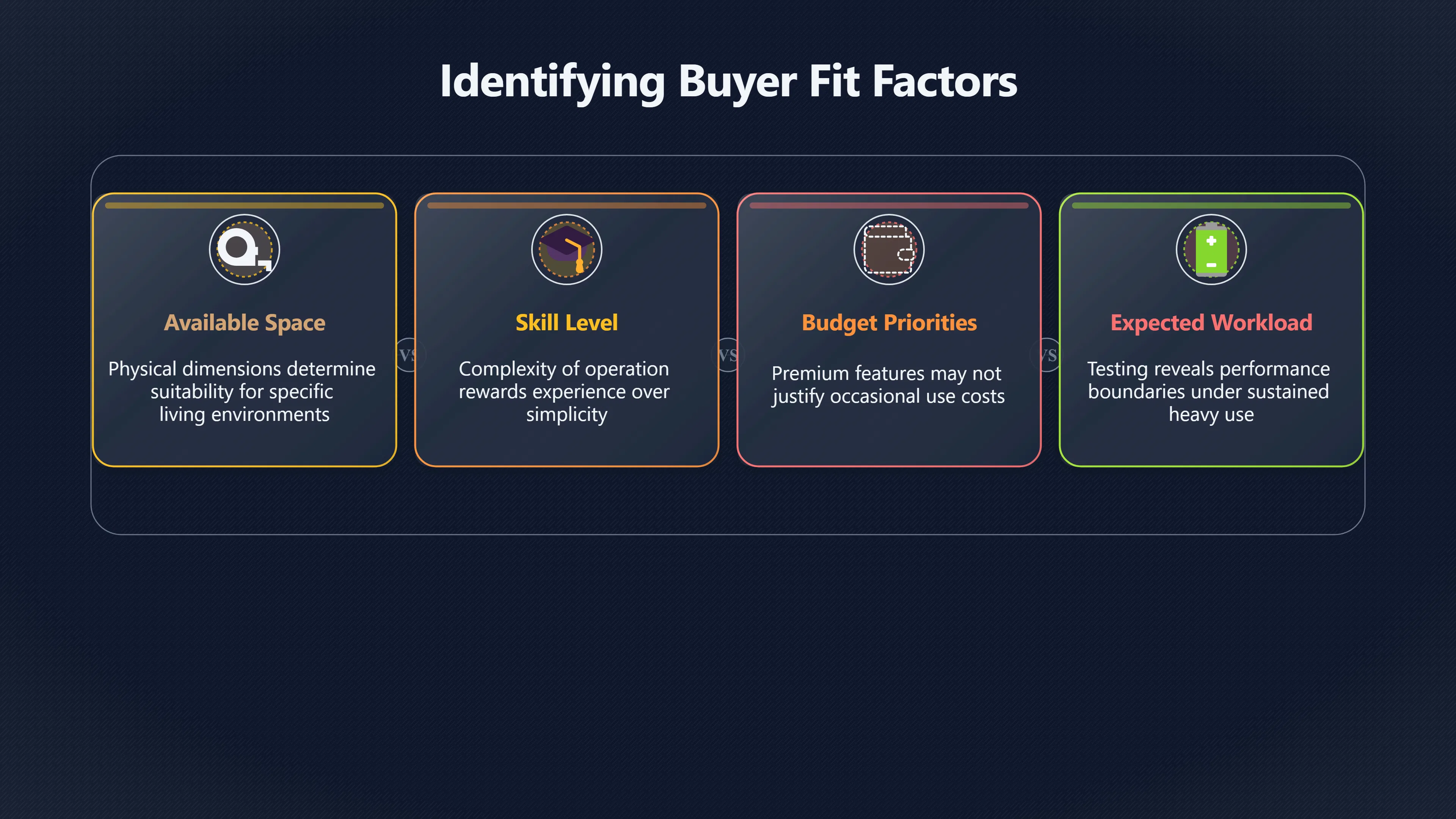
One of the biggest mistakes in affiliate reviews is assuming that a single product suits everyone. In practice, buyer fit usually depends on four practical factors.
Available space
Physical size matters more than many specifications.
A compact air fryer might be excellent for a couple living in a flat, yet frustrating for a family cooking every evening.
Likewise:
- a travel tripod may be ideal for hiking but unstable for heavier cameras
- a small toolbox suits occasional household repairs but not professional trades
- a compact standing desk converter may fit small offices while limiting larger monitor setups
Testing in realistic environments allows reviewers to explain these differences instead of treating them as minor technical details.
Skill level
Some products reward experience while others prioritise simplicity.
For example:
- advanced video editing software may offer exceptional control but overwhelm beginners
- manual espresso machines often require practice to achieve consistent results
- professional camera bodies may provide features casual photographers never use
Rather than calling these products “better”, a trustworthy review explains who can realistically benefit from the additional complexity.
Budget priorities
The highest-rated product is not always the smartest purchase.
A premium product may justify its price for heavy users but represent poor value for occasional use.
Examples include:
- professional cordless drills for someone hanging two shelves each year
- flagship smartphones for users who mainly make calls and browse the web
- expensive gaming monitors for someone playing casual strategy games
Helping readers avoid unnecessary spending increases confidence that recommendations are based on value rather than commission size.
Expected workload
Many products perform well within certain limits but disappoint when pushed beyond them.
Testing often reveals boundaries such as:
- battery performance after prolonged use
- durability under frequent transport
- storage limitations
- sustained rather than short-term performance
These practical limits are often absent from manufacturer descriptions but become obvious through first-hand use.
Use testing to identify realistic boundaries
A useful “Who should not buy this?” section should come directly from testing rather than assumption.
For example, after reviewing a backpack, a reviewer might conclude:
- not suitable if you regularly carry a 17-inch laptop
- avoid if you need waterproof protection during heavy commuting
- too small for overnight business travel
- excellent for day trips and everyday commuting
Each exclusion comes from observed use rather than speculation.
Similarly, after testing a wireless mouse:
- unsuitable for competitive gaming because of noticeable input delay
- uncomfortable for very large hands after several hours
- ideal for office productivity and travel
Readers immediately understand whether they fall inside or outside the intended audience.
Honest alternatives strengthen recommendations
The purpose of excluding buyers is not simply to criticise the recommended product. It is to guide readers towards something that better fits their needs.
Useful alternatives often fall into predictable categories:
- Cheaper alternative – for readers who need only the essential features.
- Larger alternative – for families, higher workloads or greater capacity.
- More durable alternative – for professional or outdoor use.
- Simpler alternative – for beginners who value ease of use over advanced features.
For instance:
“I recommend this compact pressure washer for patios, bicycles and garden furniture. If you clean large driveways every weekend, spend the extra money on a higher-powered model.”
This advice may reduce conversions on the featured product, but it improves long-term trust because readers recognise that the recommendation reflects their situation rather than the reviewer’s financial incentive.
Examples of credible “not for you” verdicts
Strong exclusion statements are specific, practical and measurable.
Good examples include:
- “Skip this keyboard if you need a full numeric keypad.”
- “Not suitable for runners training for marathons because the battery consistently ran flat before my longest sessions.”
- “Choose a larger air fryer if you regularly cook for more than four people.”
- “Avoid this monitor if colour accuracy is essential for professional photo editing.”
- “This vacuum cleaner is excellent on hard floors but struggles with thick pet hair on deep carpet.”
Weak examples are vague:
- “Some people may not like it.”
- “Your experience may vary.”
- “Not ideal for everyone.”
Specific limitations demonstrate observation. Generic caveats suggest the reviewer is trying to avoid making meaningful judgements.
Why saying “no” can improve affiliate income
It may seem risky to discourage purchases, but inaccurate recommendations are usually more expensive over time than honest exclusions.
Readers who feel misled are unlikely to trust future reviews. They may leave immediately, ignore future affiliate links or recommend other review sites instead.
Conversely, readers who are told that a product is not right for them often remember the honesty. They may return later when researching another purchase because they believe the site’s recommendations are based on genuine experience rather than maximising sales.
This approach also aligns with the wider direction of consumer protection and review quality. Regulators have increased scrutiny of fake, misleading and commercially manipulated reviews, while platforms and search engines increasingly reward transparent, evidence-based product content over generic promotional material.[Federal Trade Commission+2GOV.UK]ftc.govFederal Trade CommissionFederal Trade Commission Announces Final Rule Banning…August 14, 2024 — 14 Aug 2024 — The Federal Trade Commis…
For an affiliate website built on long-term authority, one of the strongest trust signals is surprisingly simple: being willing to tell readers that the recommended product is the wrong choice for them.
Amazon book picks
Further Reading
Books and field guides related to When a Good Product Is the Wrong Buy. Use these as the next step if you want deeper reading beyond the article.
Made to Stick
Supports communicating nuanced recommendations clearly, including limitations and audience fit.
Buyology: Truth and Lies About Why We Buy
Rating: 4.0/5 from 5 Google Books ratings
Provides insight into purchasing behavior, helping reviewers understand different buyer motivations and fit.
Obviously Awesome
Explains product positioning and identifying the right audience, reinforcing the importance of stating who should not buy.
Influence: The Psychology of Persuasion
Helps explain how buyers evaluate recommendations and why balanced advice builds credibility.
eBay marketplace picks
Marketplace Samples
Example marketplace items related to this page. Use the search link to explore similar finds on eBay.
Endnotes
1.
Source: GOV.UK
Title: CM A secures important changes from Google to tackle fake
Link:https://www.gov.uk/government/news/cma-secures-important-changes-from-google-to-tackle-fake-reviews
Source snippet
CMA secures important changes from Google to tackle fake...January 24, 2025 — 24 Jan 2025 — Google has agreed to make significant change...
Published: January 24, 2025
2.
Source: ftc.gov
Link:https://www.ftc.gov/news-events/news/press-releases/2024/08/federal-trade-commission-announces-final-rule-banning-fake-reviews-testimonials
Source snippet
Federal Trade CommissionFederal Trade Commission Announces Final Rule Banning...August 14, 2024 — 14 Aug 2024 — The Federal Trade Commis...
Published: August 14, 2024
Additional References
3.
Source: brownejacobson.com
Title: cma investigation spurs google to crack down on fake reviews
Link:https://www.brownejacobson.com/insights/cma-investigation-spurs-google-to-crack-down-on-fake-reviews
Source snippet
CMA investigation spurs Google to crack down on fake...4 Feb 2025 — CMA's probe into Google boosts consumer protection by tackling fake...
4.
Source: osborneclarke.com
Title: cma puts fake reviews and endorsements uk under spotlight
Link:https://www.osborneclarke.com/insights/cma-puts-fake-reviews-and-endorsements-uk-under-spotlight
Source snippet
CMA puts fake reviews and endorsements in UK under...18 Sept 2025 — Regulator issues businesses with further guidance on fake reviews, h...
5.
Source: youtube.com
Title: How to write a high converting product review [SEO Optimized]
Link:https://www.youtube.com/watch?v=XIEHGAfhlkU
Source snippet
How to write product reviews affiliate marketing How to Write A Killer Product Review For More Affiliate Sales The Affiliate Hub...
6.
Source: facebook.com
Link:https://www.facebook.com/CMAgovUK/posts/we-all-know-how-important-reviews-are-when-buying-something-onlinebut-if-busines/1329532952538269/
Source snippet
e and fraudulently posted reviews Google makes it...Read more...
7.
Source: one.oecd.org
Link:https://one.oecd.org/document/DSTI/CP%282019%295/FINAL/En/pdf
Source snippet
PRACTICE GUIDE ON ONLINE CONSUMER...9 Sept 2019 — The UK CMA encourages businesses to report to consumer authorities when detecting susp...
8.
Source: youtube.com
Title: How To Write Product Reviews (For Affiliate Websites) That Convert Like Crazy
Link:https://www.youtube.com/watch?v=PKSQrwDXFgQ
Source snippet
Affiliate Marketing: How To Write Product Reviews That Convert...
9.
Source: youtube.com
Title: Affiliate Marketing: How To Write Product Reviews That Convert!
Link:https://www.youtube.com/watch?v=jTYCJUWxJeM
Source snippet
How to write a high converting product review [SEO Optimized] - TUTORIAL...
10.
Source: pmc.ncbi.nlm.nih.gov
Link:https://pmc.ncbi.nlm.nih.gov/articles/PMC8294234/
Source snippet
reviews on online platforms: perspectives from the US...by JMM Otero · 2021 · Cited by 41 — This paper aims (1) to analyse whether and h...
11.
Source: youtube.com
Link:https://www.youtube.com/watch?v=Vmo6nuVJe1Y
Source snippet
How To Write Product Reviews (For Affiliate Websites) That Convert Like Crazy...
12.
Source: lewissilkin.com
Link:https://www.lewissilkin.com/en/insights/2025/09/04/avoiding-fake-and-misleading-consumer-reviews-cma-[updates
Source snippet
Avoiding fake and misleading consumer reviews: CMA...4 Sept 2025 — In particular, it says that aggregate ratings must reflect all genuin...
Topic Tree