Within Spam Risk
Would Your Affiliate Page Survive Review?
A defensible affiliate page should still look useful when judged against spam policies, not only when it is earning search traffic.
On this page
- Questions that expose thin affiliate risk
- Signals of independent editorial value
- A practical review workflow before publication
Page outline Jump by section
Introduction
A defensible affiliate page is one that would still deserve to exist if its search rankings disappeared tomorrow. After Google’s 2024 spam policy changes and continuing emphasis on people-first content, the central question is no longer whether a page contains affiliate links, but whether it provides original value that a merchant, manufacturer or competing affiliate page does not. Google explicitly identifies “thin affiliation” as spam when pages simply republish merchant information with affiliate links and little added value, while its broader ranking systems increasingly reward originality, first-hand experience and genuinely useful advice.[Google for Developers]developers.google.comGoogle for DevelopersSpam Policies for Google Web SearchThin affiliation is the practice of publishing content with product affiliate lin…
 For affiliate publishers, this shifts the goal from creating pages that rank to creating pages that can withstand scrutiny. If a reviewer, editor or search quality system examined the page in isolation, could they explain why it belongs in search results? That is the standard a defensible affiliate page aims to meet.
Would Your Affiliate Page Survive Review?
A useful way to judge an affiliate page is to imagine that every affiliate link has been temporarily removed. If little of value remains, the page is probably vulnerable.
Google’s own guidance consistently points towards “added value” rather than commercial intent. Affiliate marketing itself is not prohibited. The problem arises when the affiliate relationship becomes the page’s primary purpose instead of its method of monetisation.[Google for Developers+2Google Help]developers.google.comGoogle for DevelopersSpam Policies for Google Web SearchThin affiliation is the practice of publishing content with product affiliate lin…
Ask the following questions before publishing:
- Would a reader still bookmark or share this page without the purchase links?
- Does the article answer questions that the manufacturer’s product page does not?
- Have you contributed original observations rather than rewritten specifications?
- Is there clear editorial judgement explaining why products were selected, excluded or ranked?
- Does the page acknowledge weaknesses, trade-offs and situations where a product is the wrong choice?
- Could another publisher realistically recreate the page simply by copying merchant information?
The more often the answer is “no”, the closer the page moves towards thin affiliate territory.
What Signals Independent Editorial Value?
Independent editorial value is difficult to fake because it reflects decisions, experience and analysis rather than formatting.
Original evidence instead of recycled summaries
One of the strongest signals is information that originates with the publisher.
Examples include:
- original photographs taken during testing;
- measurements gathered through your own comparisons;
- tables built from your own research rather than copied specifications;
- long-term ownership observations;
- screenshots showing real product use;
- unique scoring systems with clearly explained criteria.
Google’s product review guidance has repeatedly encouraged reviews demonstrating experience, evidence and meaningful comparisons instead of generic summaries. While not every affiliate page needs hands-on testing, the more unique evidence it contains, the easier it becomes to justify its existence.[blog.google]blog.googlegoogle search update march 2024New ways we're tackling spammy, low-quality content on…5 Mar 2024 — For decades, we've relied on advanced spam-fighting systems and sp…
Editorial judgement that cannot be automated
Many weak affiliate pages simply list products from highest commission to lowest effort.
A defensible page explains:
- why certain products were rejected;
- which buyer each recommendation suits;
- which compromises each option makes;
- when spending more produces little additional benefit;
- where marketing claims differ from practical experience.
These decisions demonstrate genuine editorial input instead of template-driven publishing.
Honest limitations build credibility
Ironically, criticism often strengthens an affiliate page.
Readers—and increasingly Google’s quality systems—expect balanced information rather than universal praise. Pages that identify weaknesses, incompatibilities and situations where readers should not buy a product are more useful than pages where every recommendation is “the best”.
Commercial incentives naturally encourage positive reviews. Editorial independence requires occasionally recommending that readers avoid purchasing altogether.
Common Patterns That Create Thin Affiliate Risk
Many affiliate pages become vulnerable not because of one obvious violation but because several weak signals accumulate.
High-risk patterns include:
- replacing only product names within an otherwise identical template;
- using manufacturer descriptions with minor rewriting;
- publishing dozens of location, model or keyword variations that offer essentially identical advice;
- filling pages with affiliate buttons before answering the reader’s question;
- relying almost entirely on stock images supplied by merchants;
- publishing comparison pages where every product receives similarly positive treatment regardless of real differences.
Google’s March 2024 spam policy updates also widened enforcement against scaled content abuse. This means mass-producing large numbers of low-originality pages—whether written manually or with AI—can become problematic even when individual pages appear grammatically correct. The issue is the lack of original usefulness at scale rather than the writing method itself.[blog.google]blog.googlegoogle search update march 2024New ways we're tackling spammy, low-quality content on…5 Mar 2024 — For decades, we've relied on advanced spam-fighting systems and sp…
A Practical Review Workflow Before Publication
Instead of treating SEO as the final stage, review every affiliate page as if it were undergoing a manual quality assessment.
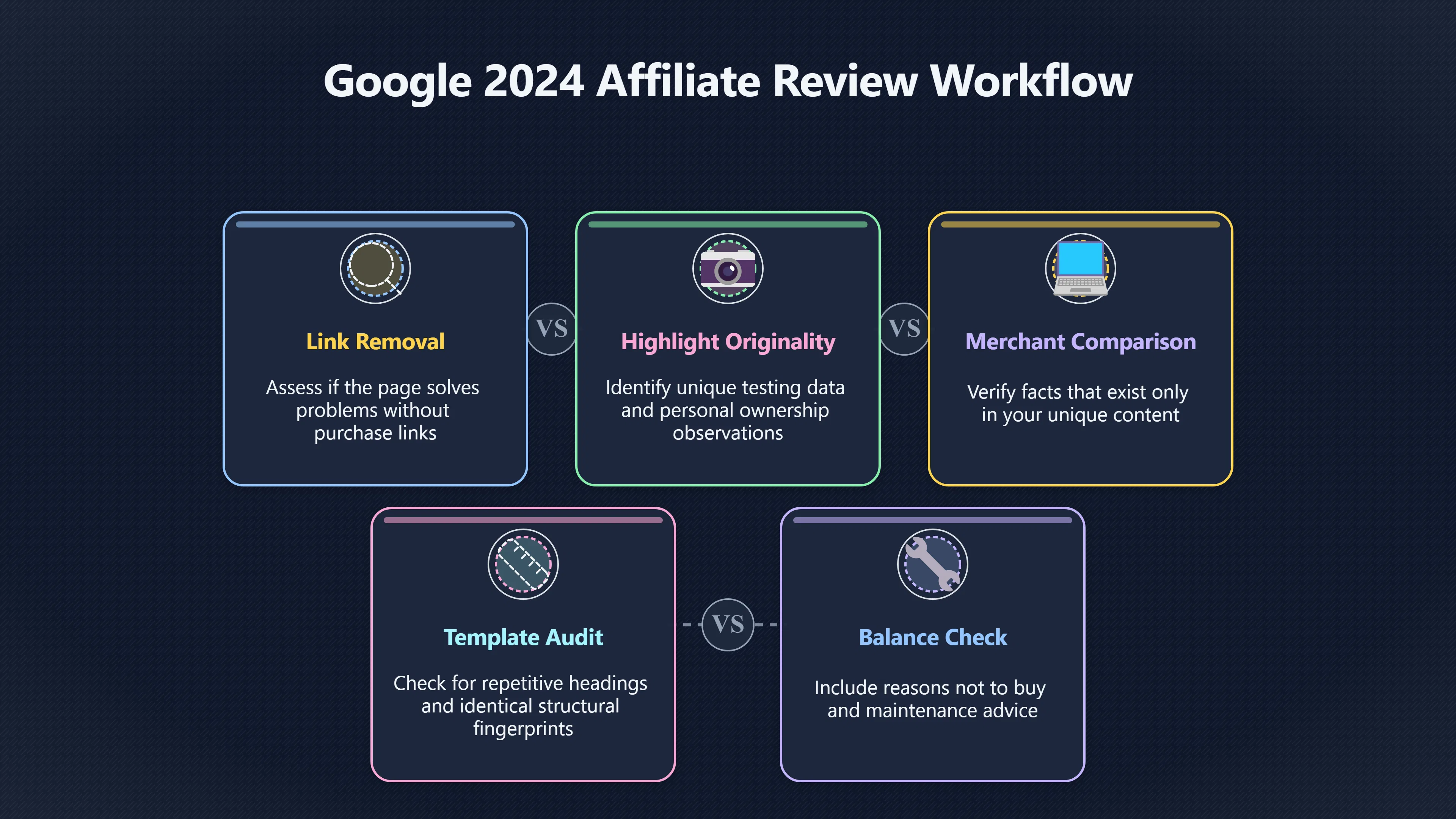
Step 1: Remove the affiliate links mentally
Ask whether the article still solves the visitor’s problem.
If not, improve the information before worrying about conversions.
Step 2: Highlight every original contribution
Mark everything that comes from your own work:
- testing;
- experience;
- analysis;
- photography;
- calculations;
- comparisons;
- recommendations.
If these highlights occupy only a small fraction of the page, originality is probably insufficient.

Step 3: Compare against the merchant
Open the official product page beside your article.
Count how many genuinely useful facts appear only in your article.
The goal is not simply to rephrase the manufacturer’s content but to extend it.
Step 4: Look for template fingerprints
Review several similar pages across your site.[support.google.com]support.google.comHelp Manual actions reportGoogle HelpManual actions report - Search Console HelpFirst, review Google's link spam policy. Next, follow the steps below to… Check…
If changing product names leaves almost identical introductions, headings and conclusions, the site may be signalling scaled production instead of editorial expertise.
Step 5: Check commercial balance
Review whether every section pushes readers towards clicking.
Useful pages often include:
- reasons not to buy;
- alternatives outside the affiliate programme;
- maintenance advice after purchase;
- compatibility warnings;
- buying-delay recommendations where appropriate.
These improve reader outcomes even when they reduce immediate commissions.
The Practical Standard: Useful Before Commercial
The safest affiliate pages are built around a simple principle: the commercial link should feel like a logical next step after the reader has already received valuable help.
If the page teaches, compares, explains, warns, measures or simplifies a buying decision in ways unavailable elsewhere, affiliate links become part of the user journey rather than its sole purpose.
That distinction has become increasingly important as Google’s spam policies and ranking systems focus less on whether content contains affiliate links and more on whether the page contributes something genuinely worth indexing. Pages that demonstrate independent editorial value are more resilient because their usefulness survives changes in algorithms, spam enforcement and search visibility.[Google for Developers+2Google Help]developers.google.comGoogle for DevelopersSpam Policies for Google Web SearchThin affiliation is the practice of publishing content with product affiliate lin…
Amazon book picks
Further Reading
Books and field guides related to Would Your Affiliate Page Survive Review?. Use these as the next step if you want deeper reading beyond the article.
Everybody Writes
Helps publishers create original, useful content that goes beyond thin affiliate pages.
They Ask, You Answer
Emphasizes answering real customer questions with original, trust-building content.
The Art of SEO
Provides broader context on sustainable search visibility and quality-oriented optimization.
Epic Content Marketing
Supports creating distinctive editorial assets that justify affiliate monetization through genuine value.
eBay marketplace picks
Marketplace Samples
Live-tested eBay searches with available results related to this page.



Endnotes
1.
Source: developers.google.com
Link:https://developers.google.com/search/docs/essentials/spam-policies
Source snippet
Google for DevelopersSpam Policies for Google Web SearchThin affiliation is the practice of publishing content with product affiliate lin...
2.
Source: blog.google
Title: google search update march 2024
Link:https://blog.google/products-and-platforms/products/search/google-search-update-march-2024/
Source snippet
New ways we're tackling spammy, low-quality content on...5 Mar 2024 — For decades, we've relied on advanced spam-fighting systems and sp...
Published: march 2024
3.
Source: support.google.com
Title: Help Manual actions report
Link:https://support.google.com/webmasters/answer/9044175?hl=en
Source snippet
Google HelpManual actions report - Search Console HelpFirst, review Google's link spam policy. Next, follow the steps below to... Check...
4.
Source: support.google.com
Link:https://support.google.com/webmasters/thread/302446608/provide-details-about-the-affiliate-products-review-guidelines-and-can-we-used-more-than-ads-network?hl=en
Source snippet
For example a website used a ad network...
Additional References
5.
Source: reddit.com
Link:https://www.reddit.com/r/SEO/comments/18w07x6/specific_google_spam_penalties_list_google_spam/
Source snippet
Specific Google Spam Penalties listThin affiliate pages. [Thin affiliate pages]({{ 'thin-pages/' | relative_url }}) are pages with product affiliate links on which the product...
6.
Source: linkedin.com
Link:https://www.linkedin.com/posts/emulent_on-april-17-2026-google-rolled-out-significant-activity-7451940280951533568-i9f8
Source snippet
Google Cracks Down on Manipulated Reviews with 2026...On April 17, 2026, Google rolled out significant updates to its Business Profile r...
Published: April 17, 2026
7.
Source: affiversemedia.com
Link:https://www.affiversemedia.com/googles-march-2026-core-update-hit-affiliate-sites-harder-than-any-other-category/
Source snippet
Google's March 2026 Core Update Hit Affiliate Sites Harder...9 Apr 2026 — Google's latest algorithm sweep finished rolling out last week...
Published: march 2026
8.
Source: w3solved.com
Link:https://w3solved.com/news/google-spam-reporting-changes-april-2026/
Source snippet
April 23, 2026, Google quietly rewrote the rules around spam reporting in ways that affect both the people filing...
Published: April 23, 2026
9.
Source: webscraft.org
Link:https://webscraft.org/blog/[google-spam-policy
Source snippet
Google Spam Policy 2026: AI Overviews Manipulation Is...17 May 2026 — Google has officially equated manipulations with AI Overview to spam...
Published: May 2026
10.
Source: spikeinteractive.net
Title: google august 2025 spam update guide
Link:https://spikeinteractive.net/google-august-2025-spam-update-guide/
Source snippet
Google's August 2025 Spam Update29 Oct 2025 — Learn how Google's August 2025 Spam Update affects your rankings and how Spike Interactive...
Published: august 2025
11.
Source: linkedin.com
Link:https://www.linkedin.com/pulse/10-google-spam-policies-every-website-owner-should-know-bilal-izqhe
Source snippet
s don't offer reviews, insights, or comparisons. Google...
12.
Source: smartindicators.org
Link:https://smartindicators.org/google-search-central-spam-policies-link-spam-site-reputation-abuse-seo-may-2026-explained-for-modern-seo-practices
Source snippet
ite reputation abuse focuses on publishing content on a trusted site mainly so that...Read more...
13.
Source: practicalecommerce.com
Title: googles spam updates explained
Link:https://www.practicalecommerce.com/googles-spam-updates-explained
Source snippet
Google's Spam Updates, Explained29 Sept 2025 — Google completed its August 2025 algorithm update a few days ago. The update coincided wit...
Published: August 2025
14.
Source: guides.freshstore.com
Title: 185 avoiding google penalties
Link:https://guides.freshstore.com/article/185-avoiding-google-penalties
Source snippet
Google penalties - FreshStore Guides31 Mar 2026 — A "Thin Affiliate" is a term coined by Google and refers to websites that promote affil...
Topic Tree