Within Content Mix
When Affiliate Content Starts Looking Thin
Affiliate pages become risky when they reuse claims without original evidence, useful comparisons, or reasons to visit.
On this page
- Signs a page adds little beyond seller claims
- How original testing and criteria reduce risk
- Why useful supporting pages protect commercial content
Page outline Jump by section
Introduction
Affiliate pages are not risky because they contain affiliate links. They become risky when they give readers little reason to visit instead of going directly to the retailer or manufacturer. A page that simply repeats product descriptions, marketing claims, specifications, or stock images while adding affiliate links contributes very little beyond what already exists elsewhere. Search engines increasingly evaluate whether a page offers original information, useful analysis, or evidence that genuinely helps users make a better buying decision. Google has repeatedly stated that affiliate content should provide substantial added value rather than acting as a duplicate distribution channel for merchant content.[Google for Developers+2Google for Developers]developers.google.comaffiliate programs and added valueGoogle for DevelopersAffiliate programs and added value27 Jan 2014 — Our quality guidelines warn against running a site with thin or scra…
 Within an affiliate content strategy, this matters most for decision-stage pages. Commercial content should not exist in isolation. Reviews, comparisons, and buying guides become stronger when supported by original testing, clear evaluation criteria, and educational pages that demonstrate real expertise throughout the buyer journey.
When Affiliate Content Starts Looking Thin
A page becomes “thin” because of its lack of usefulness, not because of its word count. A short article answering a very specific question can be valuable, while a long “Best Products” list may still be thin if every recommendation is based entirely on manufacturer marketing.
Common warning signs include:
- Rewriting manufacturer descriptions without adding new information.
- Repeating identical buying advice across many product pages.
- Ranking products without explaining the testing process or selection criteria.
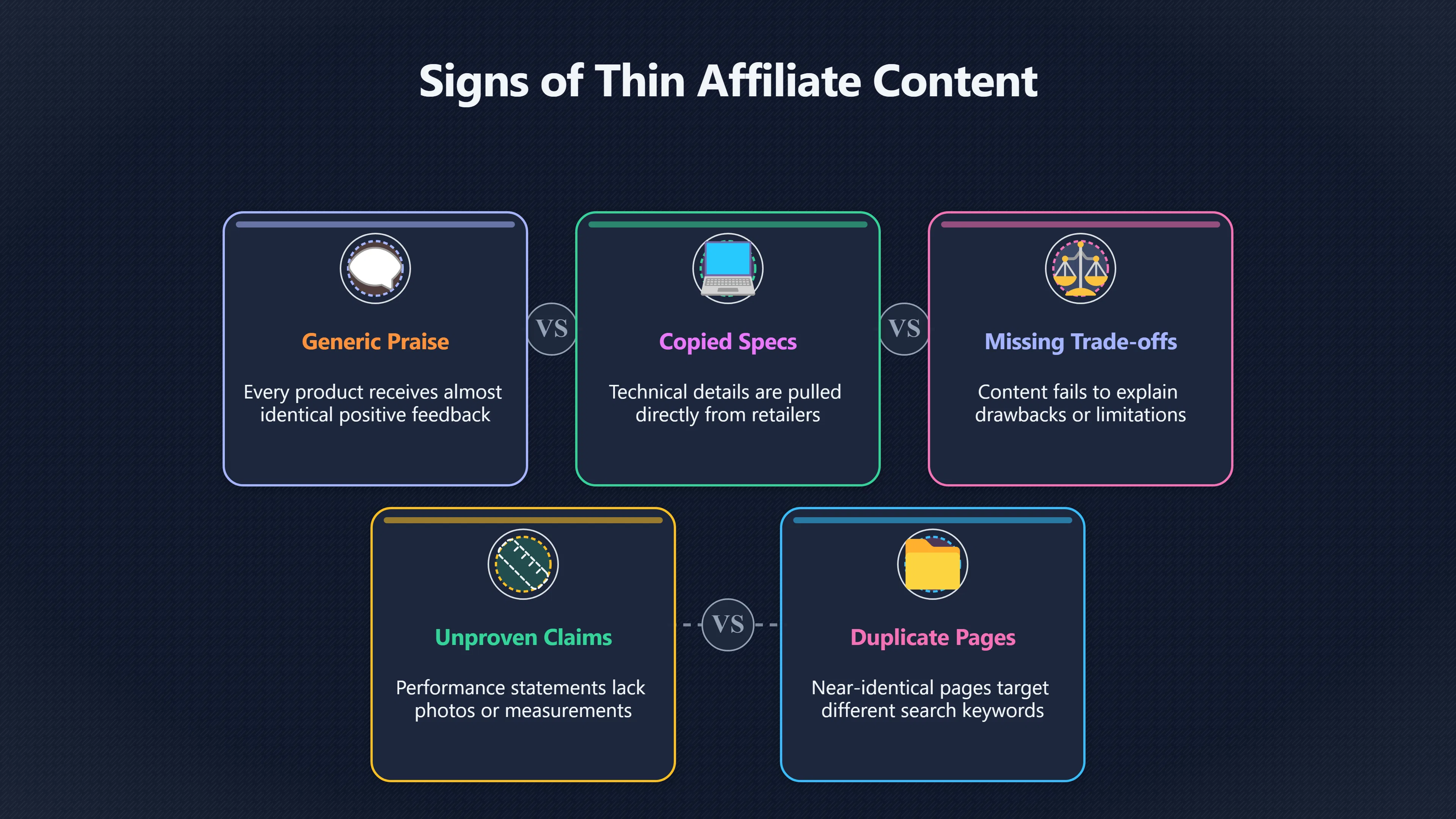
- Making performance claims without photographs, measurements, demonstrations, or first-hand observations.
- Publishing near-identical pages targeting different keywords while changing only product names or minor wording.
- Giving readers no meaningful reason to trust the recommendations beyond affiliate commissions.
Google’s guidance consistently frames the problem as one of added value. If users could obtain essentially the same information by visiting the merchant’s page, the affiliate page contributes little to search results.[Google for Developers+2Google for Developers]developers.google.comaffiliate programs and added valueGoogle for DevelopersAffiliate programs and added value27 Jan 2014 — Our quality guidelines warn against running a site with thin or scra…
Signs a page adds little beyond seller claims
Readers often recognise thin affiliate content before search engines do. Typical examples include:
- Every product receives almost identical praise.
- Pros and cons appear generic rather than product-specific.
- Technical specifications are copied directly from retailers.
- “Best overall” recommendations are unsupported by evidence.
- No discussion of who should not buy a product.
- No explanation of trade-offs between competing options.
These pages rarely answer practical questions that matter during purchasing, such as long-term durability, ease of setup, noise levels, compatibility, maintenance costs, or common frustrations. Instead, they simply repeat advertising messages already available on dozens of other websites.
How Original Testing and Clear Criteria Reduce Risk
Original work creates value that cannot easily be copied from retailer pages. Google encourages review content that demonstrates expertise, includes evidence, compares products meaningfully, and explains why one option may suit particular users better than another.[Google for Developers]developers.google.comGoogle for DevelopersCreating Helpful, Reliable, People-First ContentGoogle's ranking systems are designed to present helpful, reliable i…
Useful additions include:
- First-hand testing with original photographs.
- Measurements gathered during real use.
- Side-by-side comparisons under identical conditions.
- Clear scoring criteria that readers can understand.
- Discussion of weaknesses alongside strengths.
- Long-term observations after weeks or months of ownership.
- Advice for different user types rather than a single “best” recommendation.
For example, two cordless vacuum cleaners may have similar published specifications. Original testing might reveal that one handles pet hair significantly better while another is noticeably quieter in a small flat. Those observations cannot be inferred from marketing copy alone and therefore give readers a genuine reason to consult the affiliate page.
Even where direct testing is impossible, pages can still add value through careful synthesis. Comparing warranty terms, repairability, spare-parts availability, software support, ownership costs, or compatibility across multiple reliable sources provides decision support that retailers often do not assemble in one place.
The important distinction is between collecting information and interpreting information. Interpretation is where expertise becomes visible.
Why Supporting Content Protects Commercial Pages
One of the strongest ways to reduce “thin affiliate” signals is to avoid making commercial pages carry all of the informational burden.
A review page becomes more credible when supported by articles that answer related questions, such as:
- how to choose the correct size;
- common maintenance mistakes;
- compatibility guides;
- troubleshooting after purchase;
- explanations of important technical features;
- replacement schedules and running costs.
These supporting pages demonstrate subject knowledge beyond product promotion. They also create natural internal links that help readers continue solving problems instead of reaching a sales page immediately.
For example, a page reviewing coffee grinders is strengthened by supporting articles explaining burr types, grind consistency, cleaning routines, espresso versus filter brewing requirements, and common maintenance issues. A reader who moves between these resources is more likely to perceive the website as a specialist publication than a catalogue of affiliate links.
This broader content mix also reduces dependence on high-intent commercial keywords by attracting visitors earlier in the buying journey, allowing trust to develop before purchase decisions are made.

Added Value Is a Site-Wide Pattern, Not Just a Single Page
Thin affiliate pages are rarely an isolated issue. A website containing hundreds of near-identical reviews built from manufacturer specifications creates an overall impression of low originality, whereas a site with original reviews supported by educational resources demonstrates consistent expertise.
That does not mean every page requires laboratory testing or thousands of words. Rather, each commercial page should answer the practical question:
What will a reader learn here that they could not learn by visiting the manufacturer’s website?
If the answer is unclear, the page is likely missing the original contribution that both readers and search engines increasingly expect.
For affiliate websites aiming to generate sustainable income, the safest long-term strategy is therefore not reducing affiliate links but increasing the unique value surrounding them. Evidence, transparent evaluation methods, honest trade-offs, and supporting educational content transform commercial pages from simple referral pages into genuinely useful buying resources.[Google for Developers+2Google for Developers]developers.google.comGoogle for DevelopersCreating Helpful, Reliable, People-First ContentGoogle's ranking systems are designed to present helpful, reliable i…
Amazon book picks
Further Reading
Books and field guides related to When Affiliate Content Starts Looking Thin. Use these as the next step if you want deeper reading beyond the article.
Product-Led SEO
Explains how to build genuinely useful, scalable content that avoids thin pages and creates user value.
The Art of SEO
Covers search quality, content strategy, and creating authoritative pages that perform well in search.
They Ask, You Answer
Encourages creating trustworthy educational content that supports commercial pages with real expertise.
Content Chemistry
Focuses on producing valuable content supported by research, evidence, and user needs.
eBay marketplace picks
Marketplace Samples
Example marketplace items related to this page. Use the search link to explore similar finds on eBay.

Endnotes
1.
Source: developers.google.com
Title: affiliate programs and added value
Link:https://developers.google.com/search/blog/2014/01/affiliate-programs-and-added-value
Source snippet
Google for DevelopersAffiliate programs and added value27 Jan 2014 — Our quality guidelines warn against running a site with thin or scra...
2.
Source: developers.google.com
Link:https://developers.google.com/search/docs/fundamentals/creating-helpful-content
Source snippet
Google for DevelopersCreating Helpful, Reliable, People-First ContentGoogle's ranking systems are designed to present helpful, reliable i...
3.
Source: developers.google.com
Link:https://developers.google.com/search/docs/essentials/spam-policies
Source snippet
Google for DevelopersSpam Policies for Google Web SearchThe spam policies detail the behaviors and tactics that can lead to a page or an...
4.
Source: google.com
Link:https://www.google.com/
Source snippet
Search the world's information, including webpages, images, videos and more. Google has many special features to help you find exac...
5.
Source: support.google.com
Title: is affiliate marketing dead
Link:https://support.google.com/webmasters/thread/257058271/is-affiliate-marketing-dead?hl=en
Source snippet
affiliate marketing dead?4 Feb 2024 — Given Google's recent algorithm [updates]({{ 'updates/' | relative_url }}), how feasible it is for beginners to succeed in affiliate m...
Additional References
6.
Source: yellowgrape.io
Title: de toekomst van affiliate marketing na googles helpful content updates
Link:https://www.yellowgrape.io/en/insights/de-toekomst-van-affiliate-marketing-na-googles-helpful-content-updates
Source snippet
The future of affiliate marketing after Google's Helpful...24 Oct 2024 — As a result of these so-called Helpful Content updates, many af...
7.
Source: searchengineland.com
Title: google issues subtle warning affiliates thin content 182754
Link:https://searchengineland.com/google-issues-subtle-warning-affiliates-thin-content-182754
Source snippet
Google Issues Subtle Warning To Affiliates That Have "Thin...28 Jan 2014 — Google's Chris Nelson of the search quality team issued a war...
8.
Source: blckalpaca.at
Title: thin content identifying and fixing low value pages
Link:https://blckalpaca.at/en/knowledge-base/seo-geo/content-seo-keyword-research/thin-content-identifying-and-fixing-low-value-pages
Source snippet
Thin Content: Identifying and Fixing Low-Value Pages16 Jun 2026 — Thin Content refers to web pages with little or no added value for the...
9.
Source: morningscore.io
Title: What is thin content in SEO?
Link:https://morningscore.io/what-is-thin-content/
Source snippet
13 simple tips to fix it23 Mar 2026 — Thin content is broadly defined as website content that does not provide value to visitors. Such...
10.
Source: keyword.com
Title: affiliate links seo [rankings]({{ ‘rankings/’ | relative_url }})
Link:https://keyword.com/blog/affiliate-links-seo-rankings/
Source snippet
Do Affiliate Links Hurt or Help Your SEO Rankings?7 May 2026 — According to Google Search Central, Google believes that pure, or “thin,”...
Published: May 2026
11.
Source: keygrow.co
Title: do affiliate links hurt seo
Link:https://keygrow.co/blog/do-affiliate-links-hurt-seo
Source snippet
? The Real Risk17 Jun 2026 — Google names "thin affiliation" in its spam policies because it gives users nothing they could not get from...
12.
Source: digichefs.com
Title: types of thin content seo
Link:https://digichefs.com/types-of-thin-content-seo/
Source snippet
7 Types of Thin Content You Should Replace Immediately...8 Oct 2025 — Thin content can hurt your SEO and turn readers away. This blog sh...
13.
Source: raddinteractive.com
Title: What is Thin Content?
Link:https://raddinteractive.com/what-is-thin-content-understand-googles-thin-content-penalty-seo/
Source snippet
Google's Thin Content Penalty + SEOThin content is on-page content that has little or no value to the visitor. This means content that is...
14.
Source: youtube.com
Title: What Causes the Google Helpful Content Update (HCU)
Link:https://www.youtube.com/watch?v=0bzye0IN2oQ
Source snippet
Google helpful content update affiliate sites What Causes the Google Helpful Content Update (HCU) Edward Sturm...
15.
Source: seroundtable.com
Title: google affiliate guidelines penalty 18022
Link:https://www.seroundtable.com/google-affiliate-guidelines-penalty-18022.html
Source snippet
in porn." Matt added, "Cookie cutter sites usually don't add value." Google's Zineb...Read more...
Topic Tree