Within Affiliate Pages
What Makes Affiliate SEO Helpful Enough?
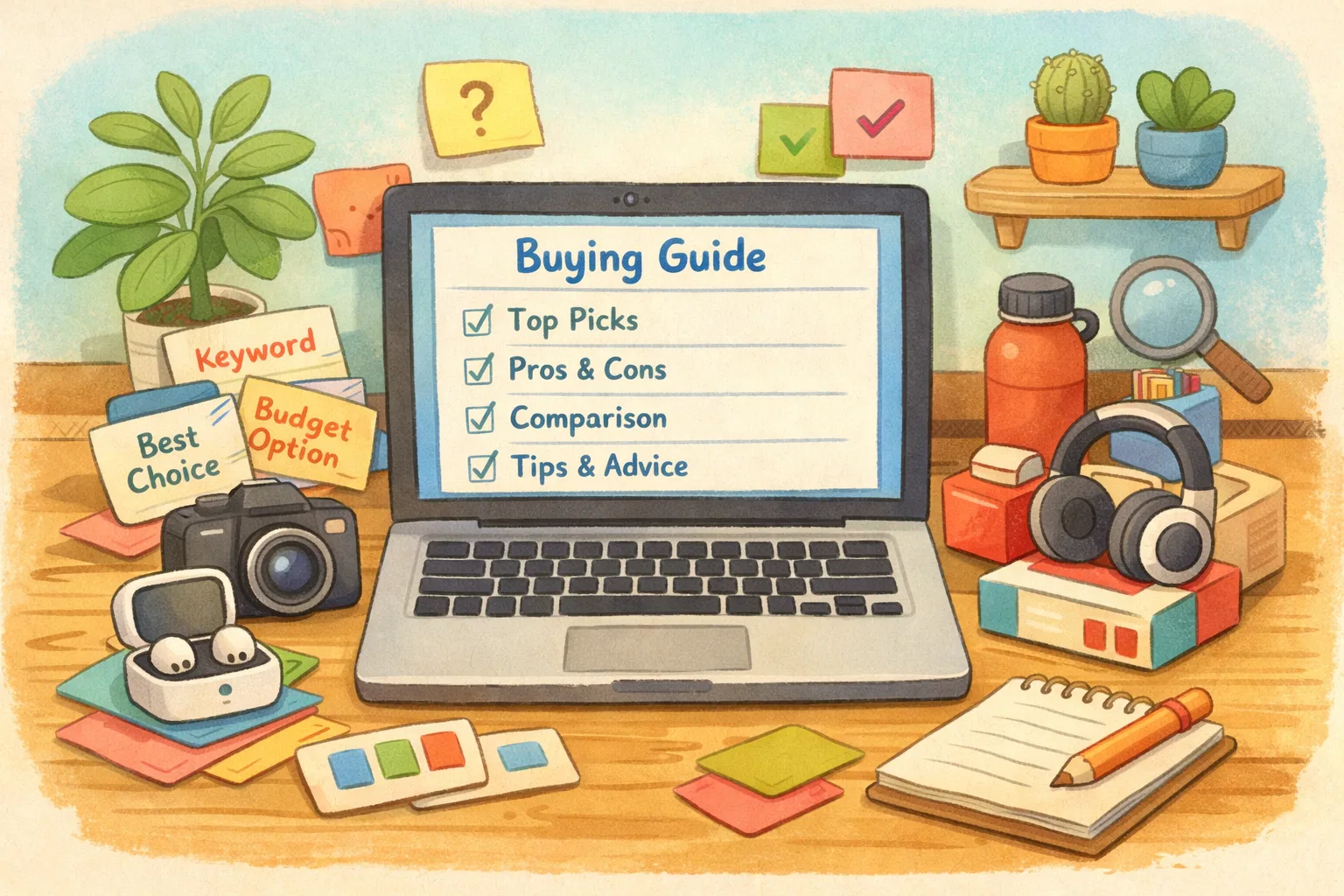
Affiliate SEO works best when a page answers a buying question more completely than retailers and competitors do.
On this page
- People first buying answers
- Search intent and page structure
- Avoiding keyword only content
Page outline Jump by section
Introduction
SEO for helpful affiliate buying guides is not about hiding commercial intent; it is about making the page so useful that a purchase-ready reader can make a better choice because they found it. A strong guide answers the real buying question behind the search, shows how recommendations were made, explains trade-offs clearly, and uses affiliate links transparently. That matters because Google’s own guidance now places product-review content in a quality frame: reviews should show expertise, evidence of experience, meaningful comparisons, pros and cons, quantitative measures where useful, and enough standalone value in ranked lists to help readers without forcing them elsewhere.[Google for Developers]developers.google.comGoogle for DevelopersHow To Write Reviews | Google Search Central | Documentation | Google for Developers…
For a website making money from affiliate links, this changes the SEO job. The page cannot merely target “best X” keywords, rewrite retailer descriptions, and send readers to a merchant. It needs to solve the moment of hesitation before purchase: which option fits my use case, what will annoy me after buying, what is worth paying extra for, and what should I avoid? Google’s helpful-content guidance asks whether a page provides original information, complete coverage, insight beyond the obvious, and substantial value compared with other search results.[Google for Developers]developers.google.comGoogle for DevelopersCreating Helpful, Reliable, People-First Content | Google Search Central | Documentation | Google for Developers…
Helpful affiliate SEO starts with the buying question
Affiliate search traffic is valuable because many queries already contain commercial intent. A reader searching for “best air purifier for allergies”, “iPad vs Kindle for reading”, or “best beginner espresso machine under £500” is not looking for a generic definition. They want a narrowed choice, a trusted explanation, and a shortcut through the uncertainty of buying.
The practical mistake is treating that query as a keyword slot instead of a decision problem. A helpful buying guide should identify the reader’s real constraint early. For example, “best running shoes” is too broad to answer honestly with one universal winner. A useful guide may split the answer by gait, surface, distance, budget, foot width, injury history, and return policy. The SEO benefit comes from satisfying the query more completely, not from repeating “best running shoes” in headings.
A people-first buying guide normally answers four questions near the top:
- What should most readers buy, and why? Give a direct recommendation, not a vague tour of options.
- Who should choose something else? This is where trust is often earned, because unsuitable buyers are not pushed towards the highest commission.
- What evidence supports the recommendation? Use testing notes, original photos, measurements, expert interviews, customer-pattern analysis, or a clearly explained research method.
- What changed since the last update? Buying guides decay quickly when prices, models, availability, warranties, or software features change.
This approach aligns with Google’s review guidance because it turns the affiliate page into a decision aid. Google specifically encourages reviewers to explain what differentiates a product from competitors, discuss comparable items, cover pros and cons based on original research, explain design choices, and provide evidence for “best overall” or “best for a certain purpose” claims.[Google for Developers]developers.google.comGoogle for DevelopersHow To Write Reviews | Google Search Central | Documentation | Google for Developers…
Search intent should shape the page, not just the title
The same product topic can support very different search intents. A page that ranks for the wrong intent may attract visitors but fail both commercially and editorially. A reader searching “Dyson V15 review” wants depth on one product. A reader searching “Dyson V15 vs Shark Stratos” wants a head-to-head answer. A reader searching “best vacuum for pet hair” wants a shortlist filtered by a specific problem.
Helpful affiliate SEO therefore begins by mapping the query to the format:
Search patternReader intentBetter page format“best X for Y”Choose from a shortlistRanked buying guide with use-case winners“X vs Y”Decide between two optionsDirect comparison with verdict by buyer type“X review”Validate one productIn-depth single-product review“is X worth it”Justify price or upgradeValue analysis with alternatives“cheap X that works”Avoid wasting moneyBudget guide with minimum acceptable standards“X alternatives”Escape a known problemSubstitute list organised by reason for switching
The structure should mirror that intent. A “best” guide should not bury the winners below a long history of the category. A comparison page should not force readers through two separate mini-reviews before saying which one suits whom. A review page should not pretend one product is always the right answer when the real question is whether its strengths match the buyer’s situation.
Google’s SEO starter guidance still supports basic clarity: titles should be unique, concise, accurate, and descriptive of what the page offers.[Google for Developers]developers.google.comGoogle for DevelopersSearch Engine Optimization (SEO) Starter GuideYou can influence the title links in Search by writing good titles: a… But for affiliate buying guides, the deeper point is that the title, opening summary, comparison table, product cards, and internal links should all agree about the same intent. A page called “Best Budget Laptops for Students” should not mainly recommend premium ultrabooks, because that creates a mismatch between the searcher’s constraint and the affiliate page’s monetisation goal.
A helpful buying guide gives retailers what they usually do not
Retailer pages are good at listing specifications, prices, shipping terms, and stock. They are often weaker at explaining cross-brand trade-offs, long-term drawbacks, hidden compatibility issues, and who should not buy. Affiliate SEO works best when the guide fills that gap.
For spec-heavy categories, comparison is not a decorative feature; it is part of the buying task. Nielsen Norman Group defines comparison tables as a way to put products or services in columns and attributes in rows so users can quickly compare features and characteristics.[Nielsen Norman Group]nngroup.comNielsen Norman Group Comparison Tables for Products, Services, and FeaturesNielsen Norman GroupComparison Tables for Products, Services, and Features - NN/G… Baymard’s ecommerce UX research found that comparison is especially important for spec-driven products because many relevant attributes cannot fit neatly into product-list snippets, and 67% of test participants used comparison features on spec-driven sites.[Baymard Institute]baymard.comBaymard InstituteProduct Comparison UX: Always Provide Comparison Features for Spec-Driven Industries (17% Don't) – Baymard…
A strong affiliate comparison should therefore do more than repeat manufacturer specifications. It should choose attributes that actually change the decision. For example:
- Laptops: battery life under realistic workload, keyboard comfort, port selection, fan noise, upgradeability, screen brightness, warranty support.
- Mattresses: firmness by sleeper type, return process, edge support, heat retention, motion isolation, delivery constraints.
- Software: limits hidden behind pricing tiers, migration effort, cancellation terms, integrations, data export, support response quality.
- Home appliances: noise, maintenance frequency, replacement-part cost, space needed for storage, warranty exclusions.
The page becomes more helpful when it turns these attributes into decisions. “This has 16GB RAM” is a specification. “Choose 16GB if you keep dozens of browser tabs open or use photo-editing software; 8GB is acceptable for email, documents, and streaming but less future-proof” is buying guidance.
First-hand evidence is the difference between a guide and a list
Affiliate pages often fail because they look interchangeable. Ten products, five-star ratings, copied product images, short pros and cons, and a button that says “check price” do not prove that the publisher has helped the reader. Google’s helpful-content questions push in the opposite direction: original reporting, research or analysis; complete description; insight beyond the obvious; and substantial additional value when using other sources.[Google for Developers]developers.google.comGoogle for DevelopersCreating Helpful, Reliable, People-First Content | Google Search Central | Documentation | Google for Developers…
First-hand evidence does not always require a laboratory, but it does require a real basis for judgement. The more expensive, technical, risky, or personal the product, the stronger the evidence should be. A helpful affiliate site might use:
- Original testing: measured battery drain, weight, noise, speed, setup time, washing results, heating time, or durability checks.
- Original visuals: photos of the product in use, close-ups of ports, seams, controls, packaging, filters, accessories, or wear after months.
- Expert input: a bike mechanic on maintenance, a physiotherapist on ergonomic chairs, a chef on knives, an accountant on bookkeeping software.
- Structured user evidence: patterns from verified customer reviews, support forums, recall notices, app-store complaints, or warranty feedback.
- Clear exclusion rules: products removed because of poor availability, weak warranty terms, misleading claims, unsafe design, or poor value.
The important SEO point is that evidence should appear where the reader needs it, not in a token “how we tested” paragraph at the bottom. If the guide recommends a coffee grinder because it produces more consistent grounds, show the test or explain the observation. If it recommends a web-hosting plan because support is better, describe how support was evaluated. If it warns against a cheap product, explain the failure mode.
This also protects the commercial integrity of the page. A guide that openly says “we would not buy this”, “this is only worth it on sale”, or “this cheaper model is better for most people” is more credible than a page where every product seems equally recommended.
Avoiding keyword-only content
Keyword-only affiliate content is written as if a search engine is the customer. It uses the right phrase, the right word count, and the right affiliate buttons, but it adds little to the buying decision. Google’s spam policies explicitly warn against thin affiliate pages when they exist mainly to pass users to another site without adding meaningful value, and its broader spam updates target scaled, unoriginal content created primarily to manipulate rankings.[Google for Developers]developers.google.comfor Developers Spam Policies for Google Web Search | Documentationfor Developers Spam Policies for Google Web Search | Documentation
For buying guides, keyword-only content usually has recognisable symptoms:
- The introduction restates the keyword without answering the buying question.
- Product descriptions could apply to almost any item in the category.
- Pros and cons are generic, such as “easy to use” and “expensive”.
- The page has no testing method, author expertise, update history, or source of comparison.
- The “best” product is the one with the best commission, not the best fit.
- The same template is reused across dozens or hundreds of near-identical pages.
- The page targets tiny keyword variants without a distinct reader need.
A more durable page usually has fewer but better claims. It can still be optimised for search, but the optimisation supports the answer. Headings should help readers scan the decision. Internal links should move them to narrower guides or supporting reviews. Product boxes should summarise the verdict, not replace the explanation. FAQs should answer genuine pre-purchase doubts rather than pad the page with search phrases.
Google’s March 2024 update is especially relevant here because it described scaled content abuse as producing many pages for the primary purpose of manipulating rankings rather than helping users, regardless of whether the pages are created by automation, humans, or a mixture of both.[Google for Developers]developers.google.comcore update spam policiescore update spam policies That matters for affiliate operators using AI-assisted workflows: the problem is not merely how content is produced, but whether the final page is original, useful, accurate, and worth visiting.
Page structure should reduce buying friction
A helpful affiliate guide should be built for a reader who is comparing, hesitating, and likely scanning on a phone. The structure should make the decision easier within seconds, then provide enough detail for readers who need confidence before clicking through.
A strong structure often looks like this:
- Direct answer: best overall, best budget, best premium, best for specific use cases.
- At-a-glance comparison: price range, best for, key strengths, important drawbacks.
- How to choose: the criteria that genuinely matter in the category.
- Individual recommendations: why each pick was included, who it fits, who should avoid it.
- Evidence and method: how products were tested, researched, selected, and updated.
- Alternatives considered: credible products that did not make the list and why.
- Buying cautions: warranty, compatibility, safety, returns, subscriptions, consumables, or hidden costs.
- Clear disclosure: affiliate relationship and editorial independence.
This structure helps SEO because it improves satisfaction. Readers can get the answer quickly, verify the reasoning, and continue to a merchant only when they understand the trade-off. It also creates natural internal-link opportunities: a broad “best laptops for students” page can link to separate reviews, a “MacBook vs Windows laptop” comparison, a “best budget laptop” guide, and a maintenance or setup article.
The best structure varies by category. A software affiliate guide may need a pricing-tier comparison and migration warnings. A mattress guide may need body-weight and sleeping-position advice. A travel-insurance guide may need exclusions, claim limits, and medical-condition rules. The common principle is that the page should be organised around the buyer’s risk, not the publisher’s keyword list.
Transparency is part of helpful SEO
Affiliate monetisation creates a conflict of interest. A reader does not need the site to be non-commercial, but they do need to understand the relationship. The FTC says that context matters, but its endorsement guidance stresses that readers may not know whether a blogger or creator earns commission from links, and the latest Endorsement Guides include a definition of “clearly and conspicuously”.[Federal Trade Commission]ftc.govOpen source on ftc.gov. In the UK, the ASA describes affiliates as effectively acting as a secondary advertiser when they earn money from attributable clicks or sales, and says affiliate marketing must be obviously identifiable.[asa.org.uk]asa.org.ukOnline Affiliate MarketingOnline Affiliate Marketing
For SEO, disclosure is not just a legal or compliance issue. It supports trust. A disclosure hidden in a footer does not help a reader interpret recommendations. A clearer approach is to put a plain-language disclosure near the top of the page and near commercial links where appropriate: “We may earn a commission if you buy through our links, but this does not affect our recommendations.”
The editorial policy should then prove the statement. Useful trust signals include:
- who wrote or reviewed the guide;
- relevant experience or credentials;[nngroup.com]nngroup.comSource details in endnotes.
- how products were chosen;
- whether products were bought, borrowed, supplied, or tested through demos;
- whether merchants can influence rankings;
- when the page was last checked;
- what changes were made in the latest update.
Affiliate links should also be handled correctly for search engines. Google says paid or advertising links should be marked with rel="sponsored", while nofollow remains an acceptable way to flag them, though sponsored is preferred.[Google for Developers]developers.google.comOpen source on google.com. This is a technical detail, but it reflects the same principle: be explicit about the commercial relationship instead of trying to disguise it.

Helpful guides balance conversion with reader protection
Affiliate SEO often talks about conversion rate as if every click is a win. A helpful buying guide is more careful. The best long-term outcome is not the maximum number of outbound clicks; it is the highest number of well-informed clicks from readers who are likely to be satisfied with the purchase.
That means the page should include buying cautions even when they reduce clicks. Examples include:
- Do not buy this if… the product has a known limitation that matters for some users.
- Check this before ordering… size, voltage, subscription terms, device compatibility, return shipping, installation requirements.
- The cheaper model is enough if… a reader does not need premium features.
- Wait for a sale if… the product is frequently discounted and poor value at full price.
- Consider repair or upgrade instead if… a new purchase may not be necessary.
This type of content may look less aggressive than a commission-focused page, but it is often more persuasive because it reduces regret. It also creates the kind of original, decision-specific content that retailers and weak competitors often omit.
The same principle applies to categories with higher stakes. In finance, health, safety, legal, or children’s products, a guide needs more careful sourcing, stronger expertise, clearer limitations, and less casual recommendation language. A page recommending budgeting apps is different from a page recommending debt products. A page comparing ergonomic chairs is different from one making medical claims about back pain. Helpful SEO means recognising when a buying decision carries real risk.
The best affiliate pages are maintained, not merely published
A buying guide is only as helpful as its current accuracy. Prices change, products disappear, software plans are renamed, warranties shrink, models are replaced, and once-good recommendations become poor value. For affiliate SEO, maintenance is part of the content strategy, not an afterthought.
A practical update routine should check:
- whether top picks are still available;
- whether prices still support the verdict;
- whether new models have replaced old ones;
- whether customer complaints reveal a recurring defect;
- whether affiliate links still lead to the correct product;[support.google.com]support.google.comaffiliate linksaffiliate links
- whether screenshots, specifications, and tables are still accurate;
- whether the page still matches current search intent.
Update notes should be specific. “Updated for freshness” tells the reader very little. “Replaced our budget pick after repeated stock issues; added a cheaper alternative with a longer warranty” is more useful. It shows that the page is actively curated rather than automatically refreshed.
This matters commercially because affiliate sites often depend on trust across repeat visits. A reader who finds a dead link, outdated price, or discontinued product may not return. A reader who sees careful updates is more likely to treat the site as a buying companion rather than a one-off search result.
What “helpful enough” looks like in practice
A helpful affiliate buying guide does not need to be the longest page in the results. It needs to be the page that best resolves the buying decision. In practice, “helpful enough” means the guide can justify every recommendation, every ranking, and every affiliate link.
A weak guide says: “This blender is powerful, stylish, and easy to use.”
A stronger guide says: “This is the best choice for smoothies and soups if you have counter space for a full-size jug. It crushed ice more evenly than the cheaper models we tested, but it is louder than our budget pick and not worth the extra cost if you mainly make protein shakes.”
A weak guide says: “Here are the top 10 project management tools.”
A stronger guide says: “Choose this tool if you need client approvals and time tracking in one place; choose this cheaper alternative if you only need kanban boards; avoid both if your team depends on offline access.”
A weak guide says: “Best overall.”
A stronger guide says: “Best overall for most UK households because replacement filters are easy to find, annual running costs are lower than the premium model, and the warranty is clearer.”
That is the core of affiliate SEO for helpful buying guides: connect purchase-ready searchers with a page that answers the buying question more completely than a retailer, a generic AI summary, or a thin affiliate competitor. The commission is earned after the trust is earned.
Amazon book picks
Further Reading
Books and field guides related to What Makes Affiliate SEO Helpful Enough?. Use these as the next step if you want deeper reading beyond the article.
Product-Led SEO
Explains how to build SEO around user needs rather than keyword stuffing, matching people-first affiliate content.
Everybody Writes
Supports creating genuinely useful buying guides with clear, trustworthy, reader-focused content.
They Ask, You Answer
Focuses on answering real customer questions transparently, aligning with helpful affiliate content principles.
The Art of SEO
Provides comprehensive guidance on search intent, site structure, content quality, and sustainable SEO practices.
eBay marketplace picks
Marketplace Samples
Live-tested eBay searches with available results related to this page.



Endnotes
1.
Source: developers.google.com
Link:https://developers.google.com/search/docs/specialty/ecommerce/write-high-quality-reviews
Source snippet
Google for DevelopersHow To Write Reviews | Google Search Central | Documentation | Google for Developers...
2.
Source: developers.google.com
Link:https://developers.google.com/search/docs/fundamentals/creating-helpful-content
Source snippet
Google for DevelopersCreating Helpful, Reliable, People-First Content | Google Search Central | Documentation | Google for Developers...
3.
Source: developers.google.com
Link:https://developers.google.com/search/docs/fundamentals/seo-starter-guide
Source snippet
Google for DevelopersSearch Engine Optimization (SEO) Starter GuideYou can influence the title links in Search by writing good titles: a...
4.
Source: baymard.com
Link:https://baymard.com/blog/provide-comparison-features
Source snippet
Baymard InstituteProduct Comparison UX: Always Provide Comparison Features for Spec-Driven Industries (17% Don't) – Baymard...
5.
Source: developers.google.com
Title: for Developers Spam Policies for Google Web Search | Documentation
Link:https://developers.google.com/search/docs/essentials/spam-policies
6.
Source: developers.google.com
Title: core update spam policies
Link:https://developers.google.com/search/blog/2024/03/core-update-spam-policies
8.
Source: asa.org.uk
Title: Online Affiliate Marketing
Link:https://www.asa.org.uk/advice-online/affiliate-marketing.html
9.
Source: developers.google.com
Link:https://developers.google.com/search/docs/crawling-indexing/qualify-outbound-links
10.
Source: support.google.com
Link:https://support.google.com/webmasters/thread/303787486/websites-no-longer-indexed-on-google-flagged-for-thin-content-with-little-or-no-added-value?hl=en
11.
Source: developers.google.com
Link:https://developers.google.com/search/docs/appearance/structured-data/product
12.
Source: support.google.com
Link:https://support.google.com/merchants/answer/14620705?hl=en
13.
Source: support.google.com
Title: my website got hit by google march 2024 core spam ai content updates
Link:https://support.google.com/webmasters/thread/269943499/my-website-got-hit-by-google-march-2024-core-spam-ai-content-updates?hl=en
Published: march 2024
14.
Source: developers.google.com
Title: merchant listing
Link:https://developers.google.com/search/docs/appearance/structured-data/merchant-listing
15.
Source: support.google.com
Link:https://support.google.com/merchants/answer/7052112?hl=en
16.
Source: support.google.com
Title: affiliate links
Link:https://support.google.com/webmasters/thread/265967320/affiliate-links?hl=en
17.
Source: developers.google.com
Link:https://developers.google.com/search/docs
18.
Source: developers.google.com
Title: links crawlable
Link:https://developers.google.com/search/docs/crawling-indexing/links-crawlable
19.
Source: baymard.com
Title: user friendly comparison tools
Link:https://baymard.com/blog/user-friendly-comparison-tools
20.
Source: baymard.com
Link:https://baymard.com/research/ecommerce-product-lists
21.
Source: baymard.com
Link:https://baymard.com/ecommerce-design-examples/39-comparison-tool
22.
Source: baymard.com
Title: current state ecommerce product page ux
Link:https://baymard.com/blog/current-state-ecommerce-product-page-ux
23.
Source: baymard.com
Title: list item design ecommerce
Link:https://baymard.com/blog/list-item-design-ecommerce
24.
Source: baymard.com
Link:https://baymard.com/research
25.
Source: keyword.com
Title: affiliate links seo rankings
Link:https://keyword.com/blog/affiliate-links-seo-rankings/
26.
Source: nngroup.com
Title: Nielsen Norman Group Comparison Tables for Products, Services, and Features
Link:https://www.nngroup.com/articles/comparison-tables/
Source snippet
Nielsen Norman GroupComparison Tables for Products, Services, and Features - NN/G...
27.
Source: blog.google
Title: more helpful product reviews
Link:https://blog.google/products-and-platforms/products/search/more-helpful-product-reviews/
28.
Source: blog.google
Title: google search update march 2024
Link:https://blog.google/products-and-platforms/products/search/google-search-update-march-2024/
Published: march 2024
29.
Source: blog.google
Title: overview our rater guidelines search
Link:https://blog.google/products-and-platforms/products/search/overview-our-rater-guidelines-search/
30.
Source: nngroup.com
Link:https://www.nngroup.com/reports/ecommerce-user-experience/
31.
Source: nngroup.com
Link:https://www.nngroup.com/topic/e-commerce/
32.
Source: goup.co.uk
Link:https://www.goup.co.uk/guides/spam/
33.
Source: linkedin.com
Link:https://www.linkedin.com/posts/baymard-institute_product-list-ux-best-practices-2025-baymard-activity-7371921940611231744-8YD1
34.
Source: GOV.UK
Title: social media endorsements being transparent with your followers
Link:https://www.gov.uk/government/publications/social-media-endorsements-guidance-for-content-creators/social-media-endorsements-being-transparent-with-your-followers
35.
Source: assets.publishing.service.gov.uk
Link:https://assets.publishing.service.gov.uk/media/58e224f5e5274a06b3000099/dcts-consumer-research-final-report.pdf
Additional References
36.
Source: youtube.com
Link:http://www.youtube.com/watch?v=zd9y09Mplos
Source snippet
Google product review update guidelines affiliate seo 3 Things You Need to Know About Google's SEO Product Review Update IgniteVisibility...
37.
Source: youtube.com
Title: How to write a high converting product review [SEO Optimized]
Link:http://www.youtube.com/watch?v=XIEHGAfhlkU
Source snippet
Google Product Review Update 2022 - Tips For Recovering Rankings...
38.
Source: youtube.com
Title: 3 Things You Need to Know About Google’s SEO Product Review Update
Link:http://www.youtube.com/watch?v=DKW2G8cj3sA
Source snippet
Content Strategy for Affiliate Marketing Sites [3.3]...
39.
Source: ecfr.gov
Link:https://www.ecfr.gov/current/title-16/chapter-I/subchapter-B/part-255
40.
Source: youtube.com
Title: Content Strategy for Affiliate Marketing Sites [3.3]
Link:http://www.youtube.com/watch?v=SLm9lJnBvyo
Source snippet
How to write a high converting product review [SEO Optimized] - TUTORIAL...
41.
Source: youtube.com
Title: Google Product Reviews Update Explained
Link:http://www.youtube.com/watch?v=0CR9Nbn6L7o
Source snippet
3 Things You Need to Know About Google's SEO Product Review Update...
42.
Source: linkedin.com
Link:https://www.linkedin.com/pulse/10-google-spam-policies-every-website-owner-should-know-bilal-izqhe
43.
Source: researchgate.net
Link:https://www.researchgate.net/publication/275944869_Helpfulness_of_Online_Product_Reviews_as_Seen_by_Consumers_Source_and_Content_Features
44.
Source: reddit.com
Link:https://www.reddit.com/r/SEO/comments/187aun2/affiliate_sites_are_getting_stomped_by_google_and/
45.
Source: reddit.com
Link:https://www.reddit.com/r/juststart/comments/zntbb2/do_we_need_to_change_nofollow_links_to/
Topic Tree
Follow this branch
Parent topic
Affiliate PagesRelated pages 29
- Amazon Is Amazon Associates Still Good for Beginners?
- Appliances What Kitchen Appliance Reviews Often Miss
- Authority Can Expertise Beat Bigger Affiliate Sites?
- Baby Travel Why Baby Travel Gear Reviews Need More Trust
- Business Tools Can Small Business Software Be a Better Affiliate Niche?
- +24 more in sidebar