Within Do Not Buy
Where Bad Advice Can Do Real Harm
In finance, health, childcare, electrical goods, and privacy tools, wrong recommendations can create more than inconvenience.
On this page
- Categories with higher consequences
- Warnings that need stronger evidence
- How to avoid unsafe affiliate pressure
Page outline Jump by section
Introduction
Affiliate reviews are most valuable when they help readers avoid products that could cause genuine harm, not just disappointment. In many consumer categories, a poor recommendation means wasted money or inconvenience. In others, it can contribute to financial loss, health problems, safety hazards, privacy breaches, or risks to children. These higher-consequence categories deserve a noticeably higher editorial standard.
 For affiliate publishers, this changes the purpose of a “Who should not buy this” section. Instead of being a marketing device, it becomes a risk-management tool for readers. The more serious the possible consequences of a poor product match, the stronger the evidence, testing, disclosure, and caution should be. This is consistent with guidance from both Google, which encourages reviews that explain limitations and appropriate use cases, and regulators that require truthful, well-supported product claims and transparent commercial relationships.[Federal Trade Commission]ftc.govhealth products compliance guidanceFederal Trade CommissionHealth Products Compliance Guidance20 Dec 2022 — This document provides guidance from FTC staff on how to ensure…
Categories Where a Bad Recommendation Has Bigger Consequences
Not every affiliate niche carries the same responsibility. The following categories deserve extra care because choosing the wrong product can create harm beyond ordinary buyer’s remorse.
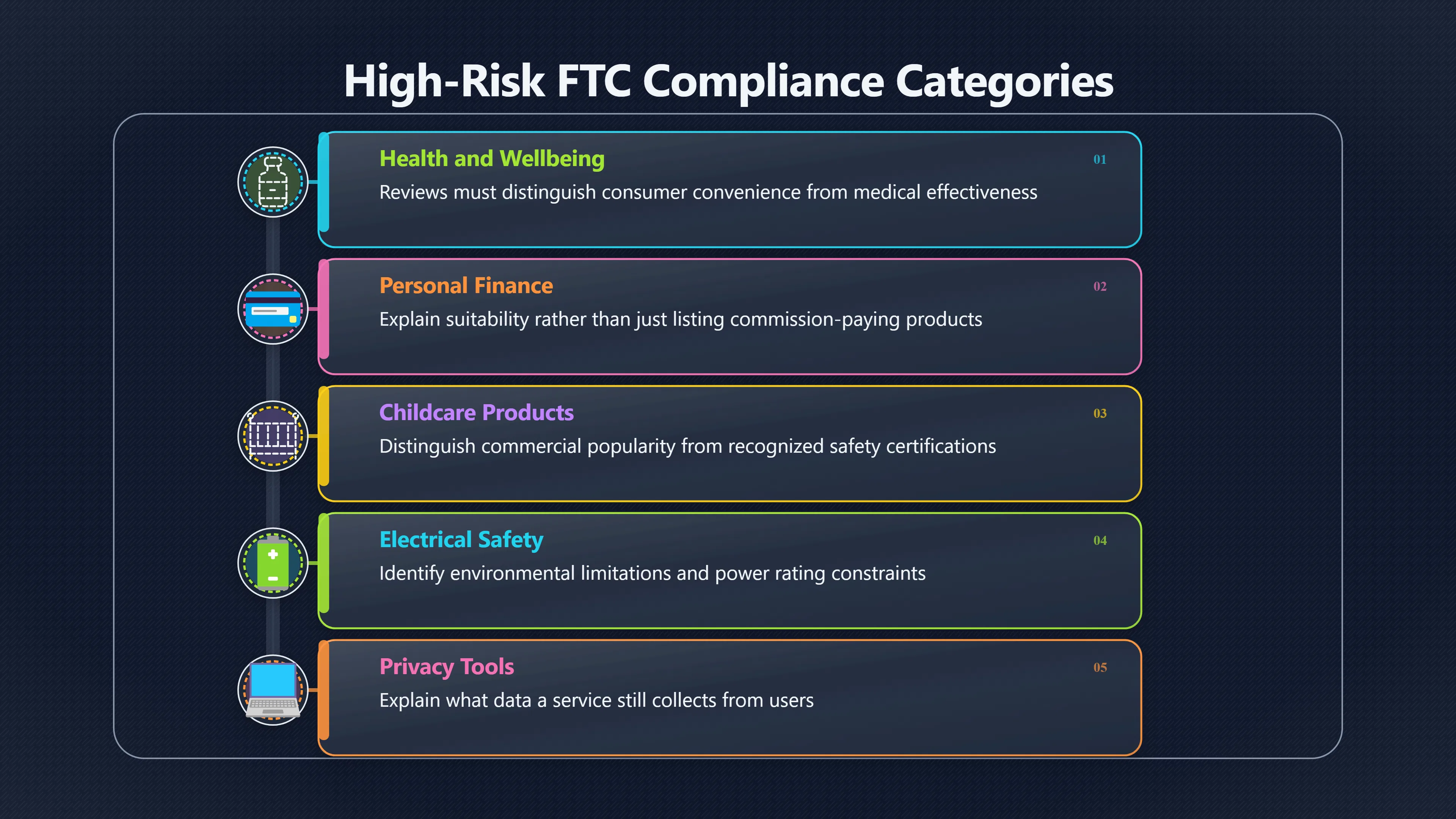
Health and wellbeing
Health-related products are among the highest-risk affiliate categories because readers may rely on reviews when making decisions that affect their wellbeing. This includes supplements, home diagnostic tests, medical devices, health-monitoring apps, mobility equipment, hearing products, and similar goods.
The key risk is that marketing language can easily be interpreted as medical advice. A review that overstates benefits, minimises limitations, or ignores contraindications may encourage someone to delay professional treatment or rely on an unsuitable product.
Good affiliate reviews therefore:
- distinguish between consumer convenience and medical effectiveness;
- identify who should avoid the product;
- explain where evidence is limited;
- avoid unsupported health claims;[ftc.gov]ftc.govhealth products compliance guidanceFederal Trade CommissionHealth Products Compliance Guidance20 Dec 2022 — This document provides guidance from FTC staff on how to ensure…
- link product capabilities to published evidence rather than manufacturer promises.
Regulators have repeatedly emphasised that health claims must be truthful, not misleading, and supported by appropriate scientific evidence across supplements, devices, health apps and related products.[Federal Trade Commission]ftc.govhealth products compliance guidanceFederal Trade CommissionHealth Products Compliance Guidance20 Dec 2022 — This document provides guidance from FTC staff on how to ensure…
Personal finance
Products involving investing, credit, insurance, tax services, banking tools, debt management, or financial software can affect someone’s long-term financial position.
A review that focuses only on commission-paying products while ignoring fees, eligibility restrictions, tax implications, or investment risks can leave readers substantially worse off.
Rather than asking whether a financial product is “best”, responsible reviews explain situations where readers should avoid it altogether. Examples include:
- investors with a short investment horizon;
- borrowers with variable income;
- people who need immediate access to savings;
- businesses requiring features unavailable in entry-level plans.
The emphasis shifts from conversion to suitability.
Childcare and family products
Products intended for babies and young children deserve unusually careful treatment because parents frequently assume that a highly recommended product has already been assessed for safety.
Affiliate reviews should avoid implying that commercial popularity equals safety certification. They should clearly distinguish between convenience features and recognised safety requirements, explain age limitations, and avoid recommending products outside their intended use.
Where products involve sleeping, feeding, transport, or supervision, vague claims such as “perfect for every family” are particularly inappropriate because family circumstances differ substantially.
Electrical and home safety products
Electrical products can create risks including electric shock, overheating, fire, or property damage if used incorrectly or selected for unsuitable environments.
Examples include:
- extension leads;
- heaters;
- chargers;
- batteries;
- power stations;
- electrical adapters;
- smart home devices.
A useful review identifies environmental limitations, power ratings, compatibility constraints, and intended workloads rather than encouraging buyers to purchase the highest-margin model.
Statements such as “not suitable for continuous heavy loads” or “avoid using with high-power appliances” often provide more value than another paragraph praising features.

Privacy and security tools
VPNs, password managers, encrypted storage, security cameras, identity-protection services, and similar products are frequently marketed using exaggerated promises.
The consequences of poor advice extend beyond inconvenience. Readers may believe they are protected when important limitations exist.
Responsible reviews explain:
- what data a service can actually protect;
- what information it still collects;
- where logging policies have independent verification;
- what threats remain outside the product’s scope.
Reviews should avoid implying complete anonymity or absolute security where neither exists.
Why These Categories Need Stronger Evidence
High-risk categories require more than rewritten manufacturer specifications.
The evidence supporting recommendations should become progressively stronger as potential harm increases. In practical terms, that means relying less on promotional copy and more on measurable observations, independent testing, recognised standards, regulatory information, published research where appropriate, and clearly described real-world use.
For example, a review of headphones may reasonably rely on listening impressions and comfort testing. A review of blood pressure monitors or health apps should instead explain validation status, measurement limitations, intended users, and situations where professional medical advice remains necessary.
Readers are not simply comparing features—they are managing risk.
What Strong “Who Should Not Buy This” Advice Looks Like
The most useful warnings are specific enough that readers can recognise themselves immediately.
Instead of writing:
“Not ideal for everyone.”
A stronger review explains:
- “Not suitable if you require continuous glucose monitoring approved for clinical decision-making.”
- “Avoid this investment platform if you expect to trade frequently because dealing fees become expensive.”
- “Not appropriate for households needing child-resistant storage.”
- “Do not rely on this VPN if your primary concern is anonymity from sophisticated state-level surveillance.”
- “Unsuitable for charging high-power workshop equipment because it exceeds the rated output.”
These statements describe a real limitation, identify the affected audience, and explain the reason.
Avoiding Unsafe Affiliate Incentives
Affiliate commissions can unintentionally encourage publishers to understate product limitations, particularly where expensive products generate larger payouts.
Higher-risk categories deserve editorial practices that actively counter that incentive.
Useful safeguards include:
- publishing clear “Who should avoid this” sections for every review;
- separating factual evidence from opinion;
- distinguishing regulated claims from marketing language;
- avoiding absolute statements such as “completely safe”, “guaranteed”, or “works for everyone”;
- recommending non-affiliate or lower-priced alternatives when they better fit the reader’s circumstances;
- updating reviews promptly when important safety information, recalls, regulatory action, or significant product changes emerge.
Transparent affiliate disclosures also matter. Readers should understand that commissions may be earned while still receiving balanced information about who should not purchase the product. Regulatory guidance on endorsements consistently stresses that commercial relationships should be clearly disclosed and that endorsements must reflect honest opinions rather than misleading marketing.[Federal Trade Commission+2Federal Trade Commission]ftc.govOpen source on ftc.gov.
The Long-Term Value of Saying “No”
Affiliate publishers sometimes worry that discouraging purchases will reduce revenue. In high-consequence categories, the opposite can be true over time.
Readers quickly notice when a review acknowledges meaningful limitations instead of trying to fit every visitor into the same recommendation. A site that openly explains why a product is unsuitable for certain people is more likely to earn repeat visitors, referrals, and long-term credibility than one that treats every expensive product as universally appropriate.
In categories involving health, finance, childcare, electrical safety, or privacy, the strongest recommendation is often not a recommendation at all. Sometimes the most valuable service an affiliate review can provide is helping the wrong buyer avoid making the wrong purchase.
Amazon book picks
Further Reading
Books and field guides related to Where Bad Advice Can Do Real Harm. Use these as the next step if you want deeper reading beyond the article.
The Copywriter's Handbook
Rating: 4.0/5 from 5 Google Books ratings
Encourages accurate benefit claims and responsible marketing language.
Influence: The Psychology of Persuasion
Provides a framework for ethical persuasion and avoiding manipulative recommendations.
eBay marketplace picks
Marketplace Samples
Example marketplace items related to this page. Use the search link to explore similar finds on eBay.




Endnotes
1.
Source: ftc.gov
Title: health products compliance guidance
Link:https://www.ftc.gov/business-guidance/resources/health-products-compliance-guidance
Source snippet
Federal Trade CommissionHealth Products Compliance Guidance20 Dec 2022 — This document provides guidance from FTC staff on how to ensure...
3.
Source: ftc.gov
Link:https://www.ftc.gov/business-guidance/resources/mobile-health-apps-interactive-tool
Source snippet
Federal Trade CommissionMobile Health App Interactive ToolThis tool is meant to help you figure out the federal regulatory, privacy, and...
4.
Source: ftc.gov
Title: advertisement endorsements
Link:https://www.ftc.gov/news-events/topics/truth-advertising/advertisement-endorsements
Source snippet
Federal Trade CommissionAdvertisement EndorsementsThe FTC revised its Endorsement Guides in June 2023 to keep them up-to-date with the wa...
Published: June 2023
5.
Source: ftc.gov
Title: consumer reviews testimonials rule questions answers
Link:https://www.ftc.gov/business-guidance/resources/consumer-reviews-testimonials-rule-questions-answers
Source snippet
The Consumer Reviews and Testimonials Rule: Questions...8 Nov 2024 — The Commission's Rule on the Use of Consumer Reviews and Testimonia...
Additional References
6.
Source: ecfr.gov
Link:https://www.ecfr.gov/current/title-16/chapter-I/subchapter-B/part-255
Source snippet
16 CFR Part 255 -- Guides Concerning Use of...The Guides address the application of section 5 of the FTC Act, 15 USC 45, to the use of e...
7.
Source: federalregister.gov
Title: guides concerning the use of endorsements and testimonials in advertising
Link:https://www.federalregister.gov/documents/2023/07/26/2023-14795/guides-concerning-the-use-of-endorsements-and-testimonials-in-advertising
Source snippet
Guides Concerning the Use of Endorsements and...26 Jul 2023 — The Federal Trade Commission (FTC or Commission) is adopting revised Guide...
8.
Source: federal-lawyer.com
Link:https://federal-lawyer.com/ftc-defense/affiliate-disclosure/
Source snippet
Understanding the FTC's Affiliate Disclosure RulesLearn what affiliate marketers and companies need to know about the FTC's affiliate dis...
9.
Source: ropesgray.com
Link:https://www.ropesgray.com/en/insights/alerts/2023/01/consumer-products-in-focus-new-ftc-and-fda-guidances-address-the-marketing-of-health-products
Source snippet
Consumer Products in Focus: New FTC and FDA...10 Jan 2023 — This Alert analyzes both new guidances and provides the key takeaways that l...
10.
Source: kslaw.com
Link:https://www.kslaw.com/news-and-insights/ftc-revamps-the-guides-concerning-the-use-of-endorsements-and-testimonials-in-advertising
Source snippet
FTC Revamps the “Guides Concerning the Use of...10 Aug 2023 — The revised Guides clarify advertisers' responsibilities to substantiate c...
11.
Source: marketinglaw.osborneclarke.com
Title: us ftc guides businesses on combatting deceptive reviews and endorsements
Link:https://marketinglaw.osborneclarke.com/advertising-regulation/us-ftc-guides-businesses-on-combatting-deceptive-reviews-and-endorsements/
Source snippet
FTC 'guides' businesses on combatting deceptive...30 Oct 2023 — The FTC has issued advertisers with Guides Concerning the Use of Endorse...
12.
Source: elevarelaw.com
Title: Learn how digital health companies can avoid legal risk using NIST’s AI Risk
Link:https://www.elevarelaw.com/blog-articles/ai-ftc-regulation-digital-health-strategy
Source snippet
Avoiding the AI Bullseye: How Digital Health Companies...6 Apr 2025 — FTC enforcement on AI is ramping up as federal policy shifts...
13.
Source: kelleydrye.com
Title: new endorsement guides include big changes but few surprises
Link:https://www.kelleydrye.com/viewpoints/blogs/ad-law-access/new-endorsement-guides-include-big-changes-but-few-surprises
Source snippet
New Endorsement Guides Include Big Changes, But Few...29 Jun 2023 — The new Guides address so-called “independent review sites” that hav...
14.
Source: linkedin.com
Title: synthetic endorsements affiliate links ftcs quiet phil gcose
Link:https://www.linkedin.com/pulse/synthetic-endorsements-affiliate-links-ftcs-quiet-phil-gcose
Source snippet
On synthetic endorsements, affiliate links, and the FTC's...In June 2023, the FTC finalised its first material update to the Guides Conc...
Published: June 2023
15.
Source: hchlawyers.com
Link:https://www.hchlawyers.com/social-media-law/ftc-compliance/
Source snippet
If you create sponsored content, use affiliate links, or accept free products in exchange...
Topic Tree