Within Price Help
What Price Makes It A Real Deal?
A clear deal threshold turns price history into practical buying advice instead of another chart beside an affiliate button.
On this page
- How usual prices differ from sale claims
- Setting a strong buy price threshold
- Explaining when waiting is worth the risk
Page outline Jump by section
Introduction
A price history chart becomes genuinely useful only when it answers the question every shopper has: “Is today’s price low enough that I should buy now, or should I wait?” That answer is the deal threshold. Instead of displaying historical prices beside an affiliate link and leaving readers to interpret the graph themselves, a high-quality affiliate page converts price history into a simple buying decision.
 A well-defined threshold also differentiates an affiliate page from a retailer listing. Rather than repeating a claimed percentage discount, the page explains whether the current price is genuinely unusual, merely average, or likely to improve soon. That editorial judgement creates practical value for readers while demonstrating original analysis beyond merchant data.
Why A Percentage Discount Is Not A Deal Threshold
Retailers usually advertise savings against a reference price, but that reference may not reflect what shoppers normally pay. A product advertised as “25% off” may have spent most of the previous six months selling at almost exactly today’s price.
This distinction matters because readers are trying to answer a practical question rather than evaluate marketing language. They need to know whether the current offer is historically attractive.
A useful affiliate page therefore separates three different ideas:
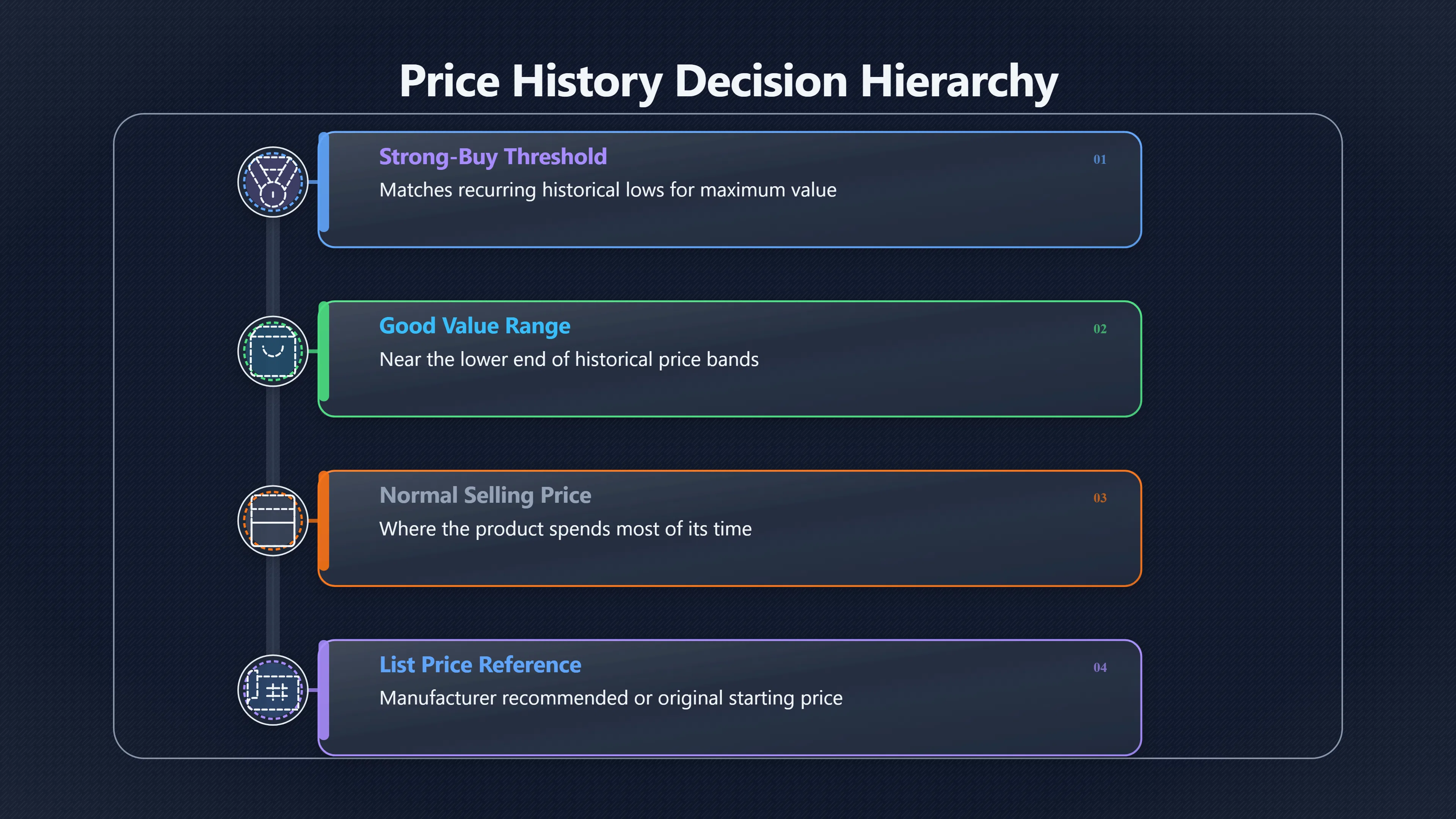
- The list price: the manufacturer’s recommended or original price.
- The usual selling price: where the product spends most of its time.
- The strong-buy threshold: the price that has historically represented unusually good value.
For example, suppose a coffee machine has an official price of £199 but typically sells between £155 and £170. A temporary reduction to £165 is not especially meaningful despite the retailer claiming a £34 saving. If the machine regularly falls below £140 during seasonal promotions, that lower figure is a far more useful benchmark for readers.
Price-history services such as Keepa and CamelCamelCamel exist precisely because historical pricing provides context that current pricing alone cannot. They allow users to view long-term pricing patterns rather than isolated discounts.[Keepa]keepa.comAmazon Price TrackerKeepa tracks over 5 billion Amazon products. We provide Amazon price history charts and price drop alerts…
Setting A Strong-Buy Price Threshold
The threshold should not be an arbitrary number chosen because it looks attractive. Instead, it should be based on repeated historical behaviour.
A practical implementation is to classify prices into clear decision bands.
Current priceReader guidanceAbove normal priceWait unless purchase is urgent.Within normal rangeBuy only if the product is needed immediately.Near the lower end of its historical rangeGood value. Worth considering.At or close to recurring historical lowsStrong buy. Historically difficult to beat.
The wording matters just as much as the number. Readers respond better to plain-language recommendations such as:
- “Historically, below £100 has been an excellent buying opportunity.”
- “Today’s price is typical rather than exceptional.”
- “This matches one of the lowest prices we’ve recorded.”
- “Unless you need it immediately, waiting has usually produced better prices.”
These statements interpret the data rather than expecting readers to analyse charts themselves.
Use Repeated Patterns Rather Than One-Off Lows
One unusually low price should rarely become the buying threshold.
Retail prices occasionally fall because of pricing errors, stock clearances or short-lived promotions that never return. Treating those isolated events as the benchmark creates unrealistic expectations and encourages readers to wait for prices that may never reappear.
A stronger threshold comes from identifying recurring behaviour, such as:
- prices that appear during every major seasonal sale;
- discounts that occur several times each year;
- predictable reductions after newer models launch;
- repeated promotional pricing across multiple retailers.
This produces advice that remains useful even when individual promotions disappear.
Instead of saying:
“The lowest price ever was £89.”
A better editorial judgement is:
“The product regularly falls to around £95–£99 during major sales, making that the realistic point where it becomes a strong buy.”
The second statement helps readers make today’s decision rather than chasing an unlikely historical anomaly.
Explaining When Waiting Is Worth The Risk
Not every product rewards patience.
Some categories experience frequent discounting, while others remain relatively stable throughout the year. A deal threshold therefore works best when paired with an explanation of how often the threshold is reached.
Readers benefit from guidance such as:
- Frequent discounts: waiting usually makes sense because similar prices appear every few weeks.
- Seasonal discounts: waiting is worthwhile if the next major sales period is close.
- Rare discounts: today’s price may deserve a stronger recommendation because similar opportunities are uncommon.
- Declining products: if a replacement model is expected soon, lower prices may become increasingly likely.
This changes a threshold from a simple number into a buying strategy.
For example:
“Although today’s price is only average, this model has dropped below £120 during each of the last three seasonal sales. Unless you need it immediately, waiting is a reasonable strategy.”
Conversely:
“This laptop has spent very little time below today’s price over the past year, making the current offer more attractive than the headline discount alone suggests.”
Making Thresholds Easy To Scan
Many visitors will not read a detailed explanation before deciding whether to click an affiliate link. The threshold therefore deserves prominent placement.
Effective layouts include:
- a “Buy now” badge only when the threshold has been reached;
- a coloured indicator such as “Excellent”, “Good”, “Average” or “Poor”;
- a summary box stating the historical buying recommendation;
- a sentence directly above the affiliate button explaining the current judgement.
For example:
Today’s verdict: At £94 this is below our £100 strong-buy threshold and close to its recurring historical lows.
That single sentence delivers far more value than simply repeating the retailer’s advertised saving.
Keeping Thresholds Credible Over Time
A threshold should be reviewed whenever pricing patterns change.
Markets evolve because manufacturers increase retail prices, products age, replacements launch or retailers adopt different promotional strategies. A threshold established two years ago may no longer reflect normal pricing.
Regular updates should check whether:
- the normal selling range has shifted permanently;
- major sales now produce deeper or shallower discounts;
- competing products have altered the product’s value position;
- inflation or manufacturer price increases have reset realistic expectations.
Updating thresholds maintains credibility and prevents outdated buying advice from misleading readers.
Why Deal Thresholds Increase Affiliate Page Value
Price history alone is data. A deal threshold is interpretation.
That distinction is important both for readers and for affiliate publishers. Charts show what happened; thresholds explain what today’s price means and what action is reasonable. By translating historical pricing into a clear buying recommendation—while being willing to tell readers to wait when appropriate—an affiliate page provides original editorial value that merchant listings and automated price trackers do not. The result is a resource that earns trust by helping readers make better purchasing decisions rather than encouraging every visit to end in an immediate sale.
Amazon book picks
Further Reading
Books and field guides related to What Price Makes It A Real Deal?. Use these as the next step if you want deeper reading beyond the article.
Dotcom Secrets
Covers funnels, traffic, and conversion strategies that complement affiliate websites.
The Psychology of Money
Supports rational purchase timing and value-focused buying decisions.
Predictably Irrational
Shows why advertised discounts and pricing cues often mislead buyers.
eBay marketplace picks
Marketplace Samples
Live-tested eBay searches with available results related to this page.
Endnotes
1.
Source: keepa.com
Link:https://keepa.com/
Source snippet
[Amazon]({{ 'amazon/' | relative_url }}) Price TrackerKeepa tracks over 5 billion Amazon products. We provide Amazon price history charts and price drop alerts...
2.
Source: camelcamelcamel.com
Link:https://camelcamelcamel.com/
Source snippet
ing you to good [deals]({{ 'deals/' | relative_url }}) on products you love.Read more...
3.
Source: uk.camelcamelcamel.com
Link:https://uk.camelcamelcamel.com/
Source snippet
camelcamelcamel.comcamelcamelcamel.com: Amazon UK price tracker, price history...Amazon purchase. camelcamelcamel is a free Amazon price...
4.
Source: camelcamelcamel.com
Link:https://camelcamelcamel.com/tools
Source snippet
Amazon Price Tracking ToolsAdd our price history charts into your browser and view them directly from retailer product pages! Download th...
5.
Source: youtube.com
Link:https://www.youtube.com/watch?v=BVM6qOEY5uY
Source snippet
Keepa Charts: The Ultimate Amazon FBA Tutorial for 2026...
6.
Source: youtube.com
Link:https://www.youtube.com/watch?v=wwNw5vNAyeM
Source snippet
How to Check Amazon Product Price History...
Additional References
7.
Source: reddit.com
Link:https://www.reddit.com/r/InternetIsBeautiful/comments/z3r90x/camelcamelcamel_analyzes_amazon_black_friday/
Source snippet
ce history, this can help show if you are actually getting a deal.Read more...
8.
Source: harpa.ai
Title: best amazon price trackers and drop alerts
Link:https://harpa.ai/blog/best-amazon-price-trackers-and-drop-alerts
Source snippet
Best Amazon Price Trackers 2026: Keepa...Discover top Amazon price trackers like Keepa & CamelCamelCamel for price history, drop alerts...
9.
Source: facebook.com
Title: Shop Smart, Spend Less This [Black Friday]({{ ‘black-friday/’ | relative_url }})!
Link:https://www.facebook.com/courtstnt/posts/shop-smart-spend-less-this-black-friday-maximize-your-savings-get-the-best-tips-/1263882405782894/
Source snippet
💡 Maximize...Shop Online for Price Comparisons • Use tools like Google Shopping, CamelCamelCamel (for Amazon price tracking), or PriceGr...
10.
Source: facebook.com
Title: identifying your individual pain point
Link:https://www.facebook.com/ronanfarrow/posts/price-tags-and-fair-market-prices-themselves-are-increasingly-a-thing-of-the-pas/1434890267984918/
Source snippet
This logic doesn't end...Price tags, and fair market prices themselves, are increasingly a thing of the past. These days, you're not see...
11.
Source: youtube.com
Title: You Don’t Need Third-Party Tools Anymore: Amazon’s New Feature Explained
Link:https://www.youtube.com/watch?v=N2g7flrqYws
Source snippet
How to Make an Affiliate Price Comparison Website with WordPress, ReHub & Content egg...
12.
Source: youtube.com
Title: How to Check Amazon Product Price History
Link:https://www.youtube.com/watch?v=FLR0_fti48M
Source snippet
You Don't Need Third-Party Tools Anymore: Amazon's New Feature Explained...
13.
Source: youtube.com
Link:https://www.youtube.com/watch?v=_UhcL0EH1DY
Topic Tree