Within SEO Guides
What Should Go in a Comparison Table?
The best comparison tables focus on attributes that change the buying decision, not every specification a retailer can list.
On this page
- Decision changing attributes versus filler specs
- How to turn specs into buying guidance
- Table layouts for spec heavy affiliate pages
Page outline Jump by section
Introduction
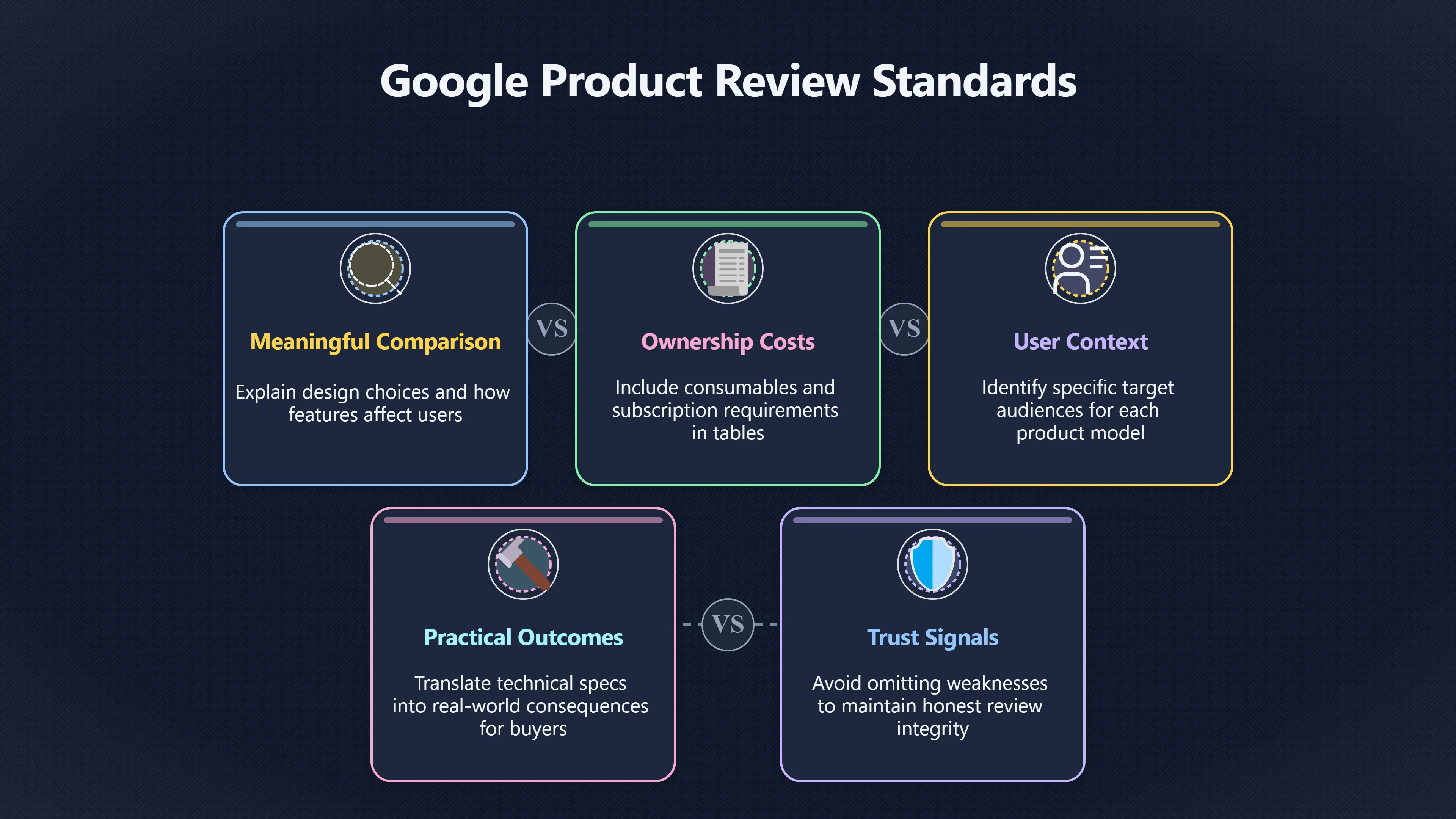
A comparison table should reduce uncertainty, not merely compress product specifications into a grid. The best affiliate buying guides use tables to answer the question a shopper is really asking: which differences will matter after I have spent my money? A table that simply repeats a retailer’s specification sheet adds little value. One that highlights meaningful trade-offs—such as battery life versus weight, subscription costs versus one-off purchase price, or beginner friendliness versus advanced features—helps readers reach a confident decision while demonstrating the original analysis that search engines increasingly reward in product reviews. Google’s product review guidance specifically encourages meaningful comparisons, explanations of differentiators and evidence-based recommendations rather than recycled manufacturer information.[Practical Ecommerce]practicalecommerce.comhow affiliates address googles product review updatesProvide free samples or access…Read more…
 For affiliate websites, comparison tables also improve usability. Many visitors scan before they read. A well-designed table gives them an immediate overview, while the surrounding article explains why those differences matter in real-world use.
What Should Go in a Comparison Table?
Every row should represent a factor that could realistically change someone’s buying decision. If removing a row would not alter a customer’s choice, it probably does not belong.
Prioritise attributes such as:
- Purchase price and expected long-term ownership costs.
- Performance measures that affect everyday use.
- Size, weight or portability where relevant.
- Key limitations or compatibility restrictions.
- Warranty length and after-sales support.
- Ease of setup or learning curve.
- Best-fit user type.
- Notable strengths and compromises.
Less valuable rows often include specifications that appear impressive but rarely influence real purchasing decisions, such as obscure chipset model numbers, excessive certification lists or dimensions that differ by only a few millimetres without affecting usability.
Instead of trying to include every specification available from a retailer, limit the table to the handful of characteristics that separate one recommendation from another.
Decision-Changing Attributes Versus Filler Specs
A useful comparison starts with the customer’s decision rather than the product catalogue.
For example, when comparing cordless vacuum cleaners, readers usually care about:
Decision-changing attributeWhy it mattersReal battery runtimeDetermines whether one charge cleans the whole house.WeightAffects comfort during extended cleaning or stair use.Dust-bin capacityInfluences how often cleaning must stop to empty it.Carpet performanceChanges suitability for homes with pets.Replacement battery availabilityExtends product lifespan.
Rows that contribute far less include:
- Motor RPM without context.
- Internal part numbers.
- Packaging dimensions.
- Marketing terminology unique to one manufacturer.
- Features identical across every product in the comparison.
Readers rarely remember specifications. They remember consequences. The table should therefore translate technical differences into practical outcomes.
How to Turn Specifications into Buying Guidance
The strongest comparison tables do more than report facts. They interpret them.
Instead of:
| Battery | 4,800 mAh |
Use:
| Typical battery life | Around two days for moderate users; one day for heavy camera use |
Instead of:
| Weight | 1.35 kg |
Use:
| Portability | Comfortable for commuting and travel but less stable on the lap than larger models |
Instead of simply listing:
| IP68 |
Explain:
| Water resistance | Suitable for rain and accidental immersion, but not intended for prolonged underwater use |
This additional interpretation is what separates a helpful buying guide from a retailer specification sheet. Google’s product review recommendations similarly encourage explaining design choices, differentiators and how features affect users rather than merely reproducing technical information.[Practical Ecommerce]practicalecommerce.comhow affiliates address googles product review updatesProvide free samples or access…Read more…
Add Context That Helps Different Buyers
Many buying decisions fail because readers assume there is one universally “best” product.
A more useful table introduces context directly into the comparison.
For example:
ProductBest forMay not suitProduct AFirst-time buyers wanting simplicityPower users needing advanced controlsProduct BFrequent travellersBuyers prioritising repairabilityProduct CMaximum performanceTight budgets
This approach immediately answers a reader’s most important question:
“Am I the right customer for this product?”
That often converts better than aggressively promoting a single “winner” because readers see evidence that recommendations are matched to genuine use cases rather than commission rates.
Include Costs Beyond the Purchase Price
Many affiliate comparisons overlook ownership costs.
Depending on the product category, the table can include:
- Replacement consumables.
- Subscription requirements.
- Accessory costs.
- Maintenance frequency.
- Software licence renewals.
- Typical repair costs.
- Expected product lifespan.
For example, two printers with similar purchase prices may differ dramatically once ink costs are included. Likewise, two coffee machines can vary significantly once filter replacements and descaling products are considered.
Highlighting total ownership cost often creates the most valuable insight on the page because retailer listings typically emphasise only the initial price.
Table Layouts for Spec-Heavy Affiliate Pages
Different product categories benefit from different table structures.
Quick shortlist table
Place this near the top of the page for readers who already intend to buy.
Typical columns include:
- Product(#endnote-2 “Snippet: Product reviews are shown in ads and”)[digistore24.com]digistore24.comaffiliate marketing product reviewsHow to Write Product Reviews for Affiliate Marketing25 Feb 2026 — Creating an honest review based on your personal experience, combined w…
- Best for
- Main advantage
- Main drawback
- Price range
- Overall recommendation
This helps visitors narrow the field before reading detailed reviews.
Feature comparison table
Best suited to electronics, appliances and software.
Keep the number of rows manageable by grouping similar features together rather than listing every specification individually.
Use-case comparison
For products with different target audiences, organise rows around scenarios rather than specifications.
Examples include:
ScenarioBetter optionSmall flatsProduct ALarge family homesProduct BFrequent travelProduct CTight budgetProduct D
This format reflects how shoppers actually think.

Upgrade comparison
Where products belong to the same brand or range, compare what buyers gain by paying more.
Include rows such as:
- Extra features gained.
- Features unchanged.
- Whether the upgrade is worthwhile.
- Who should save money instead.
These comparisons often satisfy searches containing “vs”, “worth upgrading” or “which model should I buy”.
Make Differences Easy to Scan
Comparison tables succeed when readers can identify meaningful differences within seconds.
Improve scannability by:
- Keeping wording short and consistent.
- Using the same measurement units throughout.
- Ordering rows from most important to least important.
- Leaving blank cells only when information is genuinely unavailable.
- Highlighting meaningful differences rather than formatting every cell identically.
Avoid filling every row with identical values simply to make the table appear comprehensive. If every product has the same feature, mention it once in the surrounding text instead of wasting table space.
Connect the Table to the Written Review
A comparison table should never replace the explanation beneath it.
Each important difference should link naturally into a fuller discussion.
For example:
- Why Product A’s lighter weight matters during extended use.
- Whether Product B’s higher price is justified.
- Situations where Product C’s weaker specification is irrelevant.
- Trade-offs hidden behind impressive headline specifications.
The table gives readers orientation; the surrounding content provides confidence.
Common Mistakes That Reduce Trust
Poor comparison tables often reveal that the page was assembled from retailer listings rather than genuine evaluation.
Watch for these common problems:
- Listing dozens of specifications with no explanation.
- Ranking products solely by price or commission potential.
- Omitting weaknesses to make every recommendation appear perfect.
- Mixing incomparable measurements.
- Using inconsistent terminology across products.
- Failing to explain why a higher specification may not improve the user experience.
Readers quickly recognise when a comparison has been copied rather than interpreted. Original judgement, practical context and honest trade-offs are what transform a simple specification grid into a decision-making tool that benefits both users and affiliate SEO.
Amazon book picks
Further Reading
Books and field guides related to What Should Go in a Comparison Table?. Use these as the next step if you want deeper reading beyond the article.
Everybody Writes
Supports creating clear, user-focused comparison content that improves decision-making.
The Copywriter's Handbook
Rating: 4.0/5 from 5 Google Books ratings
Helps readers write persuasive product comparisons and buying guidance rather than listing specifications.
Made to Stick
Shows how to communicate meaningful differences and memorable buying advice instead of feature lists.
Influence
Explains the psychological principles behind effective product evaluation and purchasing decisions.
eBay marketplace picks
Marketplace Samples
Live-tested eBay searches with available results related to this page.


Endnotes
1.
Source: practicalecommerce.com
Title: how affiliates address googles product review [updates]({{ ‘updates/’ | relative_url }})
Link:https://www.practicalecommerce.com/how-affiliates-address-googles-product-review-updates
Source snippet
Provide free samples or access...Read more...
2.
Source: support.google.com
Title: Help Product Ratings basics
Link:https://support.google.com/merchants/answer/14620705?hl=en
Source snippet
Product reviews are shown in ads and...
3.
Source: producthero.com
Title: a guide to review stars in google shopping
Link:https://www.producthero.com/post/a-guide-to-review-stars-in-google-shopping
Source snippet
24 Feb 2025 — In this article, we'll explain the difference between seller ratings and product ratings, how to get your reviews to show i...
Additional References
4.
Source: sellbrite.com
Link:https://www.sellbrite.com/blog/google-shopping-reviews/
5.
Source: geniuslink.com
Title: how to create affiliate product reviews
Link:https://geniuslink.com/blog/how-to-create-affiliate-product-reviews/
Source snippet
Creating Affiliate Product Reviews (With Help From ChatGPT)18 Dec 2023 — In this guide, we'll go over how to create an affiliate product...
6.
Source: digistore24.com
Title: affiliate marketing product reviews
Link:https://digistore24.com/en/blog/affiliate-marketing-product-reviews/
Source snippet
How to Write Product Reviews for Affiliate Marketing25 Feb 2026 — Creating an honest review based on your personal experience, combined w...
7.
Source: herd.io
Title: A guide to Google seller ratings
Link:https://herd.io/blogs/performance-marketing/a-guide-to-google-seller-ratings?srsltid=AfmBOooP0gcD2BTDLl0OXZT1Iy-jsePzhdJtBJFqqfCx5qdnmQ6a9M0z
Source snippet
2 Mar 2022 — Find out how seller ratings on Google Ads can help build your brand and improve results in our helpful guide. What is a...
8.
Source: mattmcwilliams.com
Title: succeed affiliate marketing using product reviews
Link:https://www.mattmcwilliams.com/succeed-affiliate-marketing-using-product-reviews/
Source snippet
Go in-depth · 2. Get Personal · Affiliate review post; 4. Be Honest · 5. Share the Pros and the Cons.Read more...
9.
Source: yotpo.com
Title: google seller ratings guide
Link:https://www.yotpo.com/blog/google-seller-ratings-guide/
Source snippet
Boost Ad Performance With Google Seller Ratings31 Jul 2025 — This guide provides a comprehensive overview of what Seller Ratings are, why...
10.
Source: youtube.com
Title: How to Create an Affiliate Product Comparison Table in Word Press (Easy)
Link:https://www.youtube.com/watch?v=HeV5cnVWwps
Source snippet
How to Create a Comparison/Versus Table in WordPress – Step by Step Tutorial - AffiliateX...
11.
Source: youtube.com
Link:https://www.youtube.com/watch?v=_Pyk2Hru9Hw
Source snippet
is a step by step tutorial that is going to show you...
12.
Source: youtube.com
Link:https://www.youtube.com/watch?v=slRsQuFNYyw
Source snippet
How to Create an Affiliate Product Comparison Table in WordPress (Easy)...
13.
Source: youtube.com
Title: Are you ready for Google Review update?
Link:https://www.youtube.com/watch?v=FFtZrmu0YDg
Source snippet
4 Types of [Affiliate Content]({{ 'content-mix/' | relative_url }}) that Convert (Make $100k+ Without Being an "Influencer")...
Topic Tree