Within Testing
Which Product Claims Should Reviews Actually Test?
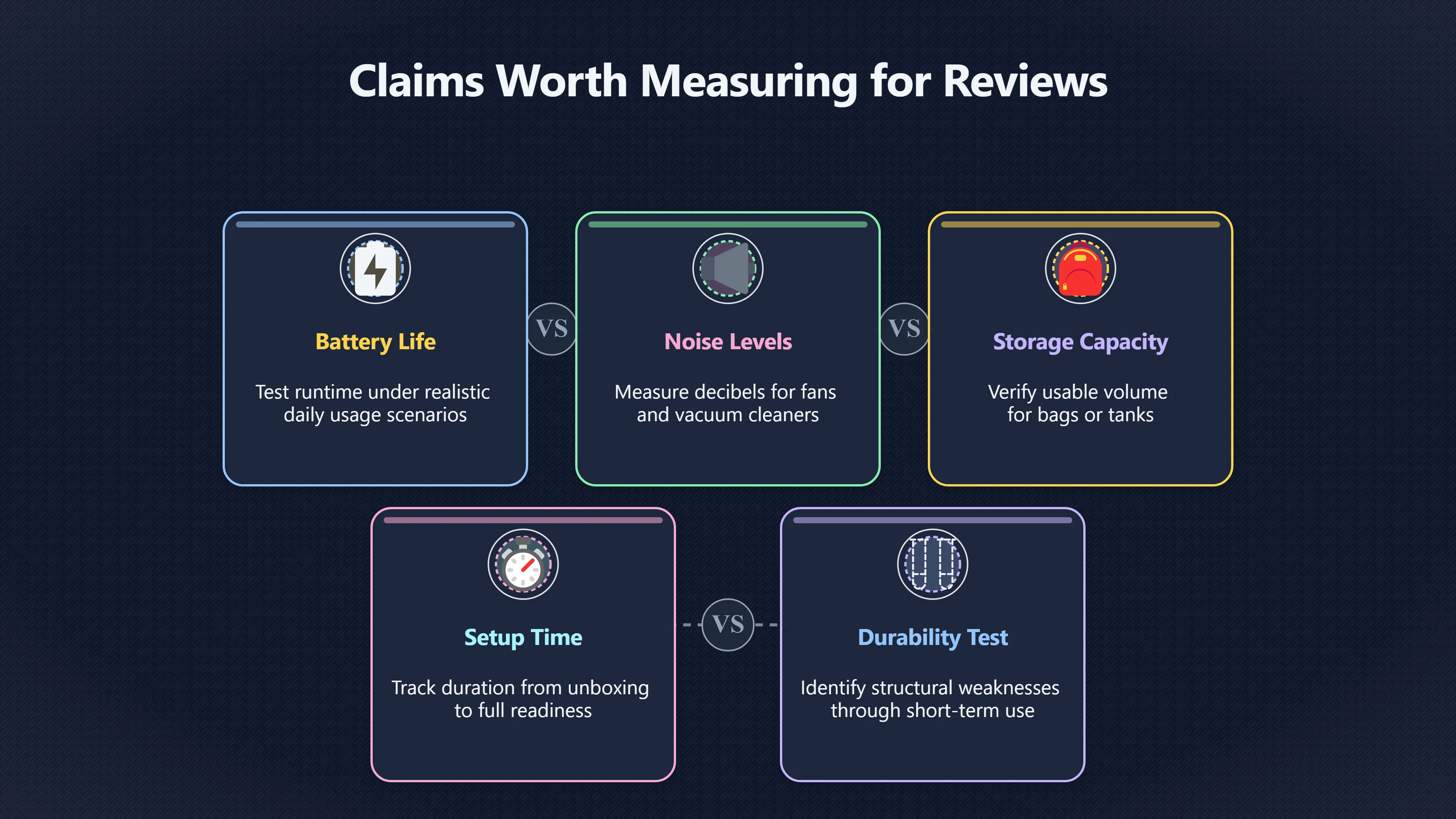
Battery life, noise, capacity, setup time, and other measurable claims become more useful when a review explains the test behind them.
On this page
- Claims worth measuring before an affiliate recommendation
- Simple home testing methods readers can understand
- How to report numbers without pretending to run a lab
Page outline Jump by section
Introduction
The most useful affiliate reviews do not try to verify every specification on a product page. They focus on the claims that influence buying decisions and then show readers how those claims were checked. Battery life, noise, storage capacity, charging speed, setup time, cleaning performance or durability are often more valuable to test than repeating a manufacturer’s marketing language.
 This approach builds trust because readers can see both the result and the method. A review that explains, “We streamed video continuously at 50% screen brightness until the battery reached 5%,” is more credible than one that simply repeats a claimed “12-hour battery life”. Google explicitly recommends that high-quality product reviews include first-hand evidence and quantitative measurements where appropriate, rather than relying on manufacturer descriptions.[Google for Developers]developers.google.comGoogle for DevelopersWrite high quality reviewsWhen recommending something as the best overall or the best for a certain purpose, include…
Claims worth measuring before an affiliate recommendation
Not every specification deserves equal attention. The best tests concentrate on the promises that buyers are likely to base their purchase on.
A practical review should prioritise claims such as:
- Battery life under realistic use rather than ideal laboratory conditions.
- Noise levels for appliances, fans, vacuum cleaners or keyboards.
- Capacity that affects daily use, such as storage volume, water tank size or backpack space.
- Performance speed, including charging, heating, boot times or processing.
- Ease of setup, especially for products marketed as “plug and play”.
- Durability where reasonable short-term testing can reveal weaknesses.
- Compatibility with commonly used devices or software.
- Comfort and ergonomics when manufacturers make strong claims about extended use.
These measurements matter because they answer the questions buyers actually ask before spending money. They also produce information that cannot simply be copied from a retailer’s specification table.
A useful rule is simple: if a failed claim would change someone’s purchasing decision, it is worth testing.
Simple home-testing methods readers can understand
Affiliate publishers do not need laboratory equipment to create trustworthy evidence. Readers generally care more about transparent methods than scientific precision.
Battery life
Instead of quoting the advertised figure, describe exactly how the test was performed.
For example:
- Fully charge the product.
- Keep screen brightness or power settings consistent.
- Use one repeatable workload, such as continuous video playback, music streaming or normal office work.
- Record the runtime.
If the manufacturer advertises “up to 15 hours”, explain whether your workload was heavier or lighter than typical usage. That context is often more valuable than the final number.
Noise
Few independent publishers own calibrated sound meters, but consistent comparison is still possible.
A smartphone sound-level application cannot replace professional acoustic testing, yet it can help compare products if every measurement is taken:
- at the same distance,
- in the same room,
- with similar background noise,
- using identical operating modes.
State clearly that the figures are comparative rather than laboratory-certified measurements. Professional acoustic testing follows recognised standards using specialised equipment, so consumer measurements should never be presented as equivalent.[vde.com]vde.comAcoustics and noise emissiontesting and certification at…10 Mar 2025 — The VDE Institute tests the acoustics and noise emission of electric appliances and perform…
Capacity
Capacity claims are often among the easiest to verify.
Examples include:
- counting how many clothes fit into a laundry basket,
- measuring how much water a tank actually holds,
- checking usable storage after formatting,
- weighing how much a bag comfortably carries before becoming impractical.
Photographs beside familiar objects often communicate capacity better than numbers alone.
Setup time
Many products promise installation “in minutes”.
Instead of accepting the claim:
- Start timing when opening the box.
- Stop when the product is genuinely ready for normal use.
- Include software updates, account creation and pairing if these are required for every buyer.
Readers appreciate knowing that “five-minute setup” actually became twenty minutes because of mandatory firmware updates.
How to report numbers without pretending to run a lab
Readers are surprisingly forgiving of imperfect equipment if reviewers are honest about limitations.
Good reporting usually includes three elements:
The method. Explain exactly what was done.
The result. Present the measurement clearly.
The limitation. Explain what the number does not prove.
For example:
The cordless vacuum ran for 34 minutes on the standard power setting while cleaning mixed carpet and hard flooring in one continuous session. We performed one full discharge test after a complete charge. Different floor types or maximum power mode will reduce runtime.
That paragraph tells readers enough to judge whether the result is relevant to their own circumstances.
By contrast, writing “Battery life: 34 minutes” provides almost no useful context.
When manufacturer claims and real-world results differ
Differences between advertised performance and observed performance are common and do not necessarily indicate that the manufacturer is being dishonest.
Many headline figures are measured under controlled conditions that differ from everyday use. Battery life may assume lower brightness settings. Network devices may quote theoretical speeds. Kitchen appliances may report heating times from ideal starting temperatures.
Instead of framing every difference as evidence that a company is misleading consumers, explain why the gap exists.
For example:
- “The manufacturer’s runtime appears achievable under lighter use.”
- “Our heavier workload reduced battery life by around 25%.”
- “The claimed charging speed required the optional higher-wattage charger.”
This approach improves credibility because readers can understand the conditions rather than being asked simply to trust the reviewer’s opinion.
Avoid common testing mistakes
Some testing practices unintentionally reduce trust.
Avoid:
- comparing products under different conditions;
- changing multiple variables at once;
- presenting one measurement as universal truth;
- rounding numbers to make products appear closer than they were;
- hiding unexpected or inconvenient results;
- testing only the manufacturer’s strongest feature while ignoring obvious weaknesses.
Equally important, avoid implying scientific certainty where none exists. One home test provides evidence, not definitive proof.
Why transparent claim testing strengthens affiliate reviews
Testing manufacturer claims works because it replaces marketing language with observable evidence. Even simple measurements become valuable when readers understand how they were collected.
Google’s guidance for review content encourages publishers to demonstrate first-hand experience, explain why products are recommended, and include meaningful quantitative measurements where appropriate. Likewise, endorsement guidance emphasises that reviews should reflect the genuine experience and honest opinion of the reviewer rather than unsupported promotional claims.[Google for Developers+2Federal Trade Commission]developers.google.comGoogle for DevelopersWrite high quality reviewsWhen recommending something as the best overall or the best for a certain purpose, include…
For affiliate websites, this creates a practical advantage. A retailer can publish specifications. A manufacturer can advertise headline figures. An independent review becomes genuinely useful only when it shows which claims were worth checking, how they were tested, and what buyers should realistically expect in everyday use.
Amazon book picks
Further Reading
Books and field guides related to Which Product Claims Should Reviews Actually Test?. Use these as the next step if you want deeper reading beyond the article.
How to Measure Anything
Helps readers design credible, quantitative tests instead of relying on marketing claims.
Bad Science
Explains how to evaluate evidence, spot weak claims, and interpret test results critically.
The Checklist Manifesto
Encourages consistent, repeatable testing processes that improve the reliability of review methodologies.
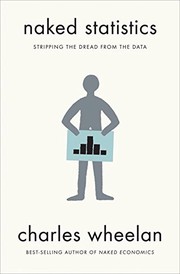
Naked Statistics
Helps reviewers understand and communicate numbers without overstating certainty.
eBay marketplace picks
Marketplace Samples
Example marketplace items related to this page. Use the search link to explore similar finds on eBay.
Endnotes
1.
Source: developers.google.com
Link:https://developers.google.com/search/docs/specialty/ecommerce/write-high-quality-reviews
Source snippet
Google for DevelopersWrite high quality reviewsWhen recommending something as the [best overall]({{ 'best-overall/' | relative_url }}) or the best for a certain purpose, include...
2.
Source: vde.com
Title: Acoustics and noise emission
Link:https://www.vde.com/tic-en/portfolio/acoustic-and-noise-emission-measurements
Source snippet
testing and certification at...10 Mar 2025 — The VDE Institute tests the acoustics and noise emission of electric appliances and perform...
3.
Source: blog.promise.legal
Link:https://blog.promise.legal/startup-central/ftc-endorsement-guides-for-startups-practical-disclosure-review-controls-built-for-global-scale/
Source snippet
Endorsement Guides for Startups: Practical Disclosure...16 Apr 2026 — This guide is for founders, marketing leads, product teams, and in...
4.
Source: support.google.com
Link:https://support.google.com/merchants/answer/6098512?hl=en-GB
Source snippet
rating policies - Google Merchant Center HelpTo participate in product ratings by uploading a feed of reviews, you must have a minimum of...
5.
Source: ftc.gov
Title: s endorsement guides what people are asking
Source snippet
Federal Trade CommissionFTC's Endorsement Guides: What People Are Asking29 Jun 2023 — An endorsement must reflect the honest opinion of t...
Additional References
6.
Source: ecfr.gov
Link:https://www.ecfr.gov/current/title-16/chapter-I/subchapter-B/part-255
Source snippet
16 CFR Part 255 -- Guides Concerning Use of...The Guides address the application of section 5 of the FTC Act, 15 USC 45, to the use of e...
8.
Source: federalregister.gov
Title: guides concerning the use of endorsements and testimonials in advertising
Link:https://www.federalregister.gov/documents/2023/07/26/2023-14795/guides-concerning-the-use-of-endorsements-and-testimonials-in-advertising
Source snippet
Guides Concerning the Use of Endorsements and...26 Jul 2023 — The Federal Trade Commission (FTC or Commission) is adopting revised Guide...
9.
Source: linkedin.com
Link:https://www.linkedin.com/pulse/4-recommended-techniques-product-testing-decision-analyst-inc–yflfc
Source snippet
4 Recommended Techniques for Product TestingMonadic and Sequential Monadic designs are recommended as the best methods for iHUTs, especia...
10.
Source: loeb.com
Link:https://www.loeb.com/en/insights/publications/2009/10/ftc-announces-revised-guides-for-endorsements-an__
Source snippet
FTC Announces Revised Guides for Endorsements and...The Federal Trade Commission announced that it has completed its review of its Guide...
11.
Source: ftcdefenselawyer.com
Link:https://ftcdefenselawyer.com/endorsements-and-social-media-influencers/
Source snippet
FTC Review Rule Lawyer + FTC Endorsement Guideline...Disclosures must be "clear and conspicuous." They must also be "unavoidable." Requi...
12.
Source: linkedin.com
Link:https://www.linkedin.com/posts/lily-ray-44755615_i-think-some-marketers-forgot-or-maybe-didnt-activity-7427037797909278720-DA5t
Source snippet
Lily Ray's PostIf you didn't have substantial evidence of having tested the products and other signs of first-hand experience and experti...
13.
Source: core.ac.uk
Link:https://core.ac.uk/download/pdf/268429114.pdf
Source snippet
December 1, 2009, the Federal Trade Commission published revised and updated Guides Concerning the Use of Endorsements and Testimonials i...
Published: December 1, 2009
14.
Source: hobo-web.co.uk
Title: googles product reviews updates signals in the google content warehouse api leak
Link:https://www.hobo-web.co.uk/googles-product-reviews-updates-signals-in-the-google-content-warehouse-api-leak/
Source snippet
Signals in the Google Content Warehouse API Leak5 Oct 2025 — Original Research & Evidence: The guideline to “provide evidence such as vis...
15.
Source: thriveagency.com
Title: google february 2023 product reviews update heres how it impacted your business
Link:https://thriveagency.com/news/google-february-2023-product-reviews-update-heres-how-it-impacted-your-business/
Source snippet
Thrive Internet Marketing AgencyWhat Is Google's 2023 Product Reviews Update?6 Apr 2023 — Google product reviews must demonstrate the rev...
Published: february 2023
Topic Tree