Within Hiking Gear
Why the Best Boot May Still Hurt
Boot reviews become more useful when they explain toe box shape, heel hold, break-in, rubbing, socks, and orthotic fit limits.
On this page
- Recording toe box, heel, instep, and arch fit
- Testing break in, socks, and rubbing points
- Writing fit caveats without weakening recommendations
Page outline Jump by section
Introduction
The best hiking boot for one walker can be the worst purchase for another. That is why the strongest affiliate reviews do more than score comfort or waterproofing—they explain who a boot fits well and who should avoid it. A boot that feels outstanding on a narrow foot may cause pressure on a wider forefoot, while a model with excellent ankle support may still allow heel lift that leads to blisters. Reliable fit notes reduce expensive returns, improve reader trust, and produce recommendations that reflect real trail use rather than marketing claims.
 For hiking gear affiliate sites, fit reporting is one of the clearest ways to add value beyond manufacturer specifications. Rather than declaring a universal winner, useful reviews document toe box shape, heel hold, instep pressure, arch compatibility, break-in behaviour, sock combinations and the limits of fitting aftermarket orthotics. These details help readers identify whether a boot suits their own feet before spending money.
Why the Best Boot May Still Hurt
Comfort is highly individual because hiking boots are built on different shoe “lasts”—the foot-shaped mould around which the boot is constructed. Two boots labelled with the same size can feel completely different across the toes, heel and midfoot. Outdoor retailers and boot manufacturers consistently recommend choosing fit before brand loyalty because no amount of premium materials compensates for the wrong shape.[REI+2LOWA]rei.comHow to Break in Your Hiking BootsGo Slow and Steady · Wear your boots inside the house. Wear the socks and insoles you'll be wearing o…
For affiliate publishers, this changes how reviews should be written. Instead of saying:
“This is the most comfortable hiking boot.”
a more useful observation is:
“Comfortable for medium-width feet with secure heel hold, but likely to feel restrictive across a broad forefoot after several hours.”
That kind of qualification strengthens rather than weakens a recommendation because it gives readers confidence that the reviewer has actually paid attention to fit.
Recording Toe Box, Heel, Instep and Arch Fit
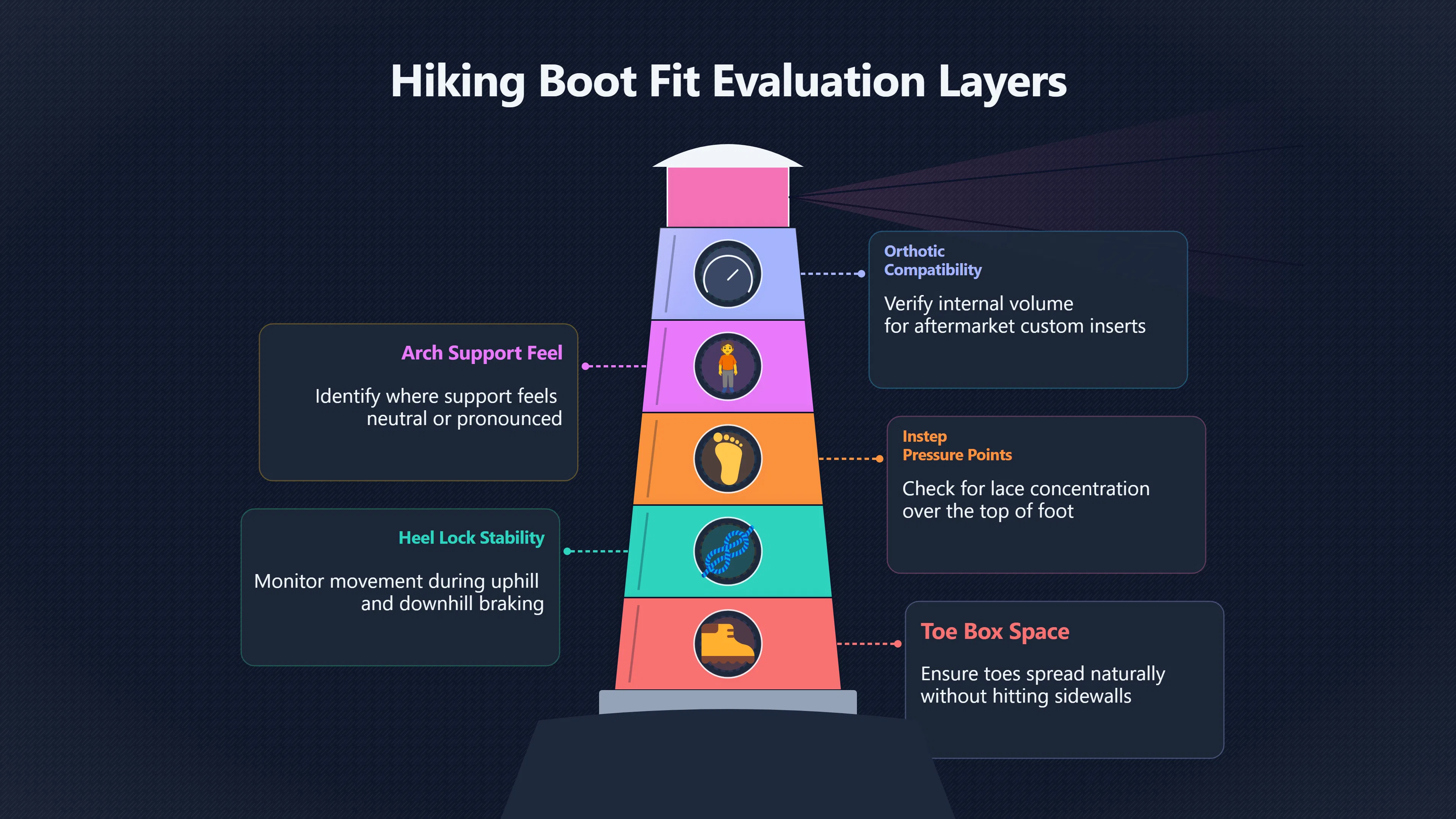
A useful fit review separates the foot into distinct areas instead of giving a single comfort score.
Toe box
The front of the boot deserves careful attention because downhill walking often reveals problems that are invisible during a brief shop fitting.
Record observations such as:
- whether toes can naturally spread
- whether the little toe contacts the sidewall
- whether the big toe rubs during steep descents
- vertical space above the toes
- whether thicker socks noticeably reduce comfort
Many boot-fitting specialists recommend roughly a thumb’s width of space in front of the longest toe while ensuring the foot cannot slide excessively inside the boot.[CURREX]currex.comThe Ultimate Hiking Boot Fitting GuideThe Ultimate Hiking Boot Fitting GuideOctober 9, 2024 — 9 Oct 2024 — Hiking boots and shoes should fit snug but not tight, leaving…
Rather than describing a toe box as simply “wide” or “narrow”, explain where the width exists. Some boots are roomy at the forefoot but taper sharply towards the big toe, while others feel generous across the metatarsals yet shallow over the toes.
Heel hold
Heel lift is one of the most useful observations a reviewer can report because it directly relates to blister risk.
Useful notes include:
- movement during uphill walking
- movement during downhill braking
- whether heel-lock lacing improves stability
- whether tightening enough to stop slipping creates pressure elsewhere
A boot that requires extreme lace tension simply to control heel movement may not suit readers with narrow heels.
Instep pressure
Pressure across the top of the foot often appears only after several hours.
Describe:
- whether lace pressure concentrates in one location
- whether eyelets allow fine adjustment
- whether loosening the laces reduces discomfort without sacrificing control
Readers with a high instep especially benefit from these details because many product specifications never mention them.
Arch compatibility
Avoid claiming that a boot has a “good arch” because arch comfort varies enormously.
Instead report:
- where support feels strongest
- whether support feels neutral or pronounced
- whether fatigue develops under the arch after extended walking
- whether the supplied footbed appears removable
These observations are more transferable than subjective comfort ratings.
Testing Break-In, Socks and Rubbing Points
Many modern hiking boots require far less break-in than traditional full-leather models, but breaking in cannot transform a fundamentally poor fit. Outdoor retailers consistently advise gradual wear because persistent pressure points usually indicate an unsuitable boot rather than insufficient use.[REI]rei.comHow to Break in Your Hiking BootsGo Slow and Steady · Wear your boots inside the house. Wear the socks and insoles you'll be wearing o…
A review becomes much more useful when it separates:
- Immediate comfort – first hour.
- Early break-in – first several walks.
- Established fit – after multiple hikes.
Readers need to know whether discomfort disappears naturally or whether it continues despite increasing mileage.

Test with realistic socks
Always report:
- sock thickness
- sock material
- whether multiple sock types were tested
Changing from a lightweight synthetic hiking sock to a thick merino pair can noticeably alter volume inside a boot. Readers should understand whether a boot already fits closely before adding thicker socks in colder weather.
Identify rubbing locations
Instead of simply stating that blisters occurred, identify exactly where:
- Achilles tendon
- heel cup
- little toe
- outside forefoot
- inside ankle
- top of foot
- base of the big toe
Specificity allows readers with similar foot characteristics to judge whether the issue is likely to affect them.
Use varied terrain
Short indoor walks rarely expose real problems.
More informative testing includes:[lowa.co.uk]lowa.co.ukroom and heel hold afterwards. Men's and…Read more…
- prolonged descents
- side slopes
- uneven rocks
- muddy climbs
- carrying a loaded daypack
These situations reveal foot movement inside the boot far more effectively than flat pavements.
Orthotics and Insoles: State the Limits Clearly
Many hikers use custom orthotics or aftermarket insoles, yet relatively few boot reviews explain whether there is sufficient internal volume to accommodate them.
Useful review notes include:
- whether the factory insole is removable
- whether replacing it noticeably reduces toe room
- whether heel hold changes after swapping insoles
- whether additional arch support increases instep pressure
Avoid claiming that a boot is “orthotic compatible” unless it has actually been tested with replacement insoles. A boot that comfortably accepts a thin aftermarket footbed may become excessively tight with a thicker custom orthotic.
Similarly, avoid presenting insoles as universal fixes. While replacement footbeds can improve volume management or support in some cases, they cannot compensate for a fundamentally incorrect boot shape.[CURREX]currex.comThe Ultimate Hiking Boot Fitting GuideThe Ultimate Hiking Boot Fitting GuideOctober 9, 2024 — 9 Oct 2024 — Hiking boots and shoes should fit snug but not tight, leaving…
Writing Fit Caveats Without Weakening Recommendations
Readers generally trust reviews that acknowledge limitations.
Instead of hiding compromises, describe them precisely.
For example:
Weak review wordingMore useful wordingExtremely comfortableComfortable for medium-width feet after minimal break-in.Fits everyoneBetter suited to average or slightly narrow heels than very wide feet.Great supportStable under heavier loads but may feel firm for walkers who prefer flexible footwear.No issuesNo rubbing during 40 km of mixed terrain using medium-weight merino socks.
Specific caveats reduce disappointment because they match products with appropriate users instead of chasing universal praise.
Fit Notes That Build Long-Term Trust
For an affiliate hiking site, detailed fit reporting is one of the strongest signals that a review comes from genuine field use rather than copied specifications.
The most valuable fit notes consistently answer practical questions readers cannot learn from a manufacturer’s product page:
- How much room remains in the toe box after several hours?
- Does the heel stay locked on steep descents?
- Does lace pressure develop over the instep?
- Does the boot become noticeably more comfortable after break-in?
- Which socks were worn during testing?
- Can the boot accommodate aftermarket orthotics without creating pressure?
When reviews answer those questions honestly, readers are less likely to buy the wrong boot for their own foot shape. That reduces costly mistakes while increasing the credibility that successful hiking affiliate websites depend upon.
Amazon book picks
Further Reading
Books and field guides related to Why the Best Boot May Still Hurt. Use these as the next step if you want deeper reading beyond the article.

Mountaineering The Freedom of the Hills
Explains proper footwear selection, foot care, and matching boots to terrain and conditions.

Trail Tested
Provides real-world advice on footwear choices, comfort, and reducing problems on trail.

Fixing Your Feet Injury Prevention and Treatments for Athlete...
First published 1799.
The complete walker IV
Covers boot selection, fit, backpacking comfort, and practical gear evaluation methods.
eBay marketplace picks
Marketplace Samples
Live-tested eBay searches with available results related to this page.
Endnotes
1.
Source: rei.com
Link:https://www.rei.com/learn/expert-advice/breaking-in-hiking-boots.html
Source snippet
How to Break in Your Hiking BootsGo Slow and Steady · Wear your boots inside the house. Wear the socks and insoles you'll be wearing o...
2.
Source: lowa.com
Link:https://lowa.com/en/experience-lowa/tips-stories/wanderschuhe-einlaufen
Source snippet
Break in hiking boots | Official LOWA WebshopWe asked our experts and here are our best tips on how to break in your hiking boots properl...
3.
Source: currex.com
Title: The Ultimate Hiking Boot Fitting Guide
Link:https://currex.com/blogs/news/ultimate-hiking-boot-fitting-guide?srsltid=AfmBOooWFDaQCkT4WQkeC8P2OAOqABInfjsQ7wm18PiiAGu-qZkp8Ez2
Source snippet
The Ultimate Hiking Boot Fitting GuideOctober 9, 2024 — 9 Oct 2024 — Hiking boots and shoes should fit snug but not tight, leaving...
Published: October 9, 2024
Additional References
4.
Source: tomsguide.com
Title: Tom’s Guide How to choose the right pair of hiking boots
Link:https://www.tomsguide.com/wellness/fitness/how-to-choose-the-right-pair-of-hiking-boots-the-experts-weigh-in
Source snippet
Experts Neil Findlay of Merrell and Lily Fearne of Cotswold Outdoor advise considering factors such as terrain, boot material, fit, and s...
5.
Source: facebook.com
Link:https://www.facebook.com/groups/1070154271134761/posts/1452340279582823/
Source snippet
toe box width, and grip, with many suggesting a visit to a...Read more...
6.
Source: lowa.co.uk
Link:https://www.lowa.co.uk/blogs/news/how-should-hiking-boots-fit?srsltid=AfmBOoqV2MCx9FV6uUxTUCH-HKCkFVXUyIND8sTtxj5-A2Ict8cPAEsI
Source snippet
room and heel hold afterwards. Men's and...Read more...
7.
Source: outdoorgearlab.com
Title: best hiking boots men
Link:https://www.outdoorgearlab.com/topics/shoes-and-boots/best-hiking-boots-men
Source snippet
The Best Hiking Boots for Men | Tested & Ranked3 Jun 2026 — Our hiking team laced up and tested 18 pairs of hiking boots to identify the...
8.
Source: youtube.com
Link:https://www.youtube.com/watch?v=sFUfOXr2cj4
Source snippet
k in your boots to keep you and your...
9.
Source: youtube.com
Title: How to Fit Walking Boots Properly | Heel Slip Fix & The Wild Garlic Lock
Link:https://www.youtube.com/watch?v=Jvdfkug5SaM
Source snippet
How to Fit a Hiking Boot...
10.
Source: youtube.com
Title: How to Fit a Hiking Boot
Link:https://www.youtube.com/watch?v=CrA1bsvy3jU
Source snippet
TOP TIPS to check your walking boots fit...
11.
Source: youtube.com
Title: TOP TIPS to check your walking boots fit!
Link:https://www.youtube.com/watch?v=p4MyaOKKHtM
Source snippet
MEC: How to fit hiking boots...
12.
Source: youtube.com
Title: MEC: How to fit hiking boots
Link:https://www.youtube.com/watch?v=lOBA_2TBOT0
Source snippet
How to Fit a Pair of Walking Boots...
13.
Source: youtube.com
Title: How to Fit a Pair of Walking Boots
Link:https://www.youtube.com/watch?v=Vs5N2WiACb4
Topic Tree