Within Long Tail
Will This Actually Work With What I Own?
Compatibility pages win when they explain whether a product fits a device, home, pet, vehicle, body type, or existing setup.
On this page
- The compatibility details retailers often leave unclear
- How to verify fit without guessing
- Examples where compatibility changes the recommendation
Page outline Jump by section
Introduction
Compatibility-focused buying queries are some of the highest-converting searches in affiliate marketing because the shopper has already chosen a product category and is trying to answer one final question: will this actually work with what I own? Instead of comparing dozens of products, they want reassurance that a particular item fits their car, camera, laptop, pet, home, body type or existing equipment. These are the online equivalent of the questions people ask an experienced sales assistant before taking a product to the checkout.
 For affiliate websites, this creates an opportunity to publish pages that solve real compatibility problems rather than simply listing products. Retailers often provide technical specifications, but they frequently leave shoppers to interpret whether those specifications apply to their own situation. A well-researched compatibility guide bridges that gap by translating specifications into practical buying advice, helping readers avoid costly mistakes while creating a page with strong commercial intent. Google continues to emphasise creating genuinely helpful content that answers people’s questions rather than pages written primarily to target keywords.[Google for Developers]developers.google.comGoogle for DevelopersGoogle Search's guidance about AI-generated contentIn this post, we'll share more about how AI-generated content fit…
Will This Actually Work With What I Own?
Compatibility searches are different from ordinary “best product” searches because they are rooted in uncertainty rather than discovery.
Typical searches include:
- Will this monitor work with my laptop?
- Which roof box fits my car?
- Is this memory card compatible with my camera?
- Which replacement battery fits my cordless drill?
- Can this robot vacuum handle thick rugs?
- Will this dog harness fit a deep-chested breed?
- Which NAS drive works with my enclosure?
The user usually has three pieces of information already:
- The existing item they own.
- The product category they want.
- A fear of buying the wrong thing.
That fear makes these searches commercially valuable. Someone asking whether a microphone works with an iPhone or whether a replacement water filter fits a particular refrigerator model is often very close to purchasing once the compatibility question has been answered.
The Compatibility Details Retailers Often Leave Unclear
Retailers typically publish manufacturer specifications, but specifications rarely answer the practical questions buyers actually have.
Instead of saying:
- USB-C connector
- HDMI 2.1
- Fits wheels 18–20 inches
- Supports Windows
A buyer wants answers like:
- Does charging still work through this cable?
- Will I get the full refresh rate on my monitor?
- Can I still fold my pushchair into the boot?
- Does this work with Windows 11 without extra drivers?
Those are completely different questions.
Strong affiliate pages translate technical language into real-world scenarios by explaining:
- which versions are supported;
- which adapters are required;
- which features are lost under certain combinations;
- common mistakes buyers make;
- whether newer models differ from older ones.
This mirrors the role of a knowledgeable shop assistant who knows the products beyond the specification sheet.
Research into ecommerce usability has long found that compatibility information is particularly valuable because shoppers struggle when they must determine whether products work together, and dedicated compatibility databases can reduce uncertainty while improving search, filtering and purchasing decisions.[Baymard Institute]baymard.comInstitute6 Use Cases for Compatibility Databases on E-CommerceBaymard Institute6 Use Cases for Compatibility Databases on E-Commerce…October 6, 2015 — 6 Oct 2015 — In this article we'll explore th…
How to Verify Fit Without Guessing
The credibility of a compatibility page depends on showing readers how the conclusion was reached rather than asking them to trust an unsupported recommendation.
A practical verification process includes:
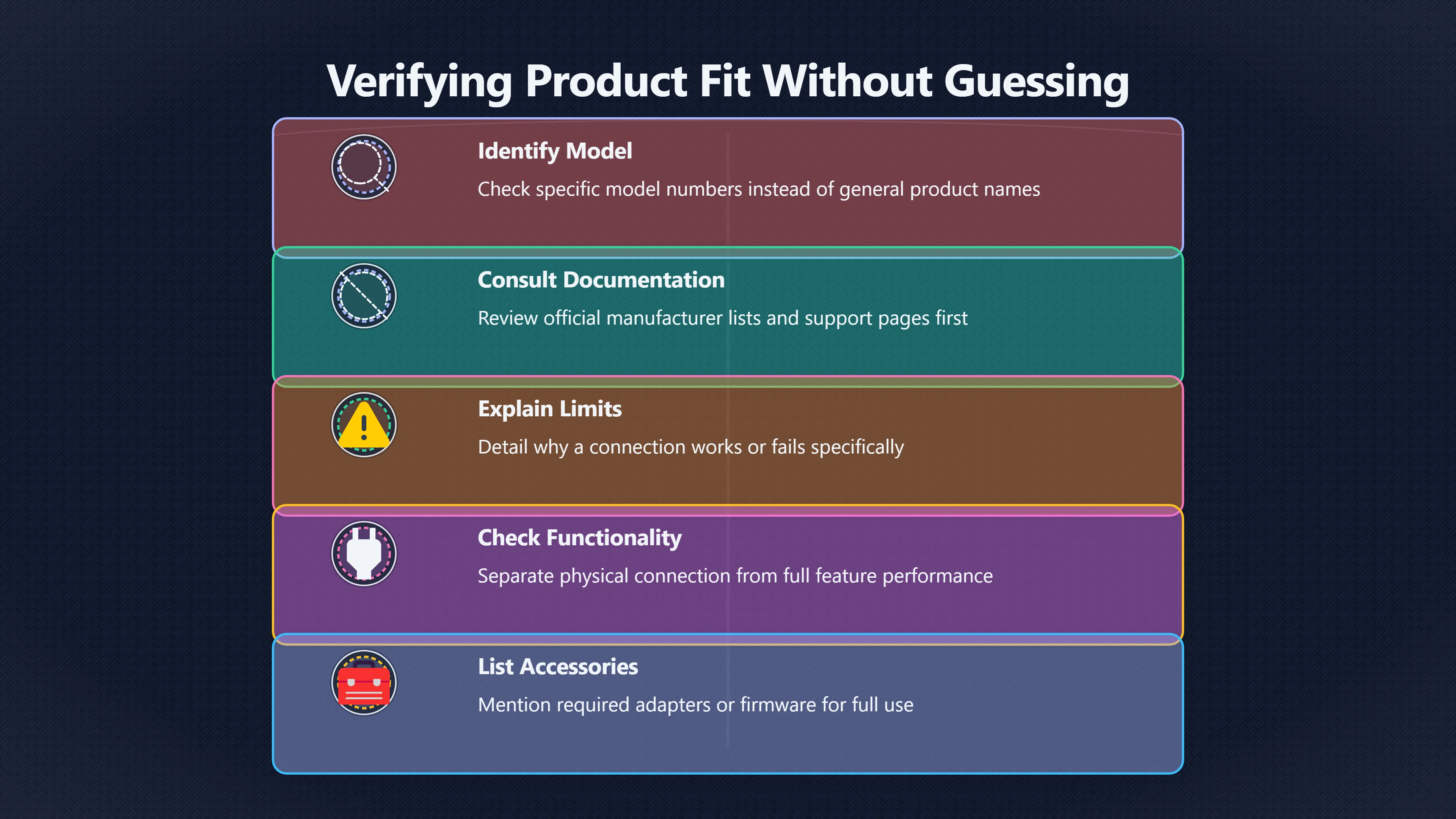
Identify the exact model. Compatibility often changes between generations that share similar names. Encourage readers to check model numbers instead of product names alone.
Check manufacturer documentation. Official compatibility lists, manuals and support pages should form the starting point whenever available.
Explain the limiting factor. Rather than simply saying “compatible”, explain why. For example:
- connector type;
- voltage;
- dimensions;
- firmware version;
- mounting standard;
- operating system;
- weight capacity;
- protocol support.
Separate physical fit from full functionality. Many products connect successfully but lose important features. A USB-C accessory may fit physically yet fail to deliver charging speeds, display output or high-speed data because of cable or port limitations.
Mention required accessories. Readers appreciate knowing in advance if they also need:
- an adapter;
- updated firmware;
- additional brackets;
- replacement screws;
- different cables;
- optional software.
These details are often what prevent returns.
Examples Where Compatibility Changes the Recommendation
Compatibility pages are most valuable when the answer changes which product should be recommended.
Electronics
A monitor buying guide should not simply recommend the highest-rated display.
The recommendation changes depending on whether the buyer needs:
- USB-C charging through a single cable;
- Thunderbolt compatibility;
- high-refresh gaming through HDMI 2.1;
- DisplayPort support;
- macOS scaling behaviour.
Two monitors with similar image quality may offer completely different user experiences depending on the computer being connected.

Vehicles
Automotive accessories are naturally compatibility-driven.
Good pages explain:
- model years supported;
- trim-level differences;
- roof rail variations;
- towing limits;
- wheel size restrictions;
- electrical connector standards.
Simply recommending “the best roof rack” is less useful than explaining which rack fits a particular vehicle generation.
Photography
Camera equipment generates thousands of compatibility searches because lenses, flashes, batteries and accessories vary across mounts and generations.
A useful page might explain:
- whether autofocus works;
- whether image stabilisation is supported;
- crop-factor implications;
- adapter limitations;
- firmware requirements.
These practical details matter more than generic review scores.
Smart Home
Smart home products frequently advertise compatibility without explaining practical limitations.
Instead of only stating that a device supports a voice assistant, explain whether:
- local control is available;
- internet access is required;
- automation features differ between ecosystems;
- advanced routines are supported.
The recommendation may change depending on which smart home platform the reader already owns.
Home and Furniture
Physical measurements become compatibility questions.
Readers often need reassurance about:
- doorway clearance;
- ceiling height;
- cupboard dimensions;
- plumbing connections;
- mattress depth;
- appliance cut-out sizes.
Simple diagrams or measurement tables can answer questions retailers frequently overlook.
Explain Compatibility in Plain English
Many retailer pages simply reproduce manufacturer specifications.
Affiliate content becomes genuinely useful when it interprets those specifications.
Instead of writing:
Supports VESA 100 × 100.
Explain:
This means it will attach directly to monitor arms using the common 100 mm square mounting pattern. If your monitor uses a different VESA size, you will need an adapter or another mounting arm.
Instead of writing:
PCIe Gen 4 SSD.
Explain:
The drive works in older PCIe Gen 3 systems, but maximum transfer speeds will be lower because the computer becomes the limiting factor.
Readers remember explanations, not specifications.
Build Pages Around Real Compatibility Questions
Compatibility content usually performs best when organised around specific buyer situations rather than isolated product names.
Useful page formats include:
- “Does Product A work with Device B?”
- “Best accessories compatible with…”
- “Replacement parts that fit…”
- “What changes between Model X and Model Y?”
- “Will this fit a small home?”
- “Which version do I actually need?”
Each page should answer one primary compatibility problem completely instead of attempting to cover every possible combination.
Where multiple scenarios exist, comparison tables showing supported features, limitations and required accessories are often more helpful than lengthy prose.
Why These Pages Convert Well
Compatibility searches often occur immediately before purchase because they represent the final objection preventing a sale.
The shopper has largely decided:
- what category they need;[baymard.com]baymard.comInstitute6 Use Cases for Compatibility Databases on E-CommerceBaymard Institute6 Use Cases for Compatibility Databases on E-Commerce…October 6, 2015 — 6 Oct 2015 — In this article we'll explore th…
- their approximate budget;
- where they may buy it.
They simply want confidence that they are not making an expensive mistake.
An affiliate page that clearly explains compatibility, cites manufacturer information where appropriate, highlights important exceptions and explains why a product fits a particular situation provides value beyond what many retailer product pages offer. That aligns closely with Google’s emphasis on helpful, original content while addressing one of the most commercially valuable forms of long-tail search intent. Accurate product attributes and compatibility information are also important for product discovery and reducing mismatches across Google’s shopping ecosystem.[Google Help]support.google.comHelp Product data specificationGoogle HelpProduct data specification - Google Merchant Center HelpUse this guide to format your product information for Merchant Center…
Amazon book picks
Further Reading
Books and field guides related to Will This Actually Work With What I Own?. Use these as the next step if you want deeper reading beyond the article.
Affiliate Program Management: An Hour a Day
Explains affiliate marketing strategy that benefits from high-converting compatibility content.
The Paradox of Choice
Rating: 3.5/5 from 13 Google Books ratings
Provides context for simplifying buying decisions through compatibility guidance.
Don't Make Me Think, Revisited
Supports creating buying guides that answer questions clearly and reduce friction.
Buyology: Truth and Lies About Why We Buy
Rating: 4.0/5 from 5 Google Books ratings
Explores purchasing behavior and the factors that influence buying confidence.
eBay marketplace picks
Marketplace Samples
Live-tested eBay searches with available results related to this page.

Endnotes
1.
Source: developers.google.com
Link:https://developers.google.com/search/blog/2023/02/google-search-and-ai-content
Source snippet
Google for DevelopersGoogle Search's guidance about AI-generated contentIn this post, we'll share more about how AI-generated content fit...
2.
Source: support.google.com
Title: Help Product data specification
Link:https://support.google.com/merchants/answer/7052112?hl=en
Source snippet
Google HelpProduct data specification - Google Merchant Center HelpUse this guide to format your product information for Merchant Center...
3.
Source: baymard.com
Title: Institute6 Use Cases for Compatibility Databases on E-Commerce
Link:https://baymard.com/blog/ecommerce-compatibility-databases
Source snippet
Baymard Institute6 Use Cases for Compatibility Databases on E-Commerce...October 6, 2015 — 6 Oct 2015 — In this article we'll explore th...
Published: October 6, 2015
4.
Source: similar.ai
Title: google ai overviews
Link:https://similar.ai/blog/google-ai-overviews/
Source snippet
What Google AI Overviews Mean for Ecommerce Product...5 Mar 2026 — Google AI Overviews are reshaping how product searches surface result...
Additional References
5.
Source: gorgias.com
Link:https://www.gorgias.com/blog/ecommerce-seo
Source snippet
The Complete Ecommerce SEO Guide for Online StoresEcommerce SEO strategies that attract buyers, not browsers. Optimize product pages, sit...
6.
Source: yellowgrape.io
Title: de toekomst van affiliate marketing na googles helpful content [updates]({{ ‘updates/’ | relative_url }})
Link:https://www.yellowgrape.io/en/insights/de-toekomst-van-affiliate-marketing-na-googles-helpful-content-updates
Source snippet
The future of affiliate marketing after Google's Helpful...24 Oct 2024 — The so-called Helpful Content Updates from Google are primarily...
7.
Source: merchkit.com
Link:https://www.merchkit.com/blog/the-ultimate-guide-to-optimizing-your-product-catalog-for-ai-search-and-agentic-commerce
Source snippet
The Ultimate Guide to Optimizing Your Product Catalog for...9 Apr 2026 — Optimize your product catalog for AI search (ChatGPT, Amazon Ru...
8.
Source: fmemodules.com
Title: 393 ecommerce seo for google ai search the complete guide for 2026
Link:https://www.fmemodules.com/en/blog/393-ecommerce-seo-for-google–ai-search-the-complete-guide-for-2026?srsltid=AfmBOoqxexSNTrb3nQtslHACtnq8CGFIDDW6XPd8XdHfNOIPu5KfB2BV
Source snippet
Sizing information. Compatibility details. Troubleshooting tips. This helps AI systems understand product relevance.Read more...
9.
Source: youtube.com
Title: $2,000,000 Google Ads Affiliate Keyword Secrets: Find High-Converting Terms!
Link:http://www.youtube.com/watch?v=vNYcZ1Pvy9o
Source snippet
The Zero Search Volume Strategy Targeting High Intent Keywords For Rapid Affiliate Sales...
10.
Source: efulfillmentservice.com
Title: the complete product data optimization guide for googles ai shopping 2026
Link:https://www.efulfillmentservice.com/2026/01/the-complete-product-data-optimization-guide-for-googles-ai-shopping-2026/
Source snippet
Increase visibility 3-4x with proper attributes, Q&A data...
11.
Source: youtube.com
Title: Keyword Research for Affiliate Marketing Sites [3.2]
Link:http://www.youtube.com/watch?v=MmhN3laA2_g
Source snippet
Affiliate marketing [buyer intent keywords]({{ 'buyer-keywords/' | relative_url }}) Keyword Research for Affiliate Marketers: How to Find Buyer Traffic...
12.
Source: clickrank.ai
Title: search intent in seo
Link:https://www.clickrank.ai/search-intent-in-seo/
Source snippet
Master Search Intent to Dominate Google Rankings in 20261 Dec 2025 — Understanding search intent helps you create content that matches us...
13.
Source: youtube.com
Link:http://www.youtube.com/watch?v=ozXHyqDzLhg
Source snippet
Keyword Research for Affiliate Marketing Sites [3.2]...
14.
Source: youtube.com
Title: Keyword Research Tips for Affiliate Marketing Sites
Link:http://www.youtube.com/watch?v=s5VZaXi7RF4
Source snippet
How To Get Affiliate Sales From Buyer Search (No Ads)...
Topic Tree