Within Niche Choice
Why 'Best For' Keywords Beat Broad Reviews
Specific 'best for' searches expose use cases, reader needs, and testing angles that generic product lists often miss.
On this page
- How use case searches narrow the reader problem
- Examples from mattresses, backpacks, and headphones
- Turning a use case into original testing criteria
Page outline Jump by section
Introduction
The “best for” modifier is one of the most useful filters for finding affiliate niches with genuine buyer intent because it reveals why someone wants to buy, not merely what they want to buy. A search such as “best mattress” is broad and highly competitive. By contrast, “best mattress for side sleepers with back pain” exposes a specific problem, a defined audience, and clear criteria for comparing products. These long-tail searches often occur when a buyer has already narrowed their options and is looking for reassurance before making a purchase. Search intent research consistently shows that commercial comparison queries require content that directly matches the user’s situation rather than generic product lists.[Ahrefs]ahrefs.comSearch Intent in SEO: What It Is & How to Optimize for ItIn other words, it's what the searcher is looking for when using a search engine like Google…
 For affiliate publishers, this makes “best for” keywords valuable not simply because they are longer, but because they naturally suggest original testing methods, stronger recommendations, and content that is harder for generic review sites to copy.
How Use-Case Searches Reveal the Real Buying Problem
A generic “best” search leaves many unanswered questions. The reader may have completely different priorities depending on where and how the product will be used.
Adding “for” changes the search from a product category into a buying scenario:
- Best backpack
- Best backpack for one-bag travel
- Best backpack for airline carry-on only
- Best backpack for photographers
- Best backpack for commuting by bicycle
Although every query concerns backpacks, each represents a different decision process.
The buyer is effectively saying:
- “I already know I need this type of product.”
- “I have a specific problem.”
- “Help me choose the option that fits my situation.”
Search intent research describes this as commercial investigation, where users compare alternatives before purchasing rather than simply learning about a topic. Search engines reward pages that directly satisfy that underlying intent instead of offering broad, unfocused advice.[Ahrefs]ahrefs.comSearch Intent in SEO: What It Is & How to Optimize for ItIn other words, it's what the searcher is looking for when using a search engine like Google…
For affiliate websites, this means the niche is no longer “backpacks”. Instead, it becomes a collection of narrowly defined purchasing situations.
Why “Best For” Keywords Often Convert Better
Specific use cases reduce uncertainty.
Someone searching for:
Best headphones
may still be deciding whether they even need new headphones.
Someone searching for:
Best headphones for open-plan offices
has already identified:
- the environment
- the problem
- the expected solution
- the purchase category
That changes the role of the affiliate page.
Instead of reviewing every product feature equally, the article can evaluate only the characteristics that matter for that scenario, such as:
- speech clarity during video calls
- effectiveness of active noise cancellation
- comfort during eight-hour workdays
- microphone quality
- battery life
The recommendation becomes far more credible because every judgement is tied back to the reader’s original problem rather than a generic specification sheet.
Examples Across Different Affiliate Niches
Mattresses
A broad review typically compares:
- firmness
- materials
- price
- warranty
A use-case page such as “Best mattress for side sleepers” introduces much more relevant evaluation criteria:
- shoulder pressure relief
- spinal alignment
- hip support
- heat retention
- suitability for different body weights
The testing framework changes because the reader’s problem changes.
Backpacks
A generic backpack review might score:
- capacity
- appearance
- build quality
A page targeting “Best backpack for hiking with camera gear” would instead examine:
- internal dividers
- weather resistance
- tripod attachment
- weight distribution
- quick camera access
- ventilation
The intended activity determines the review methodology.
Headphones
Rather than reviewing audio quality alone, “Best headphones for frequent flights” naturally focuses on:
- cabin noise reduction
- comfort during long journeys
- battery endurance
- folded size
- Bluetooth reliability
- wired backup options
Again, the recommendation becomes more persuasive because it reflects an actual purchasing situation.
Turning a Use Case into Original Testing Criteria
One of the biggest weaknesses of low-quality affiliate sites is that every review measures the same specifications in the same order.
“Best for” keywords provide an immediate solution because they generate unique evaluation criteria.
Instead of asking:
Which product is best?
Ask:
Which characteristics matter most for this particular reader?
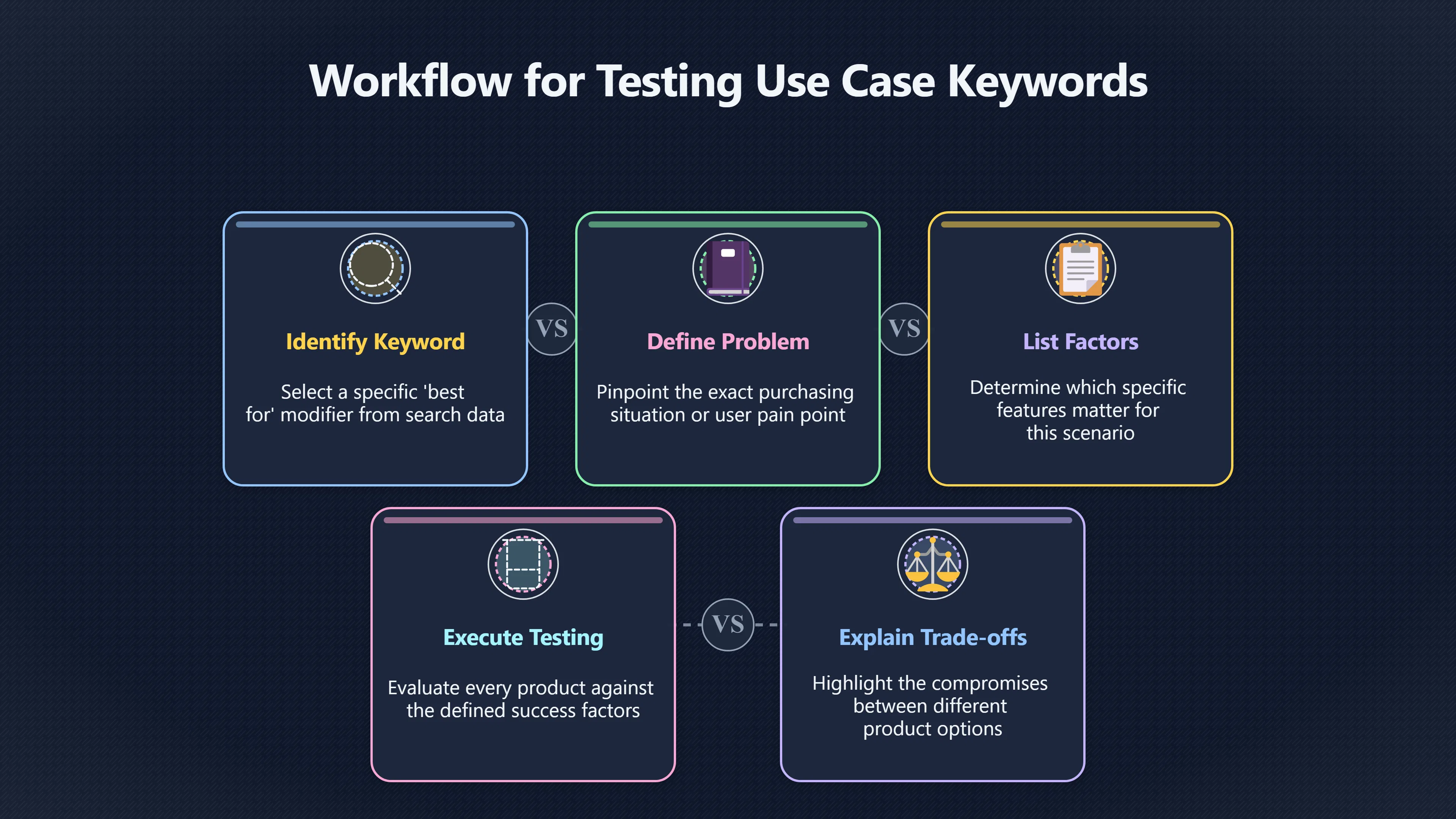
A practical workflow is:
- Identify the use-case keyword.
- Define the reader’s problem.
- List the factors that directly affect success in that situation.
- Test every product using those same factors.
- Explain trade-offs instead of chasing a single overall winner.
For example:
Use caseTesting emphasisMattress for hot sleepersCooling performance, airflow, moisture retentionRunning headphonesStability, sweat resistance, controls while movingCarry-on luggage for business travelCabin dimensions, laptop access, durability, organisationCoffee grinder for espressoGrind consistency, adjustment precision, retention
The keyword itself effectively writes the review framework.
Finding Valuable “Best For” Opportunities
Rather than brainstorming product categories, begin with the customer’s circumstances.
Useful sources include:
- Google Autocomplete suggestions[marketermilk.com]marketermilk.comhow to do keyword researchfor SEO and AEO11 Dec 2025 — Use Google/Bing/Perplexity autocomplete to find keywords; Look at ChatGPT query fan outs; Go creative mode a…
- “People Also Ask” questions
- related searches
- keyword research platforms that expose long-tail modifiers
- competitor category pages organised around use cases
Keyword research platforms also allow filtering by modifiers such as for, helping uncover hundreds of commercially focused search phrases that would be difficult to discover manually.[Ahrefs]ahrefs.comHow to Do Keyword Research for SEO (Start to Finish)Keyword research is the process of discovering valuable search queries that you…
Patterns quickly emerge.
For example, outdoor products may cluster around:
- beginners
- winter
- ultralight travel
- family camping
- dogs
- tall users
Each modifier represents a distinct audience segment with different buying priorities.
Signs That a “Best For” Keyword Is Worth Building Around
Not every long-tail phrase deserves its own page. Strong opportunities usually share several characteristics:
- The use case reflects a genuine buying problem rather than a trivial variation.
- Different products genuinely perform differently under that condition.
- The evaluation criteria can be explained and demonstrated.
- Multiple products are suitable, allowing meaningful comparison.
- Readers are likely to purchase shortly after researching the solution.
A query such as “best office chair for short people” clearly meets these conditions because seat depth, armrest adjustment, lumbar support, and height range materially affect suitability.
By contrast, an artificial variation that produces identical recommendations to the generic page adds little value.
Why This Approach Produces Better Affiliate Content
The greatest advantage of the “best for” modifier is not simply reduced keyword competition. It forces the content creator to think like the buyer.
Instead of producing another broad “top ten” article, each page answers a concrete purchasing question:
- Which product solves this specific problem?
- What trade-offs matter here?
- Which features become essential?
- Which features become irrelevant?
That shift naturally produces more original reviews, more focused testing, and recommendations that feel genuinely helpful rather than interchangeable. For affiliate websites, those qualities align closely with both user expectations and search engines’ preference for content that satisfies the specific intent behind a query.[Ahrefs]ahrefs.comSearch Intent in SEO: What It Is & How to Optimize for ItIn other words, it's what the searcher is looking for when using a search engine like Google…
Amazon book picks
Further Reading
Books and field guides related to Why 'Best For' Keywords Beat Broad Reviews. Use these as the next step if you want deeper reading beyond the article.
Everybody Writes
Explains how to create reader-focused content that matches search intent and solves specific user problems.
They Ask, You Answer
Focuses on answering buyer questions directly, closely aligning with use-case and comparison keyword strategies.
Contagious
Helps explain why certain messages and recommendations resonate with audiences, improving affiliate content effectiveness.
The Art of SEO
Provides broader search strategy context for targeting commercial-intent and long-tail queries.
eBay marketplace picks
Marketplace Samples
Live-tested eBay searches with available results related to this page.

Endnotes
1.
Source: ahrefs.com
Title: Search Intent in SEO: What It Is & How to Optimize for It
Link:https://ahrefs.com/blog/search-intent/
Source snippet
In other words, it's what the searcher is looking for when using a search engine like Google...
2.
Source: ahrefs.com
Link:https://ahrefs.com/seo/keyword-research
Source snippet
How to Do Keyword Research for SEO (Start to Finish)Keyword research is the process of discovering valuable search queries that you...
Additional References
3.
Source: linkedin.com
Link:https://www.linkedin.com/posts/jakezward_ive-tried-97-of-the-seo-tools-on-the-market-activity-7328025844835127298-2zKT
Source snippet
I've tried 97% of the SEO tools on the market. | Jake WardHere's my simple 15-tool stack: Strategy: 1. Ahrefs/Semrush: All-in-one SEO too...
4.
Source: facebook.com
Link:https://www.facebook.com/groups/enablersbysaqibazhar/posts/3194856964174469/
Source snippet
I found keyword difficulty 2 in Ahref & 47 in Semrush for the same keyword in the same geographical region. Search...
5.
Source: semrush.com
Title: types of keywords commercial informational navigational transactional
Link:https://www.semrush.com/blog/types-of-keywords-commercial-informational-navigational-transactional/
Source snippet
4 Types of Keywords in SEO (+ Examples)21 Jan 2025 — The different types of keywords for SEO are informational, navigational, commercial...
6.
Source: semrush.com
Link:https://www.semrush.com/analytics/keywordmagic/
Source snippet
tions with core metrics like search volume, keyword difficulty, CPC, and intent...
7.
Source: digidop.com
Link:https://www.digidop.com/blog/seo-keyword-research-tools
Source snippet
The tools for conducting SEO keyword research in 202512 Sept 2025 — Top keyword research tools for 2025: Google Search Console, Semrush...
8.
Source: marketermilk.com
Title: how to do keyword research
Link:https://www.marketermilk.com/blog/how-to-do-keyword-research
Source snippet
for SEO and AEO11 Dec 2025 — Use Google/Bing/Perplexity autocomplete to find keywords; Look at ChatGPT query fan outs; Go creative mode a...
9.
Source: rankmax.com.au
Title: Search Intent: Understanding User Intent for SEO
Link:https://www.rankmax.com.au/articles/search-intent
Source snippet
21 Mar 2026 — Learn what search intent is, the 4 types, and how to optimise content for search intent in both Google and AI search...
10.
Source: youtube.com
Title: How To Find Long Tail Keywords That Are SUPER Profitable To Target?
Link:https://www.youtube.com/watch?v=gGU0NhdcvUk
Source snippet
Keyword research tutorial: How to find [buyer intent keywords]({{ 'buyer-keywords/' | relative_url }})...
11.
Source: youtube.com
Title: How to Find BUYER Intent Keywords (5 Advanced Tactics)
Link:https://www.youtube.com/watch?v=AnAlZedD3CM
Source snippet
How Search Intent Works And How To Use It When Doing Keyword Research...
12.
Source: youtube.com
Title: Long-tail Keywords: What They Are and How to Get Search Traffic From Them
Link:https://www.youtube.com/watch?v=XryN6w-mo3Y
Source snippet
How To Find Long Tail Keywords That Are SUPER Profitable To Target? - A Tutorial...
Topic Tree