Within Authority
Why Best For Reviews Beat Best Overall
Use-case roundups help readers choose products for their situation instead of accepting a vague best overall pick.
On this page
- Reader situations that deserve separate recommendations
- How to compare cheaper, premium, and specialist options
- How to say who should avoid each product
Page outline Jump by section
Introduction
A generic “best product” list assumes every reader wants the same answer. In reality, buyers usually have different budgets, skill levels, constraints and priorities. Someone choosing a camera for wildlife photography needs different advice from someone documenting family holidays, even if both are shopping in the same category.
 That difference creates an opportunity for niche affiliate websites. Rather than competing against large publishers with broad “best overall” rankings, an authority blog can organise recommendations around real situations. A “best for beginners”, “best on a budget”, “best for small kitchens”, or “best for heavy daily use” format mirrors how people actually make decisions. It also encourages more honest recommendations because no single product has to be presented as universally superior. Google’s review guidance similarly encourages publishers to explain who products are for, compare alternatives and provide original analysis rather than generic summaries.[Google for Developers]developers.google.comGoogle for DevelopersWrite high quality reviewsWhen writing reviews, focus on the quality and originality of your reviews, not the length…
Why “Best For” Reviews Beat “Best Overall”
A “best overall” article often forces products into an artificial ranking. That can create several problems:
- The top-ranked product may only suit a minority of buyers.
- Budget products appear worse simply because they cost less.
- Specialist products lose points because they are not designed for general use.
- Readers whose needs differ from the assumed “average” leave without confidence.
A use-case roundup solves these weaknesses by changing the question from “Which is the best?” to “Which is best for someone like me?”
This approach reflects how experienced enthusiasts naturally recommend products. Instead of saying, “Buy this one,” they ask questions about budget, experience, available space, maintenance expectations or intended workload before recommending anything.
For affiliate sites, this produces content that feels more like expert guidance than a sales catalogue. It also aligns well with Google’s emphasis on helping users understand meaningful differences between competing products and explaining why one option may be preferable in a specific situation.[Google for Developers]developers.google.comGoogle for DevelopersWrite high quality reviewsWhen writing reviews, focus on the quality and originality of your reviews, not the length…
Reader Situations That Deserve Separate Recommendations
Good “best-for” articles begin with user problems rather than products.
Instead of one broad page covering every coffee grinder, a specialist site could divide recommendations into genuine buying situations such as:
- Best for first-time espresso owners
- Best for manual brewing
- Best under a fixed budget
- Best for low maintenance
- Best for small kitchens
- Best for quiet operation
- Best for frequent upgrades
Each recommendation should explain why that particular situation changes the buying decision.
For example, a beginner usually values forgiving performance, simple cleaning and good instructions more than maximum precision. An experienced enthusiast may accept additional complexity in exchange for greater control.
The same principle applies across almost every affiliate niche:
Generic roundupBetter niche roundupBest hiking bootsBest for wet UK trails, wide feet, lightweight summer hikes, winter hillwalkingBest office chairBest for tall users, small home offices, back pain support, under a fixed budgetBest air fryerBest for couples, large families, limited worktop space, batch cookingBest cameraBest for travel, wildlife, beginners, professional video
The recommendations become more useful because they answer a practical question rather than chasing a high-volume keyword.
Comparing Budget, Premium and Specialist Options Fairly
One of the biggest weaknesses of many affiliate rankings is that expensive products automatically rise to the top.
Authority sites avoid this by judging products against the job they are meant to perform.
A sensible comparison usually includes:
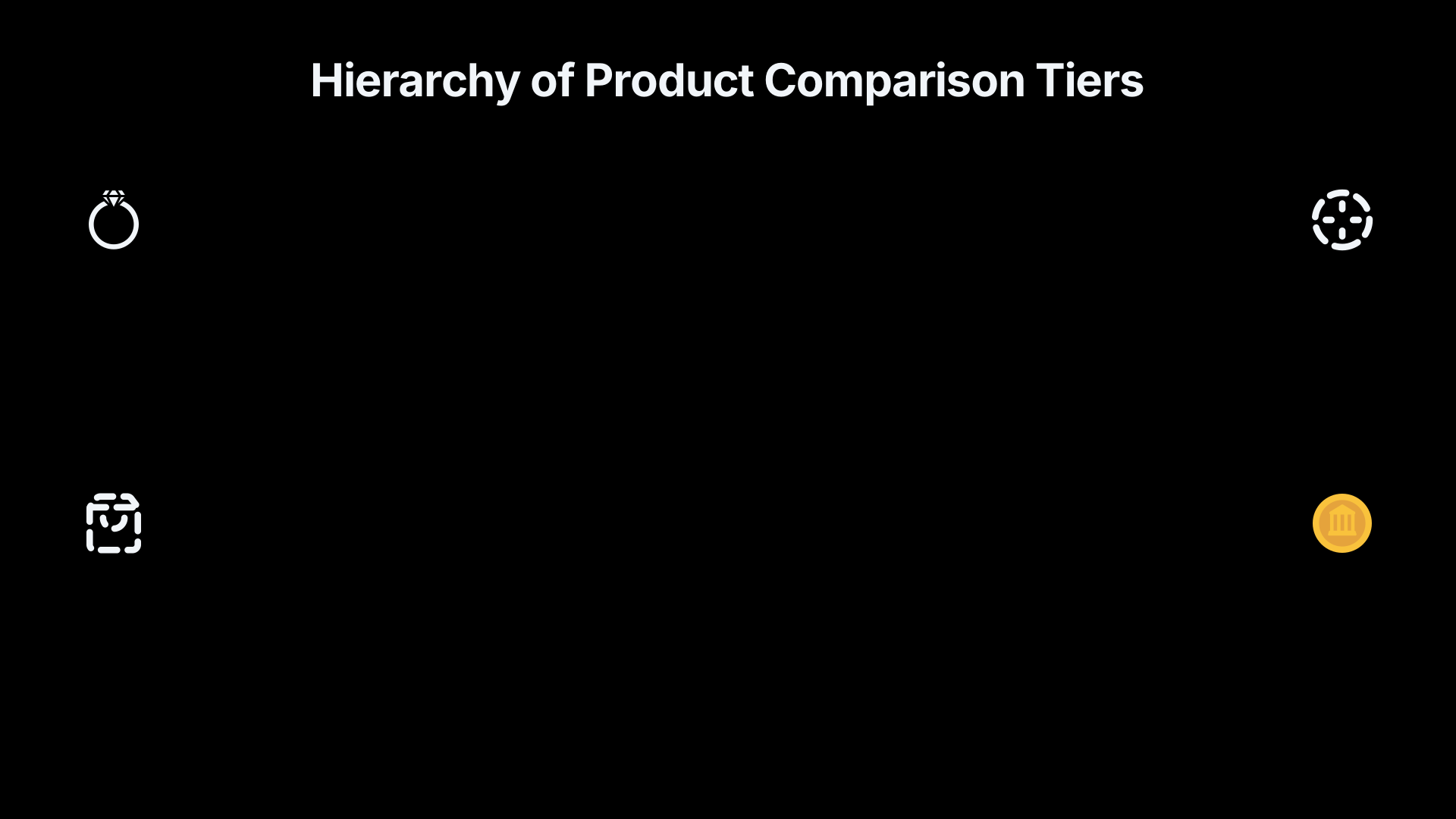
- Budget option: explains what buyers sacrifice and what they surprisingly still receive.
- Mid-range option: identifies where spending slightly more produces meaningful improvements.
- Premium option: demonstrates who genuinely benefits from the additional cost.
- Specialist option: explains why it excels for one audience while making little sense for everyone else.
Instead of using a single scoring system, compare products using criteria that matter for the intended reader.
For example, a budget camping stove might score lower on power but much higher on portability and value. A heavy-duty model may dominate long expeditions while being completely unnecessary for occasional weekend campers.
This prevents expensive products from appearing “better” simply because they have more features.

Explain Who Should Avoid Each Product
One of the strongest trust signals in affiliate content is identifying situations where a recommended product is a poor choice.
Many commercial reviews avoid discussing weaknesses because they fear reducing conversions. In practice, acknowledging limitations often increases credibility.
Useful examples include:
- “Not suitable if you need quiet operation.”
- “Avoid if you have limited storage space.”
- “Too complex for complete beginners.”
- “Excellent performance but costly replacement parts.”
- “Only worthwhile if you use it several times a week.”
Negative recommendations perform two valuable functions.
First, they prevent disappointed purchases that reduce reader trust.
Second, they demonstrate genuine evaluation rather than marketing enthusiasm.
Google’s review guidance specifically encourages discussing both benefits and drawbacks instead of presenting one-sided praise.[Google for Developers]developers.google.comGoogle for DevelopersWrite high quality reviewsWhen writing reviews, focus on the quality and originality of your reviews, not the length…
Build Decision Paths Instead of Product Rankings
Readers often arrive without knowing which category they belong to.
Instead of immediately presenting ten products, begin with a simple decision path.
For example:
- How much are you willing to spend?
- How often will you use it?
- What matters most—speed, durability, portability or ease of use?
- Do you expect to upgrade later?
- Are there important size or compatibility constraints?
Only after answering these questions should the page introduce products.
This structure mirrors the conversation an expert would have in person and reduces the likelihood of readers buying unsuitable equipment.
Avoid Common “Best-For” Mistakes
Not every use-case roundup improves quality. Several common shortcuts weaken both trust and usefulness.
Inventing artificial categories. If every product becomes “best for something”, the labels lose meaning.
Repeating identical descriptions. Changing only the heading while recycling the same explanation suggests the recommendations were created to increase affiliate links rather than help readers.
Ignoring trade-offs. Every recommendation should involve compromise. If every product is described as excellent, readers cannot distinguish meaningful differences.
Promoting commission over suitability. The highest-paying affiliate programme should never determine which product wins a category. Recommendations should remain consistent even if affiliate links disappear.
Why This Format Strengthens Affiliate Trust
Use-case roundups shift the focus from selling products to solving problems.
Readers leave with a clearer understanding of why one recommendation suits them and why another does not. Even those who decide not to buy immediately gain useful information, making them more likely to return when they are ready.
From a search perspective, this also creates richer, more original content. Instead of reproducing the same generic “top ten” rankings found across countless affiliate sites, the article demonstrates judgement, practical experience and audience awareness. Those qualities closely match Google’s published guidance for high-quality product reviews, which encourages original analysis, comparisons, discussion of trade-offs and recommendations tailored to different user needs.[Google for Developers]developers.google.comGoogle for DevelopersWrite high quality reviewsWhen writing reviews, focus on the quality and originality of your reviews, not the length…
Finally, remember that these recommendations are commercial content. If affiliate links generate commissions, that relationship should be disclosed clearly where readers will see it, rather than hidden on a separate disclosure page, helping maintain transparency and comply with advertising guidance.[Federal Trade Commission]ftc.govOpen source on ftc.gov.
Amazon book picks
Further Reading
Books and field guides related to Why Best-For Reviews Beat Best Overall. Use these as the next step if you want deeper reading beyond the article.
Everybody Writes
Helps produce clearer, audience-focused product reviews and comparisons.
They Ask, You Answer
Encourages answering real buyer questions, aligning with best-for review formats.
Building a StoryBrand 2.0
Helps frame recommendations around specific reader needs instead of generic messaging.
Influence: The Psychology of Persuasion
Explains persuasive decision-making useful for structuring buyer-focused recommendations ethically.
eBay marketplace picks
Marketplace Samples
Example marketplace items related to this page. Use the search link to explore similar finds on eBay.
Endnotes
1.
Source: developers.google.com
Link:https://developers.google.com/search/docs/specialty/ecommerce/write-high-quality-reviews
Source snippet
Google for DevelopersWrite high quality reviewsWhen writing reviews, focus on the quality and originality of your reviews, not the length...
2.
Source: blog.google
Title: more helpful product reviews
Link:https://blog.google/products-and-platforms/products/search/more-helpful-product-reviews/
Source snippet
on Search23 Mar 2022 — product reviews in Search meet certain criteria, such as: Include helpful in-depth details, like the benefits or d...
3.
Source: support.google.com
Link:https://support.google.com/product-documentation/answer/10115141?hl=en
Source snippet
Store review guidelinesFocus on what you liked or disliked about a product and your own experience using it. Don't include inappropriate...
4.
Source: support.google.com
Link:https://support.google.com/merchants/answer/6098512?hl=en-GB
Source snippet
rating policies - Google Merchant Center HelpWe strive to provide shoppers with access to transparent, authentic and helpful product revi...
6.
Source: ftc.gov
Title: s endorsement guides what people are asking
Source snippet
FTC's Endorsement Guides: What People Are Asking29 Jun 2023 — The Guides are intended to give insight into what the FTC thinks about vari...
Additional References
7.
Source: researchgate.net
Link:https://www.researchgate.net/publication/398541782The_Effects_of_the_FTC_Policy_and_Affiliation_Disclosures_on_Product_Review_Video_Engagement[Evidence
Source snippet
The Effects of the FTC Policy and Affiliation Disclosures on...12 Dec 2025 — This paper examines how the FTC policy affects viewer engag...
8.
Source: linkedin.com
Link:https://www.linkedin.com/posts/weence_ftc-endorsement-rules-google-reviews-what-activity-7458989740508299265-GkDC
Source snippet
FTC Endorsement Rules & Google Reviews: Compliance...9 May 2026 — The FTC's Endorsement Guides FAQ explains that material connections ca...
Published: May 2026
9.
Source: ftcattorney.com
Title: guide to ftc consumer review and testimonial rule
Link:https://ftcattorney.com/guide-to-ftc-consumer-review-and-testimonial-rule/
Source snippet
s1 Feb 2026 — The FTC's Rule on the Use of Consumer Reviews and Testimonials went into effect on October 21, 2024 and addresses deceptive...
Published: October 21, 2024
10.
Source: everything-pr.com
Title: Review platforms — [Amazon]({{ ‘amazon/’ | relative_url }}), Google, Yelp — fall
Link:https://everything-pr.com/ftc-influencer-disclosure-rules-2026-complete-guide
Source snippet
FTC Disclosure Rules 2026: What Brands & Creators Must KnowThe guidelines added explicit guidance prohibiting the creation, buying, or su...
11.
Source: susodigital.com
Title: How to Write Product Reviews: The Google Way
Link:https://susodigital.com/thoughts/how-to-write-product-reviews-the-google-way/
Source snippet
SUSO Digital28 Mar 2023 — Learn how to fine-tune your content and make sure that your product reviews are in line with Google's guidelines...
12.
Source: yotpo.com
Title: collect product reviews strategies
Link:https://www.yotpo.com/blog/collect-product-reviews-strategies/
Source snippet
7 Best Strategies To Collect Product Reviews (2026)15 Jan 2026 — Learn how to collect product reviews on autopilot. Discover 7 strategies...
13.
Source: youtube.com
Title: How to Write Amazon Product Reviews for Affiliate Websites Using Aff Pilot AI
Link:https://www.youtube.com/watch?v=zmMS1MguzJU
Source snippet
Learn How to Make a Profitable Product Review Website & Earn Affiliate Commissions...
14.
Source: yuko.so
Title: google reviews policy
Link:https://yuko.so/blog/google-reviews-policy/
Source snippet
Explained: Do's and Don'ts26 Nov 2025 — The Google review guidelines cover multiple aspects of the review process, including what content...
15.
Source: yotpo.com
Title: incentivized reviews
Link:https://www.yotpo.com/blog/incentivized-reviews/
Source snippet
Risks & Best Practices24 Sept 2025 — Don't risk fines or losing customer trust. Our expert guide covers the pros and cons of incentivized...
16.
Source: youtube.com
Link:https://www.youtube.com/watch?v=HKVQdlHM_Mo
Source snippet
Write High Converting Product Roundup Reviews With Product AI...
Topic Tree