Within Traffic
Where Should Affiliate Disclosures Appear?
Affiliate links still need clear disclosure when traffic comes from email, social posts, or community referrals.
On this page
- Why platform traffic does not remove disclosure duties
- Clear wording near links and recommendations
- Common mistakes in emails and social posts
Page outline Jump by section
Introduction
Affiliate disclosure obligations do not disappear simply because readers arrive through an email newsletter, a social media post, or a community recommendation instead of a search engine. If you earn a commission when someone buys through your recommendation, that commercial relationship should be made clear wherever the recommendation appears. The underlying principle is straightforward: readers should understand that you may benefit financially before, or at the time, they decide whether to trust or act on your recommendation. Regulators increasingly focus on whether disclosures are clear, prominent and understandable in the context of each platform, rather than whether a publisher has a disclosure policy hidden elsewhere on their website.[Federal Trade Commission+2eCFR]ftc.govFederal Trade CommissionFTC's Endorsement Guides: What People Are AskingHere are answers to some of the most frequently asked questions f…
 For affiliate websites that build traffic beyond Google, this means treating newsletters, social posts and community channels as independent publishing environments with their own disclosure responsibilities. A compliant disclosure on your website does not automatically cover a recommendation made in an email or on a social platform.
Why platform traffic does not remove disclosure duties
Affiliate disclosure rules are based on the existence of a material connection between the publisher and the merchant, not on the source of the visitor. Whether someone discovers a recommendation through Google, Instagram, LinkedIn, Reddit, Facebook, a newsletter or a private community, the potential commission remains capable of influencing the endorsement. Because that relationship could affect how readers evaluate the recommendation, it should be disclosed clearly.[Federal Trade Commission+2eCFR]ftc.govFederal Trade CommissionFTC's Endorsement Guides: What People Are AskingHere are answers to some of the most frequently asked questions f…
This principle has become increasingly important as affiliate publishers diversify their traffic sources. Many newsletters now contain product round-ups, deal alerts or software recommendations that function much like traditional affiliate review pages. Likewise, social media increasingly serves as the first touchpoint before readers visit an affiliate website. In both cases, the disclosure belongs where the recommendation is encountered, rather than relying solely on a website-wide disclaimer.
The practical consequence is that each communication should be judged independently. If an email contains affiliate links, the email itself should disclose the relationship. If a social media post encourages readers to click an affiliate link, that post should also contain an appropriate disclosure.[Federal Trade Commission+2SEQ Legal]ftc.govFederal Trade CommissionFTC's Endorsement Guides: What People Are AskingHere are answers to some of the most frequently asked questions f…
Clear wording near links and recommendations
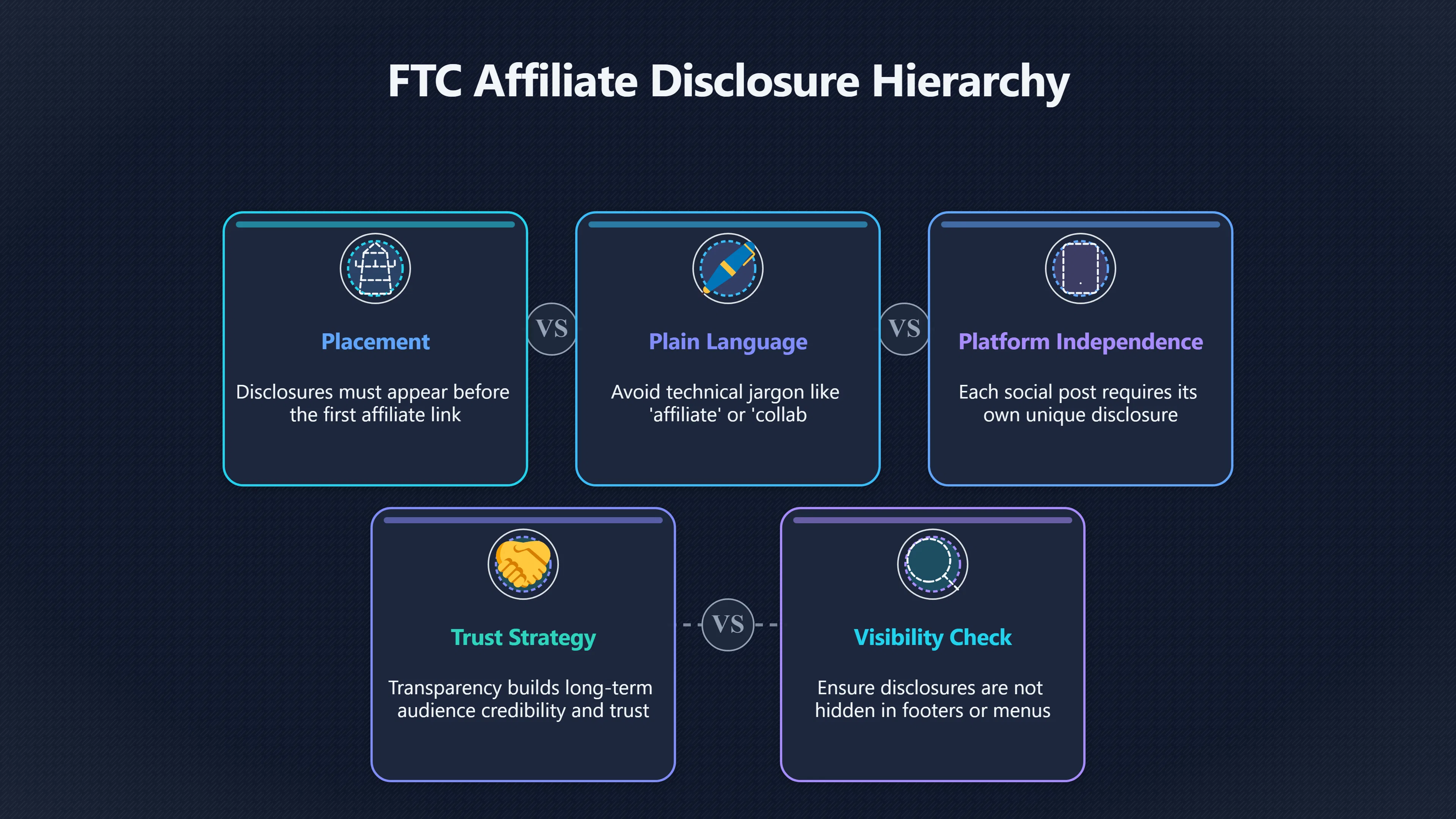
Regulators consistently emphasise that disclosures should be easy to notice and easy to understand. Technical language that assumes readers already know what affiliate marketing means is discouraged.
Simple wording usually works better than vague labels. For example:
- “This email contains affiliate links. If you buy through them, I may earn a commission at no extra cost to you.”
- “I may receive a commission if you purchase through these links.”
- “Paid link” immediately adjacent to the relevant link may also be acceptable where the relationship is obvious and clearly connected to the recommendation.[Manatt]manatt.coman in depth look at the ftcs updates 2An In-Depth Look at the FTC's Updates to the Endorsement…30 Jul 2023 — The FTC added additional guidance on disclosure of affili…
By contrast, wording such as:
- “Affiliate”[seqlegal.com]seqlegal.comaffiliate marketing lawsWhere email newsletters or marketing emails contain affiliate links, the affiliate relationship should be disclosed within the email itse… * “#affiliate”[seqlegal.com]seqlegal.comaffiliate marketing lawsWhere email newsletters or marketing emails contain affiliate links, the affiliate relationship should be disclosed within the email itse…
- “Partner link”
may not adequately explain the commercial relationship to ordinary readers because many people do not understand those terms on their own. The emphasis is on plain language that communicates the existence of compensation without requiring specialist knowledge.[Manatt]manatt.coman in depth look at the ftcs updates 2An In-Depth Look at the FTC's Updates to the Endorsement…30 Jul 2023 — The FTC added additional guidance on disclosure of affili…
Placement matters as much as wording. A disclosure hidden in a footer, on a separate disclosure page, or after multiple affiliate links is less likely to satisfy the expectation that consumers should understand the relationship before acting on a recommendation.[Federal Trade Commission]ftc.govFederal Trade CommissionFTC's Endorsement Guides: What People Are AskingHere are answers to some of the most frequently asked questions f…
Applying disclosure across newsletters and social channels
Different distribution channels require slightly different presentation, but the same underlying principle applies.
Email newsletters
Email newsletters are often overlooked because publishers assume subscribers already know the commercial model. That assumption is risky. New subscribers may arrive through referrals or forwards and never have visited the publisher’s website.
A practical approach is to:
- include a short disclosure near the beginning of any section containing affiliate recommendations;
- repeat disclosures in recurring recommendation sections rather than relying on a one-time welcome email;
- place the disclosure before the first affiliate link rather than only in the email footer.[SEQ Legal]seqlegal.comaffiliate marketing lawsWhere email newsletters or marketing emails contain affiliate links, the affiliate relationship should be disclosed within the email itse…
For newsletters mixing editorial content with product recommendations, disclosures can be brief without disrupting readability. Transparency generally strengthens trust because readers understand how the publication is funded.
Social media posts
Character limits do not remove disclosure obligations. Regulators have repeatedly indicated that disclosures should appear within the post itself when possible and be visible without requiring users to expand hidden text.
For example:
- place disclosures before “See more” truncation points where feasible;
- ensure the disclosure appears alongside the endorsement rather than only in a profile biography;
- repeat disclosures on separate promotional posts instead of assuming a previous disclosure still applies.[Federal Trade Commission+2Federal Trade Commission]ftc.govFederal Trade CommissionFTC's Endorsement Guides: What People Are AskingHere are answers to some of the most frequently asked questions f…
The same principle extends to short-form video, live streams and stories. If the recommendation contains affiliate links or another material commercial relationship, the disclosure should accompany that recommendation in a form viewers can reasonably notice.
Common mistakes in emails and social posts
Many compliance failures arise from convenience rather than deliberate concealment.
Common problems include:
- Relying only on a website disclosure page. Readers may never visit that page before clicking an affiliate link.
- Using vague labels. Terms like “affiliate” or “collab” may not explain that the publisher earns money from purchases.
- Hiding disclosures after the recommendation. Readers should not have to reach the end of an email or scroll past multiple links before learning about the relationship.
- Assuming subscribers already know. New readers, forwarded emails and first-time followers often lack that context.
- Disclosing once but not consistently. Each promotional communication should stand on its own because readers may encounter individual posts or emails in isolation.[Federal Trade Commission+2SEQ Legal]ftc.govFederal Trade CommissionFTC's Endorsement Guides: What People Are AskingHere are answers to some of the most frequently asked questions f…
Research examining affiliate disclosures on YouTube and Pinterest also found that many creators either omitted disclosures entirely or used wording that users did not fully understand. More explanatory disclosures helped readers recognise that the recommendation involved advertising or commission-based promotion, reinforcing the value of clear, plain-language statements over abbreviated labels.[arXiv]arxiv.orgEndorsements on Social Media: An Empirical Study of Affiliate Marketing Disclosures on YouTube and PinterestSeptember 3, 2018…

Building trust alongside compliance
Affiliate disclosures are often viewed solely as a legal requirement, but they also serve a commercial purpose. Readers who understand how a newsletter or social account is funded are less likely to feel misled when they discover affiliate relationships later.
For publishers building traffic beyond Google Search, consistent disclosure across newsletters, social media and community referrals creates a more coherent trust strategy. Every channel should communicate the same message: recommendations remain editorial, but the publisher may receive compensation if readers choose to buy through the provided links. That transparency supports both regulatory compliance and long-term audience credibility.[Federal Trade Commission+2Federal Trade Commission]ftc.govFederal Trade CommissionFTC's Endorsement Guides: What People Are AskingHere are answers to some of the most frequently asked questions f…
Amazon book picks
Further Reading
Books and field guides related to Where Should Affiliate Disclosures Appear?. Use these as the next step if you want deeper reading beyond the article.
Everybody Writes
Covers writing clear, trustworthy content across websites, email, and social channels where disclosures matter.
One million Followers
Relevant for creators promoting affiliate links across social platforms where disclosures must accompany endorsements.
Influence: The Psychology of Persuasion
Helps readers understand ethical persuasion and why transparency builds trust in recommendations.
Epic Content Marketing
Provides a strong foundation for building audience trust, making disclosure practices a natural complement.
eBay marketplace picks
Marketplace Samples
Live-tested eBay searches with available results related to this page.



Endnotes
1.
Source: ecfr.gov
Link:https://www.ecfr.gov/current/title-16/chapter-I/subchapter-B/part-255
Source snippet
16 CFR Part 255 -- Guides Concerning Use of...The Guides address the application of section 5 of the FTC Act, 15 USC 45, to the use of e...
2.
Source: manatt.com
Title: an in depth look at the ftcs updates 2
Link:https://www.manatt.com/insights/newsletters/advertising-law/an-in-depth-look-at-the-ftcs-updates-2
Source snippet
An In-Depth Look at the FTC's Updates to the Endorsement...30 Jul 2023 — The FTC added additional guidance on disclosure of affili...
3.
Source: arxiv.org
Link:https://arxiv.org/abs/1809.00620
Source snippet
Endorsements on Social Media: An Empirical Study of Affiliate Marketing Disclosures on YouTube and PinterestSeptember 3, 2018...
Published: September 3, 2018
4.
Source: arxiv.org
Link:https://arxiv.org/abs/1803.08488
5.
Source: youtube.com
Link:https://www.youtube.com/watch?v=TpYEmQ9njyk
Source snippet
New FTC Guidelines For Affiliate & Influencer MarketerS Must...New FTC Guidelines For Affiliate & Influencer MarketerS Must Watch Before...
6.
Source: youtube.com
Title: How to Disclose Affiliate Links on You Tube, Blogs, or Website — FTC Guidelines
Link:https://www.youtube.com/watch?v=IVjU36qO77A
Source snippet
FTC Disclosures 101 for Social Media Influencers & Creators...
7.
Source: youtube.com
Title: FTC Disclosures 101 for Social Media Influencers & Creators
Link:https://www.youtube.com/watch?v=oQhn2MkCyK4
Source snippet
Decoding the FTC: Understanding New Endorsement Guidelines For Influencer Marketing With Rob Freund...
8.
Source: youtube.com
Link:https://www.youtube.com/watch?v=pfdDMXxvLHI
9.
Source: youtube.com
Link:https://www.youtube.com/watch?v=ny2He3BVEgM
Source snippet
New FTC Guidelines & Disclosures that Brands, Agencies and Influencers Need to Know...
10.
Source: youtube.com
Link:https://www.youtube.com/watch?v=Hq1UDKzazVQ
Source snippet
Ftc affiliate disclosure guidelines social media email newsletter FTC Issues New Guidelines for Social Media Influencers Lon.TV [Snippets]({{ 'snippets/' | relative_url }})...
Source snippet
Federal Trade CommissionFTC's Endorsement Guides: What People Are AskingHere are answers to some of the most frequently asked questions f...
12.
Source: ftc.gov
Title: Federal Trade Commission Endorsements, Influencers, and Reviews
Source snippet
Federal Trade CommissionEndorsements, Influencers, and Reviews - Federal Trade CommissionAnswers to questions people are asking about the...
13.
Source: seqlegal.com
Title: affiliate marketing laws
Link:https://seqlegal.com/digital-marketing-laws/affiliate-marketing-laws/
Source snippet
Where email newsletters or marketing emails contain affiliate links, the affiliate relationship should be disclosed within the email itse...
14.
Source: termsfeed.com
Title: Affiliate payments
Link:https://www.termsfeed.com/blog/ftc-disclosures/
Source snippet
Federal Trade Commission (FTC) Disclosures - TermsFeedApril 21, 2026 — An affiliate disclosure lets users know that you receive some type...
Published: April 21, 2026
15.
Source: ftc.gov
Link:https://www.ftc.gov/
Source snippet
Federal Trade Commission | Protecting America's ConsumersThe official website of the Federal Trade Commission, protecting America's consu...
16.
Source: skinnerbooks.com
Title: affiliate link dos and donts
Link:https://skinnerbooks.com/affiliate-link-dos-and-donts/
Source snippet
Playing by the Rules: 6 affiliate link dos and don'ts in 2026You must disclose affiliate relationships right away: before the text, or on...
17.
Source: Wikipedia
Title: Federal Trade Commission
Link:https://en.wikipedia.org/wiki/Federal_Trade_Commission
Source snippet
Federal Trade CommissionThe Federal Trade Commission (FTC) is an independent agency of the United States government whose principal mi...
Additional References
18.
Source: federal-lawyer.com
Link:https://federal-lawyer.com/ftc-defense/affiliate-disclosure/
Source snippet
Understanding the FTC's Affiliate Disclosure RulesLearn what affiliate marketers and companies need to know about the FTC's affiliate dis...
19.
Source: adamigo.ai
Link:https://www.adamigo.ai/blog/ultimate-guide-to-ftc-ad-disclosures
20.
Source: craftindustryalliance.org
Link:https://craftindustryalliance.org/five-common-mistakes-involving-ftc-disclosures-for-affiliates-and-how-to-avoid-them/
Source snippet
5 Common Mistakes Involving FTC Disclosures for...24 Jun 2024 — Learn the common mistakes involving FTC disclosures for affiliates and h...
21.
Source: iubenda.com
Link:https://www.iubenda.com/en/blog/affiliate-disclosure/
Source snippet
isitors that you earn a commission when they purchase a product or...Read more...
22.
Source: support.avantlink.com
Title: 211635666 FTC Guidelines for Affiliate Marketing
Link:https://support.avantlink.com/hc/en-us/articles/211635666-FTC-Guidelines-for-Affiliate-Marketing
Source snippet
Guidelines for Affiliate Marketing - AvantLink SupportJuly 28, 2025 — These revised guidelines emphasize: Clear and conspicuous disclosur...
Published: July 28, 2025
23.
Source: postaffiliatepro.com
Title: betting affiliate disclosure requirements
Link:https://www.postaffiliatepro.com/blog/betting-affiliate-disclosure-requirements/
Source snippet
Betting Affiliate Disclosure: FTC & International Rules28 Nov 2025 — This comprehensive guide covers FTC regulations, international requi...
24.
Source: partnercentric.com
Title: how to properly disclose ftc endorsements
Link:https://partnercentric.com/blog/how-to-properly-disclose-ftc-endorsements/
Source snippet
17 Jun 2024 — We wanted to outline the essential steps for proper FTC disclosure and provide recommendations for e-commerce sites and inf...
25.
Source: stalirov.lawyer
Title: ftc affiliate marketing compliance
Link:https://stalirov.lawyer/en/posts/ftc-affiliate-marketing-compliance
Source snippet
FTC Affiliate Marketing & Compliance: Disclosure Rules...7 May 2025 — Learn FTC affiliate marketing rules ✓ Stay compliant, avoid viola...
Published: May 2025
26.
Source: termly.io
Title: ftc affiliate disclosure
Link:https://termly.io/resources/articles/ftc-affiliate-disclosure/
Source snippet
26 Feb 2026 — We unpack why you need an FTC affiliate disclosure if you promote, sponsor, or affiliate market another brand and explain w...
27.
Source: referralcandy.com
Title: ftc affiliate disclosure
Link:https://www.referralcandy.com/blog/ftc-affiliate-disclosure
Source snippet
Rules, Examples, and a 2026...This article teaches you what an FTC Affiliate Disclosure is, why you need one, who needs one, and best pr...
Topic Tree