Within Affiliate Pages
Can Expertise Beat Bigger Affiliate Sites?
A niche blog can earn affiliate income when practical expertise attracts readers before and during buying decisions.
On this page
- Building topical depth
- Mixing advice with buying pages
- Turning experience into recommendations
Page outline Jump by section
Introduction
Yes, expertise can beat bigger affiliate sites, but only in the right kind of niche and only when it is visible on the page. A niche authority blog earns affiliate income by turning practical experience into buying help: explaining trade-offs, showing real use, comparing alternatives, and recommending products in a way that readers can trust before they click a merchant link. That is different from a thin affiliate site that simply rewrites product descriptions or ranks items because they have attractive commissions.
This model works best where readers need judgement, not just a price. Home coffee, cycling repair, photography, kitchen equipment, camping gear, pet care, personal finance tools, software workflows, gardening, DIY, and specialist hobbies all reward writers who can explain what actually matters in use. Search engines and regulators have also pushed the market in this direction: Google’s review guidance favours first-hand evidence, original analysis, and expert or enthusiast knowledge, while UK and US advertising rules require affiliate relationships to be made clear. Federal Trade Commission+3Google for Developers+3Google for Developers[developers.google.com]developers.google.comGoogle for DevelopersWrite high quality reviewsWrite high quality reviews · Evaluate from a user's perspective. · Demonstrate that you ar…
Why Expertise Is the Small Site’s Advantage
Large affiliate sites often win on domain strength, publishing volume, and brand familiarity. A niche authority blog has a different advantage: it can go deeper into a narrow problem than a generalist site can justify. A cycling mechanic writing about torque wrenches, a barista testing hand grinders, or a parent comparing pushchairs after months of real use can answer questions that do not appear in a manufacturer’s specifications.
This matters because many buying decisions are not solved by “best overall”. Readers want to know which product fits their use case: a beginner’s road bike versus a commuter bike, a grinder for espresso versus pour-over, a tent for wet UK weekends versus dry summer festivals. Google’s guidance for high-quality reviews explicitly asks publishers to evaluate from a user’s perspective, show knowledge of the subject, provide evidence of their own experience, share quantitative measurements where useful, and explain what sets a product apart from competitors.[Google for Developers]developers.google.comGoogle for DevelopersWrite high quality reviewsWrite high quality reviews · Evaluate from a user's perspective. · Demonstrate that you ar…
The commercial advantage is that expert pages can attract people earlier than classic “best product” articles. A niche blog may win readers through maintenance guides, troubleshooting posts, buyer education, setup tutorials, and comparison explainers before those readers are ready to buy. When the same site later recommends a product, the affiliate link feels like a continuation of help rather than a sudden sales pitch.
A strong authority blog usually has three layers:
- Advice content, such as “why your espresso tastes sour” or “how to choose hiking boots for wide feet”.
- Buying content, such as product reviews, “best for” round-ups, and side-by-side comparisons.
- Ownership content, such as maintenance, accessories, troubleshooting, upgrades, and replacement decisions.
That structure gives the site topical depth. It also gives readers several ways to discover the blog before they reach a purchase page.
Building Topical Depth Without Becoming Generic
Topical depth means covering a subject like someone who actually understands it, not publishing dozens of shallow articles around the same keyword. A niche authority blog about home coffee, for example, should not only publish “best espresso machines”. It should explain grind size, water quality, pressure, milk steaming, burr types, cleaning routines, common faults, and the difference between entry-level and prosumer equipment. Those supporting pages make the commercial recommendations more credible.
Google’s people-first content guidance asks creators to consider whether their content demonstrates first-hand expertise and depth of knowledge, and whether readers would leave feeling they had learned enough to achieve their goal.[Google for Developers]developers.google.comOpen source on google.com. For an affiliate authority blog, that is a practical editorial test: if the page could have been written by someone who never touched the product or solved the problem, it is unlikely to build durable trust.
Topical depth also protects the site from relying on one fragile traffic pattern. A blog built only around “best X” pages competes directly with large publishers, coupon pages, retail marketplaces, and comparison tools. A blog with genuine topic coverage can rank for narrower, more specific problems: “quiet mechanical keyboard for shared office”, “bike chain skipping under load”, “best sleeping mat for side sleepers”, or “how to choose accounting software for a sole trader”. Those searches may be smaller, but the intent can be strong.
The important point is not to publish every possible article in the niche. It is to build a body of content that proves the site has a coherent point of view. A photography site that reviews camera bags should also understand lenses, travel workflows, weather protection, weight, access, airport restrictions, and how different photographers actually carry kit. A gardening site recommending secateurs should understand pruning style, hand size, blade maintenance, replacement parts, and plant types.
Mixing Advice With Buying Pages
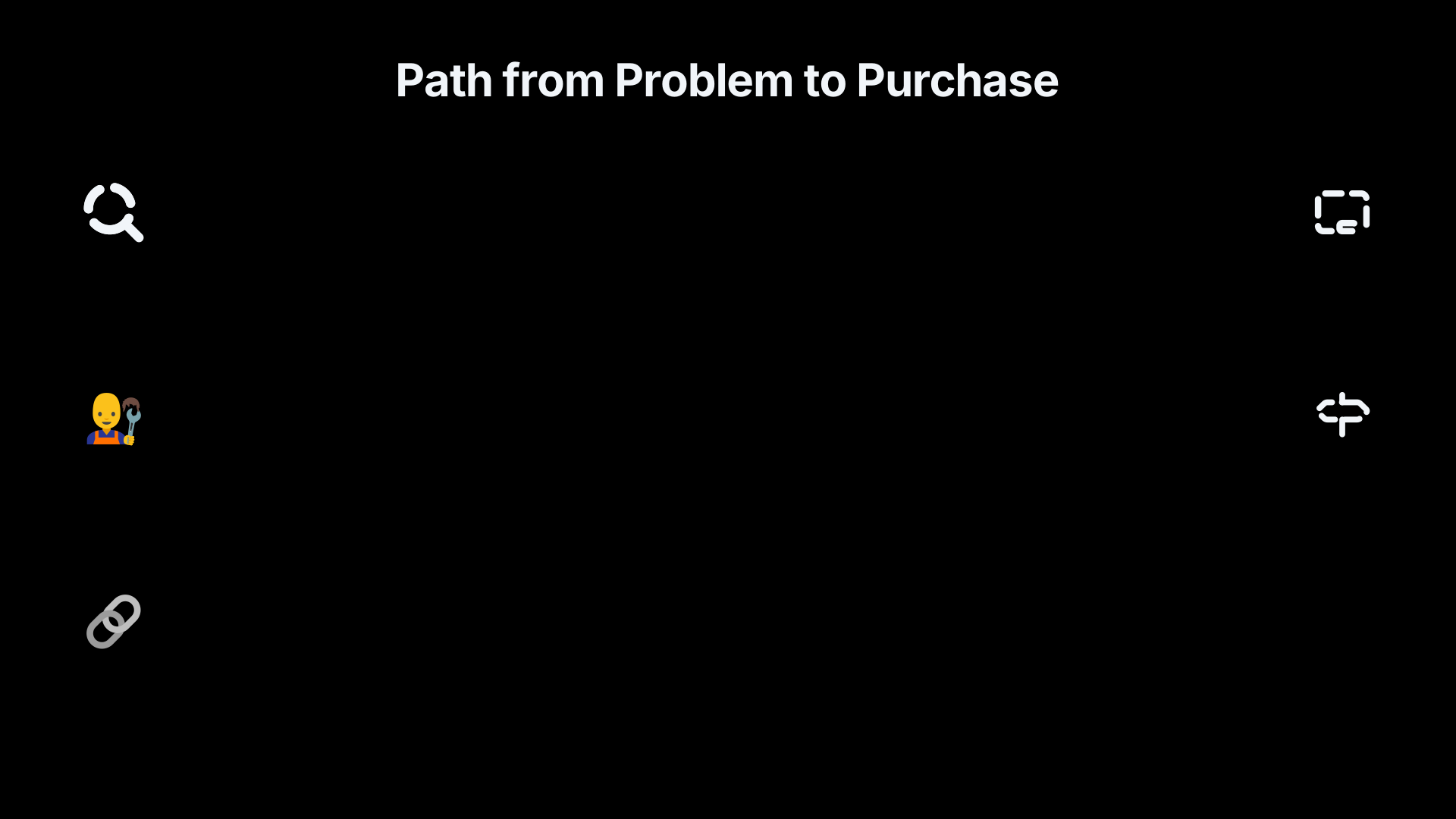
The best niche authority blogs do not treat editorial content and affiliate content as separate worlds. They create a path from problem to purchase. A reader might arrive through a troubleshooting guide, learn what caused the issue, compare possible fixes, and then click to a recommended tool, part, course, or product.
A useful structure is:
- Start with the reader’s problem. Explain the situation clearly before mentioning products.
- Teach the decision criteria. Show what matters, what does not, and why.
- Compare realistic options. Include cheaper, simpler, premium, and specialist routes when they genuinely fit.
- Recommend with conditions. Say who each product suits and who should avoid it.
- Link only where the product solves the problem. The affiliate link should feel earned.
This is where authority blogs can beat bigger affiliate pages. A generalist site may list ten products with specifications and prices. A niche expert can say, “This is excellent, but not if you have small hands,” “This cheaper version is fine unless you use it daily,” or “The upgrade only matters if you already own the rest of this system.” That type of recommendation is commercially valuable because it reduces uncertainty.
Google’s reviews system says it aims to reward reviews that provide insightful analysis and original research, especially when written by experts or enthusiasts who know the topic well.[Google for Developers]developers.google.comGoogle for DevelopersGoogle Search's Reviews SystemThe reviews system aims to better reward high quality reviews, which is content that p… That does not guarantee rankings, but it describes the direction of travel: a review page should add something beyond a merchant page, a specification table, or a generic summary.
Turning Experience Into Recommendations
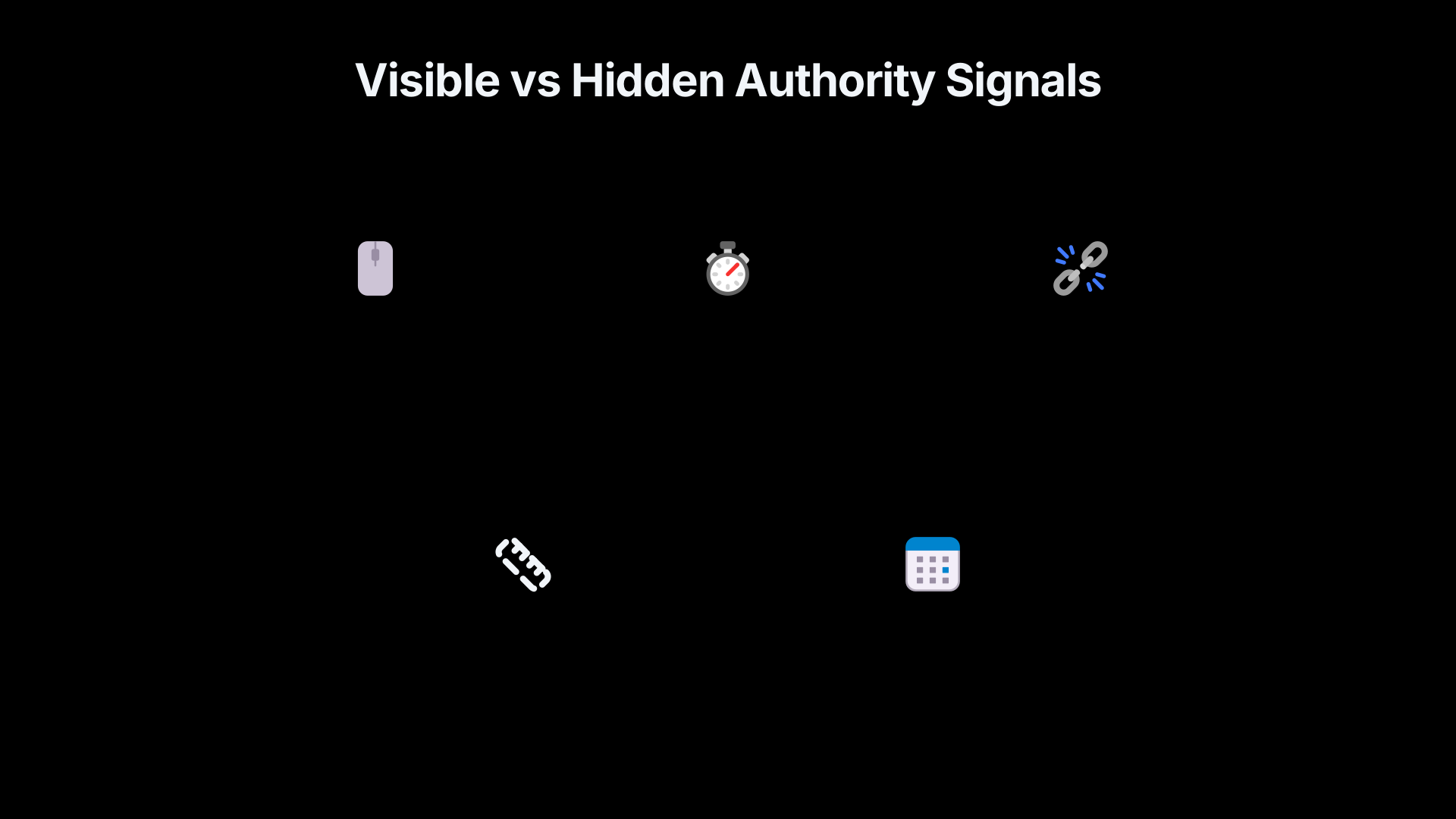
Experience needs to be shown, not merely claimed. Many affiliate pages say they are “expert tested” without making the testing visible. A niche authority blog should make the basis of its judgement obvious.
Useful signals include:
- Original photographs showing the product in use, not just stock images.
- Testing notes explaining how long the product was used and in what conditions.
- Measurements such as weight, battery life, noise, capacity, running cost, speed, durability, or fit.
- Failure observations such as weak hinges, poor instructions, awkward cleaning, unreliable apps, uncomfortable straps, or replacement-part problems.
- Comparisons to older models or products the audience already knows.
- Long-term updates showing whether the recommendation still holds after months of use.
OutdoorGearLab is a clear example of the authority-commerce model in action. It describes itself as reader-supported, says it makes money when readers click affiliate links and buy reviewed products, and frames that revenue as support for its testing work.[GearLab]outdoorgearlab.comGear Lab About Gear LabGear Lab About Gear Lab Its outdoor reviews are built around side-by-side product testing, which gives readers more than a simple list of merchant links.[GearLab]outdoorgearlab.comOpen source on outdoorgearlab.com.
Serious Eats shows the same principle in a different niche. Its equipment-review process emphasises empirical testing, specific test designs, culinary expertise, editorial vetting, and periodic updates; it also states that affiliate commissions do not affect its review process.[Serious Eats]seriouseats.comSerious Eats How We Test ProductsExpert opinion and rigorous in-house and external testing are central to our process. We conduct tests that go beyond typical home use, s… Its wider editorial standards stress recipe testing, experienced contributors, fact-checking, corrections, and a separation between editorial and advertising.[Serious Eats]seriouseats.comSerious Eats Editorial GuidelinesSerious Eats Editorial Guidelines
These examples matter because they show that the commercial page is stronger when it grows out of real subject knowledge. The reader is not just being pushed towards a product. They are being shown why a recommendation exists.
The Trust Problem Affiliate Blogs Must Solve
Affiliate income creates an obvious conflict of interest. The publisher earns when a reader buys, and different merchants may pay different rates. That does not make affiliate content automatically untrustworthy, but it does mean the trust burden is higher.
UK guidance from the Advertising Standards Authority says affiliate marketing is performance-based marketing in which an affiliate is rewarded for customers attracted through their marketing, usually through sales or click-throughs. It also explains that content containing affiliate links may need to be identifiable as advertising, depending on the nature of the content and arrangement.[ASA]asa.org.ukaffiliate marketingOnline Affiliate Marketing22 Mar 2023 — Affiliate marketing is a type of performance-based marketing where an affiliate is rewarded by… In the US, the Federal Trade Commission’s endorsement guidance says disclosures should be clear when there is a material connection between an endorser and a seller that consumers would not expect.[Federal Trade Commission]ftc.govs endorsement guides what people are askings endorsement guides what people are asking
Disclosure is not just a legal hygiene issue. It affects credibility. A Princeton-led empirical study of affiliate disclosures on YouTube and Pinterest found that only about one in ten affiliate-marketing items in its large sample contained any disclosure, and that short, vague disclosures were often not understood by users.[arXiv]arxiv.orgOpen source on arxiv.org. A 2026 study of YouTube affiliate marketing similarly found widespread affiliate linking with low disclosure compliance, and argued that standardised platform disclosure features were associated with improved compliance.[arXiv]arxiv.orgOpen source on arxiv.org.
For a niche authority blog, the best approach is simple and visible:
- Put a plain-language affiliate disclosure near the top of commercial pages.
- Explain that commissions do not change the price paid by the reader, if that is true.
- Separate editorial judgement from commission data.
- Say when products were bought, borrowed, supplied for review, or tested through a loan programme.
- Update pages when products change, disappear, or become poor value.
A disclosure hidden in a footer does little to reassure a reader who is deciding whether to trust a recommendation. A clear disclosure, paired with visible testing and balanced criticism, is more durable.
Why Bigger Is Not Always Better
Large publishers have resources, but they also have weaknesses. They may cover many categories, rely on freelance round-ups, move slowly when products change, or prioritise high-volume keywords. A niche authority blog can be sharper because it lives inside the reader’s actual problem.
The Wirecutter story shows both the power and the limits of authority-led affiliate content. The New York Times bought Wirecutter, along with its home-focused sibling The Sweethome, for more than $30 million in 2016.[Nieman Lab]niemanlab.orgOpen source on niemanlab.org. That acquisition helped prove that product-review journalism and affiliate commerce could become a serious media asset, not just a side hustle. At the same time, Wirecutter’s scale makes it hard for a small blog to copy directly. A niche site should not try to become a miniature Wirecutter across every category; it should become the most useful source in a smaller lane.
NerdWallet shows a related version of authority commerce in financial decisions. Its public investor materials describe revenue across verticals such as loans, banking products, and other financial categories, with Q1 2026 revenue of $222.2 million.[NerdWallet, Inc]investors.nerdwallet.comOpen source on nerdwallet.com. That is far beyond the scale of a typical niche blog, but the underlying lesson is relevant: affiliate-style monetisation works best when content helps readers make high-stakes, high-intent decisions.
The smaller publisher’s opportunity is not to outspend these companies. It is to choose a tighter subject and provide evidence the generalist cannot easily manufacture: real maintenance experience, field testing, professional judgement, community knowledge, and frank discussion of edge cases.
Where Authority Blogs Make the Most Money
Not every expert niche is equally commercial. A blog can be trusted and still earn little if the products are cheap, rarely bought online, unavailable through affiliate programmes, or too local to monetise.
The strongest niches usually combine four conditions:
Readers have a real buying decision. The product is not an impulse purchase only. Readers compare options, worry about mistakes, and search for advice.
The topic benefits from experience. A knowledgeable person can explain comfort, durability, setup, compatibility, maintenance, learning curve, or hidden costs better than a specification sheet can.
Affiliate programmes exist. Suitable merchants, networks, or direct programmes must track purchases reliably and pay enough to justify the content effort.
The site can keep recommendations current. Product pages decay quickly when prices change, models are discontinued, or software features shift.
The wider affiliate market is large enough to support specialist publishers. The UK Affiliate & Partner Marketing Association reported that brands invested £1.8 billion in affiliate and partner marketing in 2025, generating £20.7 billion in revenue and 357 million tracked transactions.[APMA]theapma.co.ukOpen source on theapma.co.uk. Those numbers do not mean any one blog will succeed, but they show that affiliate links remain a mainstream commercial channel.
A niche authority blog should still be careful about niche selection. “Best budget pens” may attract readers but produce tiny commissions. “Best camera bag for wedding photographers” or “best accounting software for landlords” may have fewer searches but more valuable buying intent. The right niche balances audience size, commission potential, product complexity, and the writer’s ability to offer real expertise.
The Pages That Usually Carry the Revenue
A niche authority blog rarely earns evenly across all content. A small number of commercial pages usually carry most affiliate income, while informational pages build trust, attract links, and move readers towards buying decisions.
The most valuable page types are often:
- Best-for pages, such as “best hiking boots for wide feet” or “best espresso grinder for beginners”.
- Single-product reviews, especially for expensive or complex products.[blog.google]blog.googlemore helpful product reviewsmore helpful product reviews
- Alternatives pages, such as “Product A versus Product B” or “best cheaper alternative to Product X”.
- System pages, such as complete starter kits, upgrade paths, or compatible accessories.
- Problem-solution pages, where the purchase is framed as a fix rather than a generic recommendation.
- Maintenance and replacement pages, such as filters, blades, batteries, cables, parts, and consumables.
The authority layer matters because it prevents these pages from becoming interchangeable. A generic “best tent” article competes with everyone. A field-tested guide to tents for windy, wet, two-person backpacking trips has a clearer audience, sharper criteria, and more room for genuine judgement.
The highest-performing affiliate pages often answer three questions at once: What should I buy? Why should I trust this recommendation? What mistake should I avoid?

Common Failure Modes
The biggest mistake is treating expertise as decoration. An author bio saying “expert” does not compensate for thin content. Readers need to see the expertise in the page: the examples, the caveats, the tests, the comparisons, and the willingness to say when a popular product is not the right choice.
Another failure is commission-led selection. If a blog only recommends products with affiliate programmes, readers may eventually notice gaps. This criticism appears regularly in user discussions of review sites, especially when readers suspect that products without affiliate links are underrepresented. Such comments are not formal evidence of bias in any specific review, but they reflect a real trust risk for affiliate publishers.[Reddit]reddit.comOutdoor Gear Lab.com: r/arcteryxOutdoor Gear Lab.com: r/arcteryx
A third failure is scaling content faster than knowledge. Google’s March 2024 search update and spam policies targeted low-quality, unoriginal content and practices such as scaled content abuse, expired domain abuse, and site reputation abuse.[blog.google]blog.googleOpen source on blog.google. For niche authority blogs, the lesson is not “never use tools” or “publish slowly for its own sake”. It is that the site’s value must come from judgement, testing, usefulness, and editorial responsibility, not from mass-producing pages that imitate expertise.
A fourth failure is letting buying pages drift out of date. A recommendation can become wrong because the product changed, the price doubled, a newer model fixed the flaw, or better competitors appeared. Authority is not a one-time asset; it has to be maintained.
What a Strong Niche Authority Blog Looks Like in Practice
A strong affiliate authority blog usually has a clear editorial promise. It does not merely say, “We review products.” It says, in effect, “We understand this problem, we have used or studied the options, and we will help you avoid a bad purchase.”
A practical pattern might look like this:
A home coffee blog publishes brewing guides, grinder explanations, water-quality tests, machine maintenance articles, beginner mistakes, and detailed grinder comparisons. Its buying pages recommend equipment by brewing style, budget, counter space, and tolerance for tinkering.
A cycling maintenance blog explains drivetrain wear, tyre pressure, winter riding, chain lubrication, tool compatibility, and repair workflows. Its affiliate links point to tools, parts, lubricants, lights, clothing, and repair stands that fit specific use cases.
A kitchen-equipment blog tests pans, knives, thermometers, food processors, and storage containers in repeatable cooking tasks. It explains not just which item won, but why the result matters for home cooking.
A software workflow blog compares tools by real tasks: invoicing, client onboarding, project handover, note capture, reporting, or collaboration. Its affiliate recommendations are strongest when the writer has built workflows inside the tools rather than just describing feature lists.
In each case, expertise creates commercial leverage because the advice is specific. The site is not selling everything. It is helping a defined audience make better purchases inside a subject the publisher genuinely understands.
How to Keep Monetisation From Weakening the Blog
Affiliate links should be added after the recommendation logic, not before it. A niche authority blog loses its advantage when every article feels like a funnel and every product mention becomes a sales opportunity.
A healthier editorial rule is to ask whether the reader would still benefit if all affiliate links were removed. If the answer is no, the article is probably too commercial and too thin. If the answer is yes, affiliate links can monetise value that already exists.
Good authority blogs also use “negative space”: they tell readers when not to buy. That may seem commercially counterproductive, but it builds trust. Saying “you do not need this upgrade yet” or “this is overkill for beginners” can make the next recommendation more persuasive.
The commercial model also works better when the site diversifies gradually. Affiliate income can sit alongside display advertising, sponsorships, email newsletters, paid guides, courses, consulting, communities, templates, or digital tools. However, those additions should grow from the same expertise. A cycling blog can sell a maintenance course; a coffee blog can sell a brew-dialling worksheet; a software blog can sell setup templates. Random monetisation weakens the authority signal.
The Real Answer: Expertise Wins When It Reduces Risk
Expertise can beat bigger affiliate sites when it reduces the reader’s risk better than scale does. A large site may be more recognisable, but a focused expert can be more useful at the exact moment of decision. That usefulness comes from testing, lived experience, careful comparisons, honest limitations, clear disclosures, and regular updates.
The opportunity is not to disguise a sales site as a blog. It is to build a specialist publication where affiliate income is the by-product of trusted recommendations. The more complex, expensive, personal, or failure-prone the purchase, the more valuable that trust becomes.
Amazon book picks
Further Reading
Books and field guides related to Can Expertise Beat Bigger Affiliate Sites?. Use these as the next step if you want deeper reading beyond the article.
Affiliate Marketing
Directly covers building and growing affiliate websites, including content strategy and monetization.
They Ask, You Answer
Focuses on using authentic expertise and transparent buying advice to earn trust.
The Art of SEO
Provides the search optimization foundation needed for expert-led niche authority sites.
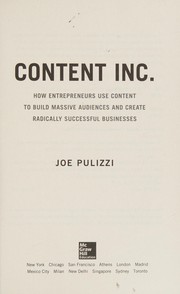
Content Inc
Explains how deep expertise and audience-first content create sustainable businesses.
eBay marketplace picks
Marketplace Samples
Live-tested eBay searches with available results related to this page.


Endnotes
1.
Source: developers.google.com
Link:https://developers.google.com/search/docs/specialty/ecommerce/write-high-quality-reviews
Source snippet
Google for DevelopersWrite high quality reviewsWrite high quality reviews · Evaluate from a user's perspective. · Demonstrate that you ar...
2.
Source: developers.google.com
Link:https://developers.google.com/search/docs/appearance/reviews-system
Source snippet
Google for DevelopersGoogle Search's Reviews SystemThe reviews system aims to better reward high quality reviews, which is content that p...
3.
Source: asa.org.uk
Title: affiliate marketing
Link:https://www.asa.org.uk/advice-online/affiliate-marketing.html
Source snippet
Online Affiliate Marketing22 Mar 2023 — Affiliate marketing is a type of performance-based marketing where an affiliate is rewarded by...
4.
Source: developers.google.com
Link:https://developers.google.com/search/docs/fundamentals/creating-helpful-content
5.
Source: outdoorgearlab.com
Title: Gear Lab About Gear Lab
Link:https://www.outdoorgearlab.com/about
6.
Source: outdoorgearlab.com
Link:https://www.outdoorgearlab.com/
7.
Source: asa.org.uk
Title: get yourself affiliated with the rules on affiliate marketing
Link:https://www.asa.org.uk/news/get-yourself-affiliated-with-the-rules-on-affiliate-marketing.html
8.
Source: arxiv.org
Link:https://arxiv.org/abs/1809.00620
9.
Source: arxiv.org
Link:https://arxiv.org/abs/2603.04383
10.
Source: investors.nerdwallet.com
Link:https://investors.nerdwallet.com/news-releases/news-release-details/nerdwallet-reports-first-quarter-results
11.
Source: theapma.co.uk
Link:https://theapma.co.uk/uk-affiliate-and-partner-marketing-spend-surges-to-1-8bn-as-brands-invest-in-tried-and-tested-performance-channels/
12.
Source: reddit.com
Title: Outdoor Gear Lab.com: r/arcteryx
Link:https://www.reddit.com/r/arcteryx/comments/ey7i08/outdoorgearlabcom/
13.
Source: blog.google
Link:https://blog.google/products-and-platforms/products/search/google-search-update-march-2024/
14.
Source: developers.google.com
Title: core update spam policies
Link:https://developers.google.com/search/blog/2024/03/core-update-spam-policies
15.
Source: developers.google.com
Title: qualify outbound links
Link:https://developers.google.com/search/docs/crawling-indexing/qualify-outbound-links
16.
Source: support.google.com
Title: is affiliate marketing dead
Link:https://support.google.com/webmasters/thread/257058271/is-affiliate-marketing-dead?hl=en
17.
Source: support.google.com
Link:https://support.google.com/webmasters/thread/302446608/provide-details-about-the-affiliate-products-review-guidelines-and-can-we-used-more-than-ads-network?hl=en
18.
Source: support.google.com
Title: low traffic affiliate site what can i do better
Link:https://support.google.com/webmasters/thread/112211009/low-traffic-affiliate-site-what-can-i-do-better?hl=en
19.
Source: services.google.com
Title: hsw sqrg
Link:https://services.google.com/fh/files/misc/hsw-sqrg.pdf
20.
Source: developers.google.com
Title: product reviews update and your site
Link:https://developers.google.com/search/blog/2021/12/product-reviews-update-and-your-site
21.
Source: support.google.com
Link:https://support.google.com/merchants/answer/6098512?hl=en-GB
22.
Source: google.com
Link:https://www.google.com/intl/en_us/search/howsearchworks/how-search-works/ranking-results
23.
Source: support.google.com
Link:https://support.google.com/merchants/answer/14620705?hl=en
24.
Source: investors.nerdwallet.com
Link:https://investors.nerdwallet.com/
25.
Source: investors.nerdwallet.com
Title: nerdwallet reports fourth quarter and full year 2025 results
Link:https://investors.nerdwallet.com/news-releases/news-release-details/nerdwallet-reports-fourth-quarter-and-full-year-2025-results/
26.
Source: investors.nerdwallet.com
Link:https://investors.nerdwallet.com/static-files/13ed8fce-3133-4294-ac05-d2df82c61b64
27.
Source: investors.nerdwallet.com
Link:https://investors.nerdwallet.com/static-files/43e39e3e-07cd-4ec9-b476-9358ef6afda6
28.
Source: youtube.com
Link:https://www.youtube.com/watch?v=7d5v6zmS-No&vl=en
29.
Source: youtube.com
Link:https://www.youtube.com/watch?v=LKROs5JIVfk
30.
Source: youtube.com
Link:https://www.youtube.com/watch?v=Z0RkLSgwQS4
31.
Source: youtube.com
Link:https://www.youtube.com/watch?v=gX9W0io6mpo
32.
Source: youtube.com
Link:https://www.youtube.com/watch?v=6qU4Z46nxr8
33.
Source: youtube.com
Title: Affiliate Case Study: 0
Link:https://www.youtube.com/watch?v=R2FuKf_0TbM
34.
Source: youtube.com
Link:https://www.youtube.com/watch?v=Gj4Zx6Vj7ko
35.
Source: youtube.com
Title: [Amazon]({{ ‘amazon/’ | relative_url }}) Affiliate Example
Link:https://www.youtube.com/watch?v=uYCADdavGXY
36.
Source: youtube.com
Title: Affiliate Site Case Study
Link:https://www.youtube.com/watch?v=a9CT_Vd_118
37.
Source: youtube.com
Link:https://www.youtube.com/watch?v=wZ-nssejqoE
38.
Source: blog.google
Title: more helpful product reviews
Link:https://blog.google/products-and-platforms/products/search/more-helpful-product-reviews/
39.
Source: reddit.com
Link:https://www.reddit.com/r/Affiliatemarketing/comments/e5wr1q/an_elegant_solution_for_affiliate_disclosure/
40.
Source: reddit.com
Link:https://www.reddit.com/r/SEO/comments/1ckfohi/google_algorithm_rolls_out_tomorrow_site/
41.
Source: reddit.com
Link:https://www.reddit.com/r/seriouseats/comments/1ay6dw1/are_serious_eats_reviews_reliable/
42.
Source: reddit.com
Link:https://www.reddit.com/r/Anticonsumption/comments/1pitgbz/opinion_on_nyt_wirecutter_and_alternative/
43.
Source: reddit.com
Link:https://www.reddit.com/r/juststart/comments/595kau/thoughts_on_nytimes_buying_wirecutter_for_30m/
44.
Source: youtube.com
Link:https://www.youtube.com/watch?v=H-rdg_oGZ50
Source snippet
How to Start Affiliate Marketing in 2026...
45.
Source: youtube.com
Link:https://www.youtube.com/watch?v=HnV5JXBWCeQ
Source snippet
Affiliate Marketing Tutorial for Beginners in 2026 (Free Course)...
46.
Source: youtube.com
Link:https://www.youtube.com/watch?v=eyA2ydgXkVE
Source snippet
How To Build Topical Authority in Affiliate Marketing...
47.
Source: youtube.com
Title: How To Build Topical Authority in Affiliate Marketing
Link:https://www.youtube.com/watch?v=0SUN6Jq-FRA
Source snippet
How to Build a $1000+/Month Affiliate Marketing Website (Make Passive Income Online)...
48.
Source: youtube.com
Link:https://www.youtube.com/watch?v=PvHi3Dk91Jw
49.
Source: ftc.gov
Title: s endorsement guides what people are asking
50.
Source: seriouseats.com
Title: Serious Eats How We Test Products
Link:https://www.seriouseats.com/commerce-guidelines-and-mission-5120865
Source snippet
Expert opinion and rigorous in-house and external testing are central to our process. We conduct tests that go beyond typical home use, s...
51.
Source: seriouseats.com
Title: Serious Eats Editorial Guidelines
Link:https://www.seriouseats.com/serious-eats-editorial-guidelines-5218189
52.
Source: niemanlab.org
Link:https://www.niemanlab.org/2016/10/the-new-york-times-is-buying-the-gadget-and-technology-review-site-the-wirecutter-for-30-million/
53.
Source: termsfeed.com
Title: Federal Trade Commission (FTC) Disclosures
Link:https://www.termsfeed.com/blog/ftc-disclosures/
54.
Source: theapma.co.uk
Title: what the latest asa rulings mean for affiliate marketing
Link:https://theapma.co.uk/what-the-latest-asa-rulings-mean-for-affiliate-marketing/
55.
Source: theapma.co.uk
Title: inside the numbers apma panel on affiliate marketings 2025 success
Link:https://theapma.co.uk/inside-the-numbers-apma-panel-on-affiliate-marketings-2025-success/
56.
Source: seriouseats.com
Link:https://www.seriouseats.com/legal-5120726
57.
Source: news.ycombinator.com
Link:https://news.ycombinator.com/item?id=37272214
58.
Source: grubstreet.com
Title: serious eats oral history
Link:https://www.grubstreet.com/2019/06/serious-eats-oral-history.html
59.
Source: assets.publishing.service.gov.uk
Title: Affiliate and Partner Marketing Association
Link:https://assets.publishing.service.gov.uk/media/69b970d8635612b767a4665f/Affiliate_and_Partner_Marketing_Association.pdf
61.
Source: GOV.UK
Title: social media endorsements being transparent with your followers
Link:https://www.gov.uk/government/publications/social-media-endorsements-guidance-for-content-creators/social-media-endorsements-being-transparent-with-your-followers
Additional References
62.
Source: ecfr.gov
Link:https://www.ecfr.gov/current/title-16/chapter-I/subchapter-B/part-255
63.
Source: awin.com
Link:https://www.awin.com/gb/market-insights
64.
Source: slideshare.net
Link:https://www.slideshare.net/slideshow/disclosures-for-affiliate-links/79694916
65.
Source: instagram.com
Link:https://www.instagram.com/reel/DTxPjwKCKY-/
66.
Source: qualia-academy.co.uk
Link:https://qualia-academy.co.uk/google-e-e-a-t-guidelines/
67.
Source: aspendigital.nl
Link:https://www.aspendigital.nl/en/insights/e-e-a-t/
68.
Source: linkedin.com
Link:https://www.linkedin.com/posts/american-marketing-association_ai-search-engines-and-googles-quality-raters-activity-7393073598149599233-shfy
69.
Source: linkedin.com
Link:https://www.linkedin.com/posts/cyrusshepard_googles-helpful-content-system-now-part-activity-7318882316993339392-NduX
70.
Source: iubenda.com
Link:https://www.iubenda.com/en/blog/affiliate-disclosure/
71.
Source: medium.com
Link:https://medium.com/the-business-of-content/inside-the-new-york-timess-post-acquisition-strategy-for-wirecutter-f6123b5f285f
Topic Tree
Follow this branch
Parent topic
Affiliate PagesRelated pages 29
- Amazon Is Amazon Associates Still Good for Beginners?
- Appliances What Kitchen Appliance Reviews Often Miss
- Baby Travel Why Baby Travel Gear Reviews Need More Trust
- Business Tools Can Small Business Software Be a Better Affiliate Niche?
- Commissions How Do Affiliate Websites Actually Get Paid?
- +24 more in sidebar