Within Comparisons
Can Readers Trust Affiliate Rankings?
Clear commission disclosure helps readers understand when affiliate income may affect coverage, ranking, or wording.
On this page
- Where commission can distort comparisons
- What readers need disclosed upfront
- How to explain ranking independence clearly
Page outline Jump by section
Introduction
Affiliate comparison pages can be both genuinely useful and commercially successful. The key question is not whether they earn commission, but whether readers can clearly see when commercial relationships could influence product selection, wording or rankings. A comparison page that openly explains its affiliate relationships is more likely to earn trust than one that presents itself as entirely impartial while hiding how it makes money.
 Modern consumer protection guidance increasingly focuses on transparency rather than banning affiliate marketing outright. Regulators generally accept that publishers can earn commission from recommendations, provided readers receive clear, timely information about those financial relationships before they rely on rankings or click affiliate links. The strongest comparison pages therefore treat disclosure as part of the editorial experience rather than as a legal afterthought.[Federal Trade Commission+2Federal Trade Commission]ftc.govs endorsement guides what people are askingFederal Trade CommissionFTC's Endorsement Guides: What People Are Asking29 Jun 2023 — Another principle in the Guides applies to ads that…
Can Readers Trust Affiliate Rankings?
Readers should approach affiliate rankings with informed confidence rather than automatic suspicion. Commission does not necessarily make a comparison misleading, but undisclosed commercial incentives can make it difficult to judge whether recommendations are based on genuine evaluation or financial reward.
Many affiliate publishers spend significant time testing products, comparing pricing, and explaining trade-offs. Their commercial incentive is compatible with useful journalism when editorial decisions remain independent. The problem arises when commercial arrangements influence rankings without readers being told that they might.
The updated US Federal Trade Commission (FTC) Endorsement Guides specifically address supposedly independent review and ranking sites. They state that businesses should not market a review site as independent if material commercial relationships exist, and that companies should not be able to buy higher positions in rankings presented as objective.[Kelley Drye & Warren LLP]kelleydrye.comnew endorsement guides include big changes but few surprisesKelley Drye & Warren LLPNew Endorsement Guides Include Big Changes, But Few…29 Jun 2023 — The new Guides address so-called “independen…
This distinction matters because readers interpret a numbered comparison differently from an advertisement. A table labelled “Best VPN Services” or “Top Website Builders” implies that products have been evaluated according to stated criteria. If payment changes those rankings without disclosure, readers may be misled about why one product appears above another.
Where Commission Can Distort Comparisons
Affiliate income can influence comparison pages in subtle ways that are not always obvious to readers.
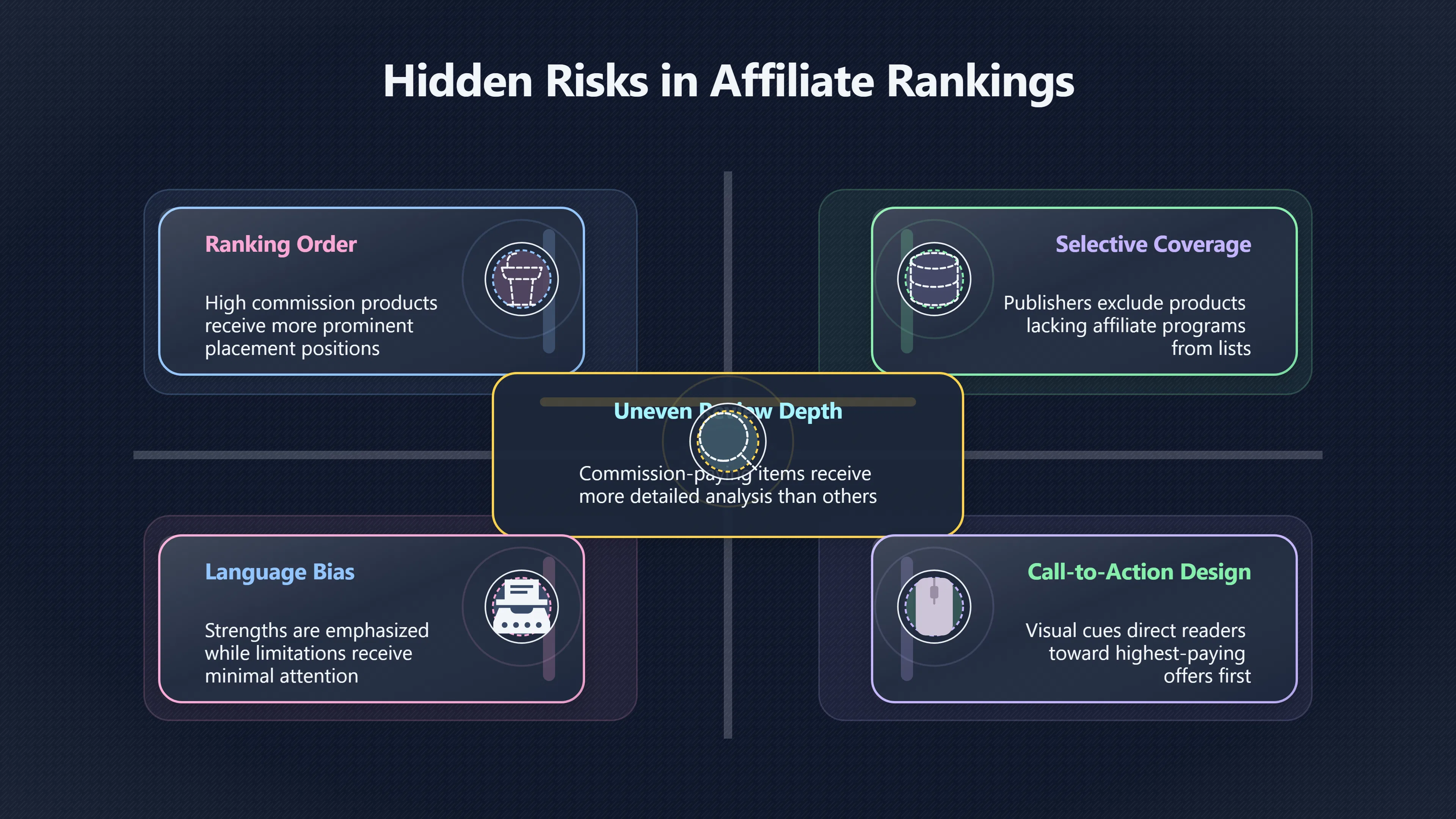
Common risk areas include:
- Ranking order. Products paying higher commissions may receive more prominent placement despite offering poorer value.
- Selective coverage. Publishers may exclude products without affiliate programmes even when those products deserve consideration.
- Uneven review depth. Commission-paying products may receive detailed analysis while competing products receive only brief summaries.
- Language bias. Strengths may be emphasised while limitations receive minimal attention.
- Call-to-action design. Readers may be directed disproportionately towards the highest-paying offers rather than the most suitable option.
None of these practices automatically prove deception. However, when commercial incentives are capable of affecting editorial decisions, readers benefit from understanding that possibility before relying on the comparison.
Competition authorities have similarly recognised that digital comparison tools often receive commission from suppliers while simultaneously acting as consumer advisers. That dual role makes transparency about commercial relationships an important governance safeguard rather than merely a legal formality.[Kelley Drye & Warren LLP]kelleydrye.comnew endorsement guides include big changes but few surprisesKelley Drye & Warren LLPNew Endorsement Guides Include Big Changes, But Few…29 Jun 2023 — The new Guides address so-called “independen…
What Readers Need Disclosed Up Front
Effective disclosure answers the practical question a reader is likely to ask:
“How does this website make money, and could that affect what I’m seeing?”
A useful disclosure should communicate:
- that affiliate commissions are earned when readers purchase through certain links;
- that not every product listed necessarily pays commission, if that is true;
- whether commission affects inclusion or ranking;
- whether products were independently researched, tested or selected;
- whether advertisers can pay for better placement.
Regulators consistently emphasise that disclosures should be clear and conspicuous. They should appear where readers encounter recommendations or affiliate links, not hidden in a footer, separate policy page or terms and conditions. Language should be understandable to ordinary readers rather than relying on technical expressions such as “affiliate relationship” alone.[Federal Trade Commission+2Federal Trade Commission]ftc.govs endorsement guides what people are askingFederal Trade CommissionFTC's Endorsement Guides: What People Are Asking29 Jun 2023 — Another principle in the Guides applies to ads that…
For comparison pages specifically, disclosure is most useful near the beginning of the page or immediately above the comparison table, where readers first begin evaluating alternatives.

How to Explain Ranking Independence Clearly
Simply stating “This page contains affiliate links” answers only part of the transparency question. Readers also want to know whether money influences rankings.
A stronger editorial explanation might communicate principles such as:
- products are ranked according to published evaluation criteria;
- commission does not determine ranking position;
- advertisers cannot purchase higher placement;
- products without affiliate programmes may still be included where appropriate;
- any sponsored listings are clearly distinguished from editorial recommendations.
These statements should accurately reflect actual editorial practice. Claiming complete independence while allowing advertisers to influence rankings may itself become misleading.
The FTC’s revised guidance highlights this distinction by treating supposedly objective ranking sites differently from obvious advertising. If rankings claim to reflect independent evaluation, payment should not secretly determine position.[Kelley Drye & Warren LLP]kelleydrye.comnew endorsement guides include big changes but few surprisesKelley Drye & Warren LLPNew Endorsement Guides Include Big Changes, But Few…29 Jun 2023 — The new Guides address so-called “independen…
Disclosure Builds Long-Term Credibility
Some publishers worry that prominent disclosures will reduce conversions. Available evidence suggests that readers primarily object to hidden commercial relationships rather than to affiliate marketing itself.
Research examining affiliate disclosures on major social platforms found that many creators failed to disclose commercial relationships at all, while user testing showed that vague or abbreviated disclosures often failed to communicate that creators earned money from recommendations. More explanatory disclosures helped users better understand the commercial relationship instead of simply recognising unfamiliar terminology.[arXiv]arxiv.orgEndorsements on Social Media: An Empirical Study of Affiliate Marketing Disclosures on YouTube and PinterestSeptember 3, 2018…
For comparison websites, this supports a broader lesson: disclosure works best when written for human understanding rather than minimum legal compliance.
A brief explanation such as “We may earn a commission if you buy through some links, but this does not affect how products are evaluated” communicates substantially more than a standalone label reading “Affiliate Link.”
Disclosure as Part of Editorial Governance
Affiliate disclosure should not be treated as an isolated legal notice. It forms part of a wider governance approach that demonstrates how editorial judgement remains separate from commercial relationships.
A comparison page becomes more trustworthy when readers can see consistent practices, including published evaluation criteria, transparent commercial disclosures, clear identification of sponsored placements, regular updates to pricing information, and honest discussion of product weaknesses alongside strengths.
When readers understand both how the comparison was produced and how the publisher earns money, they are better equipped to judge the recommendations on their merits. Transparency does not eliminate commercial incentives, but it allows those incentives to be assessed openly instead of remaining hidden behind apparently objective rankings.
Amazon book picks
Further Reading
Books and field guides related to Can Readers Trust Affiliate Rankings?. Use these as the next step if you want deeper reading beyond the article.
Everybody Writes
Supports clear, transparent editorial communication, including disclosures and trustworthy content.
Trust Me, I'm Lying
Explains how commercial incentives and media dynamics can shape published content and perceived authority.
The Content Code
Covers building audience trust and credibility in commercial online publishing.
Influence: The Psychology of Persuasion
Helps readers understand persuasive techniques that can affect recommendations and rankings.
eBay marketplace picks
Marketplace Samples
Live-tested eBay searches with available results related to this page.


Endnotes
1.
Source: ftc.gov
Title: s endorsement guides what people are asking
Source snippet
Federal Trade CommissionFTC's Endorsement Guides: What People Are Asking29 Jun 2023 — Another principle in the Guides applies to ads that...
3.
Source: kelleydrye.com
Title: new endorsement guides include big changes but few surprises
Link:https://www.kelleydrye.com/viewpoints/blogs/ad-law-access/new-endorsement-guides-include-big-changes-but-few-surprises
Source snippet
Kelley Drye & Warren LLPNew Endorsement Guides Include Big Changes, But Few...29 Jun 2023 — The new Guides address so-called “independen...
4.
Source: arxiv.org
Link:https://arxiv.org/abs/1809.00620
Source snippet
Endorsements on Social Media: An Empirical Study of Affiliate Marketing Disclosures on YouTube and PinterestSeptember 3, 2018...
Published: September 3, 2018
5.
Source: arxiv.org
Link:https://arxiv.org/abs/1803.08488
Additional References
6.
Source: elegantthemes.com
Link:https://www.elegantthemes.com/policy/disclosure/
Source snippet
Guide for Affiliate Endorsements and Appropriate DisclosureThe Federal Trade Commission requires that affiliates disclose to their reader...
7.
Source: federal-lawyer.com
Link:https://federal-lawyer.com/ftc-defense/affiliate-disclosure/
Source snippet
Understanding the FTC's Affiliate Disclosure RulesLearn what affiliate marketers and companies need to know about the FTC's affiliate dis...
8.
Source: steptoe.com
Link:https://www.steptoe.com/en/news-publications/ftc-unveils-new-endorsement-guides-and-proposed-rule-on-consumer-reviews-what-your-business-needs-to-know-and-opportunities-to-shape-whats-next.html
Source snippet
FTC Unveils New Endorsement Guides and Proposed...11 Jul 2023 — The Endorsement Guides advise the public on advertising practices the Co...
9.
Source: adamigo.ai
Link:https://www.adamigo.ai/blog/ultimate-guide-to-ftc-ad-disclosures
10.
Source: youtube.com
Link:https://www.youtube.com/watch?v=723U5nGxhTU
Source snippet
Affiliate disclosure website blogging ftc rules How to Disclose Affiliate Links on YouTube, Blogs, or Website — FTC Guidelines Eric DeLuca...
11.
Source: blog.promise.legal
Title: who this ftc endorsement guide is for and why it matters
Link:https://blog.promise.legal/startup-central/who-this-ftc-endorsement-guide-is-for-and-why-it-matters/
Source snippet
This FTC Endorsement Guide Is For (and Why It Matters)26 Mar 2026 — The FTC Endorsement Guides (16 CFR Part 255) apply when you use endor...
12.
Source: iubenda.com
Link:https://www.iubenda.com/en/blog/affiliate-disclosure/
Source snippet
isitors that you earn a commission when they purchase a product or...Read more...
13.
Source: stalirov.lawyer
Link:https://stalirov.lawyer/en/posts/ftc-affiliate-marketing-compliance
Source snippet
FTC Affiliate Marketing & Compliance: Disclosure Rules...7 May 2025 — The FTC views most affiliate marketing activities as endorsements...
Published: May 2025
14.
Source: youtube.com
Link:https://www.youtube.com/watch?v=TpYEmQ9njyk
Source snippet
The Creator Cafe, with Lawyer Kae•257 views · 34:00 · Go to channel Arlan Hamilton...
15.
Source: partnercentric.com
Title: how to properly disclose ftc endorsements
Link:https://partnercentric.com/blog/how-to-properly-disclose-ftc-endorsements/
Source snippet
17 Jun 2024 — The FTC requires that any material connection between an endorser and the marketer of a product must be disclosed clearly a...
Topic Tree