Within Comparisons
The Price Trap That Breaks Comparison Pages
Price comparisons earn trust when they show the real cost readers will face, including mandatory fees, renewal prices, and billing conditions.
On this page
- Mandatory fees and drip pricing risks
- Renewal prices, annual billing, and add ons
- How to present a fair total cost
Page outline Jump by section
Introduction
Price comparison pages only earn trust when they compare the price a customer will actually pay rather than the lowest number a merchant can advertise. For affiliate websites, this distinction matters commercially as well as ethically. Readers who click through expecting one price but discover compulsory fees, automatic renewals or expensive add-ons are less likely to complete the purchase, return to the site, or trust future recommendations. Worse, comparison pages that repeat misleading headline prices can expose publishers to reputational damage and, depending on how pricing is presented, contribute to consumer law compliance risks.
 The strongest comparison pages therefore compete on transparency rather than on the smallest headline figure. They make mandatory charges visible, explain recurring costs and distinguish optional extras from unavoidable payments so readers can compare offers on a like-for-like basis.
The hidden costs that distort price comparisons
Many online products appear inexpensive because only part of the eventual cost is shown at the comparison stage. The remaining charges are introduced later in the buying journey through a practice widely known as drip pricing. UK consumer guidance now makes clear that unavoidable fees should be included in the total price presented to consumers from the outset.[GOV.UK]GOV.UKProviding clear and accurate information about pricesJanuary 7, 2026 — 7 Jan 2026 — It's illegal to hide additional fees, taxes or other charges that the customer will have to pay until late…
For affiliate comparison pages, the most common hidden costs include:
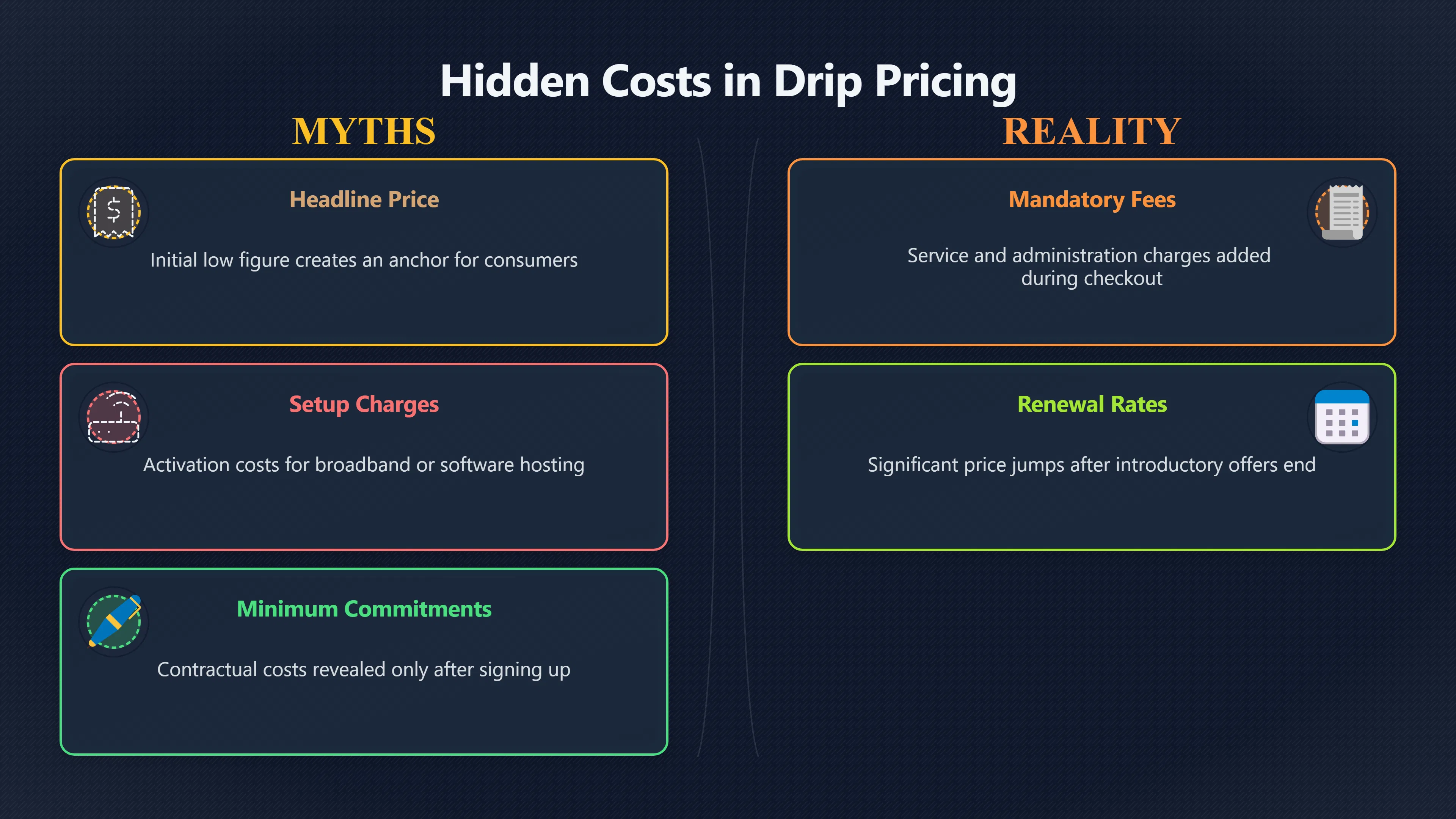
- Mandatory service or administration fees added during checkout.
- Activation or setup charges for services such as broadband, hosting or software.
- Compulsory booking fees for tickets or travel.
- Delivery charges where they cannot realistically be avoided.
- Taxes or local charges that are known before purchase.
- Minimum contract costs that are only revealed after sign-up.
- Automatic renewal pricing replacing a heavily discounted introductory offer.
Although each fee may be relatively small, together they can completely reverse the apparent ranking of competing products.
For example, a web hosting plan advertised at £2.99 per month may require annual payment upfront, charge a domain registration fee, renew at three times the introductory rate and sell essential security as a paid add-on. Another host advertised at £4.49 per month could ultimately be cheaper over two years because those costs are already included.
Mandatory fees and drip pricing risks
The greatest danger for comparison sites is treating promotional prices as though they represent the complete cost.
Behavioural research has repeatedly shown that consumers anchor their expectations around the first price they see. Once they have invested time comparing products, creating accounts or entering payment details, many continue despite additional charges because abandoning the purchase feels costly. Drip pricing exploits this behaviour by separating the advertised price from the unavoidable total.[Federal Trade Commission]ftc.govFederal Trade Commission The Rule on Unfair or Deceptive Fees: Frequently AskedFederal Trade CommissionThe Rule on Unfair or Deceptive Fees: Frequently Asked…May 1, 2025 — 1 May 2025 — The FTC's Rule on Unfair or…
For affiliate publishers, simply copying headline prices from merchant landing pages can unintentionally reproduce this problem.
Instead, comparison pages should distinguish clearly between:
DisplayAppropriate treatmentBase promotional priceLabel as introductory if applicable.Mandatory feesInclude in the effective cost wherever possible.Optional upgradesSeparate from the core comparison.User-selected extrasExplain but do not treat as part of the standard price.
This approach allows readers to compare equivalent offers rather than marketing claims.

Renewal prices, annual billing and add-ons
Subscription products create another common pricing trap because the first payment is often not representative of long-term ownership.
Examples include:
- antivirus software with a heavily discounted first year
- VPN subscriptions requiring two- or three-year commitments
- SaaS products with promotional introductory pricing
- website builders offering low initial rates before standard renewals
- cloud hosting with discounted first invoices.
A comparison page that highlights only the introductory rate may technically repeat the advertised offer, yet still fail to answer the reader’s real question: “What will this cost me after the promotion ends?”
A more useful comparison includes:
- the introductory price
- the normal renewal price
- the minimum billing commitment
- whether payment is monthly or annual
- whether VAT or equivalent taxes are included
- any compulsory setup charges
- common paid add-ons needed by most customers.
Where merchants require annual billing to obtain the advertised monthly figure, showing both the monthly equivalent and the upfront annual payment reduces misunderstanding.
How to present a fair total cost
Readers rarely object to paying fees that are explained clearly. They object to discovering them unexpectedly.
A transparent comparison page therefore focuses on the effective purchase cost rather than the marketing headline.
Good practice includes:
- Show an estimated first-year total. Add unavoidable setup costs and compulsory fees.
- Show an estimated renewal total. This prevents introductory discounts dominating rankings.
- Separate mandatory from optional charges. Readers should instantly recognise which costs they can avoid.
- Explain pricing assumptions. State whether calculations assume annual billing, monthly payment or specific user numbers.
- Date-stamp pricing. Subscription prices change regularly, so indicate when figures were last checked.
- Link to pricing policies where appropriate. Readers can verify unusual charging structures themselves.
This presentation also reduces complaints from users who discover higher costs after clicking an affiliate link.
Governance and legal expectations
Regulators increasingly expect pricing to reflect the amount consumers must actually pay rather than an artificially low entry point.
In the UK, the Digital Markets, Competition and Consumers Act strengthens requirements around price transparency by requiring the total price—including unavoidable fees—to be presented clearly in invitations to purchase. Guidance issued by the Competition and Markets Authority explains that compulsory charges should not be introduced later in the buying process through drip pricing.[GOV.UK+2GOV.UK]GOV.UKProviding clear and accurate information about pricesJanuary 7, 2026 — 7 Jan 2026 — It's illegal to hide additional fees, taxes or other charges that the customer will have to pay until late…
Enforcement has also become more visible. Recent CMA action against businesses over hidden mandatory fees demonstrates that regulators view drip pricing as more than a minor usability issue; it is increasingly treated as a consumer protection concern with financial consequences.[The Guardian+2The Guardian]theguardian.comAs a result, the schools must repay over £760,000, with an average refund of about £9 per student. The AA admitted its wrongdoing and coo…
Although affiliate publishers are usually not the merchant, repeating misleading pricing without explanation can undermine credibility. Comparison pages that independently explain mandatory costs are more likely to remain useful even when merchant marketing emphasises only promotional figures.
Why transparent pricing improves affiliate performance
Some affiliate publishers worry that showing higher real-world costs will reduce click-through rates.
In practice, transparent comparisons often improve commercial performance because they attract visitors with realistic expectations. Readers who understand renewal prices, compulsory fees and billing conditions before clicking are less likely to abandon purchases or feel misled afterwards.
Transparent pricing also supports stronger editorial positioning. Instead of competing solely on “lowest price”, an affiliate comparison becomes a decision guide that explains total ownership cost, highlights genuine value and identifies offers whose apparent savings disappear once mandatory charges are included.
For long-term affiliate businesses, that reputation is often worth far more than the temporary boost created by repeating the lowest headline price.
Amazon book picks
Further Reading
Books and field guides related to The Price Trap That Breaks Comparison Pages. Use these as the next step if you want deeper reading beyond the article.
Building a StoryBrand 2.0
Emphasizes clear communication and customer trust, supporting transparent comparison content.
Contagious
Provides insight into creating trustworthy, shareable content that attracts and retains readers.
The Art of SEO
Supports building high-quality comparison pages that balance search performance with user trust.
Influence: The Psychology of Persuasion
Helps readers understand pricing presentation, trust, and how transparent comparisons influence buying decisions.
eBay marketplace picks
Marketplace Samples
Live-tested eBay searches with available results related to this page.



Endnotes
1.
Source: GOV.UK
Title: Providing clear and accurate information about prices
Link:https://www.gov.uk/government/publications/price-transparency-cma209/providing-clear-and-accurate-information-about-prices-summary
Source snippet
January 7, 2026 — 7 Jan 2026 — It's illegal to hide additional fees, taxes or other charges that the customer will have to pay until late...
Published: January 7, 2026
2.
Source: assets.publishing.service.gov.uk
Title: CMA209 Unfair commercial practices price transparency 13.2.26
Link:https://assets.publishing.service.gov.uk/media/698f4e3e7da91680ad7f4417/CMA209_Unfair_commercial_practices__price_transparency_13.2.26.pdf
Source snippet
publishing.service.gov.ukCMA209 Unfair commercial practices, price transparency18 Nov 2025 — Drip pricing – the prohibited practice of no...
3.
Source: ftc.gov
Title: Federal Trade Commission The Rule on Unfair or Deceptive Fees: Frequently Asked
Link:https://www.ftc.gov/business-guidance/resources/rule-unfair-or-deceptive-fees-frequently-asked-questions
Source snippet
Federal Trade CommissionThe Rule on Unfair or Deceptive Fees: Frequently Asked...May 1, 2025 — 1 May 2025 — The FTC's Rule on Unfair or...
Published: May 1, 2025
4.
Source: Wikipedia
Title: Drip pricing
Link:https://en.wikipedia.org/wiki/Drip_pricing
5.
Source: theguardian.com
Link:https://www.theguardian.com/business/2026/apr/15/aa-driving-schools-refund-learner-drivers-hidden-lessons-fees
Source snippet
As a result, the schools must repay over £760,000, with an average refund of about £9 per student. The AA admitted its wrongdoing and coo...
6.
Source: theguardian.com
Link:https://www.theguardian.com/money/2026/jun/23/stubhub-uk-fined-ticket-fees-viagogo-cma-investigation
Source snippet
The UK’s Competition and Markets Authority (CMA) found that between April and December of the previous year, StubHub failed to disclose m...
Additional References
7.
Source: whitecase.com
Link:https://www.whitecase.com/insight-alert/hidden-fees-real-consequences-cma-issues-its-first-infringement-decision-under-uks
Source snippet
Hidden fees, real consequences: CMA issues its first...11 May 2026 — This practice, known as drip pricing, involves adding unavoidable f...
Published: May 2026
8.
Source: jonesday.com
Title: hidden fees heavy fines the cmas consumer protection crackdown gathers pace
Link:https://www.jonesday.com/en/insights/2026/04/hidden-fees-heavy-fines-the-cmas-consumer-protection-crackdown-gathers-pace
Source snippet
Hidden Fees, Heavy Fines: The CMA's Consumer...15 Apr 2026 — Under UK consumer law, businesses are strictly required to display all unav...
9.
Source: reedsmith.com
Title: full price no surprises cma s final price transparency guidance arrives
Link:https://www.reedsmith.com/articles/full-price-no-surprises-cma-s-final-price-transparency-guidance-arrives/
Source snippet
Full price, no surprises: CMA's final price transparency…18 Dec 2025 — The CMA's final price transparency guidance under the DMCC require...
10.
Source: linkedin.com
Link:https://www.linkedin.com/posts/gabriela-da-costa-82978a1_clear-pricing-do-you-pass-the-3-step-pricing-activity-7433196564292100096-DEGU
Source snippet
dable hidden fees. No nasty surprises. Our quick 3 Step...
11.
Source: cms.law
Title: no hidden charges clamping down on drip pricing
Link:https://cms.law/en/gbr/legal-[updates
Source snippet
Drip pricing is a practice that involves adding unavoidable hidden fees to the advertised price of a product or service...
12.
Source: youtube.com
Link:https://www.youtube.com/watch?v=Kw-7xTgE3nA
Source snippet
New FTC Law Bans Hidden Fees: How to Make Your Checkout Compliant in 2025...
13.
Source: taylorwessing.com
Title: dmcca drip pricing
Link:https://www.taylorwessing.com/fr/insights-and-events/insights/2025/04/dmcca-drip-pricing
Source snippet
Drip pricing: CMA clarifies obligations16 Apr 2025 — For the time being, the CMA will only take enforcement action against drip pricing w...
14.
Source: youtube.com
Title: Stub Hub faces lawsuit over “drip pricing” practices
Link:https://www.youtube.com/watch?v=ze0MLPY2CGA
Source snippet
Ban on Hidden Fees: UK Targets Drip Pricing and Fake [Reviews]({{ 'reviews/' | relative_url }}) in Consumer Crackdown...
15.
Source: youtube.com
Title: Drip Pricing The Hidden Costs of Travel
Link:https://www.youtube.com/watch?v=_0KQ0HfSnVM
Source snippet
Drip pricing hidden fees consumer protection Drip Pricing- The Fees On Top Of The Fee Trey Evans...
16.
Source: youtube.com
Link:https://www.youtube.com/watch?v=xLFulOaaObY
Source snippet
Drip Pricing- The Fees On Top Of The Fee...
Topic Tree