Within SEO Guides
Can Product Cards Sell Without Overselling?
Trustworthy product cards say who should buy, who should avoid, what trade-off matters, and when the price makes sense.
On this page
- What most readers need in the first product card
- Who should choose something else
- Price, trade offs, and honest caution labels
Page outline Jump by section
Introduction
Recommendation boxes are often the first thing a reader sees in an affiliate buying guide. They therefore set the tone for the entire page. If the first product card looks like an advert, uses exaggerated claims, or implies that every reader should buy the same item, trust drops immediately. If it explains who the product suits, who should choose another option, and what compromises come with the recommendation, it becomes a decision aid rather than a sales pitch.
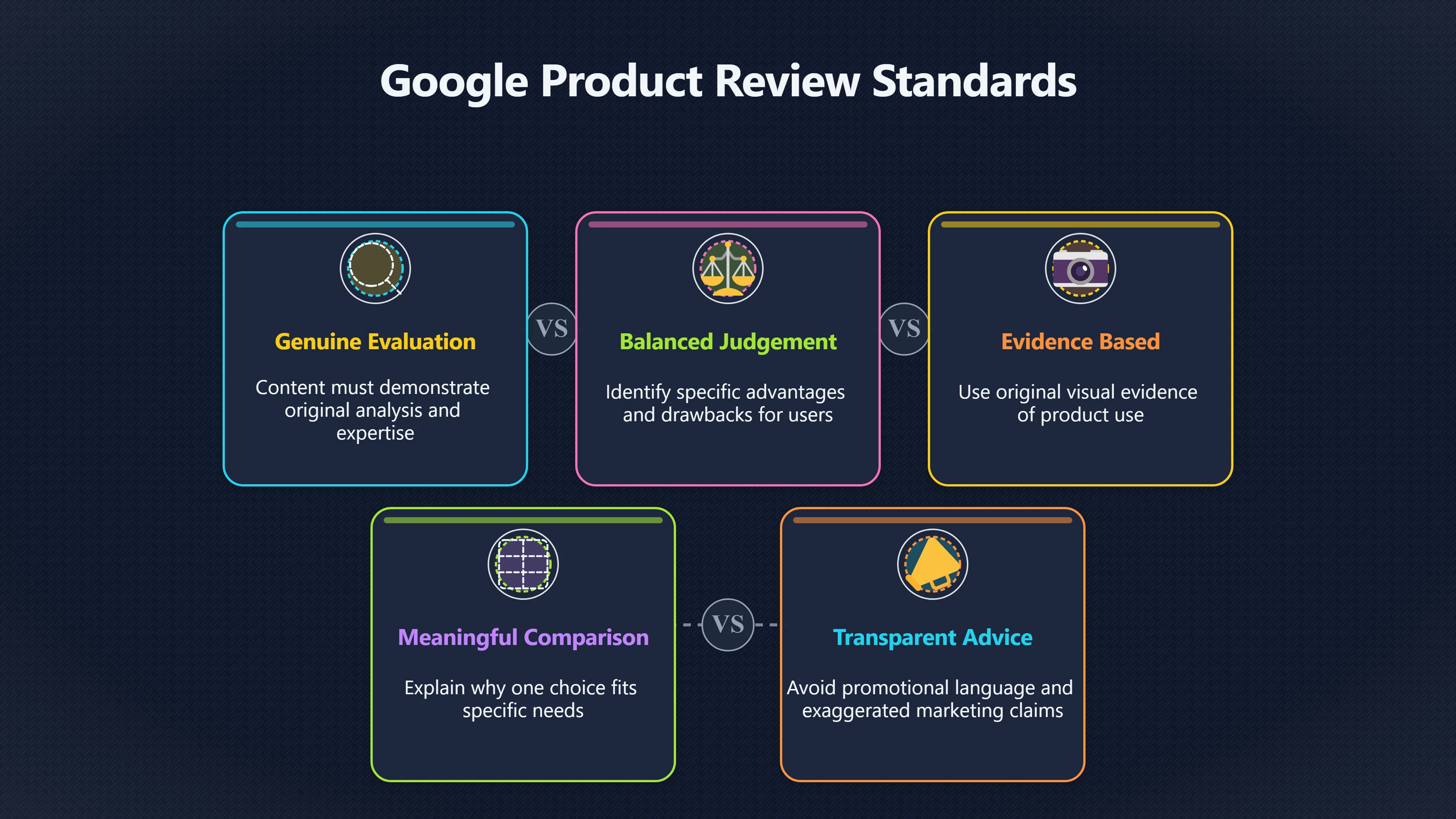
 This distinction matters for both readers and search visibility. Google’s guidance for high-quality product reviews consistently encourages content that demonstrates genuine evaluation, meaningful comparisons, evidence behind recommendations, and clear explanations of why one product may be better for particular users—not simply broad claims that something is “the best”. Product cards should therefore summarise a recommendation honestly instead of functioning as miniature advertisements.[Google for Developers]developers.google.comGoogle for DevelopersImproving Product Review ranking, one year on23 Mar 2022 — We've updated how Search ranks product reviews to priorit…
Can Product Cards Sell Without Overselling?
Yes—but only when they reduce uncertainty instead of creating urgency.
Many affiliate pages assume the recommendation box exists to maximise clicks. In practice, its more valuable role is helping visitors eliminate unsuitable products before they waste money. Readers who feel guided rather than persuaded are more likely to trust the rest of the guide and return for future buying decisions.
An honest recommendation box also supports the wider review. Google’s product review guidance favours pages that explain why products differ, discuss advantages and drawbacks, and identify the circumstances where one choice is preferable to another. A product card should therefore act as a concise summary of evidence already presented, not a replacement for it.[Google for Developers]developers.google.comGoogle for DevelopersImproving Product Review ranking, one year on23 Mar 2022 — We've updated how Search ranks product reviews to priorit…
What Most Readers Need in the First Product Card
The strongest first recommendation answers the reader’s immediate question in plain language.
Instead of:
A more useful structure is:
- Best for: commuters who travel daily
- Avoid if: you need replaceable batteries
- Main strength: longest battery life in this price range
- Main compromise: heavier than comparable models
- Worth buying when: priced below £180
This format changes the recommendation from an absolute judgement into a conditional one. Readers quickly understand that “best” depends on priorities rather than commission rates.
A trustworthy first card normally includes:
- a one-sentence explanation of the intended buyer
- one meaningful reason it earned the recommendation
- one important limitation
- a realistic expectation rather than marketing language
- a link to the detailed review section for supporting evidence
The recommendation should feel like advice from someone who has already considered the alternatives.
Who Should Choose Something Else
One of the fastest ways to build credibility is to tell some readers not to buy your top recommendation.
This feels commercially risky, yet it often improves trust because it demonstrates that the recommendation is based on fit rather than payout.
For example:
Instead of sayingSayPerfect for everyoneBest for households with mostly hard floorsHighest rated vacuumBest if pet hair is your biggest problemUltimate gaming monitorWorth the premium only if you regularly play at high refresh ratesBest laptopBest for travellers prioritising battery life over upgradeability
This small section prevents readers from discovering important limitations only after clicking through to the retailer.
It also encourages better buying decisions. Someone who realises they are not the intended customer is more likely to continue reading your comparison instead of leaving the site altogether.
Price, Trade-offs, and Honest Caution Labels
Price is often where recommendation boxes become misleading.
Phrases such as “great value”, “cheap”, or “worth every penny” mean little without context. Readers benefit more from understanding when the recommendation becomes attractive.
Examples include:
- “Excellent value below £300.”
- “Only worth paying extra if you need the optical zoom.”
- “Buy during seasonal sales rather than at full retail price.”
- “Skip this generation if you already own last year’s model.”
These statements acknowledge that buying decisions depend on timing as well as product quality.
Trade-offs deserve equal prominence.
Every product has weaknesses, even category leaders. Presenting those limitations early reduces disappointment and increases confidence that the guide is balanced.
Useful caution labels might include:
- Heavy for frequent travel
- Subscription required for advanced features
- No headphone socket
- Limited repair options
- Short warranty compared with competitors
- Excellent performance but noticeably louder than rivals
None of these warnings necessarily disqualifies the product. They simply help readers decide whether the compromise matters to them.
Language That Builds Trust Instead of Hype
Small wording changes dramatically affect how recommendation boxes are perceived.
Less trustworthy wording:
- Perfect choice
- No competition
- Must buy
- Flawless
- Guaranteed to impress
- Best on the market
More trustworthy wording:
- Best for most households
- A strong choice if…
- Performs consistently well in…
- Easier to recommend because…
- Worth considering if…
- The trade-off is…
The second style acknowledges uncertainty and reflects how real purchasing decisions work.
Research into Google’s product review guidance repeatedly highlights authentic evaluation over promotional language, encouraging creators to demonstrate expertise, original analysis, and balanced judgement rather than sales copy.[Google for Developers+2SUSO]developers.google.comGoogle for DevelopersImproving Product Review ranking, one year on23 Mar 2022 — We've updated how Search ranks product reviews to priorit…

A Recommendation Box Readers Remember
A useful product card is surprisingly restrained. Rather than trying to maximise excitement, it maximises clarity.
A practical structure is:
- Our recommendation
- Best for
- Choose something else if
- Biggest advantage
- Main compromise
- Good value at
- Why we recommend it (one or two concise sentences)
Every element answers a genuine buying question.
When recommendation boxes consistently identify the right buyer, acknowledge meaningful drawbacks, explain pricing context, and avoid exaggerated claims, they stop looking like affiliate widgets and start functioning as trustworthy editorial summaries. That not only improves the reader’s first impression but also reinforces the people-first approach expected of modern affiliate buying guides.[Google for Developers]developers.google.comGoogle for DevelopersImproving Product Review ranking, one year on23 Mar 2022 — We've updated how Search ranks product reviews to priorit…
Amazon book picks
Further Reading
Books and field guides related to Can Product Cards Sell Without Overselling?. Use these as the next step if you want deeper reading beyond the article.
Everybody Writes
Helps improve product descriptions, recommendation copy, and reader-focused content.
They Ask, You Answer
Focuses on answering buyer questions honestly, aligning well with transparent product recommendations.
The Copywriter's Handbook
Rating: 4.0/5 from 5 Google Books ratings
Provides practical guidance for writing persuasive yet credible product copy that emphasizes benefits and trade-offs.
Influence: The Psychology of Persuasion
Explains persuasive techniques while helping readers understand the importance of trust and avoiding manipulative selling.
eBay marketplace picks
Marketplace Samples
Live-tested eBay searches with available results related to this page.



Endnotes
1.
Source: developers.google.com
Link:https://developers.google.com/search/blog/2022/03/product-review-ranking-one-year-on
Source snippet
Google for DevelopersImproving Product Review ranking, one year on23 Mar 2022 — We've updated how Search ranks product reviews to priorit...
2.
Source: susodigital.com
Link:https://susodigital.com/thoughts/how-to-write-product-reviews-the-google-way/
Source snippet
SUSOHow to Write Product Reviews: The Google Way - SUSO Digital28 Mar 2023 — 10 Best Practices For Writing High-Quality Product Reviews · 1...
3.
Source: support.google.com
Link:https://support.google.com/merchants/answer/6098512?hl=en-GB
Source snippet
rating policies - Google Merchant Center HelpWe strive to provide shoppers with access to transparent, authentic and helpful product revi...
Additional References
4.
Source: sellbrite.com
Link:https://www.sellbrite.com/blog/google-shopping-reviews/
5.
Source: producthero.com
Title: a guide to review stars in google shopping
Link:https://www.producthero.com/post/a-guide-to-review-stars-in-google-shopping
Source snippet
24 Feb 2025 — In this article, we'll explain the difference between seller ratings and product ratings, how to get your reviews to show i...
6.
Source: youtube.com
Title: Table of Contents for Affiliate Websites, are they important?
Link:https://www.youtube.com/watch?v=2FTJpY705DY
Source snippet
Affiliate product boxes [tables]({{ 'tables/' | relative_url }}) cro seo best practices Affiliatable Review & Lifetime Deal | Best Product Comparison Table Builder...
7.
Source: digistore24.com
Title: affiliate marketing product reviews
Link:https://www.digistore24.com/en/blog/affiliate-marketing-product-reviews/
Source snippet
Google's quality guidelines for review content specifically favor original visual evidence of product use. Short-form video clips embedde...
8.
Source: storegrowers.com
Title: product ratings in google shopping
Link:https://www.storegrowers.com/product-ratings-in-google-shopping/
Source snippet
The Ultimate Guide to Using Product Ratings in Your...8 Jan 2026 — Benefits of Using Product Ratings in Google Shopping Listings · Incre...
9.
Source: mattmcwilliams.com
Title: succeed affiliate marketing using product reviews
Link:https://www.mattmcwilliams.com/succeed-affiliate-marketing-using-product-reviews/
Source snippet
Sandra makes a point to share at least one flaw. Now, this doesn't need to be a fatal flaw, but you...Read more...
10.
Source: youtube.com
Link:https://www.youtube.com/watch?v=1FIywpiqBcY
Source snippet
Affiliatable Review & Lifetime Deal | Best Product Comparison Table Builder...
11.
Source: youtube.com
Title: Affiliatable Review & Lifetime Deal | Best Product Comparison Table Builder!
Link:https://www.youtube.com/watch?v=v5YvX2Qbc-A
Source snippet
Table of Contents for Affiliate Websites, are they important?...
12.
Source: practicalecommerce.com
Title: how affiliates address googles product review [updates]({{ ‘updates/’ | relative_url }})
Link:https://www.practicalecommerce.com/how-affiliates-address-googles-product-review-updates
Source snippet
Provide free samples or access...Read more...
13.
Source: youtube.com
Title: Get started with Affiliatable!
Link:https://www.youtube.com/watch?v=4kXMiCKE6lQ
Source snippet
Affiliatable Review: Create Stunning Comparison Tables & Product Boxes | Appsumo Lifetime Deal...
Topic Tree