Within Long Tail
Which Option Makes Sense for This Buyer?
X-versus-Y searches convert when the page normalises facts and explains the practical difference for a specific buyer.
On this page
- Why comparison searches happen near the end of buying
- How to make product facts genuinely comparable
- Where cheaper alternatives deserve the win
Page outline Jump by section
Introduction
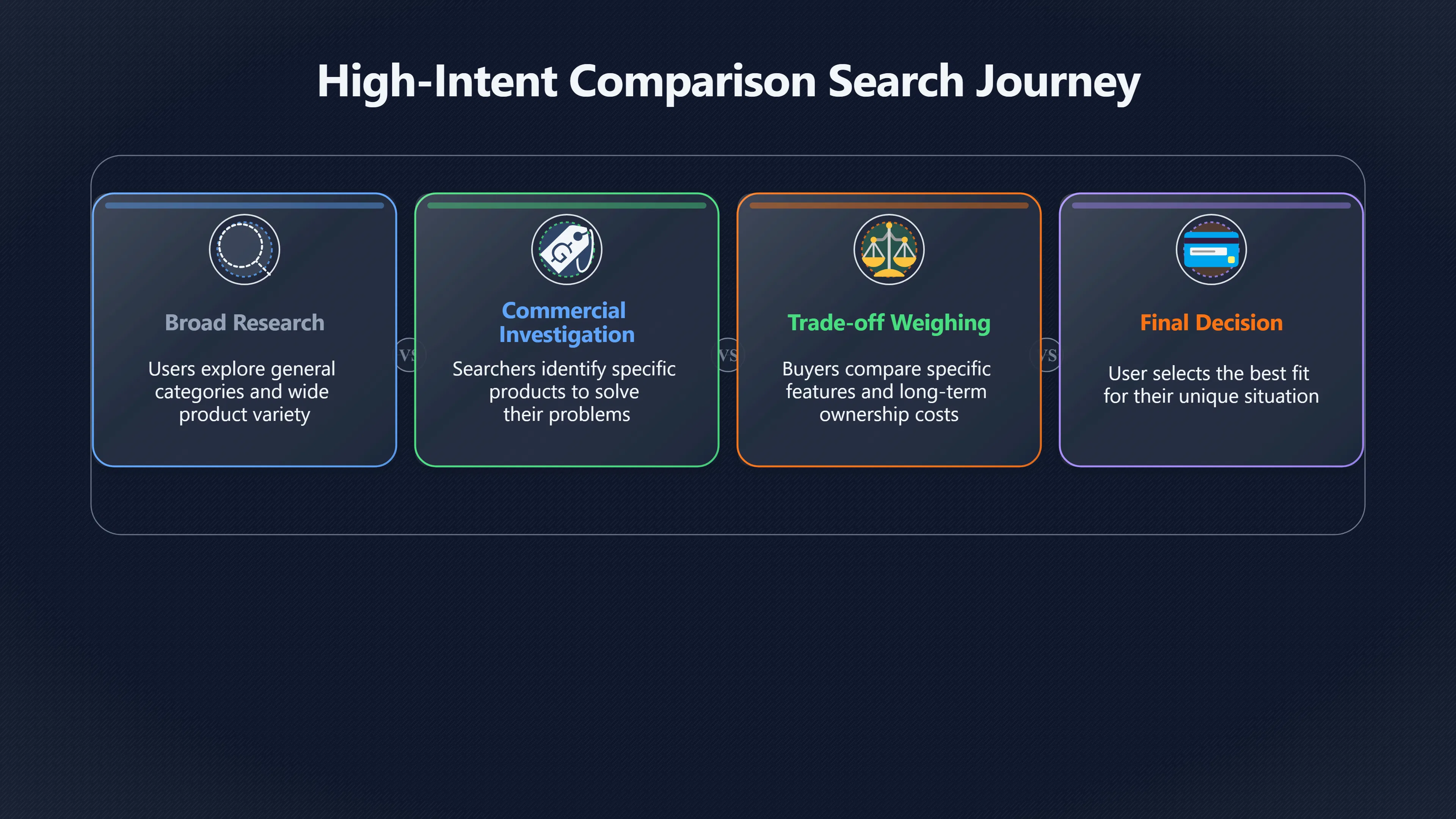
Comparison searches such as “Product A vs Product B” or “Is Brand X better than Brand Y?” sit close to the end of the buying journey. By the time someone searches this way, they have usually narrowed the market to two realistic options and want help making a confident decision rather than reading another generic “best products” list. For affiliate websites, these pages often produce higher-value visitors because they answer the final uncertainty that prevents a purchase.
 The challenge is that comparison pages are also easy to do badly. Simply copying specification tables or declaring a winner without evidence offers little value to readers or search engines. The strongest comparison pages help a specific type of buyer understand which option better matches their circumstances, explain why, and acknowledge where the supposedly weaker product is actually the smarter purchase. That practical decision-making is what separates useful affiliate content from thin comparison pages created only for search rankings.[Webis Downloads]downloads.webis.deDownloads Is Google Getting Worse?A Longitudinal Investigation of…April 3, 2024 — by J Bevendorff · Cited by 48 — In this paper, we investigate the common observation t…
Why comparison searches happen near the end of buying
Unlike broad research queries, comparison searches reveal commercial investigation intent. The searcher has already accepted that both products could solve their problem. They are now weighing trade-offs.
Typical motivations include:
- Choosing between two similarly priced products.
- Deciding whether a premium model justifies its extra cost.
- Comparing compatibility with existing equipment.
- Understanding differences in long-term ownership costs.
- Resolving conflicting online reviews.
This makes comparison pages different from standard reviews. A review asks whether a product is good. A comparison asks which product is better for a particular buyer.
For affiliate publishers, this distinction matters because it changes how recommendations should be presented. The objective is not to convince everyone to buy Product A. It is to help each reader identify which option fits their own priorities. That aligns more closely with Google’s guidance on creating genuinely helpful review content than simply ranking products from best to worst.[Webis Downloads]downloads.webis.deDownloads Is Google Getting Worse?A Longitudinal Investigation of…April 3, 2024 — by J Bevendorff · Cited by 48 — In this paper, we investigate the common observation t…
How to make product facts genuinely comparable
The most useful comparison pages normalise information so readers can evaluate products on equal terms instead of jumping between two separate manufacturer pages.
A good comparison starts by identifying the handful of criteria that actually influence the purchase decision for that audience rather than listing every specification.
For example, a comparison between two cordless vacuum cleaners might compare:
Buying factorProduct AProduct BWhy it mattersBattery life during normal cleaningLongerShorterDetermines whether one charge covers the whole homeWeightLighterHeavierImportant for stairs and overhead cleaningSpare battery availabilityOptionalNot availableInfluences long-term convenienceMaintenance costsLowerHigherAffects total ownership costBest suited toLarge homesSmall flatsGives context beyond specifications
The explanation beneath each comparison is usually more valuable than the table itself. Instead of saying one machine has a 60-minute battery and another 45 minutes, explain whether either figure represents real-world use with powered attachments, whether maximum-power mode changes the outcome, and whether either runtime is sufficient for typical households.
That translation from specifications into practical consequences is where affiliate content adds value.
Compare like with like
Many poor comparison pages accidentally compare different usage scenarios.
Instead, every category should measure equivalent conditions.
For example:
- Compare warranties over the same period.
- Compare storage after formatting, not advertised capacity.
- Compare coffee machine running costs including capsules.
- Compare printers using cost per printed page rather than cartridge price.
- Compare laptops using battery life during similar workloads.
Readers rarely struggle to find specifications. They struggle to understand what those specifications mean for everyday ownership.
Which differences actually change the buying decision?
Not every product difference deserves equal attention.
High-converting comparison pages usually separate meaningful differences from cosmetic ones.
Meaningful differences often include:
- Reliability history.
- Compatibility with existing devices.
- Repairability.
- Upgrade options.
- Running costs.
- Customer support quality.
- Return policy.
- Availability of accessories.
- Long-term software updates.
- Real performance under normal use.
Less important differences often include:
- Tiny specification improvements with no practical benefit.
- Marketing terminology.
- Features hidden behind paid upgrades.
- Cosmetic design variations.
This approach prevents readers becoming overwhelmed by dozens of specifications that have little influence on satisfaction after purchase.
Where cheaper alternatives deserve the win
One of the biggest mistakes affiliate publishers make is assuming the more expensive product should always win.
Readers trust comparison pages more when the cheaper option is clearly recommended in situations where it genuinely makes more sense.
Examples include:
- A budget webcam offering almost identical video quality for occasional video calls.
- A mid-range monitor providing excellent colour accuracy for office work despite lacking premium gaming features.
- A basic espresso machine producing comparable coffee when the buyer has no interest in advanced milk systems.
- An older smartphone offering substantially better value after price reductions.
Explaining these situations improves credibility because the recommendation appears based on buyer needs rather than commission value.
For example:
Choose Product A if:
- You use it professionally every day.
- Long-term durability matters.
- You need advanced features immediately.
Choose Product B if:
- You are buying your first model.
- Budget matters more than premium features.
- You are unlikely to use the advanced functions.
That structure directly answers the buyer’s real question instead of forcing a universal winner.
Make trade-offs explicit instead of hiding them
Every product involves compromise.
Readers usually become suspicious when comparison pages present one product as superior in every category.
Instead, acknowledge genuine trade-offs.
For example:
- Better battery life but slower charging.
- Lower purchase price but fewer software updates.
- Superior image quality but heavier body.
- Better customer support but fewer customisation options.
Balanced comparisons often produce greater trust because they resemble the reasoning a knowledgeable friend would use rather than marketing copy.

Use evidence beyond manufacturer claims
The strongest comparison pages combine official specifications with independent evidence and practical interpretation.
Useful evidence includes:
- Manufacturer documentation for verified specifications.
- Independent benchmark testing where appropriate.
- Reliability reports.
- Long-term ownership experiences.
- Return or maintenance considerations.
- Consistent measurements from respected review organisations.
Manufacturer specifications establish the baseline, but they rarely answer questions about real-world ownership. Explaining how products perform after months of use or under common conditions gives readers information they cannot obtain from product listings alone.[arXiv]arxiv.orgJuly 7, 2021…
Common mistakes that weaken comparison pages
Several patterns reduce both usefulness and credibility.
Avoid:
- Declaring a winner before presenting evidence.
- Copying specification sheets without interpretation.
- Comparing products from completely different price categories without acknowledging the gap.
- Ignoring situations where the lower-priced product is the better purchase.
- Filling pages with affiliate buttons before helping readers decide.
- Updating prices while leaving outdated product information unchanged.
Research into search quality has highlighted ongoing efforts by search engines to reduce the visibility of low-quality affiliate content that relies on monetisation without providing original value. Comparison pages that simply recycle specifications or manufacturer descriptions risk resembling the kind of content increasingly targeted by quality improvements.[Webis Downloads]downloads.webis.deDownloads Is Google Getting Worse?A Longitudinal Investigation of…April 3, 2024 — by J Bevendorff · Cited by 48 — In this paper, we investigate the common observation t…
Build pages around buyer decisions, not product battles
The highest-performing comparison pages are not entertainment pieces where one brand defeats another. They function as decision guides.
A reader searching for “Product A vs Product B” is usually asking a more specific question:
- Which lasts longer?
- Which is cheaper to own?
- Which works better in my situation?
- Which solves my particular problem?
An affiliate comparison page succeeds when it answers those hidden questions clearly enough that the reader can stop researching and buy with confidence. That means organising comparisons around real purchasing criteria, presenting equivalent evidence for both products, and being willing to recommend either option when it genuinely fits the buyer better.
Amazon book picks
Further Reading
Books and field guides related to Which Option Makes Sense for This Buyer?. Use these as the next step if you want deeper reading beyond the article.
Buyology: Truth and Lies About Why We Buy
Rating: 4.0/5 from 5 Google Books ratings
Explains how buyers make decisions and what influences final purchase choices.
Don't Make Me Think, Revisited
Useful for presenting comparisons that reduce buyer friction and improve decision confidence.
Contagious: Why Things Catch On
Helps explain why certain products and recommendations gain traction with buyers.
Influence: The Psychology of Persuasion
Provides evidence-based insight into persuasion and decision-making relevant to comparison content.
eBay marketplace picks
Marketplace Samples
Live-tested eBay searches with available results related to this page.


Endnotes
1.
Source: downloads.webis.de
Title: Downloads Is Google Getting Worse?
Link:https://downloads.webis.de/publications/papers/bevendorff_2024a.pdf
Source snippet
A Longitudinal Investigation of...April 3, 2024 — by J Bevendorff · Cited by 48 — In this paper, we investigate the common observation t...
Published: April 3, 2024
2.
Source: arxiv.org
Link:https://arxiv.org/abs/2107.03256
Source snippet
July 7, 2021...
Published: July 7, 2021
Additional References
3.
Source: affiversemedia.com
Title: how to build software comparison pages that convert a guide for affiliates
Link:https://www.affiversemedia.com/how-to-build-software-comparison-pages-that-convert-a-guide-for-affiliates/
Source snippet
AffiverseHow to Build Software Comparison Pages That Convert5 Feb 2026 — High-intent comparison content captures buyers at the decision s...
4.
Source: wispra.com
Title: website keyword analysis the ultimate guide for seo ai en
Link:https://wispra.com/blog/website-keyword-analysis-the-ultimate-guide-for-seo-ai-en
Source snippet
Website Keyword Analysis: The Ultimate Guide for SEO & AI26 Apr 2026 — **Commercial** queries go to comparison pages, detailed categories...
5.
Source: surnex.io
Title: Affiliate Marketing Keyword Research: A Modern Guide
Link:https://surnex.io/blog/affiliate-marketing-keyword-research
Source snippet
Master affiliate marketing keyword research with our step-by-step guide. Find profitable keywords, analyze intent, and track AI vis...
6.
Source: vibe-marketing.org
Title: Commercial Intent Keywords for B2B and Saa S
Link:https://vibe-marketing.org/blog/commercial-intent-keywords
Source snippet
Commercial Intent Keywords for B2B and SaaS - VibeMarketing26 Dec 2025 — Learn how to identify commercial intent keywords, map them to pa...
7.
Source: youtube.com
Title: How to Choose Topics That Actually Make Money (for Affiliate Marketers)
Link:http://www.youtube.com/watch?v=2LNRb0BSt4s
Source snippet
Affiliate marketing product comparison vs keywords strategy Content Strategy for Affiliate Marketing Sites [3.3] Ahrefs...
8.
Source: gaconnector.com
Title: identifying [high intent keywords]({{ ‘intent-costs/’ | relative_url }})
Link:https://gaconnector.com/blog/identifying-high-intent-keywords/
Source snippet
Identifying High-Intent Keywords22 Apr 2026 — If you see product pages, service pages, pricing pages, comparison pages, and review sites...
9.
Source: youtube.com
Link:http://www.youtube.com/watch?v=hYoXWByCaKY
Source snippet
How to Choose Topics That Actually Make Money (for Affiliate Marketers)...
10.
Source: instagram.com
Title: Affiliate links and SEO
Link:https://www.instagram.com/p/DY7U4v9nOcn/
Source snippet
Friends, enemies, or complicated?...Long-tail terms help you create focused landing pages, review content, comparisons, FAQs, and suppor...
11.
Source: shopware.com
Link:https://www.shopware.com/en/news/ecommerce-seo/
Source snippet
Ecommerce SEO: Guide to visibility in AI search11 Feb 2025 — The more specific the search query (long-tail), the higher the probability t...
12.
Source: youtube.com
Title: How to Find KEYWORDS For Affiliate Marketing (This Makes It Easy)
Link:http://www.youtube.com/watch?v=6iW6CfOMjfQ
Source snippet
How to Find Keywords for Affiliate Marketing (The FREE, Standard, and Advanced Methods)...
Topic Tree