Within Thin Pages
What Google Means by Thin Affiliate
Google treats affiliate pages as thin when copied product content lacks original value for the searcher.
On this page
- The policy meaning of thin affiliation
- Why copied network content creates risk
- What added value looks like in practice
Page outline Jump by section
Introduction
Google does not ban affiliate marketing, and it does not penalise pages simply because they contain affiliate links. The issue is whether an affiliate page gives searchers something genuinely useful that they could not get just by visiting the original merchant. In Google’s plain-language view, a page becomes a thin affiliate page when it mainly exists to send visitors elsewhere for a commission while contributing little original information, judgement or practical help. Google’s spam policies specifically describe thin affiliation as affiliate content that copies product descriptions or reviews from merchants without adding original content or meaningful value.[Google for Developers]developers.google.comGoogle for DevelopersSpam Policies for Google Web SearchThe spam policies detail the behaviors and tactics that can lead to a page or an…
 This distinction matters because many affiliate websites fail not through the presence of affiliate links, but because every page looks like a slightly rewritten version of the same manufacturer information. Google’s systems are designed to reward pages that solve users’ problems rather than simply acting as another step between the search result and the retailer.[Google for Developers]developers.google.comGoogle for DevelopersSpam Policies for Google Web SearchThe spam policies detail the behaviors and tactics that can lead to a page or an…
What Google Means by Thin Affiliate
The simplest way to understand Google’s policy is to imagine asking one question:
“If this page disappeared, would searchers lose anything useful?”
If the answer is no because the same information already exists on the merchant’s website, then the page is at risk of being considered thin.
Google’s policy is aimed at pages that:
- Copy or lightly rewrite merchant product descriptions.
- Repeat reviews supplied by affiliate networks.
- Publish nearly identical content across many products or websites.
- Exist mainly to earn referral commissions rather than help readers make informed decisions.[Google for Developers]developers.google.comGoogle for DevelopersSpam Policies for Google Web SearchThe spam policies detail the behaviors and tactics that can lead to a page or an…
Notice what Google is not saying. It is not requiring a certain word count. It is not banning product round-ups. It is not requiring professional laboratory testing. The focus is whether the page provides information, insight or experience that is genuinely its own.
That is why a short review based on real experience can be stronger than a long article built from copied specifications.
Why Copied Network Content Creates Risk
Many affiliate programmes distribute ready-made product feeds, images and descriptions so publishers can build pages quickly. While convenient, this creates a problem for search engines.
If hundreds of websites publish essentially the same content, Google has little reason to rank every version. Showing identical pages wastes search results and gives users no additional benefit. Google’s spam documentation explicitly identifies affiliate programmes that distribute duplicated material without added value as an example of thin affiliation.[Google for Developers]developers.google.comGoogle for DevelopersSpam Policies for Google Web SearchThe spam policies detail the behaviors and tactics that can lead to a page or an…
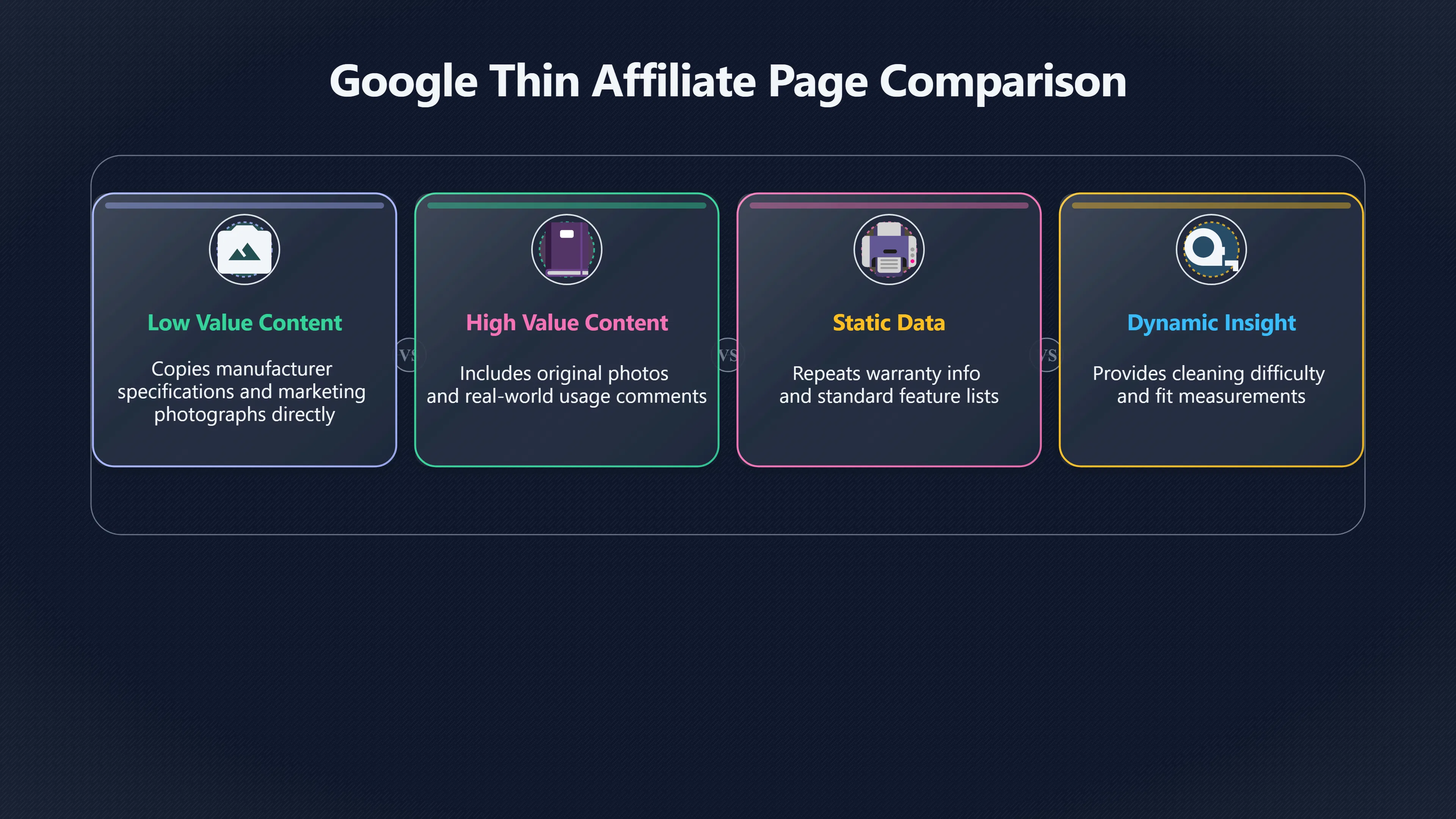
Consider two hypothetical pages reviewing the same coffee machine.
The first reproduces:
- the manufacturer’s specifications,
- marketing photographs,
- feature list,
- warranty information,
- and a “Buy Now” affiliate button.
The second includes:
- photographs taken during actual use,
- comments on cleaning difficulty,
- measurements showing whether it fits under kitchen cupboards,
- comparisons with competing machines,
- who should avoid buying it,
- and the same affiliate link.
Both pages earn commission if someone buys the product. Only the second changes the reader’s understanding. That difference is what Google’s policy is trying to encourage.
What Added Value Looks Like in Practice
Google never publishes a checklist guaranteeing rankings, but its guidance consistently points towards creating original, people-first information instead of recycled commercial content.[Google for Developers]developers.google.comGoogle for DevelopersSpam Policies for Google Web SearchThe spam policies detail the behaviors and tactics that can lead to a page or an…
In practice, useful added value often includes:
- Independent testing or hands-on experience.
- Original photographs or videos.
- Honest discussion of weaknesses as well as strengths.
- Comparisons based on real use rather than specification tables.
- Advice for different types of buyers.
- Clear explanations of trade-offs.
- Information gathered from expertise rather than copied from a retailer.
The key idea is independence. Readers should learn something they could not simply discover by reading the merchant’s own sales page.
For example, instead of repeating that a laptop has a ten-hour battery life because the manufacturer says so, a valuable affiliate page might explain that the battery lasted only seven hours during video editing but nearly eleven hours during office work. That is original editorial value rather than recycled marketing.
Common Misunderstandings About the Policy
Several myths regularly appear in discussions about affiliate SEO.
Myth: Google dislikes affiliate links.
False. Google has repeatedly made clear that affiliate links themselves are not a spam signal. The problem is low-value pages built around them.[Google for Developers]developers.google.comGoogle for DevelopersSpam Policies for Google Web SearchThe spam policies detail the behaviors and tactics that can lead to a page or an…
Myth: Rewriting product descriptions is enough.
Changing wording without adding new information rarely creates meaningful value. A rewritten paragraph that communicates exactly the same facts remains largely interchangeable from the reader’s perspective.
Myth: Longer content automatically fixes thin affiliation.[reddit.com]reddit.com“Low-quality or shallow pages”. “Substantially duplicate content”.Read moreThin Content Explained - How to Identify and Fix It Before…Google's official guidelines use phrases like: “Little or no added value”…
A 5,000-word article can still be thin if it simply expands marketing claims, repeats specifications and fills space with generic buying advice. Originality and usefulness matter more than length.
Myth: Every affiliate page must include personal testing.
Hands-on testing is one way to add value, but not the only one. Original research, expert analysis, meaningful comparisons, transparent methodology and well-supported recommendations can also demonstrate independent usefulness.
The Practical Standard to Remember
A useful way to translate Google’s policy into plain English is:
Affiliate links are acceptable. Pages that merely exist to carry affiliate links are not.
When evaluating an affiliate page, Google is effectively asking whether it contributes something unique before asking the reader to click through to a retailer. If the page functions only as an extra stop on the journey to the merchant, it is unlikely to stand out in search. If it helps readers make a better decision through original insight, evidence or experience, it aligns much more closely with Google’s guidance on helpful, people-first content and avoids the defining characteristics of thin affiliation.[Google for Developers+2blog.google]developers.google.comGoogle for DevelopersSpam Policies for Google Web SearchThe spam policies detail the behaviors and tactics that can lead to a page or an…
Amazon book picks
Further Reading
Books and field guides related to What Google Means by Thin Affiliate. Use these as the next step if you want deeper reading beyond the article.
Product-Led SEO
Emphasises building search-focused content that satisfies users instead of manipulating rankings.
Everybody Writes
Helps readers produce distinctive, useful copy instead of lightly rewritten merchant text.
Content Chemistry
Focuses on creating original, useful content that adds value beyond copied material.
The Art of SEO
Explains sustainable SEO practices, quality content, and avoiding low-value pages.
eBay marketplace picks
Marketplace Samples
Live-tested eBay searches with available results related to this page.



Endnotes
1.
Source: developers.google.com
Link:https://developers.google.com/search/docs/essentials/spam-policies
Source snippet
Google for DevelopersSpam Policies for Google Web SearchThe spam policies detail the behaviors and tactics that can lead to a page or an...
2.
Source: blog.google
Title: google search update march 2024
Link:https://blog.google/products-and-platforms/products/search/google-search-update-march-2024/
Source snippet
New ways we're tackling spammy, low-quality content on...5 Mar 2024 — We're making several updates to our spam policies to better addres...
Published: march 2024
3.
Source: support.google.com
Link:https://support.google.com/webmasters/thread/185398252/my-affiliate-website-pages-that-were-ranking-got-suddenly-deindexed-from-google-search?hl=en
Source snippet
affiliate website pages that were ranking got suddenly deindexed...October 23, 2022 — All the ranked pages (or maybe all the pages) of m...
Published: October 23, 2022
4.
Source: google.com
Link:https://www.google.com/
Source snippet
Search the world's information, including webpages, images, videos and more. Google has many special features to help you find exac...
5.
Source: support.google.com
Link:https://support.google.com/webmasters/thread/189339560/how-to-recover-from-thin-content-with-little-or-no-added-value-when-the-site-has-valuable-content?hl=en
Source snippet
to recover from Thin content with little or no added...19 Nov 2022 — We don't accept spam on our site, we are very careful who to link t...
6.
Source: support.google.com
Link:https://support.google.com/webmasters/answer/9044175?hl=en
Source snippet
actions report - Search Console HelpGoogle issues a manual action against a site when a human reviewer at Google has determined that page...
Additional References
7.
Source: seo-revolution.com
Link:https://seo-revolution.com/glossar/thin-content/
Source snippet
Thin Content: erkennen und vermeidenWas ist Thin Content und wie können „dünne Inhalte“ vermieden werden? Erhalte wertvolle Tipps zur Ver...
8.
Source: youtube.com
Link:https://www.youtube.com/watch?v=w3-obcXkyA4
Source snippet
Thin content with little or no added valueMatt Cutts explains what it means if your site has a manual action labeled as "Thin content wit...
9.
Source: linkedin.com
Title: google spam policies 2025 what every website owner must asif ali aqguf
Link:https://www.linkedin.com/pulse/google-spam-policies-2025-what-every-website-owner-must-asif-ali-aqguf
Source snippet
Google Spam Policies 2025: What Every Website Owner...Scan for thin pages or duplicate paragraphs. Rewrite low-value content keep experi...
10.
Source: impact.com
Title: googles updated site reputation abuse policy on affiliate marketers
Link:https://impact.com/affiliate/googles-updated-site-reputation-abuse-policy-on-affiliate-marketers/
Source snippet
Google's New Site Reputation Policy: Impact on Affiliate...5 May 2024 — In March 2024, Google updated its Search Console guidelines to i...
Published: May 2024
11.
Source: blog.rakutenadvertising.com
Link:https://blog.rakutenadvertising.com/news/google-spam-update-and-its-impact-on-affiliate-marketing/
Source snippet
Spam Update and Its Impact on Affiliate MarketingJune 11, 2024 — Google has updated its Site Reputation Abuse Policy...
Published: June 11, 2024
12.
Source: seroundtable.com
Link:https://www.seroundtable.com/google-affiliate-programs-spam-docs-removed-34762.html
Source snippet
Google Explains Why The Affiliate Programs Spam Documentation...January 20, 2023 — Lizzi said on Twitter, "the spam policy covers our cu...
Published: January 20, 2023
13.
Source: goup.co.uk
Link:https://www.goup.co.uk/guides/spam/
Source snippet
Types Of SEO Spam And How To Recover From A Penalty31 Jan 2023 — [Thin affiliate pages]({{ 'thin-pages/' | relative_url }}) lack original content and value, relying on...
14.
Source: reddit.com
Title: “Low-quality or shallow pages”. “Substantially duplicate content”.Read more
Link:https://www.reddit.com/r/SEMrush/comments/1leadrk/thin_content_explained_how_to_identify_and_fix_it/
Source snippet
Thin Content Explained - How to Identify and Fix It Before...Google's official guidelines use phrases like: “Little or no added value”...
15.
Source: fatrank.com
Title: Thin Content With Little or No Added Value
Link:https://www.fatrank.com/thin-content-with-little-or-no-added-value/
Source snippet
Google SEO...The Thin Content With Little or No Added Value penalty means Google has detected low-quality pages or shallow pages on your...
16.
Source: seroundtable.com
Title: google affiliate guidelines penalty 18022
Link:https://www.seroundtable.com/google-affiliate-guidelines-penalty-18022.html
Source snippet
Google Warns Affiliates: If Your Site Doesn't Add Value...28 Jan 2014 — Last night, Google published a blog post on their webmaster cen...
Topic Tree