Within Email
When One Affiliate Newsletter Becomes Too Blunt
Segmenting subscribers by interest or buying stage helps affiliate sites send fewer but more relevant recommendations.
On this page
- Interest segments for product category sites
- Buying stage segments for comparison readers
- Signals that segmentation is improving clicks
Page outline Jump by section
Introduction
A growing email list is only valuable if subscribers receive recommendations that match what they actually want to buy. For affiliate websites, segmentation is the mechanism that turns a general newsletter into a series of targeted recommendations based on interests, buying intent and subscriber behaviour. Instead of sending every product recommendation to every subscriber, segmentation delivers fewer, more relevant emails, helping maintain trust while increasing the likelihood of clicks and affiliate conversions. Industry guidance consistently shows that targeted email campaigns outperform one-size-fits-all broadcasts because relevance drives engagement rather than volume.[Mailchimp+2HubSpot Blog]mailchimp.comLearn the step‑by‑step process of segmenting your list by behavior, demographics, and more to drive higher conversions.Read more…
 For affiliate publishers trying to reduce dependence on search traffic, segmentation also creates a stronger reason for subscribers to stay on the list. Readers are more likely to return directly to the website when each email consistently reflects their interests and current buying needs.
Interest Segments for Product-Category Sites
The simplest and often most effective form of segmentation is by product interest. Rather than maintaining separate newsletters for every niche, an affiliate site can allow subscribers to express what they care about and use those preferences throughout future campaigns.
A technology affiliate website might divide readers into segments such as:
- Laptops and desktops
- Home networking
- Photography equipment
- Gaming hardware
- Productivity software
A home improvement website could instead segment subscribers into gardening, DIY tools, kitchen appliances and smart home products.
This approach improves relevance because subscribers rarely have equal interest across every category. Someone researching mirrorless cameras may have little interest in office chairs, while a reader comparing VPN services is unlikely to appreciate frequent gaming accessory promotions.
Interest data can be collected in several ways:
- categories selected on the signup form
- links clicked within previous newsletters
- buying guides downloaded
- quizzes or recommendation tools completed
- repeated visits to particular sections of the website
Modern email platforms increasingly support behavioural tagging, allowing segments to update automatically as subscribers interact with emails or the website rather than relying solely on information collected during signup.[HubSpot Blog+2Campaign Monitor]blog.hubspot.comemail list segmentationHubSpot BlogEmail List Segmentation: 30 Ways to Earn Higher…14 Jan 2026 — Explore our list of 30 ways you could segment your email con…
The result is not simply higher click rates. It also reduces subscriber fatigue because readers receive fewer irrelevant promotions.
Buying-Stage Segments for Comparison Readers
Interest alone does not explain whether someone is ready to buy.
Affiliate websites frequently attract readers at different stages of the purchasing journey. Sending identical recommendations to all of them often produces disappointing results because their questions differ.
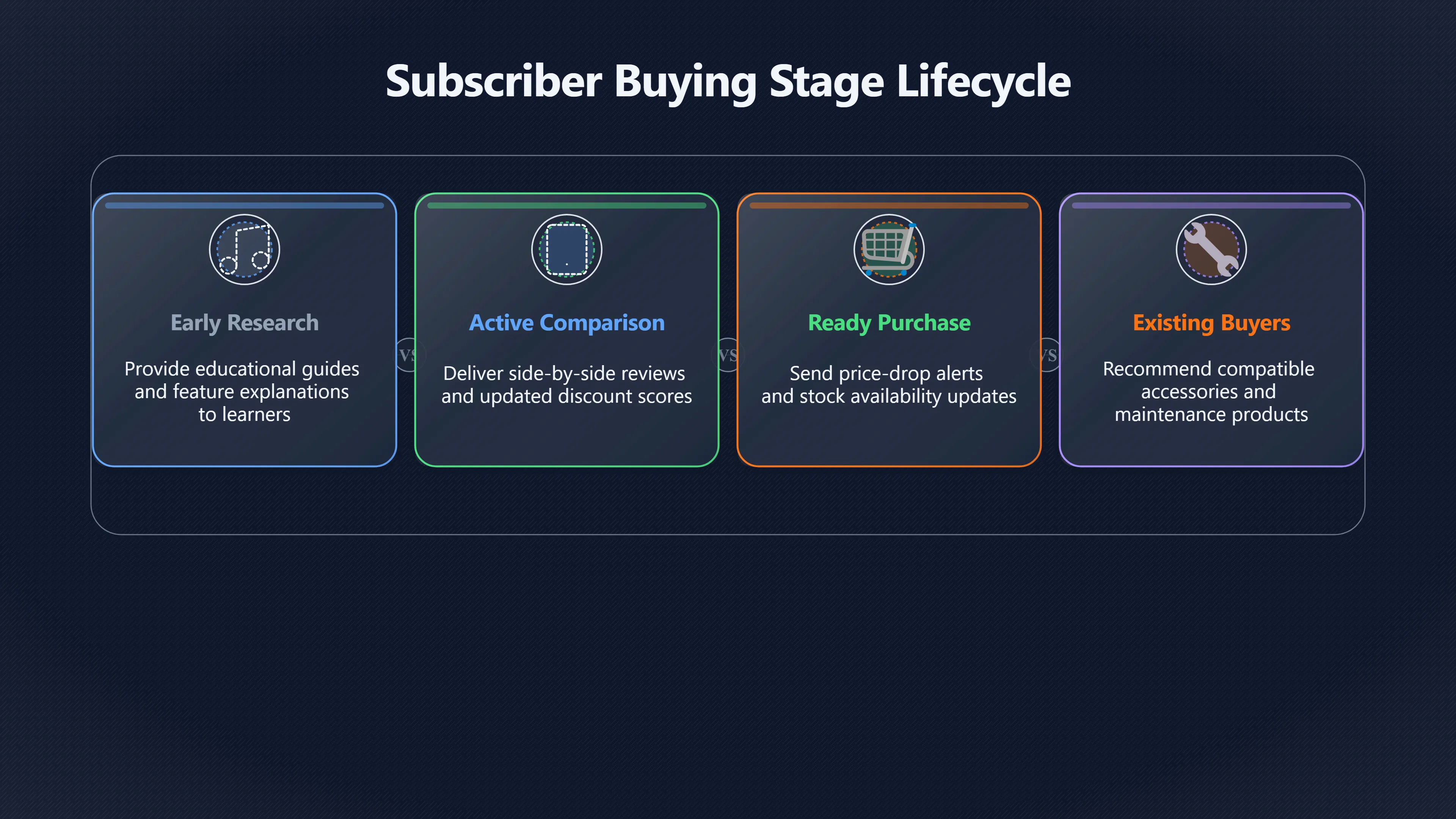
A practical buying-stage model includes:
These readers are still learning about product categories. They benefit from educational material, buying guides and explanations of important features rather than direct affiliate promotions.
Examples include:
- “How much RAM do you really need?”
- “Mirrorless versus DSLR”
- “Choosing your first espresso machine”
Active comparison
These subscribers have narrowed their choices and are comparing specific products.
Emails can focus on:
- side-by-side comparisons
- updated review scores
- newly released alternatives
- current retailer discounts
- buying recommendations by budget
Ready to purchase
Readers demonstrating strong purchase intent often respond well to:
- price-drop alerts
- limited-time promotions
- stock availability updates
- reminder emails after clicking comparison pages
Existing buyers
Affiliate relationships should not end after one purchase.
Subscribers who have already bought can receive:
- compatible accessories
- maintenance products
- software upgrades
- replacement schedules
- complementary purchases
For example, someone who purchased a beginner telescope may later appreciate recommendations for eyepieces, astronomy guides or carrying cases rather than another beginner telescope.
Behaviour-based lifecycle segmentation is widely recommended because subscriber needs change over time rather than remaining fixed. Automated segments can move readers between stages based on their actions instead of requiring manual list management.[HubSpot Blog+2wecantrack]blog.hubspot.comemail list segmentationHubSpot BlogEmail List Segmentation: 30 Ways to Earn Higher…14 Jan 2026 — Explore our list of 30 ways you could segment your email con…

Use Behaviour Instead of Guesswork
The strongest affiliate segmentation relies on observable behaviour rather than assumptions.
Useful behavioural signals include:
- clicking multiple reviews within one product category
- revisiting comparison pages
- opening seasonal buying emails
- downloading buyer checklists
- ignoring repeated promotions from one category while engaging heavily with another
Suppose a subscriber repeatedly clicks articles comparing cordless lawn mowers but ignores power tool emails. Their future recommendations should naturally shift towards garden equipment rather than remaining evenly distributed across all home improvement products.
Behavioural segmentation becomes increasingly accurate over time because every interaction provides another indication of genuine buying interests.
This approach also helps avoid a common affiliate mistake: assuming that every subscriber should receive every high-paying offer.
Keep Segments Flexible Rather Than Permanent
Subscriber interests evolve.
Someone researching travel insurance today may later become interested in luggage, travel credit cards or packing accessories. Likewise, a subscriber renovating a kitchen may stop engaging with appliance offers once the project is complete.
Effective segmentation therefore uses dynamic rules rather than permanent labels.
Instead of assigning someone forever to “coffee equipment”, a publisher might define a rule such as:
- clicked two coffee-related emails in the last 60 days
- visited three coffee buying guides during the previous month
- downloaded a coffee brewing guide
If those behaviours stop, the subscriber naturally leaves the segment.
Dynamic segmentation reduces stale targeting and keeps recommendations aligned with current interests rather than historical ones.[HubSpot Blog+2Campaign Monitor]blog.hubspot.comemail list segmentationHubSpot BlogEmail List Segmentation: 30 Ways to Earn Higher…14 Jan 2026 — Explore our list of 30 ways you could segment your email con…
Signals That Segmentation Is Improving Clicks
The purpose of segmentation is not to create more lists. It is to improve relevance and affiliate performance.
Useful indicators include:
- higher click-through rates within individual segments
- increased clicks on affiliate comparison pages
- stronger conversion rates after recommendation emails
- fewer unsubscribes following promotional campaigns
- increased repeat visits from email traffic
- longer subscriber retention
Open rates should be interpreted carefully because privacy features, including Apple’s Mail Privacy Protection, make them a less reliable measure of engagement than they once were. Clicks, on-site behaviour and affiliate conversions provide a clearer picture of whether segmentation is working.[TechRadar]techradar.comTech Radar Email marketing ROI: How modern platforms turn campaigns into revenueWhile the average ROI for email marketing stands at $36–$42 per dollar spent, top-performing teams achieve much higher returns—often due…
Comparing segmented campaigns against previous general newsletters can reveal whether particular subscriber groups respond better to specialised recommendations.
Avoid Over-Segmenting Too Early
One common mistake is creating dozens of tiny segments before there is enough subscriber data.
A newsletter with only a few hundred subscribers rarely benefits from highly specific combinations such as “budget gaming laptops under £800 for university students”. Small segments can become too inactive to support meaningful testing.
Most affiliate publishers achieve better results by beginning with a handful of broad, high-value segments based on:
- primary product interests
- buying stage
- engagement level
- previous purchases or referrals
Additional refinement becomes worthwhile only after subscriber numbers and behavioural data have grown sufficiently.
The objective is relevance without unnecessary complexity. Every segment should exist because it changes the recommendations subscribers receive, not simply because the email platform makes another filter possible.
Amazon book picks
Further Reading
Books and field guides related to When One Affiliate Newsletter Becomes Too Blunt. Use these as the next step if you want deeper reading beyond the article.
Dotcom Secrets
Discusses email lists, funnels, customer segmentation, and converting subscribers into buyers.
Building a StoryBrand 2.0
Helps marketers create clearer messaging for different audience segments and buying stages.
Email Marketing Rules
Covers segmentation, personalization, and improving email performance, matching the page's focus.
Email Persuasion
Explains targeted email messaging, audience understanding, and higher-converting campaigns.
eBay marketplace picks
Marketplace Samples
Live-tested eBay searches with available results related to this page.



Endnotes
1.
Source: mailchimp.com
Link:https://mailchimp.com/resources/email-segmentation/
Source snippet
Learn the step‑by‑step process of segmenting your list by behavior, demographics, and more to drive higher conversions.Read more...
2.
Source: blog.hubspot.com
Title: email list segmentation
Link:https://blog.hubspot.com/marketing/email-list-segmentation
Source snippet
HubSpot BlogEmail List Segmentation: 30 Ways to Earn Higher...14 Jan 2026 — Explore our list of 30 ways you could segment your email con...
3.
Source: wecantrack.com
Link:https://wecantrack.com/insights/affiliate-email-marketing/
Source snippet
Segmenting Email Lists For Affiliate Marketing SuccessThis guide covers how to use email marketing for affiliate promotions, fr...
4.
Source: techradar.com
Title: Tech Radar Email marketing ROI: How modern platforms turn campaigns into revenue
Link:https://www.techradar.com/pro/email-marketing-roi
Source snippet
While the average ROI for email marketing stands at $36–$42 per dollar spent, top-performing teams achieve much higher returns—often due...
5.
Source: mailchimp.com
Link:https://mailchimp.com/resources/email-marketing-benchmarks/
Source snippet
Email Marketing Benchmarks & Industry StatisticsEmail marketing benchmarks play a pivotal role in providing businesses with a comprehensi...
6.
Source: hubspot.com
Title: marketing statistics
Link:https://www.hubspot.com/marketing-statistics
Source snippet
2026 Marketing Statistics, Trends, & Data78% of marketers report that subscriber segmentation is the most effective strategy they use for...
7.
Source: campaignmonitor.com
Link:https://www.campaignmonitor.com/resources/guides/guide-to-segmentation-for-the-evolving-marketer/
Source snippet
Guide to Segmentation in Marketing for the Evolving MarketerLearn the basics and benefits of email segmentation, and get practical tips t...
Additional References
8.
Source: youtube.com
Title: The Only Email Segmentation System You’ll Ever Need
Link:https://www.youtube.com/watch?v=rJr7z0YCRnk
Source snippet
This Email Segmentation Strategies guide outlines how to implement user interest surveys and link tracking to deliver hyper-targeted affi...
9.
Source: fluentcrm.com
Title: email segmentation statistics
Link:https://fluentcrm.com/blog/email-segmentation-statistics/
Source snippet
121 Must-Know Email Segmentation Statistics13 Mar 2025 — Discover 121 essential email segmentation statistics, best practices and real ex...
10.
Source: business.adobe.com
Title: email marketing segmentation
Link:https://business.adobe.com/blog/basics/email-marketing-segmentation
Source snippet
to email marketing segmentation — what, why, and...10 Aug 2023 — Email segmentation helps your business target the right customers, whic...
11.
Source: aimondo.com
Title: In-app segmentation capabilities.Read more
Link:https://www.aimondo.com/en/article/top-7-tools-and-solutions-for-email-marketing-that-support-deep-customer-segmentation
Source snippet
Top 7 Tools and Solutions For Email Marketing That...22 Feb 2024 — Like ActiveCampaign, Campaign Monitor allows the creation of unlimite...
12.
Source: youtube.com
Title: How To Segment Your Email List: 3 Effective Strategies
Link:https://www.youtube.com/watch?v=mEMHyAm4kgg
Source snippet
How To Segment Your Email List | GetResponse Tutorial...
13.
Source: youtube.com
Title: How To Segment Your Email List | Get Response Tutorial
Link:https://www.youtube.com/watch?v=HnUCnIoA32k
Source snippet
Master Mailchimp Segments and Boost Your Conversions...
14.
Source: youtube.com
Title: Master Mailchimp Segments and Boost Your Conversions
Link:https://www.youtube.com/watch?v=BM30C-LNiPQ
Source snippet
The Only Email Segmentation System You'll Ever Need...
15.
Source: youtube.com
Title: Segmentation and Triggers in Email Marketing
Link:https://www.youtube.com/watch?v=-uAo37GjdCA
Source snippet
How To Segment Your Email List: 3 Effective Strategies...
Topic Tree