Within Income Math
How Much Could an Affiliate Page Earn?
Plain-number scenarios show how traffic, CTR, conversion rate, order value, and commission combine into realistic income ranges.
On this page
- Building the visitors to commission formula
- Comparing weak, moderate, and strong page economics
- Using scenarios without turning them into promises
Page outline Jump by section
Introduction
A beginner-friendly affiliate income forecast is not a prediction of what a website will earn. It is a way of testing how changes in traffic, click-through rate (CTR), merchant conversion rate, average order value, and commission affect potential earnings. That matters because affiliate income is the product of several small percentages, and a modest improvement at one stage of the funnel can have a larger effect than simply attracting more visitors. Industry guidance consistently recommends measuring the full funnel rather than focusing on traffic alone, because clicks, conversions, order values, and earnings per click vary widely between niches and affiliate programmes.[impact.com+2Awin]impact.comaffiliate marketing benchmarkAffiliate Benchmark 2025: Fewer Buys, Higher Order ValueFebruary 9, 2026 — Longer research, shorter purchase windows. Discover how 2025 s…
 For beginners creating websites with affiliate links, scenario modelling helps answer practical questions such as: “What happens if my page doubles its traffic but visitors rarely click?” or “Would a higher-paying affiliate programme matter more than another 1,000 monthly visitors?” By comparing different assumptions instead of relying on optimistic forecasts, you can judge whether a website idea is commercially realistic before investing significant time.
Building the visitors-to-commission formula
The simplest monthly affiliate income model is:
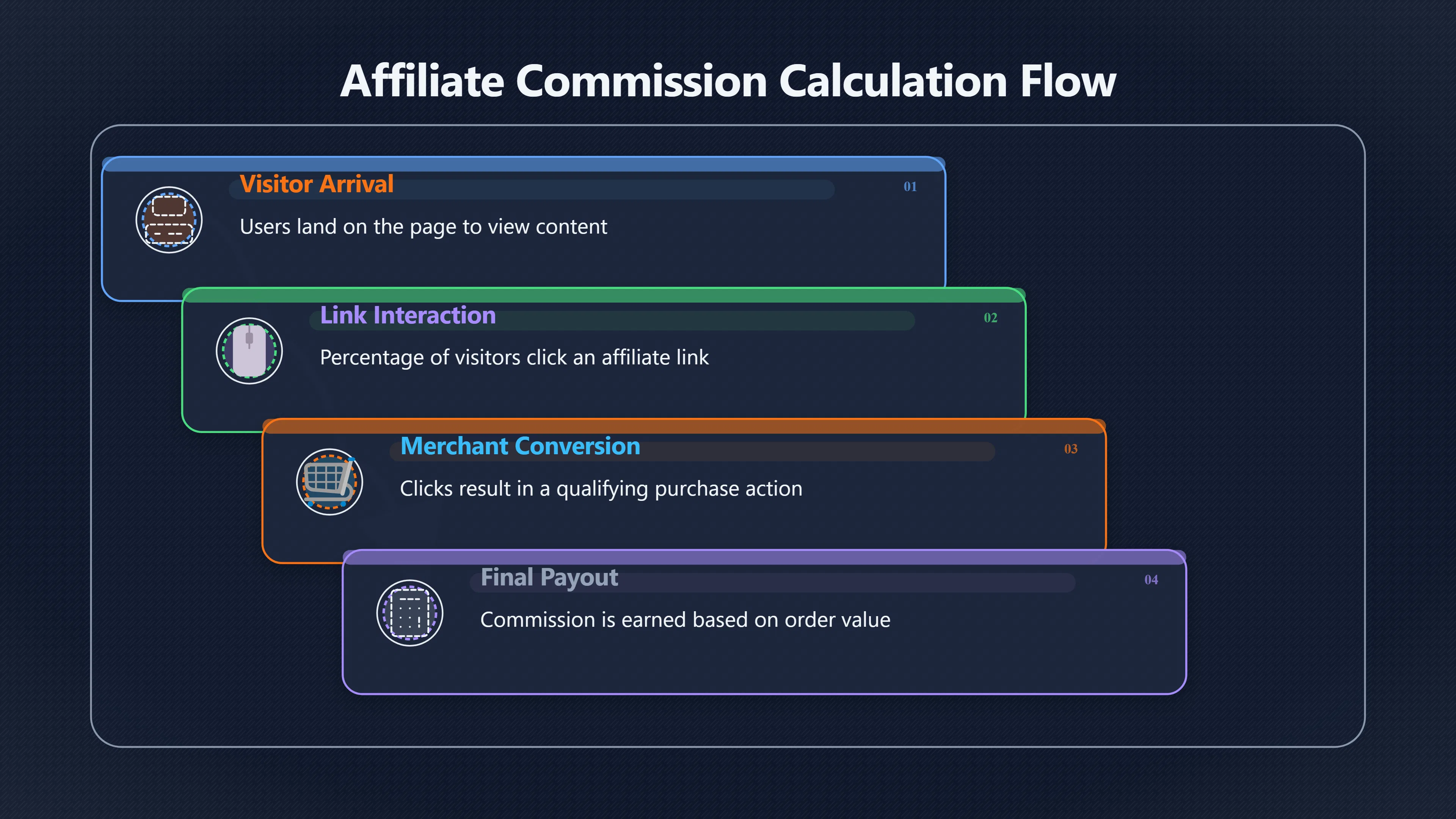
Visitors × Affiliate CTR × Merchant Conversion Rate × Average Order Value × Commission Rate = Estimated Commission
Each variable represents a different stage in the journey:
- Visitors – people arriving at the page.
- Affiliate CTR – the percentage who click an affiliate link.
- Merchant conversion rate – the percentage of those clicks that complete the qualifying action, usually a purchase.
- Average order value (AOV) – the average amount spent.
- Commission rate – the percentage or fixed payment earned by the affiliate.[floatingcta.com]floatingcta.comaffiliate marketing conversion rates: 2026 Benchmarks by…Awin's published guidance puts the typical affiliate conversion rate at 0.5-1%, while Authority Hacker's affilia…
A useful way to model this is to leave every number as an assumption that can be changed. Rather than asking, “How much will 5,000 visitors earn?”, ask, “How much would 5,000 visitors earn if 4% click, 3% buy, the average order is £80, and the commission is 8%?”
Using those assumptions:
- 5,000 visitors
- 4% CTR = 200 affiliate clicks * 3% conversion rate = 6 sales[floatingcta.com]floatingcta.comaffiliate marketing conversion rates: 2026 Benchmarks by…Awin's published guidance puts the typical affiliate conversion rate at 0.5-1%, while Authority Hacker's affilia… * £80 average order[wecantrack.com]wecantrack.comAffiliate Program Performance StatisticsConversion rates for affiliate marketing programs average 1.8%.2; The average order value (AOV) f…
- 8% commission
Monthly commission:
6 × £80 × 8% = £38.40
The exercise is valuable because every assumption is visible and can be adjusted as real data arrives.
Comparing weak, moderate, and strong page economics
The following examples are illustrations rather than benchmarks. Real performance varies by niche, audience intent, merchant, season, and product pricing.
ScenarioVisitorsCTRConversionAOVCommissionEstimated Monthly IncomeWeak5,0001%1%£605%£1.50Moderate5,0004%3%£808%£38.40Strong5,0008%5%£15010%£300.00
These scenarios highlight several important lessons.
First, traffic alone explains very little. The same number of visitors produces dramatically different results depending on what happens after they arrive.
Second, small percentage improvements multiply together. Doubling CTR and increasing conversion rate by only a few percentage points can create much larger income differences than another few hundred visitors.
Third, commission structure matters. Two merchants selling similar products may convert equally well, but a higher commission or higher average basket size can substantially change earnings.
Industry reports repeatedly show that affiliate performance differs widely between programmes, categories, and buying intent, making fixed “expected earnings” figures unreliable.[impact.com+2Awin]impact.comaffiliate marketing benchmarkAffiliate Benchmark 2025: Fewer Buys, Higher Order ValueFebruary 9, 2026 — Longer research, shorter purchase windows. Discover how 2025 s…
Which assumptions deserve the most attention?
Beginners often overestimate the importance of one variable while ignoring the others. In practice, every stage deserves testing.
If traffic doubles while every other metric remains unchanged, commission roughly doubles.
If CTR doubles while traffic remains constant, affiliate clicks double before the merchant even has an opportunity to convert visitors.
If conversion rate improves because the content attracts readers closer to making a purchase, more of the existing clicks become commission.
If average order value increases, each successful referral becomes more valuable without requiring additional traffic.
If commission rates increase through a different affiliate programme or product category, every successful sale becomes more profitable.
Because these effects multiply together rather than add together, modest improvements across several stages often outperform a dramatic improvement in only one stage.
Using scenarios without turning them into promises
Scenario modelling works best when it explores a range of outcomes instead of assuming everything goes well.
A practical approach is to maintain three versions of every forecast:
- Conservative – lower CTR, lower conversion, lower order values.
- Expected – assumptions based on current site performance or reliable programme data.
- Optimistic – stronger performance that remains plausible rather than exceptional.
As actual website data accumulates, replace estimated values one by one. For example:
- Replace estimated visitors with measured search traffic.
- Replace estimated CTR with actual affiliate-link click data.
- Replace estimated conversion with reports from the affiliate network.[floatingcta.com]floatingcta.comaffiliate marketing conversion rates: 2026 Benchmarks by…Awin's published guidance puts the typical affiliate conversion rate at 0.5-1%, while Authority Hacker's affilia…
- Replace assumed order value with the merchant’s reported average.
- Replace assumed commission with the actual payout.
The model gradually changes from a planning exercise into a measurement tool.

Common beginner mistakes when modelling income
Several errors repeatedly produce unrealistic forecasts.
Treating all visitors as buyers. Only a proportion of visitors click affiliate links, and only a proportion of those clicks convert.
Using unusually high conversion rates. Conversion varies considerably between merchants, products, devices, and traffic sources. Industry guidance emphasises that averages differ widely across programmes, making generic “typical” figures unreliable.[Awin]awin.comhow to use affiliate marketing to drive low cost conversions for your brandAll About Affiliate Marketing Conversion Rates14 Sept 2022 — Wondering what a good conversion rate for affiliate marketing is and how…
Ignoring buying intent. A page answering an informational question usually behaves differently from a detailed product comparison written for readers already deciding what to buy.
Assuming every page performs equally. One well-targeted review may produce most of a site’s affiliate income while dozens of informational articles generate little direct commission.
Never updating assumptions. Scenario models become increasingly useful as estimated numbers are replaced with real measurements.
Turning forecasts into decisions
The greatest value of scenario modelling is not predicting an exact monthly income figure. It is identifying which assumptions deserve improvement.
If the model shows that CTR is extremely low, improving page design and calls to action may produce better returns than writing additional articles.
If conversion is consistently poor despite healthy CTR, the merchant, product selection, or audience fit may need attention.
If commission remains low even when conversions are strong, comparing alternative affiliate programmes with similar products may be worthwhile.
Viewed this way, an affiliate income model becomes a decision-making tool rather than an earnings promise. It helps beginners evaluate website ideas, set realistic expectations, and measure progress using evidence instead of optimistic guesses.
Amazon book picks
Further Reading
Books and field guides related to How Much Could an Affiliate Page Earn?. Use these as the next step if you want deeper reading beyond the article.
Affiliate Program Management
Explains affiliate economics, commissions, conversion metrics, and programme performance.
The Lean Startup
Rating: 3.0/5 from 33 Google Books ratings
Supports scenario testing, assumptions, and evidence-based forecasting rather than unrealistic income promises.
Web Analytics 2.0
Helps readers understand funnels, conversion rates, and measuring performance across visitor journeys.
Traction
Focuses on acquiring traffic efficiently, a key input to affiliate revenue models.
eBay marketplace picks
Marketplace Samples
Live-tested eBay searches with available results related to this page.



Endnotes
1.
Source: impact.com
Title: affiliate marketing benchmark
Link:https://impact.com/affiliate/affiliate-marketing-benchmark/
Source snippet
Affiliate Benchmark 2025: Fewer Buys, Higher Order ValueFebruary 9, 2026 — Longer research, shorter purchase windows. Discover how 2025 s...
Published: February 9, 2026
2.
Source: awin.com
Title: how to use affiliate marketing to drive low cost conversions for your brand
Link:https://www.awin.com/us/how-to-use-awin/how-to-use-affiliate-marketing-to-drive-low-cost-conversions-for-your-brand
Source snippet
All About Affiliate Marketing Conversion Rates14 Sept 2022 — Wondering what a good conversion rate for affiliate marketing is and how...
3.
Source: success.awin.com
Link:https://success.awin.com/s/article/Terminology-used-in-affiliate-marketing
Source snippet
Awin Partner Success CenterThe Essential Affiliate Marketing GlossaryThis Affiliate Marketing Glossary will allow you to get to know an a...
Additional References
4.
Source: wecantrack.com
Link:https://wecantrack.com/insights/affiliate-program-performance-statistics/
Source snippet
Affiliate Program Performance StatisticsConversion rates for affiliate marketing programs average 1.8%.2; The average order value (AOV) f...
5.
Source: searlco.com
Title: top affiliate marketing metrics a comprehensive guide
Link:https://www.searlco.com/article/top-affiliate-marketing-metrics-a-comprehensive-guide
Source snippet
Top Affiliate Marketing Metrics: A Comprehensive Guide30 Apr 2025 — Conversion rate is a critical metric that measures the percentage of...
6.
Source: thrivecart.com
Title: Conversion rates of 0.5% to 1% are considered average.Read more
Link:https://thrivecart.com/blog/affiliate-marketers-everything-you-need-to-know-about-conversion-rates/?srsltid=AfmBOors6Q44uhGLX6YO3CKXz25vQMNyHcLa_ifJlzNpYcAXuZYh9zPN
Source snippet
How to Compute Affiliate Marketing Conversion Rate31 Mar 2026 — As a general guideline, conversion rates for affiliate marketing may seem...
7.
Source: floatingcta.com
Title: affiliate marketing conversion rate
Link:https://floatingcta.com/insights/affiliate-marketing-conversion-rate/
Source snippet
s: 2026 Benchmarks by...Awin's published guidance puts the typical affiliate conversion rate at 0.5-1%, while [Authority]({{ 'authority/' | relative_url }}) Hacker's affilia...
8.
Source: growsurf.com
Title: affiliate program benchmarks
Link:https://growsurf.com/statistics/affiliate-program-benchmarks/
Source snippet
(2026)Conversion rates vary significantly by industry and offer type. The overall average is 1-5%. E-commerce programs average 2.8%, SaaS...
9.
Source: partnero.com
Link:https://www.partnero.com/articles/21-essential-affiliate-marketing-benchmarks
Source snippet
21 Affiliate Marketing Benchmarks & KPIs - PartneroAverage conversion rates typically range from 1% to 3% across different industries, bu...
10.
Source: youtube.com
Title: The Affiliate Funnel, Explained
Link:https://www.youtube.com/watch?v=Y3E3MrCVpks
Source snippet
Affiliate marketing math calculator revenue forecasting How much money can your ONLINE COURSE earn? This calculator will tell you...
11.
Source: youtube.com
Title: How to Build an Affiliate Marketing Funnel that Converts
Link:https://www.youtube.com/watch?v=SbG7R8kK8t8
Source snippet
Free Funnel Math Calculator: How Much Will Your Funnel Make?...
12.
Source: youtube.com
Title: Excel Tutorial Series for Affiliate Marketers
Link:https://www.youtube.com/watch?v=Z2EMPJaZanQ
Source snippet
How to Build an Affiliate Marketing Funnel that Converts...
13.
Source: youtube.com
Title: Affiliate Marketing KPI Scorecard in Excel
Link:https://www.youtube.com/watch?v=ejjFhGJBKac
Source snippet
Excel Tutorial Series for Affiliate Marketers...
Topic Tree