Within Deals
Can Shoppers Trust Your Coupon Codes?
A coupon page earns trust when it shows which codes were tested, when they worked, and why failed offers were removed.
On this page
- What code verification should show
- How failed tests still help readers
- Why freshness beats code volume
Page outline Jump by section
Introduction
Trust is the most valuable asset on a coupon page. Readers who search for a discount code are often only moments away from completing a purchase, so a single expired, misleading or fabricated offer can permanently damage confidence. For affiliate publishers, that matters twice: disappointed visitors are less likely to click future affiliate links, and search engines increasingly reward pages that demonstrate genuine usefulness rather than simply republishing promotional claims.
 The strongest coupon pages therefore focus less on listing the largest number of codes and more on proving which offers have been checked recently, what happened during testing, and why some promotions no longer work. Verification becomes part of the product rather than an invisible editorial process.
What code verification should show
A verified coupon page should answer the questions a shopper would otherwise have to discover by trial and error at the checkout.
Rather than displaying a generic “active” badge, each offer should include practical evidence such as:
- Date and time of the latest test, so readers understand how fresh the information is.
- Test outcome, such as “worked”, “expired”, “account required”, or “could not be verified”.
- Observed discount, for example “15% off full-price items” instead of simply “Save money”.
- Key restrictions, including minimum spend, new-customer requirements, excluded brands, app-only availability, or regional limitations.
- Expiry date, where officially published by the retailer.
- Source of the promotion, distinguishing retailer-issued promotions from user-submitted codes or historical offers.
This level of transparency helps readers judge whether a code is likely to succeed before interrupting their checkout.
Retail platforms themselves also expect promotions to be accurate. Google’s Merchant Center promotion requirements require merchants to provide valid redemption codes, accurate promotion details and applicable terms, while promotions that fail testing or do not provide an actual checkout benefit may be rejected.[Google Help]support.google.comHelp Promotions data specificationFree delivery promotions must include a valid coupon code that customers can apply manually.Read more…
How failed tests still help readers
Many coupon sites remove failed codes without explanation. In practice, failed tests can provide useful information when presented honestly.
For example, a coupon page might report:
StatusValue for the readerWorked todayHigh confidence that the code is still valid.ExpiredPrevents wasted checkout attempts.New-customer onlyExplains why returning customers were rejected.Account-specificIndicates that the code is not intended for general use.Could not reproduceSignals uncertainty instead of pretending the offer works.
This approach turns negative results into useful buying information.
Readers also gain confidence when they can distinguish between an expired promotion and a code that simply does not apply to their particular basket. A voucher that excludes sale items or premium brands has not necessarily failed—it simply has conditions that should have been explained before checkout.
Showing unsuccessful verification also demonstrates editorial independence. Instead of promoting every available code because it might generate an affiliate click, the publisher is documenting real outcomes.
Why freshness beats code volume
Large coupon databases often appear impressive, but dozens of stale offers create more frustration than value.
A page containing five recently tested promotions usually serves shoppers better than one containing fifty unverified codes.
Freshness matters because retailers frequently:
- replace promotional campaigns;
- change minimum spending thresholds;
- restrict codes to selected customer groups;
- end seasonal offers without warning;
- disable codes that spread beyond their intended audience.
A verification timestamp helps readers understand that coupon information is perishable. Unlike product specifications, promotional offers change constantly.
Google’s own promotion guidance reflects this reality by requiring valid promotion periods and redemption information rather than indefinite promotional claims.[Google Help]support.google.comHelp Promotions data specificationFree delivery promotions must include a valid coupon code that customers can apply manually.Read more…
Build trust through visible editorial standards
Verification is not only about testing coupon codes. It is also about explaining how the page is maintained.
Useful editorial signals include:
- stating how frequently offers are reviewed;
- identifying whether testing was manual or retailer-confirmed;
- clearly separating verified offers from community submissions;
- removing expired promotions instead of allowing them to accumulate;
- explaining why a code was withdrawn.
Some publishers also include simple status labels such as:
- Verified today
- Verified this week
- Retailer offer
- Community reported
- Expired – kept for reference
This allows readers to judge reliability at a glance rather than assuming every listed promotion has equal credibility.
Common mistakes that reduce shopper confidence
Several practices repeatedly undermine coupon websites, even when some of their offers are genuine.
Inflated success claims. Describing every promotion as “working” despite limited testing quickly damages credibility when shoppers encounter repeated failures.
Artificial urgency. Countdown timers or “last chance” labels that continue indefinitely teach readers to ignore future warnings.
Duplicate offers. Listing the same promotion multiple times under different headlines creates the illusion of choice without adding value.
Missing conditions. A coupon that only works for first-time customers should never be presented as a universal discount.
Keeping dead codes for traffic. Leaving expired offers online simply to capture search visits wastes readers’ time and increases bounce rates.

A practical verification workflow
For an affiliate publisher, a lightweight but consistent verification process is often enough to differentiate the site from low-quality coupon directories.
A practical workflow might look like this:
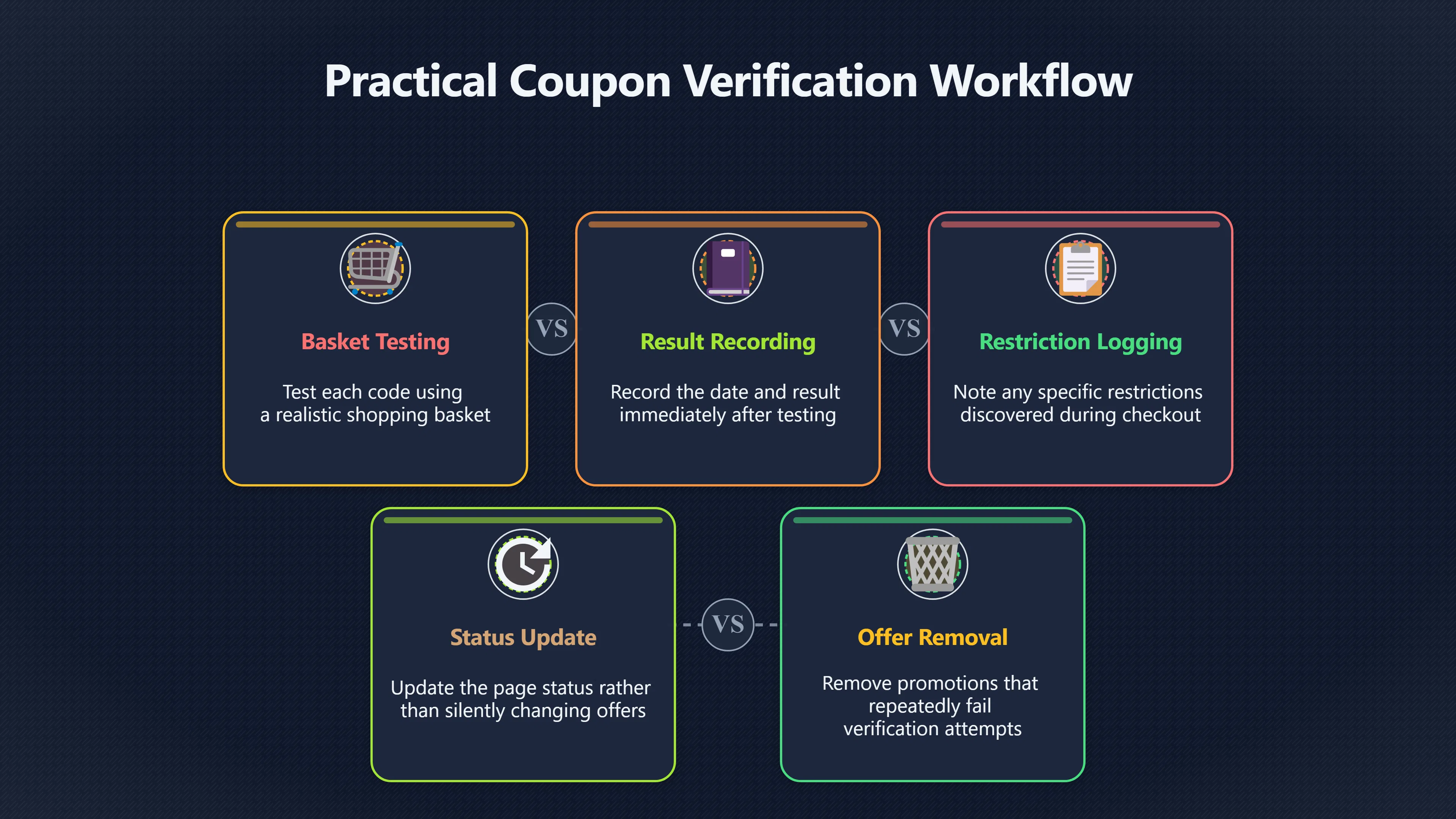
- Test each code using a realistic shopping basket.
- Record the date and result immediately.
- Note any restrictions discovered during checkout.
- Update the page status rather than silently changing offers.
- Remove promotions that repeatedly fail verification.
- Prioritise recently verified offers at the top of the page.
The emphasis should be on consistency rather than perfect coverage. Readers are generally more forgiving of a limited selection of well-documented offers than a huge catalogue with uncertain accuracy.
Trust becomes a competitive advantage
Affiliate coupon pages succeed when they reduce friction instead of creating it. Verification is therefore not merely an editorial task but a competitive advantage. By showing when codes were tested, documenting why unsuccessful attempts failed, and keeping information fresher than competing sites, publishers demonstrate that they are helping shoppers complete purchases rather than simply chasing affiliate commissions.
In a market where many coupon pages contain duplicated or outdated promotions, visible verification practices become one of the clearest signals that a site deserves both reader confidence and repeat visits.
Amazon book picks
Further Reading
Books and field guides related to Can Shoppers Trust Your Coupon Codes?. Use these as the next step if you want deeper reading beyond the article.
Trust Me, I'm Lying
Provides context on deceptive online publishing practices, reinforcing the value of transparent coupon verification.
Building a StoryBrand 2.0
When you apply the StoryBrand framework your brand will stand out. Developing that framework to clarify your message and grow your busine...
Influence: The Psychology of Persuasion
Explains the trust and credibility principles that underpin effective, honest coupon and affiliate pages.
eBay marketplace picks
Marketplace Samples
Live-tested eBay searches with available results related to this page.


Endnotes
1.
Source: support.google.com
Title: Help Promotions data specification
Link:https://support.google.com/merchants/answer/2906014?hl=en-GB
Source snippet
Free delivery promotions must include a valid coupon code that customers can apply manually.Read more...
Additional References
2.
Source: youtube.com
Link:https://www.youtube.com/watch?v=cf8XTwQj09o
Source snippet
How coupon sites work affiliate verification strategy Coursera Affiliate Discount...
3.
Source: feedoptimise.com
Link:https://www.feedoptimise.com/blog/google-shopping-merchant-centre-promotions-basics
Source snippet
Google Merchant Centre Shopping Promotions4 Nov 2024 — In such cases, verify that your coupon code is working and request Goo...
4.
Source: youtube.com
Link:https://www.youtube.com/watch?v=ir6WbRO4Amw
Source snippet
How to make Affiliate Coupons and [Deals]({{ 'deals/' | relative_url }}) Website with WordPress & Cashback Tracker plugin...
5.
Source: youtube.com
Title: FREE Plugin To Create Deals and Coupons Website For Affiliate Marketing
Link:https://www.youtube.com/watch?v=ZIDVFO8FvsY
Source snippet
EARN 1000$ A MONTH BY CREATING AN AFFILIATE COUPONS WEBSITE...
6.
Source: youtube.com
Title: Coupon Affiliate Programs
Link:https://www.youtube.com/watch?v=k7–_k-uXWA
Source snippet
FREE Plugin To Create Deals and Coupons Website For Affiliate Marketing...
7.
Source: youtube.com
Title: Who Makes Money From Online Coupon Codes?
Link:https://www.youtube.com/watch?v=IKwerybtc0w
Source snippet
Coupon Affiliate Programs - How Coupon Sites Make Money...
Topic Tree