Within Long Tail
What Buyer Worry Is Hiding in the Search?
Pain-point searches reveal the specific worry that stops a shopper from buying, from noise and fit to setup, safety, and returns.
On this page
- How pain point wording changes purchase intent
- Common hesitation patterns worth building pages around
- When a pain point is too thin for its own page
Page outline Jump by section
Introduction
Pain-point keywords are not simply longer search phrases. They reveal the exact concern preventing a buyer from completing a purchase. Instead of searching for a generic product, the user has identified a specific obstacle such as excessive noise, poor fit, difficult installation, safety concerns, compatibility, or the risk of making an expensive mistake. For affiliate websites, these searches often represent some of the highest-value opportunities because the content can resolve the final unanswered question before a buying decision.
 The key difference is that the search is driven by hesitation rather than curiosity. A page built around a genuine buying obstacle can be significantly more useful than a broad “best products” article because it explains why certain products succeed or fail under the reader’s specific circumstances. This aligns with Google’s emphasis on original, helpful review content that demonstrates practical understanding instead of simply listing products.[growandconvert.com]growandconvert.comLong-Tail Keyword Strategy: What It Is, Pros, Cons & MoreMay 10, 2024 — 10 May 2024 — In this guide, we cover how to use a long-tail keyword strategy to increase conversion rates and overall leads…
What buyer worry is hiding in the search?
Every buying hesitation leaves clues in the language people use. Once a shopper begins adding words that describe a problem instead of a product, their intent changes.
Compare these examples:[keywordme.io]keywordme.iolong tail keywords examples10 Long Tail Keywords Examples to Boost SEO in 2025Discover 10 powerful long tail keywords examples that drive high-intent traffic. See h…
Broad searchPain-point searchHidden hesitationBest office chairBest office chair for lower back pain under 6 feetComfort and physical fitRobot vacuumRobot vacuum that works on black carpetCompatibility concernWireless headphonesWireless headphones that don’t fall out while runningSecurity and fitAir purifierQuiet air purifier for bedroom at nightNoise anxietyPrinterPrinter with cheapest ink for occasional useLong-term ownership costStanding deskStanding desk easy to assemble aloneSetup difficulty
The buyer is no longer asking, “What should I buy?” They are asking, “Which option avoids my particular problem?”
That distinction changes the purpose of the affiliate page. Instead of reviewing every product in the category, the page should explain the mechanism behind the concern before recommending suitable products.
How pain-point wording changes purchase intent
Pain-point keywords often indicate that the shopper has already completed much of their research.
Rather than comparing every available option, they are trying to eliminate risk. Common language includes:
- “too noisy”
- “won’t fit”
- “easy to install”
- “safe for…”
- “works with…”
- “doesn’t leak”
- “doesn’t overheat”
- “without subscription”
- “for small spaces”
- “for sensitive skin”
- “under heavy use”
These modifiers dramatically narrow the decision.
For example, someone searching for “best mechanical keyboard” could still be casually browsing.
Someone searching for “quiet mechanical keyboard for shared office” has already accepted mechanical keyboards as the solution. Their remaining concern is workplace noise.
Similarly:
- “best mattress” explores a category.
- “best mattress for side sleeper with shoulder pain” identifies a comfort problem.
- “best laptop” compares products.
- “best laptop that stays cool during video editing” targets a performance concern.
Research on long-tail keywords consistently shows that highly specific searches tend to reflect stronger commercial intent because users know what they need and are closer to taking action.[Semrush+2growandconvert.com]semrush.comhow to choose long tail keywordsLong-Tail Keywords: The Ultimate Guide for 20255 Aug 2025 — Long-tail keywords are highly precise search engine queries. Optimizin…
Common hesitation patterns worth building pages around
Not every concern deserves a separate article, but many recurring buying worries appear across almost every affiliate niche.
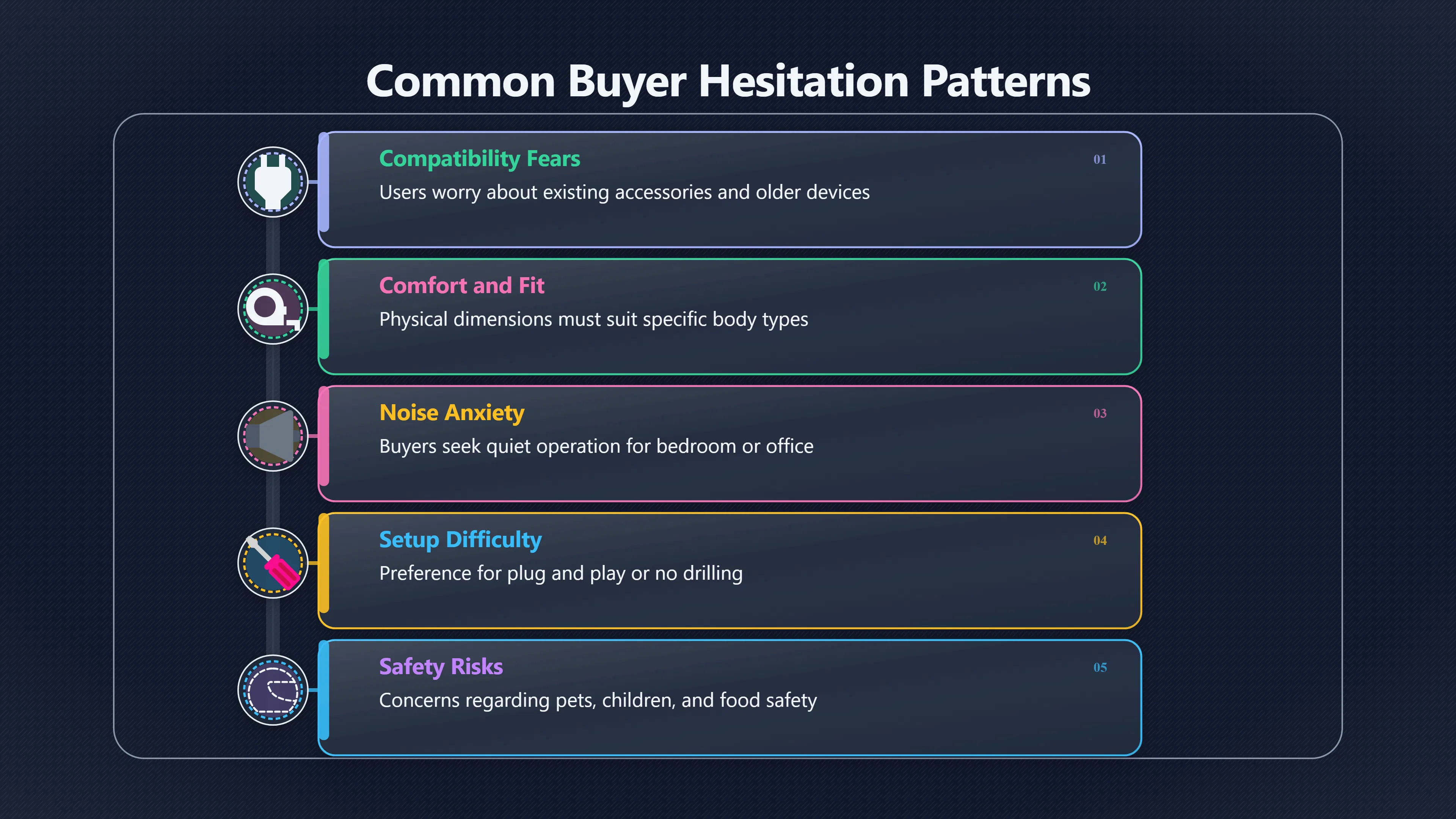
Compatibility fears
Compatibility questions often convert well because buyers fear wasting money.
Examples include:
- works with older devices
- compatible with existing accessories
- fits certain dimensions
- supports specific operating systems
- works in rented accommodation
These pages succeed by explaining compatibility rules before recommending products.
Comfort and fit
Comfort cannot always be judged from product specifications.
Typical searches include:
- for wide feet
- for tall people
- for glasses wearers
- for small hands
- comfortable for long sessions
Retailers frequently provide measurements but rarely explain how those measurements affect real-world use.
Noise concerns
Noise is a classic hidden objection.
Examples include:
- quiet dishwasher
- silent air compressor
- quiet treadmill
- low-noise fan
- keyboard without loud clicking
Instead of repeating manufacturer decibel ratings, a useful affiliate page explains what those figures actually sound like in a bedroom, office or flat.

Ease of setup
Many shoppers worry less about the product than the work required afterwards.
Searches often include:
- easy installation
- beginner friendly
- no drilling
- plug and play
- no wiring required
These readers need practical guidance rather than another specification table.
Safety and reliability
Some purchases carry perceived risk.
Examples include:
- safe around pets
- child-safe
- food-safe materials
- reliable during power cuts
- waterproof enough for heavy rain
Trust matters more than feature count in these searches. The strongest pages explain testing standards, certifications and realistic limitations rather than making broad claims.
Cost after purchase
Many products have hidden ownership costs.
Common modifiers include:
- low maintenance
- cheap replacement filters
- affordable ink
- long battery life
- no monthly subscription
The buying hesitation is future expense rather than purchase price.

Why these pages outperform generic buying guides
Pain-point pages usually compete on relevance rather than volume.
A broad “best coffee machine” article attempts to satisfy dozens of different audiences simultaneously.
A page answering “best coffee machine for very small kitchen with limited worktop space” serves one audience exceptionally well.
That focus produces several advantages:
- Recommendations become easier to justify.
- Product comparisons become more meaningful.
- Readers spend less effort deciding whether the advice applies to them.
- Internal links naturally connect related pain points without repeating identical content.
Google’s guidance for helpful content and product reviews also encourages demonstrating first-hand understanding of what actually matters to buyers rather than producing generic summaries or keyword-heavy pages.[growandconvert.com]growandconvert.comLong-Tail Keyword Strategy: What It Is, Pros, Cons & MoreMay 10, 2024 — 10 May 2024 — In this guide, we cover how to use a long-tail keyword strategy to increase conversion rates and overall leads…
When a pain point is too thin for its own page
Not every modifier represents a meaningful buying problem.
Some long-tail searches merely add unnecessary words without changing the recommendation.[yotpo.com]yotpo.comlong tail keywords guideLong-Tail Keywords: The Ultimate Guide for 202628 Jan 2026 — A long-tail keyword is a search query that is highly specific and typically…
For example:
- “best blue wireless mouse”
- “best modern toaster”
- “best nice-looking kettle”
If the modifier has little influence on product selection, creating a dedicated page usually produces thin content with little unique value.
A stronger test is to ask:
- Does this concern eliminate many otherwise good products?
- Does it require different buying criteria?
- Can the page explain why the concern matters?
- Would the recommended products genuinely differ from a general buying guide?
If the answer is no, the topic is often better handled as a section within a broader article.
By contrast, a page about “best external monitor for MacBook Air with single-cable charging” clearly changes the evaluation criteria. USB-C power delivery, display scaling, cable compatibility and charging wattage become central to the recommendation, making the page genuinely distinct.
Building pages around mechanisms, not keywords
The most effective pain-point affiliate pages treat the keyword as evidence of a buying obstacle rather than an SEO target.
Instead of mechanically repeating the search phrase, they explain:
- Why the problem occurs.
- Which product characteristics solve it.
- Which specifications are genuinely important.
- Which commonly recommended products fail for that situation.
- Which products best address the concern, with clear reasoning.
This approach produces content that satisfies both the search query and the underlying hesitation. It also creates pages that remain useful even as individual products change, because the buyer learns how to evaluate future options instead of simply following a list of recommendations.
Amazon book picks
Further Reading
Books and field guides related to What Buyer Worry Is Hiding in the Search?. Use these as the next step if you want deeper reading beyond the article.
They Ask, You Answer
Focused on uncovering and answering the exact concerns that stop buyers from purchasing.
Made to Stick
Helps communicate solutions to buyer pain points in memorable, convincing ways.
Building a StoryBrand 2.0
Shows how to frame products around customer problems and objections.
Buyer Personas
Explains how to identify customer questions, hesitations and buying triggers.
eBay marketplace picks
Marketplace Samples
Live-tested eBay searches with available results related to this page.
Endnotes
1.
Source: growandconvert.com
Title: Long-Tail Keyword Strategy: What It Is, Pros, Cons & More
Link:https://www.growandconvert.com/seo/long-tail-keyword-strategy/
Source snippet
May 10, 2024 — 10 May 2024 — In this guide, we cover how to use a long-tail keyword strategy to increase conversion rates and overall leads...
Published: May 10, 2024
2.
Source: semrush.com
Title: how to choose long tail keywords
Link:https://www.semrush.com/blog/how-to-choose-long-tail-keywords/
Source snippet
Long-Tail Keywords: The Ultimate Guide for 20255 Aug 2025 — Long-tail keywords are highly precise search engine queries. Optimizin...
3.
Source: yotpo.com
Title: long tail keywords guide
Link:https://www.yotpo.com/blog/long-tail-keywords-guide/
Source snippet
Long-Tail Keywords: The Ultimate Guide for 202628 Jan 2026 — A long-tail keyword is a search query that is highly specific and typically...
Additional References
4.
Source: linkedin.com
Link:https://www.linkedin.com/pulse/long-tail-keywords-saas-finding-targeting-niche-search-james-gunn-tk9pe
Source snippet
Long-Tail Keywords in SaaS: Finding and Targeting Niche...Long-tail keywords offer SaaS companies the opportunity to tap into high-inten...
5.
Source: fatjoe.com
Title: What Is Pain Point SEO? Turning Problems Into Profit
Link:https://fatjoe.com/blog/pain-point-seo/
Source snippet
fatjoe.29 Jul 2024 — Pain point SEO is a marketing strategy that focuses on [high-intent keywords]({{ 'intent-costs/' | relative_url }}). The goal is to attract more conversion...
6.
Source: youtube.com
Title: Buying Keywords
Link:https://www.youtube.com/watch?v=C3PufBlfXRc
Source snippet
Pain point seo buyer intent keywords Pain Point SEO: What is it? Examples, Objections and How to Get Started- Grow and Convert Deep Dives...
7.
Source: hivehq.ai
Title: affiliate marketing keyword research
Link:https://www.hivehq.ai/blog/affiliate-marketing-keyword-research
Source snippet
That Converts1 Nov 2025 — Master affiliate marketing keyword research. Learn to find high-intent keywords, analyze competitors, and creat...
8.
Source: keywordme.io
Title: long tail keywords examples
Link:https://www.keywordme.io/blog/long-tail-keywords-examples
Source snippet
10 Long Tail Keywords Examples to Boost SEO in 2025Discover 10 powerful long tail keywords examples that drive high-intent traffic. See h...
9.
Source: youtube.com
Link:https://www.youtube.com/watch?v=jnd52MH5iqg
Source snippet
How to Use SEO Intent to Make More Money | Keyword Research Review...
10.
Source: factors.ai
Link:https://www.factors.ai/blog/niche-keyword-research-guide
Source snippet
es that typically have lower search volumes but higher conversion rates...
11.
Source: youtube.com
Title: How to Use SEO Intent to Make More Money | Keyword Research Review
Link:https://www.youtube.com/watch?v=R9nvcMEG1IM
Source snippet
High Conversion SEO Tutorial | How to Rank [Buyer Intent]({{ 'buyer-intent/' | relative_url }}) Commercial Keywords...
12.
Source: youtube.com
Title: High Conversion SEO Tutorial | How to Rank Buyer Intent Commercial Keywords
Link:https://www.youtube.com/watch?v=cSQxVmy5gig
Source snippet
Keyword Value & Buyer Intent: Is It Valuable to Rank...
13.
Source: masudjubayer.com
Title: affiliate marketing keyword research
Link:https://masudjubayer.com/affiliate-marketing-keyword-research/
Source snippet
They have lower search volume individually, but collectively they make up the...
Topic Tree