Within Deals
Who Really Earned the Coupon Commission?
Coupon sites can add real value, but last-click tracking can also credit them for sales another publisher helped create.
On this page
- How last click credit works
- When coupons are incremental
- Why creators and deal tools clash
Page outline Jump by section
Introduction
Coupon and deal websites occupy one of the most valuable positions in affiliate marketing because they often appear immediately before a purchase. Under the traditional last-click attribution model, the affiliate responsible for the final tracked click before checkout usually receives the entire commission, regardless of which publisher first introduced, educated or persuaded the customer. This creates a long-running debate: did the coupon site genuinely create a new sale, or did it simply intercept a customer who had already decided to buy?
 For website owners building affiliate businesses, this distinction matters. Coupon publishers can deliver genuine value by reducing basket abandonment, exposing shoppers to better offers and convincing hesitant buyers to complete a purchase. Equally, the same mechanics can divert commissions away from reviewers, bloggers, YouTubers and comparison sites that influenced the buying decision much earlier. Understanding this tension is essential when evaluating the economics and ethics of affiliate marketing.
How last-click credit works
In most affiliate programmes, a customer journey is simplified into a single rewarded event. When a shopper clicks an affiliate link, a tracking cookie or similar identifier records that interaction. If another tracked affiliate link is clicked before the purchase, the newer interaction often replaces the earlier one. The affiliate responsible for the final qualifying click receives the commission.
This model became popular because it is straightforward to implement and audit. Networks can identify a single commission recipient without attempting to estimate the relative influence of multiple marketing touchpoints. However, simplicity comes at the cost of nuance. Last-click attribution measures proximity to the transaction rather than the entire buying journey.[Marketing Week]marketingweek.comHead, IAB Affiliate CouncilRead more…
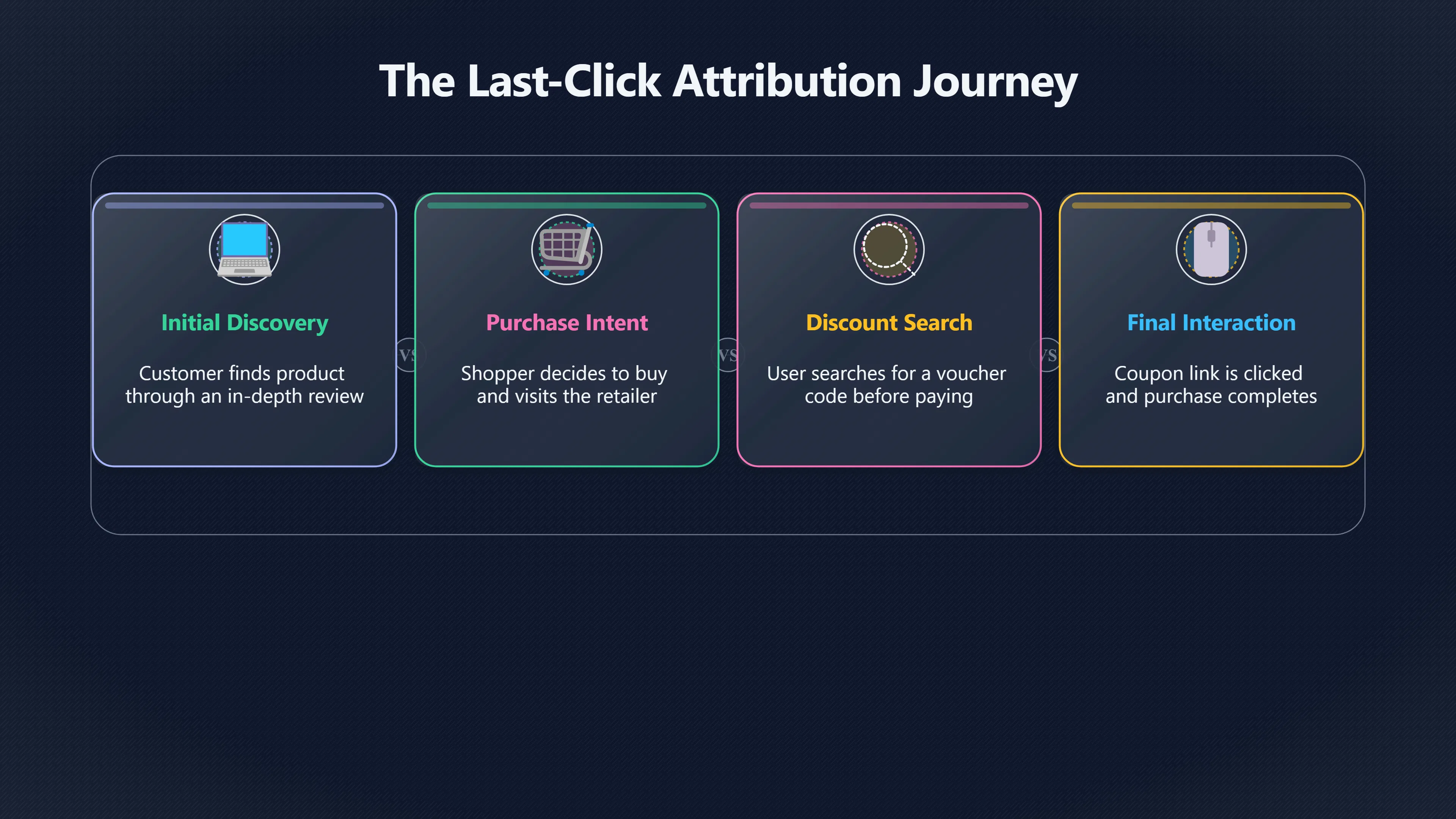
A typical customer path illustrates the issue:
- A reader discovers a product through an in-depth review.
- They decide to buy and visit the retailer.
- Before paying, they search for a discount code.
- They click a coupon affiliate link.
- The purchase completes.
Under a conventional last-click model, the coupon publisher receives the commission, even though the review site may have done most of the work that created purchase intent.
When coupon publishers genuinely create incremental sales
Not every coupon commission is undeserved. The key question is incrementality—whether the affiliate caused a sale that would not otherwise have happened.
A coupon or deal site may add genuine commercial value when it:
- persuades a hesitant customer to complete checkout;
- encourages a shopper to choose one retailer over another;
- introduces a better promotion the customer would not otherwise have found;
- increases basket size because a discount makes additional purchases attractive;
- brings new customers who began their shopping journey on the deal platform rather than elsewhere.
Retailers have long recognised these effects. Discount offers can reduce cart abandonment and influence where consumers choose to purchase, particularly in highly competitive retail categories. However, the degree of incremental value varies significantly by merchant, promotion and customer behaviour rather than being guaranteed by the presence of a coupon.[Trackier]trackier.comIncrementality in Affiliate Marketing: True Impact & ROICompare any multi-touch attribution results with your experimental result…
This explains why many merchants continue to work with coupon affiliates despite criticism. Some coupon traffic clearly creates additional revenue instead of merely redistributing commissions.
Why creators and deal tools clash
The conflict emerges when another publisher has already generated demand before the coupon interaction.
Content creators typically invest substantial effort in activities such as:
- creating comparison guides;
- demonstrating products in videos;
- building audience trust over months or years.
If a customer reaches checkout because of that work but performs a final “discount code” search immediately before payment, the creator may receive nothing.
The growth of automated coupon browser extensions has intensified this debate. These tools can activate automatically during checkout, searching for available codes and, in many affiliate programmes, becoming the final tracked interaction. Creators argue that this allows extensions to earn commissions even when they contributed little to the purchasing decision. Extension providers respond that they operate within existing affiliate rules and may still provide meaningful value by finding discounts or reassuring customers before purchase.[Business Insider+2The Washington Post]businessinsider.comBusiness Insider Influencers are suing Pay Pal over its browser extension HoneyHoney, which searches for web coupons, earns money through last-click attribution, a system where the last referral source before a purch…
The disagreement is therefore not simply about technology but about what affiliate commissions are intended to reward:
- Influence over the buying decision.
- Assistance at the moment of purchase.
- Technical ownership of the final tracked click.
Last-click attribution generally rewards only the third.
Why “last click” does not always equal “most valuable”
The principal criticism of last-click attribution is that it can confuse credit with causation.
A shopper who has already chosen a product may search for a voucher simply because checking for discounts has become routine. If the purchase would have happened anyway, awarding 100% of the commission to the coupon publisher may overstate its commercial contribution.
This phenomenon is often described as commission cannibalisation rather than outright fraud. The issue is not necessarily that anyone broke programme rules but that the rules themselves may reward the wrong behaviour. Brands can end up paying commissions on customers they had effectively already acquired through other marketing investments.[impact.com+2PartnerCentric]impact.comPerformance Marketing: How to Ensure Quality and Brand…Cannibalization occurs when your partners claim credit for sales or traffic you…
For creators, the consequences include:
- lower affiliate income despite generating genuine demand;
- reduced incentives to invest in expensive editorial content;
- greater uncertainty about revenue forecasting.
For advertisers, the concern is different. If too much commission flows to checkout-stage affiliates, budgets may gradually shift away from publishers who introduce new customers earlier in the purchase journey.
How affiliate programmes are responding
Many affiliate programmes no longer rely exclusively on a rigid winner-takes-all approach.
Common responses include:
- Custom attribution rules, where coupon sites receive commission only under defined circumstances.
- Coupon attribution policies that distinguish between exclusive offers and publicly available codes.
- Commission splitting, allowing multiple publishers involved in a customer journey to share rewards.
- Incrementality testing, using controlled experiments to estimate whether affiliates generated genuinely additional sales.
- Soft-click or assist models, designed to prevent certain late-stage interactions, particularly browser extensions, from automatically overriding earlier publishers.[Awin+2impact.com]awin.comensuring fair attribution how awin partners with browser extensionsHow Awin partners with browser extensions8 Jan 2025 — Offering this Soft Click proposition allows advertisers to work with partners l…
Industry discussion has increasingly shifted from asking “Who got the last click?” to “Who created measurable business value?” This reflects broader interest in multi-touch attribution and incrementality rather than treating every affiliate interaction as equally influential.[impact.com]impact.comWatch now. Key takeaways. Expand measurement beyond last-click metrics.Read moreRethinking affiliate measurement for today's partnershipsApr 14, 2025 — Join experts as they reveal how incrementality drives growth and…
What this means for affiliate website owners
For creators building websites around affiliate links, last-click attribution creates both an opportunity and a risk.
A genuine coupon website that verifies offers, negotiates exclusive discounts and attracts shoppers directly can earn commissions fairly because it contributes meaningful value to purchasing decisions.
Conversely, publishers whose business depends primarily on intercepting customers moments before checkout face increasing scrutiny from advertisers seeking higher incremental returns. As affiliate programmes become more sophisticated, merchants are paying closer attention to whether commissions reflect new demand or simply the final recorded interaction.
The long-term trend is therefore less about eliminating coupon affiliates and more about rewarding the publishers that demonstrably influence customer behaviour. Successful affiliate websites increasingly compete not just for the last click, but for evidence that their traffic changes purchasing outcomes in ways that benefit both merchants and consumers.
Amazon book picks
Further Reading
Books and field guides related to Who Really Earned the Coupon Commission?. Use these as the next step if you want deeper reading beyond the article.
Affiliate Program Management
Explains affiliate program mechanics, attribution, commissions, and publisher relationships central to last-click coupon debates.

Performance Partnerships
Provides broader context on affiliate partnerships, incentives, and attribution beyond simple last-click models.
Influence
This is a Summary of the original book, Influence: The Psychology of Persuasion by Robert Cialdini.The book is an authoritative work on t...
eBay marketplace picks
Marketplace Samples
Live-tested eBay searches with available results related to this page.


Endnotes
1.
Source: impact.com
Title: Watch now. Key takeaways. Expand measurement beyond last-click metrics.Read more
Link:https://impact.com/affiliate/affiliate-measurement-incrementality-strategies/
Source snippet
Rethinking affiliate measurement for today's partnershipsApr 14, 2025 — Join experts as they reveal how incrementality drives growth and...
2.
Source: trackier.com
Link:https://trackier.com/incrementality-in-affiliate-marketing/
Source snippet
Incrementality in Affiliate Marketing: True Impact & ROICompare any multi-touch attribution results with your experimental result...
3.
Source: partnercentric.com
Link:https://partnercentric.com/affiliate-resources/guide-to-incrementality/
Source snippet
What is Incrementality in Affiliate Marketing?Cannibalization: Affiliate marketing activities may inadvertently cannibalize...
4.
Source: impact.com
Link:https://impact.com/partnerships/marketing-quality-assurance/
Source snippet
Performance Marketing: How to Ensure Quality and Brand...Cannibalization occurs when your partners claim credit for sales or traffic you...
5.
Source: awin.com
Title: ensuring fair attribution how awin partners with browser extensions
Link:https://www.awin.com/gb/news-and-events/industry-news/ensuring-fair-attribution-how-awin-partners-with-browser-extensions
Source snippet
How Awin partners with browser extensions8 Jan 2025 — Offering this Soft Click proposition allows advertisers to work with partners l...
6.
Source: impact.com
Title: last click attribution affiliate marketing fashion publishers
Link:https://impact.com/affiliate/last-click-attribution-affiliate-marketing-fashion-publishers/
7.
Source: marketingweek.com
Link:https://www.marketingweek.com/who-dares-venture-beyond-the-last-click/
Source snippet
Head, IAB Affiliate CouncilRead more...
8.
Source: businessinsider.com
Title: Business Insider Influencers are suing Pay Pal over its browser extension Honey
Link:https://www.businessinsider.com/creators-are-suing-paypal-over-its-browser-extension-honey
Source snippet
Honey, which searches for web coupons, earns money through last-click attribution, a system where the last referral source before a purch...
9.
Source: washingtonpost.com
Title: The Washington Post Honey says it finds online [deals]({{ ‘deals/’ | relative_url }})
Link:https://www.washingtonpost.com/business/2025/05/16/honey-coupons-paypal-creators-controversy/
Source snippet
Creators say it swipes their income.YouTube creators are facing significant losses in affiliate commissions due to the practices of coupo...
Additional References
10.
Source: wsj.com
Link:https://www.wsj.com/articles/creators-insist-coupon-browser-extensions-are-stealing-their-money-will-the-courts-agree-60079a1f
Source snippet
Will the Courts Agree?Social media creators are suing browser extensions like PayPal Honey, Capital One Shopping, and Microsoft Shopping...
11.
Source: linkedin.com
Title: Brand bidding gets people fired up. Some call it cannibalization
Link:https://www.linkedin.com/posts/rakesh-mistry-4b76a458_affiliatemarketing-performancemarketing-growthmarketing-activity-7381282168829874177-sq3n
Source snippet
Brand Bidding: Smart Growth or Expensive Mistake in Affiliate...Brand Bidding: Smart Growth Play or the Most Expensive Mistake in Affili...
12.
Source: marketingiseasy.com
Link:https://marketingiseasy.com/attribution-1/
Source snippet
If your SEO improves and starts cannibalizing your affiliate channel – that's a...Read more...
13.
Source: mediaweek.com.au
Title: iab report finds affiliate marketing lifts revenue for brands
Link:https://www.mediaweek.com.au/iab-report-finds-affiliate-marketing-lifts-revenue-for-brands/
Source snippet
Apr 21, 2026 — IAB Australia's 2026 State of the Nation report finds affiliate marketing is lifting revenue, with brands increasing spend...
14.
Source: buyapowa.com
Title: What’s incrementality in marketing and why does it matter?
Link:https://www.buyapowa.com/blog/incrementality-marketing/
Source snippet
misattribution argument as with coupon or voucher code sites.... In other words, referrals are far more likely to generate incremental s...
15.
Source: linkedin.com
Link:https://www.linkedin.com/top-content/marketing/affiliate-marketing-tips/understanding-incrementality-in-affiliate-marketing-measurement/
Source snippet
ast-click attribution, by showing the true impact of affiliate campaigns on...Read more...
16.
Source: linkedin.com
Link:https://www.linkedin.com/pulse/beyond-coupons-diversifying-your-affiliate-partner-vishwakarma-vjfrc
Source snippet
ementality—do they drive additional sales or simply claim credit for...Read more...
17.
Source: linkedin.com
Link:https://www.linkedin.com/posts/helensouthgate_what-counts-as-an-incremental-sale-in-affiliate-activity-7355625395473317888-TIr5
Source snippet
The rest? Pure last click theft and 0 added value. Like.Read more...
18.
Source: roundbarnlabs.com
Title: how to avoid affiliate cannibalization 13
Link:https://www.roundbarnlabs.com/blog/how-to-avoid-affiliate-cannibalization-13
Source snippet
How to Avoid Affiliate Cannibalization #1310 Feb 2023 — How to Avoid Affiliate Cannibalization · Cannibalization as a term assumes nefari...
19.
Source: bluepear.net
Title: block affiliate brand cannibalization
Link:https://bluepear.net/blog/block-affiliate-brand-cannibalization
Source snippet
Affiliate Brand Cannibalization: How It Hurts Sales &...11 Jun 2025 — Affiliate brand cannibalization can drain your traffic, inflate ad...
Topic Tree