Within Wirecutter
Disclosure Is Not the Same as Trust
Clear disclosure is only the legal floor; the harder job is making readers believe the ranking itself was not bought.
On this page
- What clear affiliate disclosure must tell readers
- Why vague labels can fail ordinary shoppers
- How disclosure fits into a wider trust system
Page outline Jump by section
Introduction
Affiliate disclosure is the minimum legal requirement for websites that earn commissions from product recommendations. Trust, however, demands something more. The lesson from Wirecutter is that readers do not simply want to know that affiliate links exist; they want confidence that those links did not determine the recommendation in the first place. That distinction has become increasingly important as regulators have tightened disclosure expectations while readers have grown more sceptical of review sites that appear to exist primarily to generate commissions.
 For anyone building an affiliate website, the practical challenge is therefore twofold. First, disclose commercial relationships clearly enough to satisfy consumer protection rules. Second, explain the editorial process that keeps those commercial relationships from controlling rankings. The first addresses legal compliance. The second addresses credibility.
Disclosure Is a Legal Requirement, Not Proof of Independence
Affiliate disclosure rules across major jurisdictions share a common principle: readers should be told when a recommendation could result in financial gain for the publisher.
In the United States, the Federal Trade Commission (FTC) requires disclosure of any “material connection” that could affect the credibility consumers give to an endorsement. The disclosure should be clear, conspicuous and placed where ordinary readers will notice it before or alongside the recommendation rather than hidden in a footer or separate legal page. The FTC also stresses that disclosures should use plain language rather than technical or ambiguous wording.[Federal Trade Commission]ftc.govFederal Trade Commission FTC's Endorsement Guides: What People Are AskingFederal Trade CommissionFTC's Endorsement Guides: What People Are AskingSeptember 7, 2017 — 29 Jun 2023 — Here are answers to some of the…
In the UK, the Advertising Standards Authority (ASA) and the CAP Code similarly require marketing communications to be obviously identifiable. Recent ASA guidance specifically addresses affiliate marketing, explaining that affiliate content often falls within advertising rules and must be labelled clearly enough that consumers immediately understand its commercial nature.[ASA]asa.org.ukget yourself affiliated with the rules on affiliate marketingGet yourself affiliated with the rules on affiliate marketing10 Oct 2024 — This CAP Advice explains the circumstances under which diff…
These rules answer one question:
“Is there a commercial relationship?”
They do not answer the more difficult question that readers actually care about:
“Did that commercial relationship influence the recommendation?”
That second question is where the Wirecutter model became influential.
What Clear Affiliate Disclosure Must Tell Readers
A useful disclosure does more than admit the existence of affiliate links. It explains the commercial arrangement in language an ordinary shopper understands.
A strong disclosure typically communicates three facts:
- the page contains affiliate links;[asa.org.uk]asa.org.ukget yourself affiliated with the rules on affiliate marketingGet yourself affiliated with the rules on affiliate marketing10 Oct 2024 — This CAP Advice explains the circumstances under which diff…
- the publisher may earn a commission if the reader purchases through those links;
- the commission does not increase the purchase price.
Those facts should appear before readers encounter the purchasing decision rather than after they have already clicked. Both the FTC and UK guidance emphasise prominence and clarity over legalistic wording.[Federal Trade Commission]ftc.govFederal Trade Commission FTC's Endorsement Guides: What People Are AskingFederal Trade CommissionFTC's Endorsement Guides: What People Are AskingSeptember 7, 2017 — 29 Jun 2023 — Here are answers to some of the…
However, websites modelled on Wirecutter often extend beyond the legal minimum by adding editorial disclosures such as:
- products are selected independently of commercial teams;
- manufacturers cannot buy favourable rankings;
- recommendations may include products that generate no commission;
- products are re-tested and rankings updated when evidence changes.
These statements are not substitutes for legal disclosure. Instead, they explain the editorial safeguards that disclosure alone cannot communicate.
Why Vague Labels Can Fail Ordinary Shoppers
Many affiliate publishers technically disclose commercial relationships while still leaving readers confused.
Examples include phrases such as:
- “Some links may be compensated.”
- “We participate in partner programmes.”
- “This page may contain promotional content.”
Although legally safer than saying nothing, these expressions often fail to explain what actually happens when a reader clicks a recommendation.
Research into affiliate disclosures supports this concern. Large-scale studies of YouTube and Pinterest found that only a small minority of affiliate content included disclosures at all, and that short or unexplained disclosures were significantly less effective than plain-language explanations in helping users recognise commercial endorsements.[arXiv]arxiv.orgEndorsements on Social Media: An Empirical Study of Affiliate Marketing Disclosures on YouTube and PinterestSeptember 3, 2018…
This matters because many consumers interpret recommendations through ordinary assumptions rather than advertising law. If readers cannot immediately understand that the publisher receives a commission, disclosure has failed its practical purpose even if some form of notice technically exists.
The Wirecutter approach demonstrates that transparency should reduce uncertainty rather than create another puzzle for the reader to decode.
Why Disclosure Alone Does Not Create Trust
Readers increasingly understand that affiliate marketing is a common online business model. What often determines credibility is not whether commissions exist, but whether recommendations appear independent of them.
That is why disclosure works best when it forms one element of a wider trust system.
Instead of relying on a single disclaimer, trustworthy review publishers typically combine disclosure with visible editorial practices such as:
- explaining how products were chosen for testing;
- identifying products that performed poorly;
- discussing trade-offs instead of only benefits;
- updating recommendations when better products become available;
- acknowledging uncertainty where evidence is mixed.
These practices make the commercial relationship easier to evaluate because readers can observe the reasoning behind the recommendation rather than merely being told to trust it.
In other words, disclosure explains that money is involved. Editorial transparency explains why the advice should still be believed.

How Disclosure Fits Into a Wider Trust System
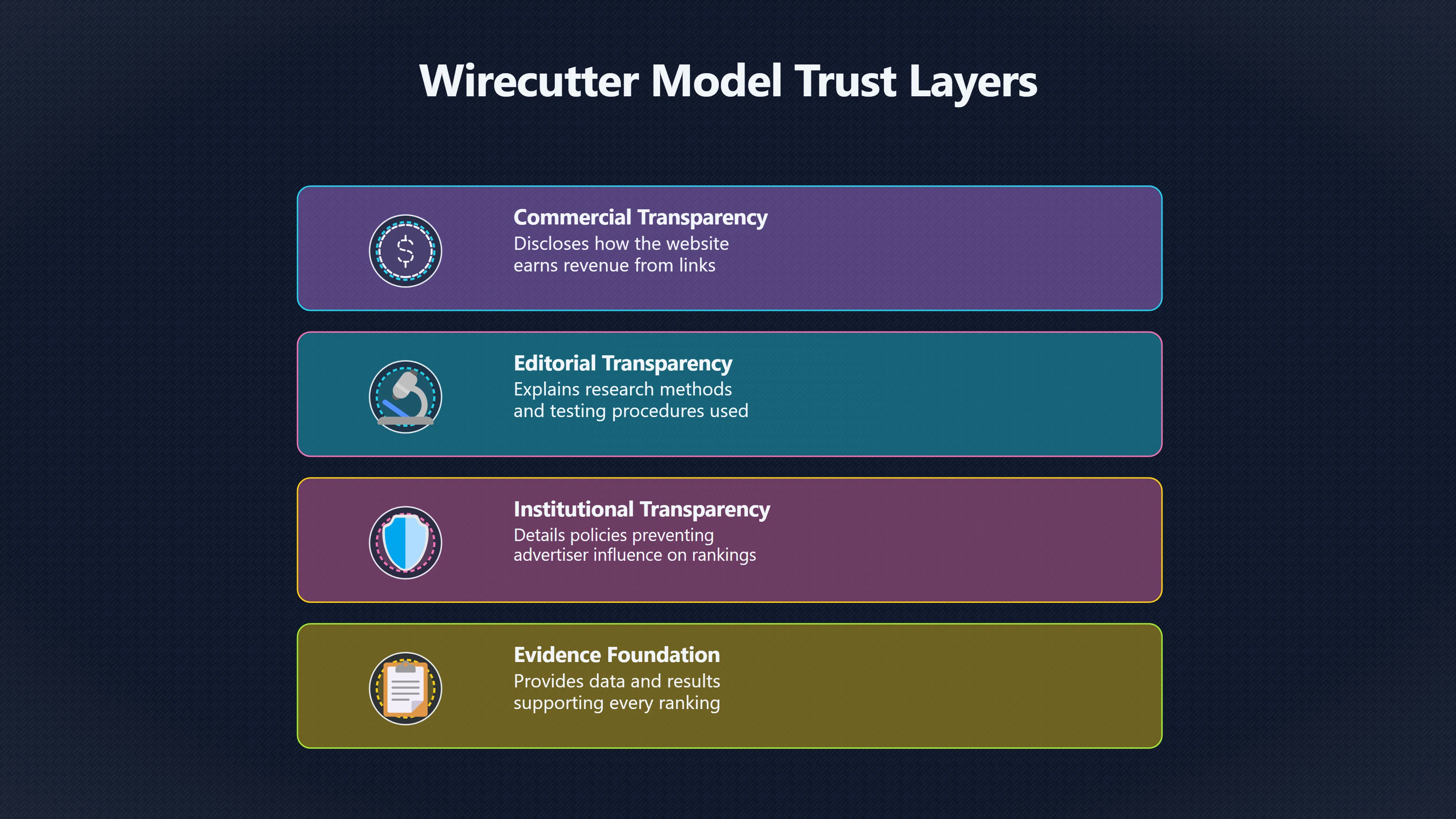
The Wirecutter model effectively separates three different layers that many affiliate websites merge together.
Commercial transparency tells readers how the site earns revenue.
Editorial transparency explains how recommendations are researched, tested and updated.
Institutional transparency explains the policies that prevent advertisers or affiliate partners from determining rankings.
When these layers work together, readers can judge the recommendation on its merits while fully understanding the site’s financial incentives.
This is particularly important because affiliate commissions are not inherently evidence of bias. Many respected publishers use affiliate revenue. The difference lies in whether readers can see credible mechanisms preventing commercial incentives from overriding editorial judgement.
That distinction has become increasingly important as regulators have expanded scrutiny of endorsements, influencer marketing and online reviews. The direction of policy has consistently been towards making commercial relationships easier to understand rather than assuming consumers will infer them.[Federal Trade Commission+2ASA]ftc.govOpen source on ftc.gov.
The Practical Lesson for Affiliate Website Owners
For publishers building affiliate websites today, disclosure should be viewed as the beginning of trust rather than its destination.
A high-quality review page should enable readers to answer four questions quickly:
- Does this page earn affiliate commissions?
- How does the publisher decide what to recommend?
- What protects those recommendations from commercial influence?
- What evidence supports the ranking?
Legal disclosure answers only the first question.
The enduring lesson from the Wirecutter approach is that long-term credibility comes from answering all four. Readers are generally willing to accept that publishers need revenue. What they increasingly reject is uncertainty about whether the recommendation was earned through careful editorial judgement or purchased through commercial influence.
Amazon book picks
Further Reading
Books and field guides related to Disclosure Is Not the Same as Trust. Use these as the next step if you want deeper reading beyond the article.
Everybody Writes
Helps affiliate publishers communicate clearly and transparently with readers.
Trust Me, I'm Lying
Provides valuable context on media credibility, manipulation, and why transparent editorial standards matter.
Epic Content Marketing
Focuses on building audience trust through valuable content rather than short-term monetization.
Influence: The Psychology of Persuasion
Explains the psychology behind credibility, persuasion, and why trust matters beyond simple disclosure.
eBay marketplace picks
Marketplace Samples
Live-tested eBay searches with available results related to this page.



Endnotes
1.
Source: ftc.gov
Title: Federal Trade Commission FTC’s Endorsement Guides: What People Are Asking
Source snippet
Federal Trade CommissionFTC's Endorsement Guides: What People Are AskingSeptember 7, 2017 — 29 Jun 2023 — Here are answers to some of the...
Published: September 7, 2017
3.
Source: asa.org.uk
Title: get yourself affiliated with the rules on affiliate marketing
Link:https://www.asa.org.uk/news/get-yourself-affiliated-with-the-rules-on-affiliate-marketing.html
Source snippet
Get yourself affiliated with the rules on affiliate marketing10 Oct 2024 — This CAP Advice explains the circumstances under which diff...
4.
Source: arxiv.org
Link:https://arxiv.org/abs/1809.00620
Source snippet
Endorsements on Social Media: An Empirical Study of Affiliate Marketing Disclosures on YouTube and PinterestSeptember 3, 2018...
Published: September 3, 2018
5.
Source: arxiv.org
Link:https://arxiv.org/abs/1803.08488
6.
Source: youtube.com
Title: Starting Affiliate Programs: Affiliate Marketing Compliance for Businesses
Link:https://www.youtube.com/watch?v=gAYD5NvQzmE
Source snippet
How to Disclose Brand [Deals]({{ 'deals/' | relative_url }}) and Affiliate Links on YouTube — FTC Endorsement Guidelines...
7.
Source: youtube.com
Link:https://www.youtube.com/watch?v=Z0RkLSgwQS4
Source snippet
Affiliate Link Disclosure Rules for FTC...
8.
Source: youtube.com
Title: Affiliate Link Disclosure Rules for FTC
Link:https://www.youtube.com/watch?v=fnCkagoHXx0
Source snippet
FTC Disclosures: How to Share Links with Integrity...
9.
Source: youtube.com
Title: FTC Disclosures: How to Share Links with Integrity
Link:https://www.youtube.com/watch?v=OfS8EyLv2fg
Source snippet
How to Disclose Affiliate Links on YouTube, Blogs, or Website — FTC Guidelines...
10.
Source: youtube.com
Title: How to Disclose Affiliate Links on You Tube, Blogs, or Website — FTC Guidelines
Link:https://www.youtube.com/watch?v=IVjU36qO77A
Additional References
11.
Source: adamigo.ai
Link:https://www.adamigo.ai/blog/ultimate-guide-to-ftc-ad-disclosures
12.
Source: mattmcwilliams.com
Link:https://www.mattmcwilliams.com/2023-ftc-endorsement-guide-[updates
Source snippet
FTC Endorsement Guide Updates: What Affiliates and Affiliate...10 Aug 2023 — The Federal Trade Commission (FTC) has recently released up...
13.
Source: affiliboost.com
Link:https://affiliboost.com/understanding-the-ftcs-guidelines-on-affiliate-marketing/
Source snippet
Clear and Conspicuous Disclosure · 2. Honest Reviews and Recommendations · 3. Using #ad or #sponsored Hashtags.Read more...
14.
Source: iubenda.com
Link:https://www.iubenda.com/en/blog/affiliate-disclosure/
Source snippet
isitors that you earn a commission when they purchase a product or...Read more...
15.
Source: wecantrack.com
Title: What Is an Affiliate Disclosure?
Link:https://wecantrack.com/insights/affiliate-disclosure/
Source snippet
Why You Need OneAn affiliate disclosure, or disclaimer, states that certain links on a website are affiliate links, informing users of yo...
16.
Source: usercentrics.com
Title: [amazon]({{ ‘amazon/’ | relative_url }}) affiliate disclosure
Link:https://usercentrics.com/guides/terms-of-service/amazon-affiliate-disclosure/
Source snippet
Examples And Template27 Nov 2024 — Learn about what an Amazon affiliate disclosure is, where to include it on your website, and discover...
17.
Source: impact.com
Title: affiliate link disclosure
Link:https://impact.com/influencer/affiliate-link-disclosure/
Source snippet
s: 2025 Compliance Guide (+...Learn how to craft clear affiliate link disclosures to build trust and stay FTC-compliant. This guide cove...
18.
Source: seqlegal.com
Title: affiliate marketing laws
Link:https://seqlegal.com/digital-marketing-laws/affiliate-marketing-laws/
Source snippet
Affiliate Marketing Disclosure Requirements (2026)A detailed guide to affiliate marketing laws and disclosure requirements in the UK, EU...
19.
Source: termsfeed.com
Link:https://www.termsfeed.com/blog/affiliate-marketing-legal-compliance/
Source snippet
Affiliate Marketing Compliance Guide for Brands26 Jun 2025 — Another key law that applies to affiliate marketing, particularly if you are...
20.
Source: clarigital.com
Link:https://www.clarigital.com/codex/affiliate-marketing/affiliate-compliance-regulation/
Source snippet
Affiliate Compliance & FTC Disclosure: The Legal - Clarigital6 Apr 2026 — The FTC's Endorsement Guides (16 CFR Part 255, updated most rec...
Topic Tree