Within Content Mix
Why Trust Starts Before Product Reviews
Early research pages help readers define the problem before brands and affiliate links enter the decision.
On this page
- Problem led topics readers search before buying
- When to keep affiliate links light
- Examples that prove niche understanding
Page outline Jump by section
Introduction
The most successful affiliate websites begin earning trust long before they ask readers to click an affiliate link. Early research pages answer the questions people ask when they are still defining their problem rather than choosing between brands. Instead of leading with “best” lists, they explain concepts, clarify trade-offs, and help readers understand whether they even need a product. This approach serves both readers and the long-term health of an affiliate site because it demonstrates genuine expertise before introducing commercial recommendations. Google’s guidance consistently encourages content created primarily to help people rather than to manipulate search rankings, while its research into buying behaviour shows that consumers repeatedly move between exploration and evaluation before making a purchase.[Google for Developers]developers.google.comGoogle for DevelopersCreating Helpful, Reliable, People-First ContentGoogle's ranking systems are designed to present helpful, reliable i…
 Within an affiliate content strategy, these pages occupy the earliest stage of the buyer journey. Their purpose is not immediate conversion but building confidence that the site understands the niche well enough to give reliable advice when the reader eventually reaches a buying decision.
Why trust starts before product reviews
Many affiliate sites make the mistake of treating every visitor as someone ready to buy. In reality, a large share of searches are informational. People often begin with questions such as:
- What problem does this product solve?
- Is there a cheaper alternative?
- How does this type of product work?
- Which features actually matter?
- What mistakes should beginners avoid?
When those questions receive balanced, practical answers, readers become more willing to trust later buying advice from the same website.
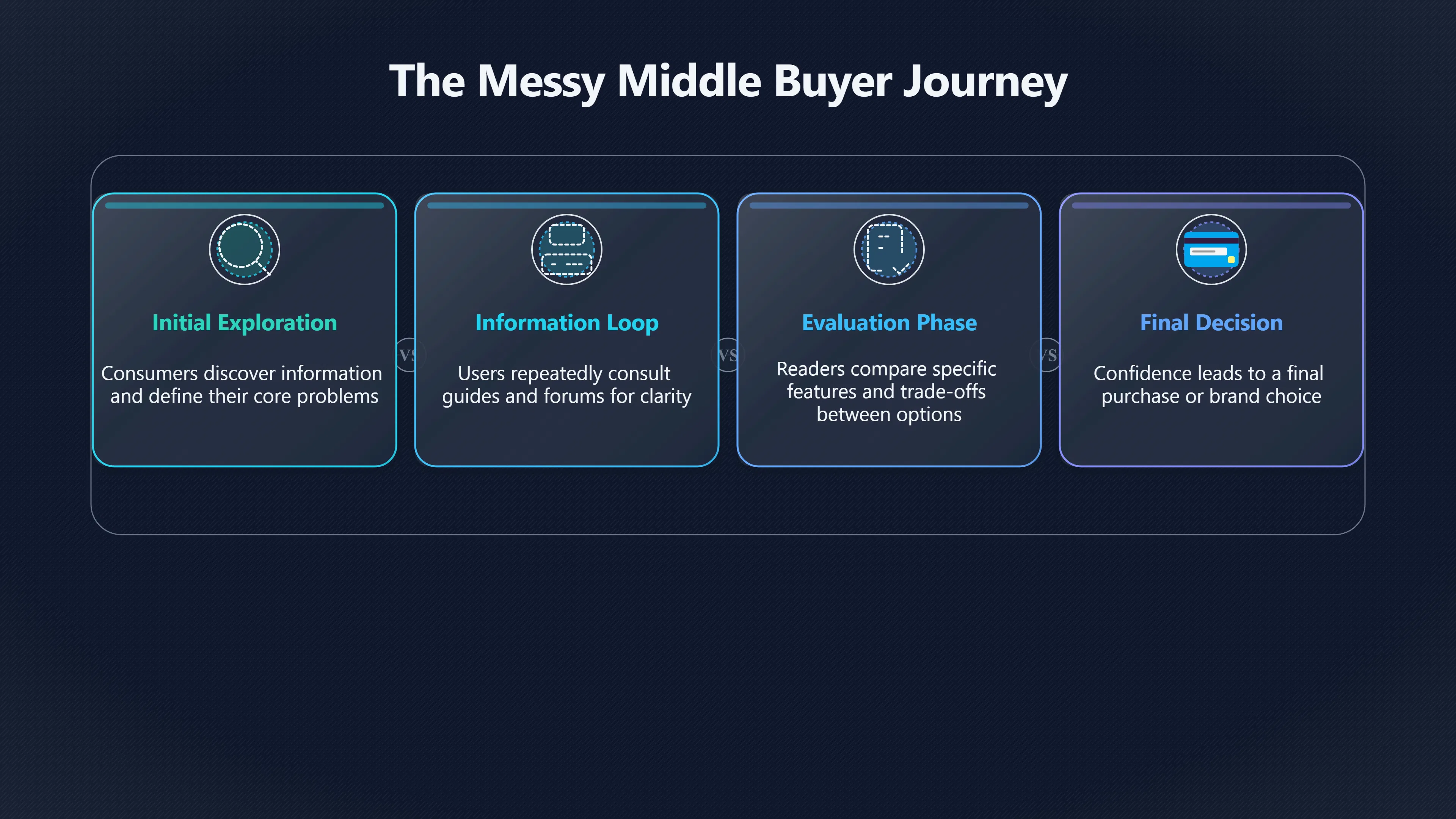
Google’s research describes this stage as part of the “messy middle”, where consumers continually alternate between discovering information and evaluating options. During this period they may consult guides, forums, review sites, videos and manufacturer information before narrowing their choices. An affiliate site that appears repeatedly with genuinely helpful educational content becomes familiar before commercial intent develops.[Google]business.google.comHow people decide what to buy lies in the 'messy middle' of…People loop through these twin modes of exploration and evaluation…
Problem-led topics readers search before buying
Early research content should begin with the reader’s problem rather than with a product category.
Instead of asking “Which coffee grinder is best?”, a beginner is more likely to search:
- Why is my coffee bitter?
- Do burr grinders really make a difference?
- How noisy are home coffee grinders?
- Is freshly ground coffee worth it?
Those searches reveal uncertainty rather than purchase intent.
The same pattern appears across many affiliate niches:
NicheEarly research questionCommercial question that often followsHome networkingWhat causes Wi-Fi dead spots?Best mesh Wi-Fi systemsFitnessDo resistance bands build muscle?Best resistance bandsGardeningWhy does my lawn become patchy?Best lawn scarifierPhotographyWhat is aperture?Best beginner DSLR cameraHome officeDo standing desks reduce back pain?Best standing desks
The educational article does not need to avoid mentioning products altogether. Instead, products should appear naturally as one possible solution after the reader understands the underlying problem.
When to keep affiliate links light
An early research page is usually strongest when commercial elements remain secondary.
Readers searching for explanations are rarely ready to compare retailers or prices. Filling the page with prominent affiliate buttons can interrupt the educational experience and make the advice appear biased.
A lighter approach often works better:
- Explain the problem completely before suggesting products.
- Mention categories instead of specific brands where appropriate.
- Introduce affiliate recommendations only after discussing when buying makes sense.
- Recommend not buying when the product is unnecessary.
That last point is surprisingly powerful. A page explaining that many households do not need an expensive appliance unless certain conditions apply demonstrates independence. Readers who later discover they genuinely need one are more likely to trust the site’s recommendations because they have already seen advice that was not designed simply to generate a commission.
This aligns closely with Google’s broader emphasis on people-first content that exists to satisfy user needs rather than search engines or monetisation goals.[Google for Developers]developers.google.comGoogle for DevelopersCreating Helpful, Reliable, People-First ContentGoogle's ranking systems are designed to present helpful, reliable i…
Examples that prove niche understanding
Strong early research pages demonstrate practical knowledge rather than merely rewriting manufacturer descriptions.
Useful signals include:
Real-world scenarios
Instead of defining a dehumidifier, explain why condensation appears in different rooms, why opening windows sometimes makes it worse, and when mould indicates a more serious ventilation issue.
Decision frameworks
A guide on choosing binoculars can explain magnification, field of view, weight and intended use before mentioning individual models.
Failure cases
An article about office chairs can discuss why expensive ergonomic chairs still cause discomfort if incorrectly adjusted.
Trade-offs
A cordless lawnmower guide should discuss battery maintenance, garden size and storage limitations instead of assuming cordless is always better.
These details reassure readers that the author understands the category independently of any individual affiliate product.
Building expertise without reviewing products
Early research pages provide opportunities to demonstrate experience in ways product round-ups often cannot.
For example:
- Explaining terminology in plain language.
- Showing photographs or diagrams of common problems.
- Sharing maintenance routines.
- Discussing compatibility issues.
- Comparing different approaches before comparing brands.
- Correcting common myths within the niche.
This type of information becomes reusable across the rest of the website. Later review pages can link back to these explanations instead of repeating them, creating a more coherent knowledge base rather than isolated sales pages.

How early research supports later affiliate revenue
These pages frequently convert indirectly rather than immediately.
A visitor who first reads an educational article may:
- Return later through branded searches.
- Bookmark the website.
- Visit related comparison pages.
- Click internal links to buying guides.
- Trust future recommendations because previous advice proved useful.
Google’s buying research suggests consumers repeatedly revisit information sources throughout the exploration and evaluation process rather than progressing through a simple linear funnel. Educational content therefore remains valuable even if it generates relatively few direct affiliate clicks on its own.[Google]business.google.comHow people decide what to buy lies in the 'messy middle' of…People loop through these twin modes of exploration and evaluation…
Common mistakes
Several patterns weaken trust at the research stage.
Answering every question with a product recommendation
Sometimes the correct advice is to change a habit, perform maintenance or understand a concept rather than purchase new equipment.
Writing only definitions
A glossary-style explanation rarely satisfies readers. They usually want context, practical consequences and examples.
Forcing commercial keywords
Educational pages should match informational intent. Turning every heading towards product recommendations creates a mismatch between the searcher’s expectations and the page.
Repeating manufacturer claims
Readers gain little from specifications copied from marketing material. Original explanations, comparisons and practical observations provide far more value.
Why these pages strengthen the whole affiliate site
Early research pages perform a role that product reviews cannot. They establish credibility before commercial recommendations appear, demonstrate genuine understanding of the niche and help readers make sense of problems before introducing solutions.
For affiliate websites that aim to build sustainable income rather than short-term clicks, these educational resources become the foundation for later comparison guides, reviews and buying advice. They create trust first, making affiliate recommendations feel like a natural continuation of useful guidance instead of the primary purpose of the page.
Amazon book picks
Further Reading
Books and field guides related to Why Trust Starts Before Product Reviews. Use these as the next step if you want deeper reading beyond the article.
They Ask, You Answer
Explains how trust is built by answering buyer questions before selling, matching the page's core message.
Everybody Writes
Helps creators produce clear, useful, reader-first content that establishes expertise and trust.
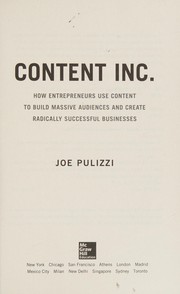
Content Inc
Focuses on building an audience through valuable content before monetization.
Influence
Provides foundational insight into trust, credibility, and ethical persuasion that underpins effective affiliate content.
eBay marketplace picks
Marketplace Samples
Example marketplace items related to this page. Use the search link to explore similar finds on eBay.
Endnotes
1.
Source: developers.google.com
Link:https://developers.google.com/search/docs/fundamentals/creating-helpful-content
Source snippet
Google for DevelopersCreating Helpful, Reliable, People-First ContentGoogle's ranking systems are designed to present helpful, reliable i...
2.
Source: business.google.com
Link:https://business.google.com/en-all/think/consumer-insights/navigating-purchase-behavior-and-decision-making/
Source snippet
How people decide what to buy lies in the 'messy middle' of...People loop through these twin modes of exploration and evaluation...
3.
Source: business.google.com
Link:https://business.google.com/en-all/think/consumer-insights/messy-middle-2023/
Source snippet
Behaviour in the Messy MiddleUnderstand the buying behaviour of omnichannel shoppers and navigate the Messy Middle of e-commerce customer...
4.
Source: business.google.com
Title: navigating purchase behavior and decision making
Link:https://business.google.com/uk/think/consumer-insights/navigating-purchase-behavior-and-decision-making/
Source snippet
people decide what to buy lies in the 'messy middle' of...As people explore and evaluate in the messy middle, cognitive biases shape the...
5.
Source: thinkwithgoogle.com
Link:https://www.thinkwithgoogle.com/_qs/documents/9998/Decoding_Decisions_The_Messy_Middle_of_Purchase_Behavior.pdf
Source snippet
Decoding DecisionsGetting comfortable with the messy middle could ultimately help bridge organisational divides that our research suggest...
6.
Source: iodigital.com
Link:https://www.iodigital.com/en/insights/blogs/google-e-e-a-t-creating-content-that-puts-people-first
Source snippet
Google E-E-A-T: creating content that puts people first6 Jun 2025 — EEAT stands for Experience, Expertise, Authoritativeness and Trustwor...
7.
Source: impressiondigital.com
Title: e e a t
Link:https://www.impressiondigital.com/blog/e-e-a-t/
Source snippet
Google's E-E-A-T: The Complete Guide12 Jun 2026 — High E-E-A-T pages will satisfy search intent and will be home to high-quality, well-wr...
8.
Source: youtube.com
Link:https://www.youtube.com/watch?v=gkolTazlkrY
Source snippet
Google's SECRET SEO Guide (and How to Use It)How to Rank #1 on Google in 2026. Rank Math SEO · 21K views; How to Choose the RIGHT...
9.
Source: neveralwaysbook.com
Title: messy middle
Link:https://neveralwaysbook.com/learn/messy-middle
Source snippet
Marketing: Google's Consumer Journey Model1 May 2026 — The messy middle is Google's research-backed model describing the complex phase be...
Published: May 2026
10.
Source: ketchup-marketing.co.uk
Link:https://www.ketchup-marketing.co.uk/blog/content-that-fulfils-the-google-e-a-t-principle-will-rank-higher/
Source snippet
Why does content that fulfils the Google E-E-A-T principle...E-E-A-T stands for experience, expertise, authoritativeness and trustworthi...
Additional References
11.
Source: mrs.org.uk
Link:https://www.mrs.org.uk/pdf/NCI5%20-%20Google%20%26%20The%20Behavioural%20Architects.pdf
Source snippet
Surpassing Expectations in the Messy MiddleWe explore strategies for success in the "messy middle" – where consumers actively explore and...
12.
Source: mailchimp.com
Link:https://mailchimp.com/resources/google-eeat/
Source snippet
What Is Google E-E-A-T and Why It MattersEEAT is not a specific ranking factor but rather a set of guidelines Google quality raters use t...
13.
Source: linkedin.com
Link:https://www.linkedin.com/pulse/messy-middle-purchase-journey-how-influence-decisions-bavisath-jain-hwale
14.
Source: discoverydesign.co.uk
Title: what is the messy middle and why should marketers care about it
Link:https://discoverydesign.co.uk/blog/post/what-is-the-messy-middle-and-why-should-marketers-care-about-it/
Source snippet
What Is the 'Messy Middle' and Why Should Marketers...16 Aug 2024 — The 'messy middle' is a widely used term in marketing as it refers t...
15.
Source: iabeurope.eu
Link:https://iabeurope.eu/knowledge_hub/insights-from-think-with-google-how-people-decide-what-to-buy-lies-in-the-messy-middle-of-the-purchase-journey/
Source snippet
wing how brands can win and retain customers in the “messy middle” of the purchase...Read more...
16.
Source: cdxe.de
Link:https://www.cdxe.de/en/blog/messy-middle-the-mysterious-place-of-consumer-decision-making
Source snippet
le Australia conducted one of the largest studies on this topic and came up with...Read more...
17.
Source: articles.data.blog
Title: blog The “messy middle” of the purchase journey
Link:https://articles.data.blog/2020/07/19/the-messy-middle-of-the-purchase-journey/
Source snippet
“messy middle” of the purchase journey - Articles of Interest19 Jul 2020 — People loop through these twin modes of exploration and evalua...
18.
Source: linkedin.com
Link:https://www.linkedin.com/pulse/lessons-from-messy-middle-how-biases-drive-buying-you-thompson
Source snippet
g how consumer purchasing decisions are influenced and made.Read more...
19.
Source: linkedin.com
Link:https://www.linkedin.com/pulse/navigating-messy-middle-consumer-decision-making-jamie-chen-hou-jx0de
Source snippet
Navigating the "Messy Middle" of Consumer Decision-MakingThis process involves two distinct mental modes: exploration and evaluation...
20.
Source: thepolka.co.uk
Title: What is Google’s Messy Middle Framework?
Link:https://www.thepolka.co.uk/post/what-is-googles-messy-middle-framework
Source snippet
The Polka14 Mar 2026 — Google's Messy Middle is a model that describes the complex decision-making process people go through before choos...
Topic Tree