Within Deals
When Coupon Pages Look Thin to Google
Coupon pages are safest when they add maintained offer data instead of copying merchant text or publishing generic discount claims.
On this page
- What thin affiliation means for deals
- Original value beyond merchant feeds
- Search quality risks from stale pages
Page outline Jump by section
Introduction
Coupon pages are not automatically risky simply because they contain affiliate links. Google’s guidance has consistently distinguished between affiliate content that genuinely helps users and pages that exist primarily to redirect visitors to a merchant. For deal and coupon publishers, the key question is not whether commissions are earned, but whether the page contributes original, useful information that shoppers cannot obtain just by visiting the retailer directly.[Google for Developers]developers.google.comaffiliate programs and added valueGoogle for DevelopersAffiliate programs and added value27 Jan 2014 — Our quality guidelines warn against running a site with thin or scra…
 This distinction matters because coupon pages are especially easy to commoditise. Thousands of sites can publish identical promotion codes, merchant descriptions, and generic claims such as “Save 10% today”. When a page adds little beyond copied offer data or affiliate links, it becomes vulnerable to Google’s quality systems and, in some circumstances, its spam policies.
When coupon pages look thin to Google
Google has never maintained a blanket prohibition on affiliate marketing. Instead, its long-standing guidance warns against sites that use affiliate programmes while failing to provide “substantial added value” beyond content already available from the merchant or affiliate feed.[Google for Developers]developers.google.comaffiliate programs and added valueGoogle for DevelopersAffiliate programs and added value27 Jan 2014 — Our quality guidelines warn against running a site with thin or scra…
For coupon pages, “thin” usually describes a combination of characteristics rather than a single fault:
- Lists of voucher codes copied from affiliate feeds without independent verification.
- Merchant descriptions duplicated across hundreds of affiliate websites.
- Pages created for every retailer despite offering no unique information.
- Generic discount claims that are rarely updated.
- Little editorial content explaining whether an offer is worthwhile or how it works.
The problem is not the affiliate link itself. It is that another publisher could reproduce the same page almost instantly because it contains almost no original work.
Google’s people-first content guidance similarly encourages publishers to create content that satisfies visitors rather than pages produced mainly because they might rank for commercial searches.[Google for Developers]developers.google.comSEO can be a helpful activity when it is applied to people-first content, rather than search engine-…Read more…
Original value beyond merchant feeds
The safest coupon pages behave more like maintained consumer resources than collections of affiliate links.
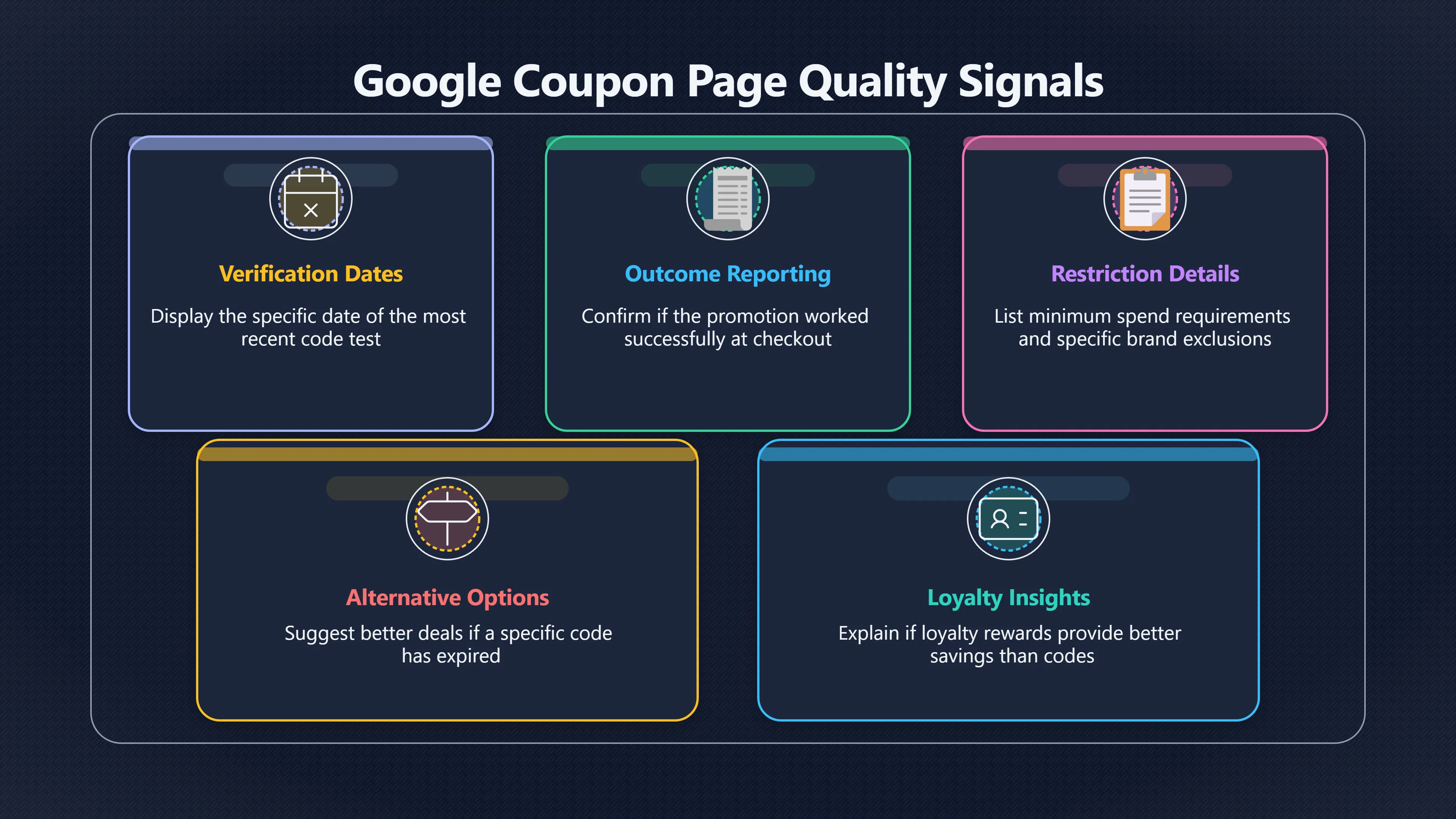
Original value can come from practical information that merchants often omit or present poorly, including:
- The date and outcome of the most recent code test.
- Whether the promotion worked successfully at checkout.
- Minimum spend requirements.
- Product or brand exclusions.
- Whether the offer is limited to new customers.
- Regional availability.
- Whether multiple promotions can be combined.
- Better alternatives if a code has expired.
This information requires ongoing editorial work. It cannot simply be imported from an affiliate network or merchant feed.
A useful example is a coupon page that reports:
“Verified on 24 June 2026. Code applied successfully to full-price footwear but excluded sale items. Free delivery required a separate £50 minimum spend.”
That type of update gives shoppers information they could not obtain merely by clicking an affiliate link.
Similarly, original commentary explaining when a retailer typically runs stronger promotions, whether seasonal sales usually beat the current code, or whether loyalty rewards provide better savings demonstrates editorial judgement rather than automated aggregation.

Search-quality risks from stale pages
One of the biggest quality risks for coupon sites is not copied content alone but neglected content.
Expired offers create several problems simultaneously:
- Users waste time attempting invalid codes.
- Trust declines after repeated failures.
- Search engines receive weaker quality signals when visitors quickly return to search results.
- Thousands of obsolete pages accumulate without meaningful maintenance.
Although Google does not publish a specific “expired coupon” penalty, its broader quality systems reward pages that remain useful. A coupon page showing dozens of invalid promotions from previous shopping seasons offers little continuing value.
Many successful publishers therefore invest heavily in maintenance rather than publication volume. They remove expired offers, update testing dates, archive seasonal promotions appropriately and avoid keeping thousands of abandoned pages indexed indefinitely.
Freshness alone is not sufficient—Google does not reward changing dates without meaningful updates—but genuine maintenance helps ensure the page continues to answer the user’s query.[Google for Developers]developers.google.comSEO can be a helpful activity when it is applied to people-first content, rather than search engine-…Read more…
The newer policy risk: site reputation abuse
An important recent development affects some coupon publishers but not the coupon model itself.
Google’s 2024 site reputation abuse policy targets situations where third-party companies publish coupon or commercial content on authoritative websites with little editorial oversight, primarily to benefit from the host site’s reputation in search results. Google’s own examples specifically mention coupon sections hosted on news websites under these conditions.[Google for Developers+2junction.cj.com]developers.google.comGoogle for DevelopersSpam Policies for Google Web SearchThe spam policies detail the behaviors and tactics that can lead to a page or an…
The policy is narrower than many headlines suggested.
It does not state that coupon pages are inherently spam.
Instead, the concern is when:
- a publisher lends its domain authority to an external coupon operator;
- the host exercises little meaningful editorial control; and
- the arrangement exists mainly to improve search rankings rather than provide value.
Conversely, Google has indicated that coupon content created or closely supervised by the host publisher is not automatically considered site reputation abuse.[junction.cj.com]junction.cj.comhow googles new site reputation abuse policy affects affiliateThey assert that site reputation…Read more…
For independent affiliate sites, this policy is generally less relevant than overall content quality. Their greater risk comes from publishing pages that offer little unique information.
Practical signals that reduce thin-affiliate risk
A coupon page is more likely to demonstrate genuine value when it consistently shows evidence of original editorial work.
Useful signals include:
- Regular verification with visible testing dates.
- Honest reporting when no working code exists.
- Clear explanations of offer restrictions.
- Editorial ranking based on shopper benefit rather than affiliate payout.
- Removal or consolidation of obsolete coupon pages.
- Original buying advice alongside current offers.
- Transparent affiliate disclosure without overwhelming promotional language.
Perhaps the strongest quality signal is willingness to publish disappointing news. A page stating “No verified discount code is currently available; here are the best active alternatives” may disappoint some visitors, but it builds credibility in a way that fabricated or outdated offers cannot.
For Google, the distinction is consistent with its broader guidance on affiliate content: affiliate monetisation is acceptable when the publisher contributes substantial value that helps users make better decisions, rather than merely reproducing information available elsewhere.[Google for Developers]developers.google.comaffiliate programs and added valueGoogle for DevelopersAffiliate programs and added value27 Jan 2014 — Our quality guidelines warn against running a site with thin or scra…
Amazon book picks
Further Reading
Books and field guides related to When Coupon Pages Look Thin to Google. Use these as the next step if you want deeper reading beyond the article.
Product-Led SEO
Focuses on creating scalable, user-first search content rather than low-value pages.
Everybody Writes
Helps publishers produce original editorial content that adds value beyond merchant feeds.
The Art of SEO
Explains search quality, content value, and SEO practices directly relevant to avoiding thin affiliate pages.
Content Chemistry
Covers creating useful, trustworthy web content that supports long-term organic visibility.
eBay marketplace picks
Marketplace Samples
Live-tested eBay searches with available results related to this page.


Endnotes
1.
Source: developers.google.com
Title: affiliate programs and added value
Link:https://developers.google.com/search/blog/2014/01/affiliate-programs-and-added-value
Source snippet
Google for DevelopersAffiliate programs and added value27 Jan 2014 — Our quality guidelines warn against running a site with thin or scra...
2.
Source: developers.google.com
Link:https://developers.google.com/search/docs/fundamentals/creating-helpful-content
Source snippet
SEO can be a helpful activity when it is applied to people-first content, rather than search engine-...Read more...
3.
Source: developers.google.com
Link:https://developers.google.com/search/docs/essentials/spam-policies
Source snippet
Google for DevelopersSpam Policies for Google Web SearchThe spam policies detail the behaviors and tactics that can lead to a page or an...
4.
Source: junction.cj.com
Title: how googles new site reputation abuse policy affects affiliate
Link:https://junction.cj.com/article/how-googles-new-site-reputation-abuse-policy-affects-affiliate
Source snippet
They assert that site reputation...Read more...
5.
Source: support.google.com
Link:https://support.google.com/webmasters/thread/383811831/my-6-year-old-coupon-site-has-6-000-pages-but-only-1-000-are-indexed-continuous-deindexing?hl=en
Source snippet
6-year-old coupon site has 6000+ pages but only...29 Oct 2025 — Affiliate/coupon filters: While there's no specific “coupon penalty,” Go...
6.
Source: support.google.com
Title: thin content
Link:https://support.google.com/webmasters/thread/261563965/thin-content?hl=en
Source snippet
The content is written by me personally and from my own experience. Everything written is supported...
7.
Source: support.google.com
Title: is affiliate marketing dead
Link:https://support.google.com/webmasters/thread/257058271/is-affiliate-marketing-dead?hl=en
Source snippet
affiliate marketing dead?4 Feb 2024 — Given Google's recent algorithm updates, how feasible it is for beginners to succeed in affiliate m...
8.
Source: support.google.com
Link:https://support.google.com/webmasters/thread/302446608/provide-details-about-the-affiliate-products-review-guidelines-and-can-we-used-more-than-ads-network?hl=en
Source snippet
For example a website used a ad network...
Additional References
9.
Source: impact.com
Title: googles updated site reputation abuse policy on affiliate marketers
Link:https://impact.com/affiliate/googles-updated-site-reputation-abuse-policy-on-affiliate-marketers/
Source snippet
Google's New Site Reputation Policy: Impact on Affiliate...5 May 2024 — In March 2024, Google updated its Search Console guidelines to i...
Published: May 2024
10.
Source: propelbon.com
Title: googles new policy on discount code and coupon websites
Link:https://propelbon.com/en/googles-new-policy-on-discount-code-and-coupon-websites/
Source snippet
Google's New Policy on Coupon and Discount Websites12 Jun 2024 — Learn how Google's new "site reputation abuse" policy is impacting coupo...
11.
Source: awin.com
Title: insight of the month google site reputation update
Link:https://www.awin.com/gb/affiliate-marketing/insight-of-the-month-google-site-reputation-update
Source snippet
Google's Site Reputation Abuse Update: Early Impact &...6 Aug 2024 — We share an exclusive before-and-after account of the clampdown on...
12.
Source: seozoom.com
Title: Site reputation abuse: Google’s anti-spam rule
Link:https://www.seozoom.com/site-reputation-abuse-google/
Source snippet
21 Nov 2024 — It is the latest chapter in Google's fight against spam and attempts to manipulate SERPs with abusive and manipulati...
13.
Source: youtube.com
Link:https://www.youtube.com/watch?v=rhoRyQSki-U
Source snippet
NEW Spam Policies for Google Web Search: How To Avoid...Spam Policies for Google Web Search: How To Avoid That? Looking into the spam po...
14.
Source: youtube.com
Link:https://www.youtube.com/watch?v=8tnMvzZtxeI
Source snippet
The Google Site Reputation Abuse Policy: What It Is, What Can We Learn, How Can We Avoid It...
15.
Source: reddit.com
Link:https://www.reddit.com/r/SEO/comments/187aun2/affiliate_sites_are_getting_stomped_by_google_and/
Source snippet
Affiliate sites are getting stomped by Google and they only...Affiliate sites are largely responsible for the very low quality, trash co...
16.
Source: developer.chrome.com
Title: cws policy update affiliate ads 2025
Link:https://developer.chrome.com/blog/cws-policy-update-affiliate-ads-2025
Source snippet
Web Store policy updates: Strengthening our policies...11 Mar 2025 — The updated policy ensures that affiliate links are only included w...
17.
Source: theapma.co.uk
Title: what googles latest search updates mean for coupon publishers
Link:https://theapma.co.uk/what-googles-latest-search-updates-mean-for-coupon-publishers/
Source snippet
What Google's latest search updates mean for Coupon...30 Aug 2024 — Google's decision to include third-party sites displaying vouchers a...
18.
Source: youtube.com
Link:https://www.youtube.com/watch?v=EBIbG3d0k9c
Source snippet
Thin content (and why quality content matters) | Sustainable Monetized Websites...
Topic Tree