Within Reviews
Can Free Review Samples Be Trusted?
Readers judge independence differently when a site buys products, keeps samples, or relies on manufacturer access.
On this page
- Why product sourcing affects credibility
- What buying products independently signals
- How to disclose samples without weakening trust
Page outline Jump by section
Introduction
Whether a review site buys products itself or accepts free samples is one of the clearest signals readers use when judging independence. Neither approach automatically produces better reviews. A publication can write excellent, critical reviews of products supplied by manufacturers, while another can buy every item it tests yet still produce biased recommendations. The difference lies in editorial independence, transparent disclosure, and a willingness to criticise products even when doing so may reduce future opportunities.
 For affiliate websites, this distinction matters because trust directly affects long-term revenue. Readers increasingly look for signs that a reviewer has genuine freedom to reach an unfavourable conclusion. A clear sourcing policy, visible disclosures, and consistent editorial standards often do more for credibility than claiming complete independence without evidence.
Why product sourcing affects credibility
How a review site obtains products influences both perception and reality.
When a manufacturer provides a free sample, it removes the financial cost of testing. That makes it possible to review more products, particularly expensive cameras, laptops, appliances, or specialist equipment that would otherwise be beyond the budget of smaller publishers. The trade-off is that readers may wonder whether access depends on keeping brands happy.
The concern is not always direct pressure. More commonly, it is the subtle incentive created by ongoing relationships. If a publication relies heavily on manufacturers for early access or loan units, reviewers may worry that consistently harsh reviews could reduce future opportunities. Even where no company explicitly demands favourable coverage, readers often recognise this potential conflict.
By contrast, purchasing products independently signals that the reviewer selected the item in the same way as an ordinary customer. That removes questions about preferential treatment, specially prepared review units, or access conditioned on maintaining commercial relationships.
For this reason, many respected review organisations explain exactly how products are sourced instead of expecting readers to assume independence.
What buying products independently signals
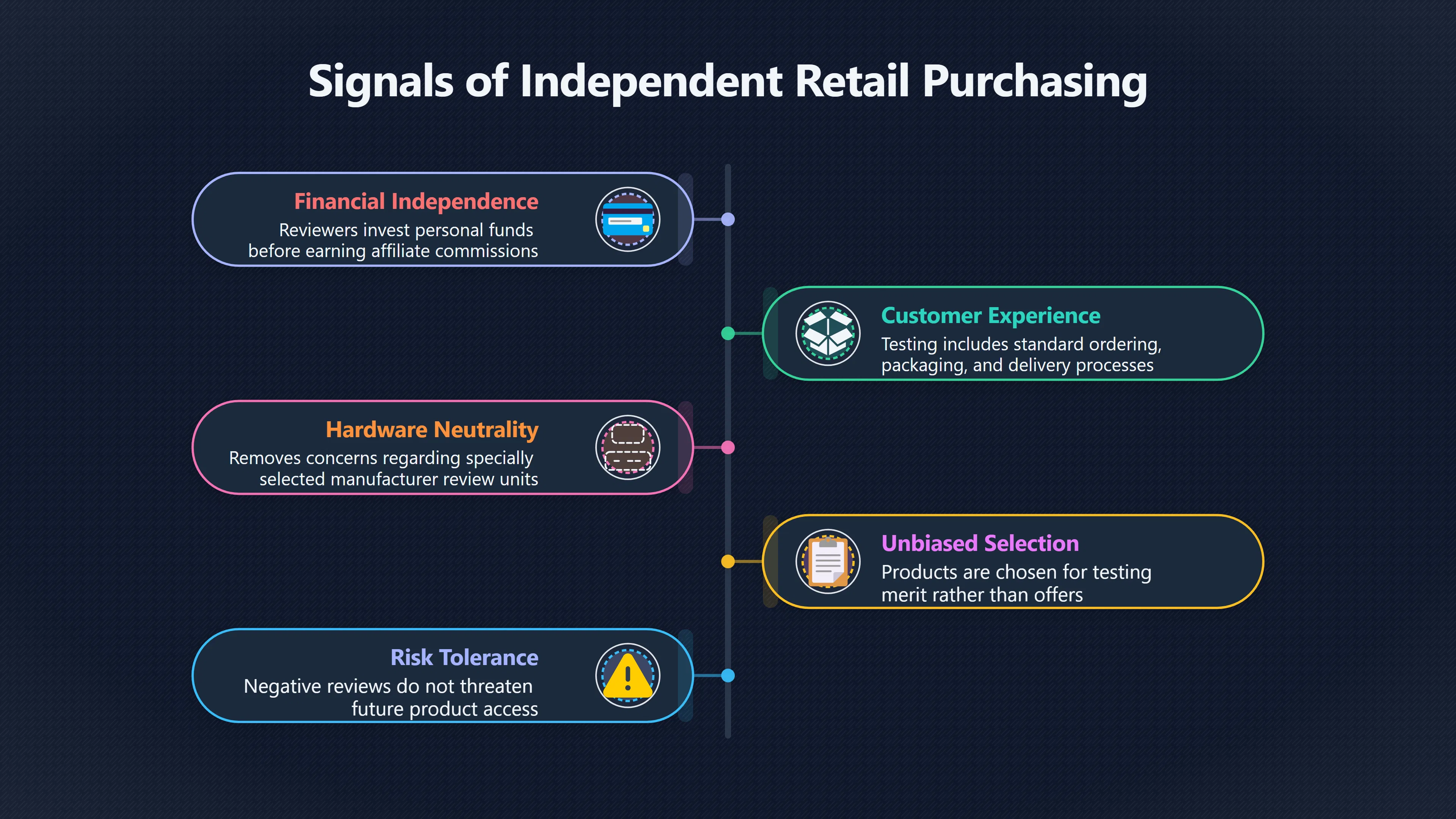
Buying products at retail sends several useful credibility signals.
First, it demonstrates financial independence. The reviewer has invested their own money before earning any affiliate commission, making the review appear driven by editorial priorities rather than manufacturer marketing.
Second, retail purchases usually reflect the customer experience more accurately. The reviewer encounters normal ordering processes, packaging, delivery, setup, warranty registration and customer support instead of receiving products through a dedicated press channel.
Third, independently purchased products reduce concerns that manufacturers have supplied specially selected hardware or software. While there is little evidence that this is widespread across reputable brands, buying anonymously removes the question altogether.
Readers often interpret retail purchases as evidence that:
- products were chosen because they deserve testing rather than because they were offered;
- negative reviews are less likely to threaten future product access;
- comparisons include products regardless of manufacturer relationships;
- recommendations reflect actual buying decisions rather than promotional campaigns.
None of these guarantees objectivity, but together they strengthen the perception of editorial independence.
Free samples are not automatically unreliable
Accepting review samples should not be treated as evidence of bias on its own.
Many respected technology, photography and consumer publications rely partly on loan units or manufacturer samples because purchasing every product would be financially impossible. Testing dozens or hundreds of products each year would otherwise require budgets beyond most independent publishers.
Free samples can also benefit readers by allowing:
- reviews to appear close to launch;
- comparisons across larger product ranges;
- long-term testing of specialist equipment;
- coverage of products that are difficult to obtain through retail channels.
The key question is not whether the sample was free but whether the reviewer remained free to publish an unfavourable assessment.
Readers tend to trust review sites that demonstrate this through consistent behaviour. If products regularly receive mixed verdicts, obvious criticism, or recommendations against purchase when appropriate, the disclosure of a free sample becomes much less concerning.
How to disclose free samples without weakening trust
Disclosure should remove uncertainty rather than create it.
A useful disclosure is specific, prominent and written in plain language. Instead of hiding the information in a footer or legal page, place it where readers naturally encounter it near the beginning of the review.
For example:
- “The manufacturer provided this product for review. It had no right to preview or edit this review.”
- “We purchased this product ourselves.”
- “This review unit will be returned after testing.”
- “The manufacturer did not pay for this review.”
Simple statements like these answer the questions readers actually have.
Where affiliate links are also present, disclosures should distinguish between the source of the product and the way the website earns money. Receiving a review sample and earning affiliate commission are separate relationships, and readers benefit from understanding both.
Regulators have consistently emphasised that material relationships capable of influencing credibility should be disclosed clearly and conspicuously. The US Federal Trade Commission’s endorsement guidance similarly expects audiences to be informed about relationships that would not otherwise be obvious, including free products where relevant.[Federal Trade Commission]ftc.govFederal Trade CommissionThe Consumer Reviews and Testimonials Rule: Questions…8 Nov 2024 — The rule prohibits businesses from implying…
Building policies that readers can verify
Rather than relying on marketing claims about being “independent”, trustworthy review sites publish practical editorial policies.
A useful sourcing policy might explain:
- when products are purchased versus supplied;
- whether review samples are returned;
- whether manufacturers see reviews before publication;
- whether companies can influence scores or rankings;
- how affiliate income is separated from editorial decisions.
The most convincing policies are reinforced by observable behaviour. Readers notice when expensive products receive poor ratings, when recommended alternatives are cheaper than the highest-commission option, or when reviews remain available even after criticism of major brands.
Consistency across hundreds of reviews ultimately carries more weight than a single disclosure statement.
A balanced approach for affiliate review websites
For many affiliate publishers, an all-or-nothing approach is unnecessary.
Buying flagship products independently while supplementing coverage with clearly disclosed review samples can provide both credibility and practical sustainability. Some publishers also purchase products after initially testing manufacturer loan units to verify long-term performance or retail quality.
Whatever approach is chosen, the principles remain consistent:
- disclose how every reviewed product was obtained;
- keep editorial decisions separate from commercial relationships;
- never promise favourable coverage in exchange for access;
- publish criticism when justified, even if it risks future manufacturer cooperation;
- make sourcing policies easy for readers to find and understand.
Over time, readers judge review sites less by whether every product was purchased and more by whether the publication repeatedly demonstrates that its conclusions cannot be bought with free products or protected commercial relationships.
Amazon book picks
Further Reading
Books and field guides related to Can Free Review Samples Be Trusted?. Use these as the next step if you want deeper reading beyond the article.
Everybody Writes
Shows how credible, reader-focused content builds long-term trust rather than relying on promotional tactics.
The Elements of Journalism
Explains editorial independence, transparency, and ethical standards directly relevant to trustworthy product reviews.
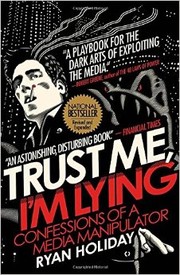
Trust Me, I'm Lying
Helps readers understand how incentives can influence published content and why transparency matters in reviews.
Content Chemistry
Provides practical guidance on creating authoritative web content that supports credibility and audience trust.
eBay marketplace picks
Marketplace Samples
Example marketplace items related to this page. Use the search link to explore similar finds on eBay.
Endnotes
1.
Source: ftc.gov
Link:https://www.ftc.gov/business-guidance/resources/consumer-reviews-testimonials-rule-questions-answers
Source snippet
Federal Trade CommissionThe Consumer Reviews and Testimonials Rule: Questions...8 Nov 2024 — The rule prohibits businesses from implying...
2.
Source: ftc.gov
Title: Even without that condition,
Link:https://www.ftc.gov/business-guidance/resources/soliciting-paying-online-reviews-guide-marketers
Source snippet
Federal Trade CommissionSoliciting and Paying for Online Reviews: A Guide...25 Jan 2022 — If you offer an incentive for a review, don't...
Additional References
3.
Source: law.stackexchange.com
Title: is it legal for businesses to give financial incentives for leaving positive rev
Link:https://law.stackexchange.com/questions/110358/is-it-legal-for-businesses-to-give-financial-incentives-for-leaving-positive-rev
Source snippet
it legal for businesses to give financial incentives...20 Jul 2025 — Is it legal for businesses to give financial incentives for leaving...
4.
Source: bclplaw.com
Title: part 3 what the ftcs final rule means for incentivized reviews
Link:https://www.bclplaw.com/en-US/events-insights-news/part-3-what-the-ftcs-final-rule-means-for-incentivized-reviews.html
Source snippet
Part 3: What the FTC's final rule means for incentivized...9 Sept 2024 — The Final Rule prohibits businesses from providing compensation...
5.
Source: bhfs.com
Title: ftc finalizes rule to combat deceptive online reviews
Link:https://www.bhfs.com/insight/ftc-finalizes-rule-to-combat-deceptive-online-reviews/
Source snippet
28 Aug 2024 — The new rule makes clear that businesses cannot offer compensation or incentives in exchange for reviews expressing a senti...
6.
Source: facebook.com
Link:https://www.facebook.com/groups/alvintxsmb/posts/1557795015631734/
Source snippet
or reviews tied to a *specific sentiment*—whether that’s positive...
7.
Source: nector.io
Title: incentivized reviews ftc guidelines
Link:https://www.nector.io/blog/incentivized-reviews-ftc-guidelines
Source snippet
Understanding Incentivized Reviews and FTC Guidelines7 Jul 2025 — Incentivized reviews are customer reviews where the reviewer receives a...
8.
Source: yotpo.com
Title: incentivized reviews
Link:https://www.yotpo.com/blog/incentivized-reviews/
Source snippet
Risks & Best Practices24 Sept 2025 — Honest Opinions Required: You absolutely cannot condition the incentive on the review being positive...
9.
Source: youtube.com
Title: Your Guide to Free Samples | Affiliate Marketing | Tik Tok Shop UK
Link:https://www.youtube.com/watch?v=QpefR93MnH4
Source snippet
How to Apply for Free Samples from Your TikTok Creator Shop...
10.
Source: youtube.com
Title: The Fake Reviews Industrial Complex: Why Nothing You Read Is Real
Link:https://www.youtube.com/watch?v=L2K0bblsdlk
Source snippet
Create a Winning WordPress Affiliate Website In 15 Minutes...
11.
Source: youtube.com
Title: How to Apply for Free Samples from Your Tik Tok Creator Shop
Link:https://www.youtube.com/watch?v=phZiFCN1nZQ
Source snippet
How to Make Money Reviewing Products on [Amazon]({{ 'amazon/' | relative_url }})...
12.
Source: youtube.com
Title: How to Make Money Reviewing Products on Amazon
Link:https://www.youtube.com/watch?v=29OqJH72Zck
Source snippet
The Fake Reviews Industrial Complex: Why Nothing You Read Is Real...
Topic Tree