Within Disclosures
Do Commissions Decide Your Product Rankings?
Readers trust affiliate reviews more when the site explains how products are chosen, tested, ranked, and monetised.
On this page
- The trust question readers bring
- Review criteria and monetisation notes
- Separating ratings from payout incentives
Page outline Jump by section
Introduction
Affiliate commissions do not have to decide product rankings, but readers have good reason to wonder whether they do. When a website earns money from purchases made through its links, there is an obvious potential conflict of interest: the products that pay the highest commission could be placed above better options. The most trustworthy affiliate sites address this concern directly by explaining how rankings are created, what role commissions play, and what safeguards prevent commercial incentives from overriding editorial judgement. That transparency helps readers judge recommendations on their merits instead of guessing at hidden motives.
 Simply saying “we use affiliate links” is only part of the answer. Readers increasingly want to know whether commissions influence the order of recommendations, review scores, or buying advice. Explaining that process clearly is often more valuable than repeating generic disclosure language.
Why Readers Question Affiliate Rankings
The trust problem is not that affiliate commissions exist. It is that readers cannot see the publisher’s internal decision-making.
Imagine two products that perform similarly. One pays a 3% commission and another pays 10%. Without an explanation of the site’s review process, readers may reasonably suspect that the higher-paying product will appear first, regardless of quality.
That suspicion matters because affiliate content often presents itself as independent editorial advice rather than advertising. Consumer protection guidance from regulators such as the US Federal Trade Commission (FTC) focuses on ensuring readers understand material financial relationships that could affect the credibility they assign to recommendations. The UK Advertising Standards Authority (ASA) similarly requires commercial intent to be obvious where it is not already apparent.[Federal Trade Commission]ftc.govFederal Trade CommissionFTC's Endorsement Guides: What People Are AskingHere are answers to some of the most frequently asked questions f…
A clear explanation therefore answers a practical question:
“If two products compete, what actually decides the ranking?”
Review Criteria Should Come Before Revenue
Readers gain confidence when a site explains the factors that determine rankings before mentioning monetisation.
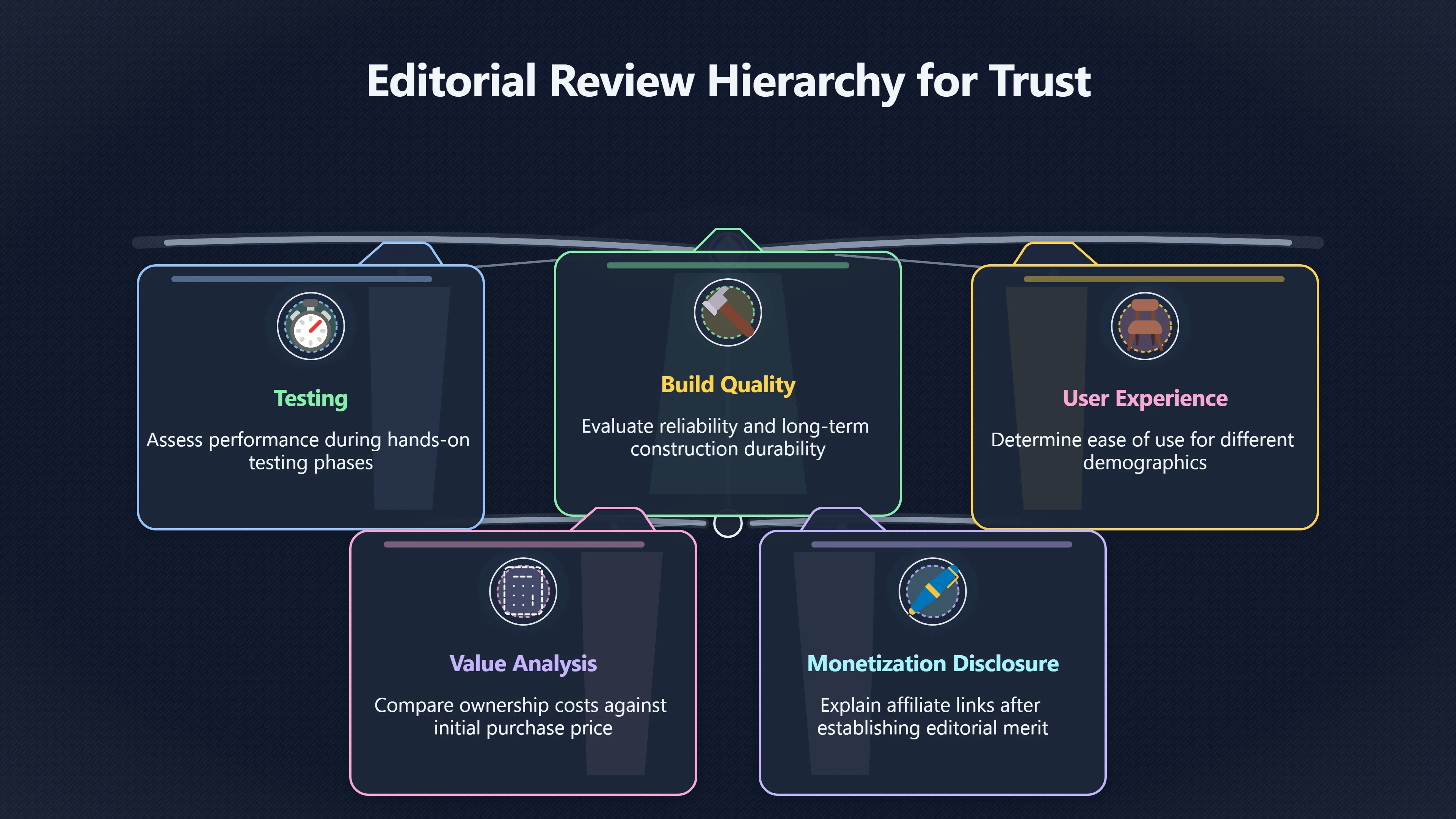
A useful methodology might explain that products are assessed using criteria such as:
- Performance during testing.
- Reliability and build quality.
- Ease of use.
- Value for money.
- Customer support.
- Long-term ownership costs.
- Suitability for different users.
Only after those criteria are described should the site explain that some recommended products also generate affiliate commissions.
This order matters psychologically. It signals that editorial judgement creates the ranking and monetisation follows the recommendation—not the other way around.
Google’s guidance for high-quality reviews reinforces this approach by encouraging original analysis, evidence, comparisons, and first-hand insight rather than thin lists assembled primarily for commercial purposes. Search systems increasingly reward reviews that demonstrate genuine expertise instead of simply promoting products with purchase links.[Google for Developers+2Google for Developers]developers.google.comGoogle for DevelopersWrite high quality reviewsLearn how to write high quality reviews and see how they can help shoppers discover your r…
Separating Ratings from Commission Incentives
The strongest affiliate sites explain the governance that keeps commercial incentives separate from editorial decisions.
Examples include:
- Editors do not know commission rates while assigning scores.
- Products are rated before affiliate links are added.
- Rankings are based on published scoring criteria.
- Products without affiliate programmes can still be recommended.
- Editors are free to rank a non-paying product above a paying one.
These policies are far more persuasive than broad assurances such as “our opinions are honest.”
Some publishers also explain that they occasionally recommend products that generate no commission at all. While this may reduce revenue, it demonstrates that usefulness to readers comes before monetisation.
What You Should Never Claim
Transparency is not improved by making promises that cannot be supported.
Statements such as:
- “Commissions never influence us.”
- “We are completely unbiased.”
- “Our rankings are totally independent.”
may sound reassuring, but they create expectations that are difficult to prove.
Regulators are particularly concerned where businesses present themselves as independent while hidden commercial relationships exist. The FTC’s updated Endorsement Guides discuss review sites that claim objectivity while operating under financial incentives, and distinguish ordinary affiliate commissions from deceptive “pay-to-play” ranking systems where payment directly determines placement. A site that says rankings are objective should ensure that payment genuinely does not affect those rankings.[eCFR+2Manatt]ecfr.govOpen source on ecfr.gov.
A more credible statement is:
“Our editorial ratings are based on our published review criteria. We may earn commissions when readers purchase through some links, but commission rates do not determine review scores or product order.”
Unlike an absolute claim of perfect objectivity, this explains the mechanism readers actually care about.
When Commissions Can Legitimately Influence Coverage
There is an important distinction between influencing coverage and influencing rankings.
Affiliate programmes naturally affect which products are commercially practical to cover. A small publisher may prioritise reviewing products available through recognised affiliate networks because reviewing every product on the market is impossible.
Readers generally understand this trade-off if it is explained openly.
For example:(#endnote-8 “Snippet: For example a website used a ad network”)[support.google.com]support.google.comFor example a website used a ad network…
- Coverage decisions may consider product availability and reader demand.
- Rankings should still reflect comparative quality among the products reviewed.
- If an outstanding product lacks an affiliate programme, readers should still be told about it where relevant.
Making this distinction prevents unrealistic promises while maintaining editorial integrity.
Practical Ways to Demonstrate Independence
Readers are more likely to trust a process that leaves visible evidence.
Helpful signals include:
- Explaining exactly how products are tested.
- Publishing scoring categories.
- Listing both strengths and weaknesses.
- Explaining why lower-ranked products lost points.
- Updating reviews when products improve or decline.
- Including “best for” recommendations rather than declaring a single universal winner.
Balanced criticism is especially important. Pages that praise every product equally often appear promotional regardless of their disclosure.
Google’s review quality guidance similarly encourages detailed comparisons, evidence supporting rankings, and discussion of limitations instead of one-sided marketing copy.[Google for Developers]developers.google.comGoogle for DevelopersWrite high quality reviewsLearn how to write high quality reviews and see how they can help shoppers discover your r…
The Reader Should Understand the Safeguard
The purpose of explaining whether commissions affect rankings is not to apologise for earning affiliate income. Affiliate marketing is a legitimate business model. The goal is to show readers the safeguard that protects editorial judgement from financial incentives.
A concise explanation should leave readers understanding three points:
- The website may earn commissions from some recommendations.
- Rankings are determined using published editorial criteria rather than payout rates.
- Commercial relationships are disclosed so readers can evaluate recommendations with full knowledge of how the site is funded.
When readers understand not only that a site earns commissions but also why those commissions do not dictate product rankings, they have a much stronger basis for trusting the recommendations that follow.
Amazon book picks
Further Reading
Books and field guides related to Do Commissions Decide Your Product Rankings?. Use these as the next step if you want deeper reading beyond the article.
Everybody Writes
Supports best practices for producing transparent, reader-first editorial content, including trustworthy product recommendations.
The (Honest) Truth about Dishonesty
Provides context on conflicts of interest, ethics, and the psychology behind honest behavior.
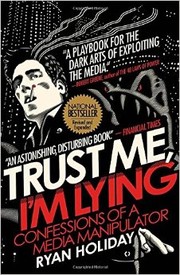
Trust Me, I'm Lying
Explores how commercial incentives can shape online content and why transparency matters.
Influence: The Psychology of Persuasion
Helps readers understand how recommendations, persuasion, and perceived credibility influence purchasing decisions.
eBay marketplace picks
Marketplace Samples
Example marketplace items related to this page. Use the search link to explore similar finds on eBay.

Endnotes
Source snippet
Federal Trade CommissionFTC's Endorsement Guides: What People Are AskingHere are answers to some of the most frequently asked questions f...
2.
Source: asa.org.uk
Title: affiliate marketing
Link:https://www.asa.org.uk/advice-online/affiliate-marketing.html
Source snippet
Online Affiliate Marketing22 Mar 2023 — The Code also states that marketing communications must not falsely claim or imply that the marke...
3.
Source: developers.google.com
Link:https://developers.google.com/search/docs/specialty/ecommerce/write-high-quality-reviews
Source snippet
Google for DevelopersWrite high quality reviewsLearn how to write high quality reviews and see how they can help shoppers discover your r...
4.
Source: developers.google.com
Title: product reviews update
Link:https://developers.google.com/search/blog/2021/04/product-reviews-update
Source snippet
Google for DevelopersWhat creators should know about Google's April 2021...8 Apr 2021 — We're sharing an improvement to our ranking syst...
Published: April 2021
5.
Source: developers.google.com
Title: product reviews update and your site
Link:https://developers.google.com/search/blog/2021/12/product-reviews-update-and-your-site
Source snippet
Google for DevelopersDecember 2021 Product reviews update and your site1 Dec 2021 — We are now rolling out a new update, the first major...
Published: December 2021
6.
Source: ecfr.gov
Link:https://www.ecfr.gov/current/title-16/chapter-I/subchapter-B/part-255
7.
Source: manatt.com
Title: an in depth look at the ftcs [updates]({{ ‘updates/’ | relative_url }}) 2
Link:https://www.manatt.com/insights/newsletters/advertising-law/an-in-depth-look-at-the-ftcs-updates-2
Source snippet
An In-Depth Look at the FTC's Updates to the Endorsement...30 Jul 2023 — The FTC added additional guidance on disclosure of affiliate ma...
8.
Source: support.google.com
Link:https://support.google.com/webmasters/thread/302446608/provide-details-about-the-affiliate-products-review-guidelines-and-can-we-used-more-than-ads-network?hl=en
Source snippet
For example a website used a ad network...
9.
Source: support.google.com
Link:https://support.google.com/merchants/answer/14620705?hl=en
Source snippet
Ratings basics - Google Merchant Center HelpThe Product Ratings program allows you to display aggregated reviews for your products to cus...
10.
Source: developers.google.com
Title: creating helpful content
Link:https://developers.google.com/search/docs/fundamentals/creating-helpful-content
Source snippet
Helpful, Reliable, People-First ContentGoogle's ranking systems are designed to present helpful, reliable information that's created to b...
Source snippet
Endorsements, Influencers, and ReviewsAnswers to questions people are asking about the FTC's Endorsement Guides, including information ab...
12.
Source: GOV.UK
Title: If you’ve been incentivised in any way
Link:https://www.gov.uk/government/publications/social-media-endorsements-guidance-for-content-creators/social-media-endorsements-being-transparent-with-your-followers
Source snippet
media endorsements: guidance for content creators3 Sept 2025 — Non-compliant content creators can be named and shamed by the ASA for not...
Additional References
13.
Source: federalregister.gov
Title: guides concerning the use of endorsements and testimonials in advertising
Link:https://www.federalregister.gov/documents/2023/07/26/2023-14795/guides-concerning-the-use-of-endorsements-and-testimonials-in-advertising
Source snippet
Guides Concerning the Use of Endorsements and...26 Jul 2023 — Staff business guidance applying section 5 of the FTC Act to endorsements...
14.
Source: reddit.com
Link:https://www.reddit.com/r/Affiliatemarketing/comments/mp1ckh/google_product_reviews_update/
Source snippet
Google Product Reviews Update: r/AffiliatemarketingRolling out just now (since the 8th) for 2 weeks approx. This will be a big one for a...
15.
Source: myroomismyoffice.com
Link:https://myroomismyoffice.com/uk-affiliate-link-disclosures/
Source snippet
UK Affiliate Link Disclosures: Where to Put Them (and...In affiliate marketing terms, the ASA/CAP guidance makes it clear that affiliate...
16.
Source: federal-lawyer.com
Link:https://federal-lawyer.com/ftc-defense/affiliate-disclosure/
Source snippet
Understanding the FTC's Affiliate Disclosure RulesLearn what affiliate marketers and companies need to know about the FTC's affiliate dis...
17.
Source: steptoe.com
Link:https://www.steptoe.com/en/news-publications/ftc-unveils-new-endorsement-guides-and-proposed-rule-on-consumer-reviews-what-your-business-needs-to-know-and-opportunities-to-shape-whats-next.html
Source snippet
FTC Unveils New Endorsement Guides and Proposed...11 Jul 2023 — The Endorsement Guides advise the public on advertising practices the Co...
18.
Source: linkedin.com
Link:https://www.linkedin.com/pulse/working-influencers-within-asa-guidelines-beki-sharman-w3qpe
19.
Source: rpclegal.com
Title: cma and asa publish updated influencer guidance on social media endorsements
Link:https://www.rpclegal.com/snapshots/advertising-and-marketing/winter-2025/cma-and-asa-publish-updated-influencer-guidance-on-social-media-endorsements/
Source snippet
CMA and ASA publish updated influencer guidance on...2 Jan 2026 — To improve compliance, the ASA and CMA have published updated guidance...
20.
Source: youtube.com
Link:https://www.youtube.com/watch?v=0CR9Nbn6L7o
Source snippet
Google Product Reviews Update ExplainedHave you been hit by the new Google Product Reviews Update? Find out everything need to know about...
21.
Source: youtube.com
Link:https://www.youtube.com/watch?v=TpYEmQ9njyk
Source snippet
New FTC Guidelines For Affiliate & Influencer MarketerS Must...New FTC Guidelines For Affiliate & Influencer MarketerS Must Watch Before...
22.
Source: yellowgrape.io
Title: de toekomst van affiliate marketing na googles helpful content updates
Link:https://www.yellowgrape.io/en/insights/de-toekomst-van-affiliate-marketing-na-googles-helpful-content-updates
Source snippet
The future of affiliate marketing after Google's Helpful...24 Oct 2024 — As a result of these so-called Helpful Content updates, many af...
Topic Tree