Within Authority
Can Affiliate Disclosure Improve Trust?
Clear affiliate disclosure can protect trust when the page also explains how recommendations are made.
On this page
- Why affiliate links create a trust burden
- Where disclosures should appear for clarity
- How editorial standards reduce perceived bias
Page outline Jump by section
Introduction
Affiliate disclosure does not have to reduce conversions or weaken recommendations. When it is clear, specific and placed where readers will actually see it, disclosure can strengthen confidence because it removes uncertainty about why a product is being recommended. For niche authority blogs, where expertise is the main competitive advantage, readers are more likely to trust advice when commercial relationships are explained openly and editorial judgement is shown to be independent.
 The real challenge is not whether to disclose affiliate links, but how to do so without making every recommendation feel like advertising. Effective disclosure combines legal compliance with transparent editorial practice: readers should immediately understand that a commission may be earned while also seeing that products are selected because they genuinely solve the problem discussed.
Why Affiliate Links Create a Trust Burden
Affiliate marketing introduces a potential conflict of interest. A publisher may earn money when a reader purchases through a recommendation, creating a reasonable question: was this product chosen because it is the best option or because it pays the highest commission?
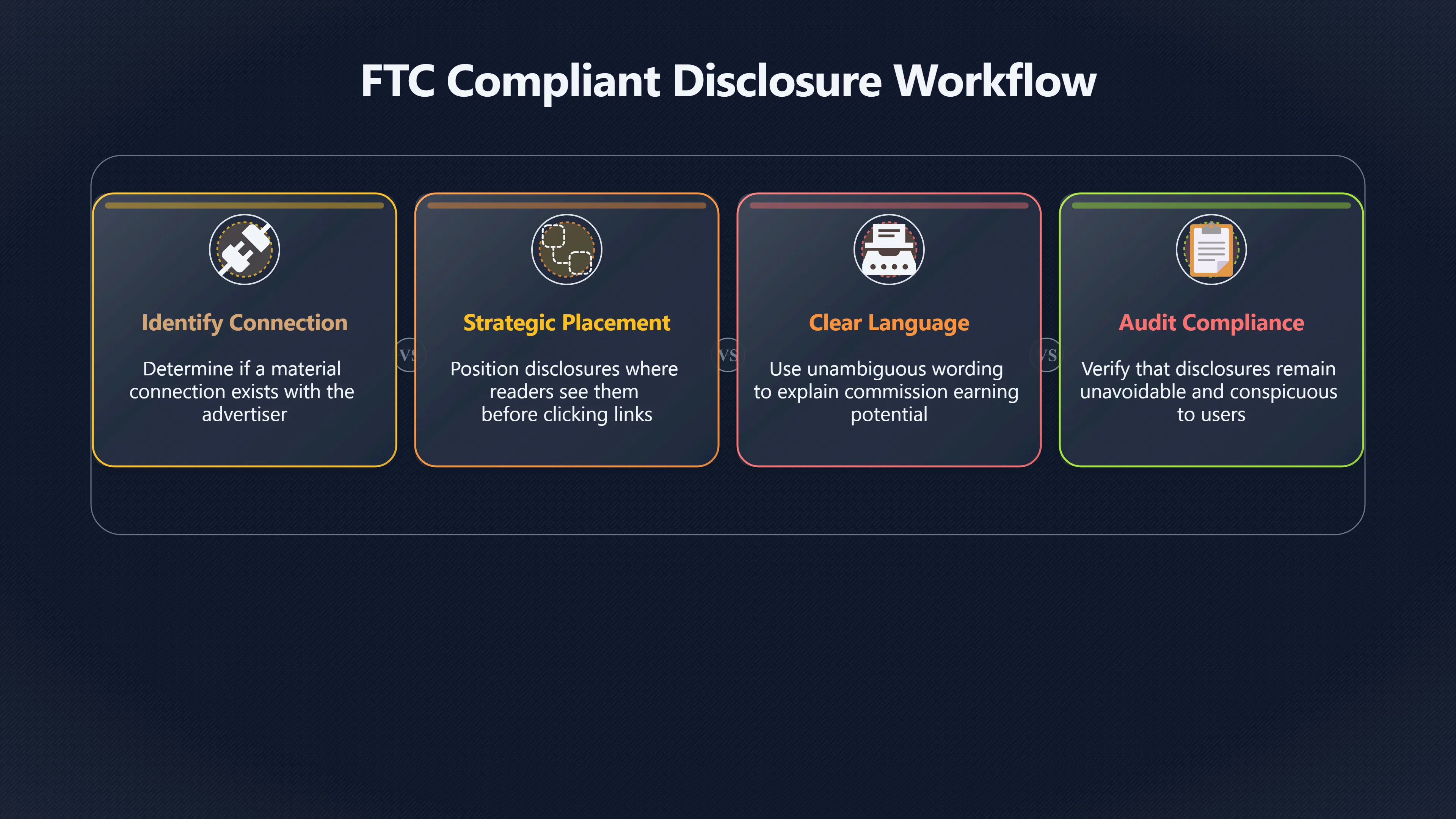
Consumer protection authorities treat this as a “material connection” that readers deserve to know about before making a purchasing decision. In the United States, the Federal Trade Commission (FTC) requires clear and conspicuous disclosure of material relationships between publishers and advertisers. Similar principles apply under UK advertising rules, which require commercial intent to be made obvious where consumers might otherwise be misled.[Federal Trade Commission]ftc.govOpen source on ftc.gov.
For authority blogs, disclosure is therefore more than a legal obligation. It signals confidence. Publishers who are comfortable explaining how they make money appear less defensive than those who hide disclosures in footers or legal pages.
Readers are generally capable of understanding that expert publishers need revenue. Trust is usually damaged not by affiliate commissions themselves, but by the appearance that financial incentives have been concealed.
Where Disclosures Should Appear for Clarity
A disclosure is most effective when readers encounter it before or alongside affiliate recommendations rather than after they have already clicked.
Good placement typically includes:
- A short disclosure near the beginning of review, comparison and buying-guide pages.
- A reminder immediately before the first affiliate link when commercial recommendations begin.
- A comprehensive affiliate policy page explaining how the website earns income and how recommendations are produced.
- Additional disclosures wherever affiliate links appear unexpectedly, such as newsletters or downloadable buying guides.
Simply placing a disclosure in a website footer or terms page is generally insufficient because many readers will never see it. The FTC repeatedly emphasises that disclosures should be clear, unavoidable and located where consumers are likely to notice them before acting on a recommendation.[Federal Trade Commission]ftc.govOpen source on ftc.gov.
Clarity also depends on language. Statements such as:
“This article contains affiliate links. If you buy through them, we may earn a commission at no extra cost to you. Our recommendations are based on independent evaluation.”
communicate the commercial relationship without distracting from the article itself.
How Editorial Standards Reduce Perceived Bias
Disclosure alone cannot create trust if the surrounding content appears promotional. Readers judge credibility through the entire editorial process.
Authority blogs can reduce perceived bias by adopting visible editorial standards such as:
- explaining how products were selected;
- identifying testing methods or real-world experience;
- discussing both strengths and weaknesses;
- comparing products that do not generate affiliate income where appropriate;
- recommending lower-priced or even “do not buy” options when they better fit particular users.
These practices demonstrate that recommendations follow evidence rather than commission rates.
Google’s guidance for high-quality product reviews reinforces many of these same principles. It encourages first-hand experience, meaningful comparisons, evidence of testing, discussion of trade-offs and explanations of which users will benefit from particular products. While Google’s guidance is aimed at search quality rather than advertising law, the same characteristics also make affiliate recommendations appear more trustworthy.[Federal Trade Commission]ftc.govOpen source on ftc.gov.
Showing How Recommendations Are Made
One of the strongest ways to preserve confidence is to explain the editorial process rather than relying only on a disclosure statement.
For example, a buying guide might briefly explain:
- whether products were personally tested;
- whether manufacturers supplied review samples;
- whether products were purchased independently;
- what evaluation criteria were used;
- whether commission rates influence rankings.
Many respected review publications explicitly state that affiliate commissions never determine review scores or product rankings. While readers cannot independently verify every claim, providing a transparent methodology makes the recommendation process easier to evaluate.
This approach shifts attention away from the existence of affiliate income and towards the quality of the editorial process that produced the recommendation.
What Weakens Reader Confidence
Certain practices undermine even technically compliant disclosures because they create the impression that transparency is reluctant rather than genuine.
Common examples include:
- hiding disclosures behind links labelled “Legal” or “Terms”;
- using vague wording such as “some links may be affiliated”;
- placing disclosures only after affiliate links;
- presenting every reviewed product as exceptional;
- removing criticism from reviews while emphasising purchase buttons;
- allowing commission rates to determine rankings without explanation.
Research into affiliate disclosures on social platforms has shown that brief or ambiguous disclosures often fail to help users recognise commercial relationships, whereas explanatory disclosures are better understood. Studies have also found that disclosure rates have historically been relatively low, highlighting why visible transparency continues to matter.[arXiv]arxiv.orgEndorsements on Social Media: An Empirical Study of Affiliate Marketing Disclosures on YouTube and PinterestSeptember 3, 2018…

Transparency as a Competitive Advantage
Smaller authority blogs often compete against much larger publishers with stronger brands and higher search visibility. Transparency can become part of that competitive advantage.
When readers consistently encounter:
- obvious disclosures;
- balanced reviews;
- explanations of testing methods;
- acknowledgement of product limitations; and
- recommendations that occasionally reduce immediate affiliate revenue,
they receive repeated signals that editorial judgement is independent of commercial relationships.
In that context, the disclosure no longer feels like a legal warning. Instead, it reinforces the message that the site’s expertise—not its commission structure—is the primary reason readers should trust its recommendations.
Amazon book picks
Further Reading
Books and field guides related to Can Affiliate Disclosure Improve Trust?. Use these as the next step if you want deeper reading beyond the article.
Affiliate Program Management
Provides practical context on affiliate marketing practices, relationships, and ethical program management.
Everybody Writes
Supports creating transparent, reader-first editorial content that builds long-term trust.
Trust Me, I'm Lying
Helps readers understand why transparency and credibility matter when publishing recommendations.
Content Inc
Emphasizes audience trust and long-term authority, reinforcing transparent affiliate publishing practices.
eBay marketplace picks
Marketplace Samples
Live-tested eBay searches with available results related to this page.


Endnotes
Source snippet
FTC's Endorsement Guides: What People Are AskingYou should disclose the affiliate relationship both in the videos and in the description...
3.
Source: arxiv.org
Link:https://arxiv.org/abs/1809.00620
Source snippet
Endorsements on Social Media: An Empirical Study of Affiliate Marketing Disclosures on YouTube and PinterestSeptember 3, 2018...
Published: September 3, 2018
4.
Source: arxiv.org
Link:https://arxiv.org/abs/1803.08488
5.
Source: consumer.ftc.gov
Title: s endorsement guides what people are asking
Source snippet
ftc.govFTC's Endorsement Guides: What People Are AskingAdvertisers shouldn't encourage endorsements using features that don't allow for c...
Additional References
6.
Source: consultantlm.com
Link:https://consultantlm.com/consultant-article/ftc-affiliate-disclosure-rules-2025-how-to-avoid-lawsuits-and-legal-penalties-for-your-website
Source snippet
FTC Affiliate Disclosure Rules 2025 How to Avoid Lawsuits...16 Nov 2025 — The FTC mandates full disclosure of any paid promotions, affil...
7.
Source: linkedin.com
Link:https://www.linkedin.com/pulse/synthetic-endorsements-affiliate-links-ftcs-quiet-phil-gcose
8.
Source: heyseva.com
Title: ftc guidelines for affiliates creators and brands 2025
Link:https://www.heyseva.com/blog-posts/ftc-guidelines-for-affiliates-creators-and-brands-2025
Source snippet
FTC Guidelines for Affiliates, Creators and Brands 2025 - SEVA18 Jan 2025 — Here's a comprehensive and easy-to-understand guide on who ne...
9.
Source: vivianagency.com
Title: affiliate marketing compliance checklist for brands
Link:https://www.vivianagency.com/affiliate-marketing-compliance-checklist-for-brands/
Source snippet
Practical Affiliate Marketing Compliance Checklist for...20 May 2026 — Stay compliant in 2026 with our full affiliate marketing complian...
Published: May 2026
10.
Source: iubenda.com
Link:https://www.iubenda.com/en/blog/affiliate-disclosure/
Source snippet
isitors that you earn a commission when they purchase a product or...Read more...
11.
Source: auditsocials.com
Title: ftc affiliate disclosure requirements 2026 guide
Link:https://www.auditsocials.com/blog/ftc-affiliate-disclosure-requirements-2026-guide
Source snippet
FTC Affiliate Disclosure Requirements 2026 - AuditSocials14 Mar 2026 — FTC affiliate disclosure 2026 — exact placement rules, per-violati...
12.
Source: postaffiliatepro.com
Title: what should i write in affiliate disclosure
Link:https://www.postaffiliatepro.com/faq/what-should-i-write-in-affiliate-disclosure/
Source snippet
Learn how to write effective affiliate disclosures that comply with FTC regulations, build trust with your audience, and protect your...
13.
Source: thepma.org
Title: Proposed Changes to FTC Endorsement Guides
Link:https://thepma.org/proposed-changes-to-ftc-endorsement-guides/
Source snippet
The PMA28 Jun 2022 — Advertisers can be held liable for the lack of affiliate disclosures, and should provide guidance to Affiliates rega...
14.
Source: partnercentric.com
Title: how to properly disclose ftc endorsements
Link:https://partnercentric.com/blog/how-to-properly-disclose-ftc-endorsements/
Source snippet
17 Jun 2024 — We wanted to outline the essential steps for proper FTC disclosure and provide recommendations for e-commerce sites and inf...
15.
Source: growth-onomics.com
Title: ultimate guide affiliate compliance 2026
Link:https://growth-onomics.com/ultimate-guide-affiliate-compliance-2026/
Source snippet
Ultimate Guide to Affiliate Compliance 20266 Feb 2026 — The FTC mandates that affiliates must clearly disclose any "material connection"...
Topic Tree