Within SEO Guides
What Changed Since the Last Review?
Fresh update notes show readers what changed in price, availability, models, warranties, or features since the last review.
On this page
- Why affiliate recommendations decay over time
- What belongs in a useful update note
- How to refresh pages without hiding old evidence
Page outline Jump by section
Introduction
Affiliate buying guides do not usually become unhelpful because the original recommendation was wrong. They become unreliable because the market changes. A product that was the best value six months ago may have doubled in price, been replaced by a newer model, lost an important software feature, gained one through a firmware update, or disappeared from retailers altogether. Without visible maintenance, readers cannot tell whether a guide reflects today’s buying landscape or yesterday’s.
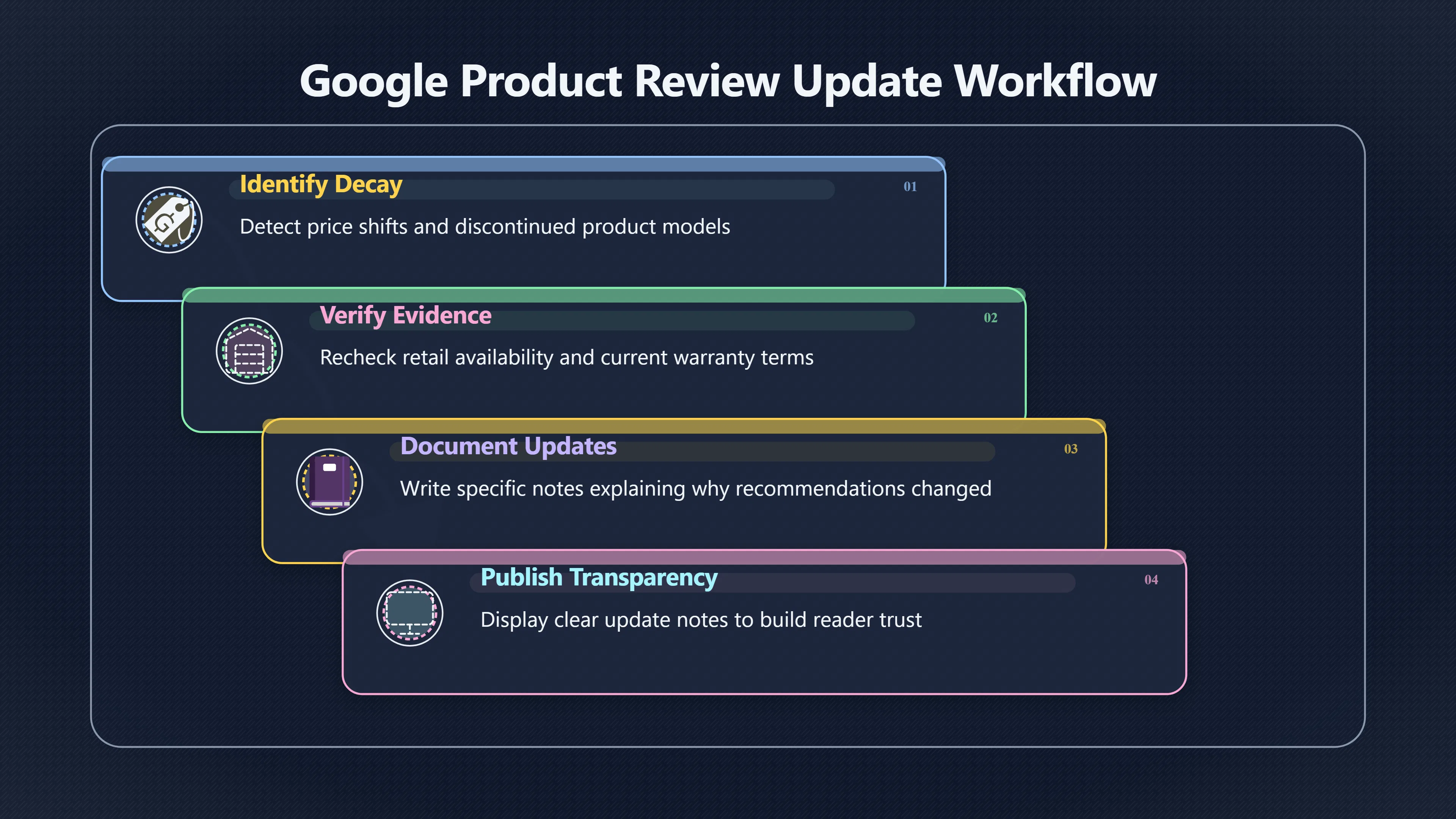
 A well-written update note solves this problem. Rather than silently rewriting recommendations, it explains what has changed, why the recommendation still stands (or no longer does), and what evidence was reviewed during the refresh. This approach improves trust, helps readers understand the reasoning behind recommendations, and aligns with Google’s emphasis on original, helpful product review content that demonstrates expertise and ongoing evaluation rather than static summaries.[Google for Developers]developers.google.comproduct reviews updateGoogle for DevelopersWhat creators should know about Google's April 2021…8 Apr 2021 — We're sharing an improvement to our ranking syst…
Why affiliate recommendations decay over time
Buying guides are unusually vulnerable to becoming outdated because they depend on variables that change continuously.
The most common causes include:
- Price movement. A “best value” recommendation can become poor value if its price rises while competitors remain stable.
- Product replacements. Manufacturers frequently discontinue successful products in favour of revised versions with different specifications.
- Availability changes. Regional stock shortages or permanent discontinuations can leave readers clicking recommendations that are no longer purchasable.
- Warranty and support revisions. Brands occasionally shorten warranty periods, alter return policies or discontinue software support.
- Firmware and software updates. Smart devices, cameras, phones and networking equipment often gain—or lose—features after launch through software updates.
- Competitive changes. A product may remain unchanged while a rival introduces a substantially better alternative.
These changes do not necessarily invalidate the original testing. Instead, they change the buying decision. Readers need to know whether the recommendation still represents the best option today.
Google’s guidance for high-quality reviews explicitly encourages explaining how products differ from previous versions, discussing improvements over earlier models and providing evidence for “best” recommendations. Those expectations naturally favour regularly maintained buying guides over pages that remain untouched for years.[Google for Developers]developers.google.comproduct reviews updateGoogle for DevelopersWhat creators should know about Google's April 2021…8 Apr 2021 — We're sharing an improvement to our ranking syst…
What belongs in a useful update note
An update note is not a changelog for search engines. It is a decision aid for readers.
The most useful notes briefly answer three questions:
- What changed?
- Did the recommendation change?
- Why?
For example:
Updated June 2026: Rechecked UK pricing and retailer availability. The previous Best Budget recommendation increased from approximately £170 to around £240, making it poor value. Product X now replaces it after offering similar performance at a significantly lower price. Performance testing remains unchanged because the hardware is identical.
That single paragraph communicates far more than simply replacing one affiliate link.
Useful update notes commonly include:
- date of review
- products rechecked
- major pricing shifts affecting value
- discontinued models
- newly released replacements
- firmware or software changes affecting performance
- warranty or support policy changes
- corrected factual errors
- changes to buying advice rather than cosmetic edits
Readers rarely care that spelling mistakes were fixed or headings reorganised. They care whether the buying advice changed.
Explain what changed—not merely that the page was updated
Many affiliate sites display “Last updated” dates without explaining what actually happened. This creates ambiguity.
A transparent note might state:
- “Checked against three major retailers; availability unchanged.”
- “Recommendation unchanged after testing firmware version 4.2.”
- “Added comparison with newly released Model Z.”
- “Removed discontinued Product A.”
These statements demonstrate ongoing editorial review instead of merely refreshing a timestamp.
Conversely, vague statements such as “Updated for accuracy” or “Reviewed regularly” add little value because they provide no indication of what was actually verified.
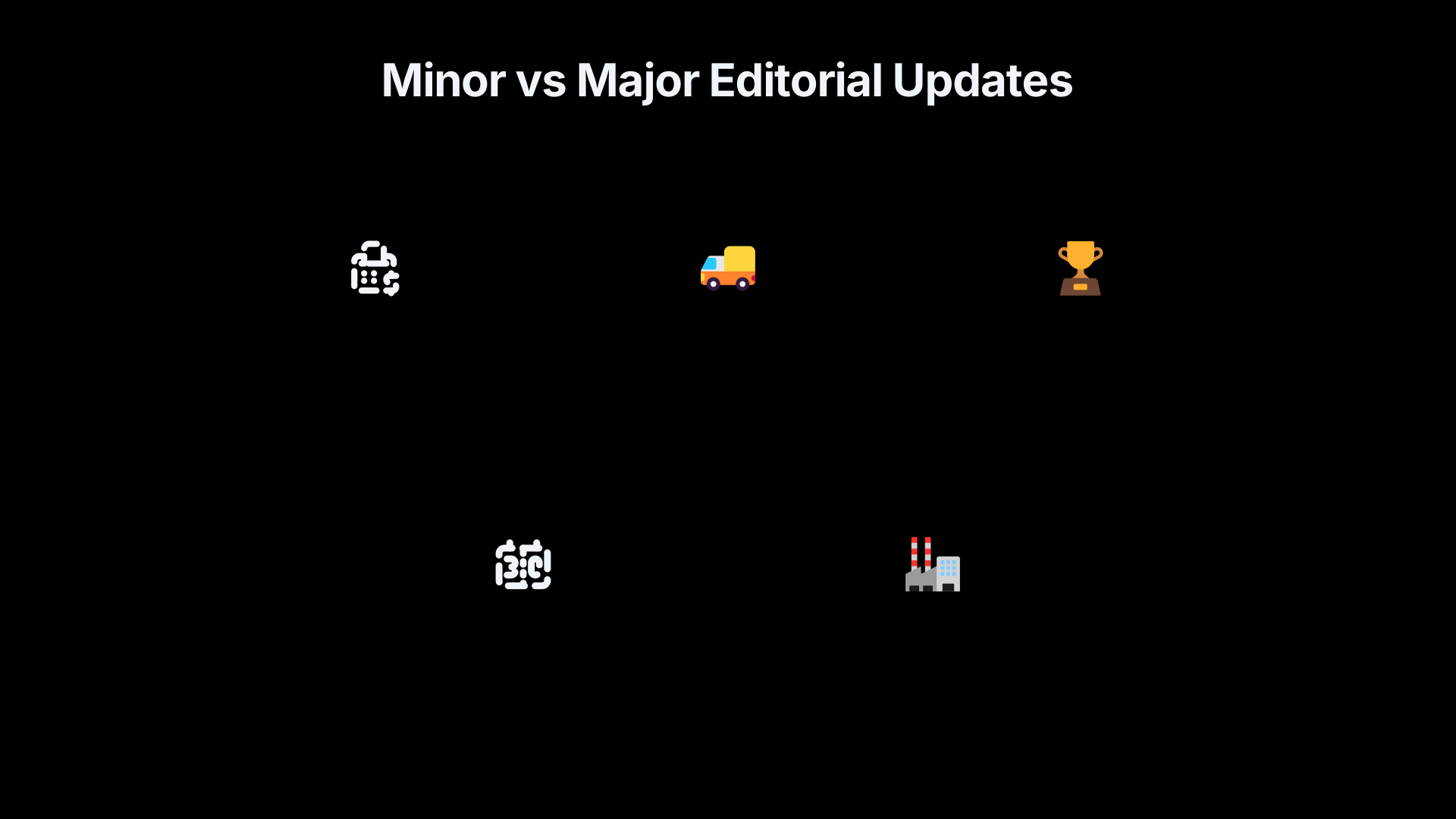
Distinguish editorial updates from recommendation changes
Readers benefit from knowing whether the core buying advice has changed or whether only supporting information has been refreshed.
A simple distinction works well.
Minor updates may include:
- refreshed prices
- updated retailer availability
- revised warranty information
- corrected specifications
- new photographs
- additional frequently asked questions
Major updates may include:
- replacing the overall winner
- introducing a new recommended model
- removing discontinued products
- changing rankings
- rewriting comparisons following new testing
- withdrawing previous recommendations
Separating these two types of changes avoids unnecessary confusion while helping returning visitors identify whether they need to reconsider an earlier purchase decision.
How to refresh pages without hiding old evidence
One common mistake is rewriting an article so thoroughly that readers cannot tell what has changed.
Instead, preserve the evidence while clearly documenting revisions.
Good practice includes:
- retaining original testing observations where they remain accurate
- adding supplementary testing instead of replacing earlier findings
- identifying when recommendations have changed
- explaining why previous advice is no longer appropriate
- archiving discontinued products instead of pretending they never existed
For example:
Previously recommended until May 2026. Now discontinued across major UK retailers. We continue to recommend existing owners keep using it, but new buyers should consider Product B instead because it offers comparable performance with current manufacturer support.
This preserves historical context while providing updated buying guidance.
Google’s product review guidance rewards original analysis and meaningful comparisons rather than rewritten manufacturer descriptions. Maintaining visible evidence of ongoing evaluation reinforces that original work instead of obscuring it.[Google for Developers]developers.google.comproduct reviews updateGoogle for DevelopersWhat creators should know about Google's April 2021…8 Apr 2021 — We're sharing an improvement to our ranking syst…
Avoid artificial freshness
Updating timestamps without meaningful editorial work can reduce reader trust.
Instead of changing every page monthly, update guides when there is something worth documenting.
Legitimate reasons include:
- significant market price shifts
- important new product launches
- discontinued recommendations
- firmware changes affecting performance
- revised warranty terms
- corrected testing methodology
- discovery of factual inaccuracies
If nothing material has changed, saying so can itself be valuable.
For example:
Reviewed June 2026. Prices fluctuated slightly, but no competing products currently offer a better balance of performance and value. Recommendations remain unchanged.
Readers gain reassurance that someone actually checked the market.

Create a consistent update policy
Affiliate sites covering dozens or hundreds of buying guides benefit from an editorial standard rather than ad hoc updates.
A practical governance policy might require reviewers to verify:
- current retail availability
- representative pricing
- warranty terms
- manufacturer support status
- new competing products
- software or firmware releases
- whether each recommendation still matches its intended use case
Documenting these checks internally also makes future updates faster because reviewers know exactly what evidence must be revisited.
Consistency matters more than frequency. A guide reviewed every six months using a documented process is often more trustworthy than one displaying frequent timestamp changes with no visible explanation.
Update notes as a trust signal
Readers returning to a buying guide are often making expensive purchasing decisions. They want reassurance that someone has looked again at the evidence.
A concise update section communicates editorial responsibility without forcing visitors to reread the entire article. It demonstrates that recommendations evolve alongside the products themselves, rather than remaining frozen after publication.
For affiliate publishers, this transparency has a second benefit. It helps distinguish genuinely maintained buying guides from pages that simply accumulate affiliate links over time. That difference supports reader confidence, aligns with Google’s emphasis on original, evidence-based product reviews, and reduces the risk that outdated recommendations quietly undermine both credibility and conversions.[Google for Developers+2blog.google]developers.google.comproduct reviews updateGoogle for DevelopersWhat creators should know about Google's April 2021…8 Apr 2021 — We're sharing an improvement to our ranking syst…
Amazon book picks
Further Reading
Books and field guides related to What Changed Since the Last Review?. Use these as the next step if you want deeper reading beyond the article.
Everybody Writes
Explains how to keep content useful, trustworthy, and updated for readers.
Content Strategy for the Web
Covers governance, maintenance, and systematic content refresh processes.
The Art of SEO
Provides context for maintaining authoritative, high-quality review content over time.
Made to Stick
Encourages clear communication of updates and supporting rationale that readers remember.
eBay marketplace picks
Marketplace Samples
Live-tested eBay searches with available results related to this page.


Endnotes
1.
Source: developers.google.com
Title: product reviews update
Link:https://developers.google.com/search/blog/2021/04/product-reviews-update
Source snippet
Google for DevelopersWhat creators should know about Google's April 2021...8 Apr 2021 — We're sharing an improvement to our ranking syst...
Published: April 2021
2.
Source: blog.google
Title: more helpful product reviews
Link:https://blog.google/products-and-platforms/products/search/more-helpful-product-reviews/
Source snippet
on Search23 Mar 2022 — Learn about Search's latest update to show in-depth and authentic product reviews...
3.
Source: support.google.com
Link:https://support.google.com/merchants/answer/6098512?hl=en
Source snippet
Ratings policies - Google Merchant Center HelpWe strive to provide shoppers with access to transparent, authentic, and helpful product re...
Additional References
4.
Source: yoast.com
Title: google product reviews update quality content
Link:https://yoast.com/google-product-reviews-update-quality-content/
Source snippet
What can Google's "Product reviews" update teach us...27 Apr 2021 — Learn how we can take Google's review guidelines, and apply them to...
5.
Source: susodigital.com
Title: How to Write Product Reviews: The Google Way
Link:https://susodigital.com/thoughts/how-to-write-product-reviews-the-google-way/
Source snippet
SUSO Digital28 Mar 2023 — We have prepared a concise guide that will help you fine-tune your content and make sure it's up to date with t...
6.
Source: gsqi.com
Title: google product reviews algorithm update
Link:https://www.gsqi.com/marketing-blog/google-product-reviews-algorithm-update/
Source snippet
Google's Product Reviews Update – Analysis and findings22 Apr 2021 — Google's Product Reviews Update – Analysis and findings from a major...
7.
Source: facebook.com
Title: googles best practices on how to write product reviews was updated with new exam
Link:https://www.facebook.com/SearchEngineJournal/posts/googles-best-practices-on-how-to-write-product-reviews-was-updated-with-new-exam/10159298477838721/
Source snippet
It suggests staying organized with collections, demonstrating expertise...
8.
Source: youtube.com
Link:https://www.youtube.com/watch?v=RoiIz33iY9Y
Source snippet
How to Update Old Blog Posts for SEO (Over-The-Shoulder Demo for Small Business)...
9.
Source: youtube.com
Title: Old Blog Posts Are Your Hidden Goldmine (Here’s Why)
Link:https://www.youtube.com/watch?v=Jh9RCLYuKWA
Source snippet
How to update old blog posts content decay affiliate seo Republishing Content: How to Update Blog Posts For More Organic [Traffic]({{ 'traffic/' | relative_url }}) Ahrefs...
10.
Source: youtube.com
Title: Republishing Content: How to Update Blog Posts For More Organic Traffic
Link:https://www.youtube.com/watch?v=9HWna4hK47c
Source snippet
Why Tom Drake is Deleting 1,000s of Blog Posts: SEO Strategies + How to "Revive" Old Blogs...
11.
Source: youtube.com
Title: How to Update Old Blog Posts for SEO (Over-The-Shoulder Demo for Small Business)
Link:https://www.youtube.com/watch?v=YHDvvP1Imc0
Source snippet
Outdated Blog Makeover: Revamp Old Content for Affiliate Success...
12.
Source: stellarcontent.com
Title: Google’s Product Review Algo Update
Link:https://www.stellarcontent.com/blog/ecommerce/googles-product-review-algo-update-what-does-it-mean-for-content-creation/
Source snippet
In other words, content that aims (and succeeds) at providing the kind of...Read more...
13.
Source: youtube.com
Title: Outdated Blog Makeover: Revamp Old Content for Affiliate Success
Link:https://www.youtube.com/watch?v=JDvfgu4_E0w
Source snippet
Old Blog Posts Are Your Hidden Goldmine (Here's Why)...
Topic Tree