Within Spam Risk
Why Generic Best Lists Lose Search Trust
A best list becomes fragile when it ranks products without showing testing, criteria, trade-offs, or reasons a reader should trust the choices.
On this page
- The difference between ranking products and reviewing them
- Evidence signals readers and Google can inspect
- How to turn a list into useful buying advice
Page outline Jump by section
Introduction
A “best” list is not automatically useful simply because it ranks products. For affiliate websites, the difference between a page that earns trust and one that risks being treated as thin affiliate content is the presence of genuine editorial work. Google does not prohibit affiliate marketing, but it explicitly warns against affiliate pages that merely reproduce merchant descriptions or syndicated content without adding meaningful value. Useful comparison pages demonstrate independent judgement, explain why products were selected, and help readers make better buying decisions rather than simply directing them to a retailer.[Google for Developers]developers.google.comGoogle for DevelopersSpam Policies for Google Web SearchThin affiliation is the practice of publishing content with product affiliate lin…
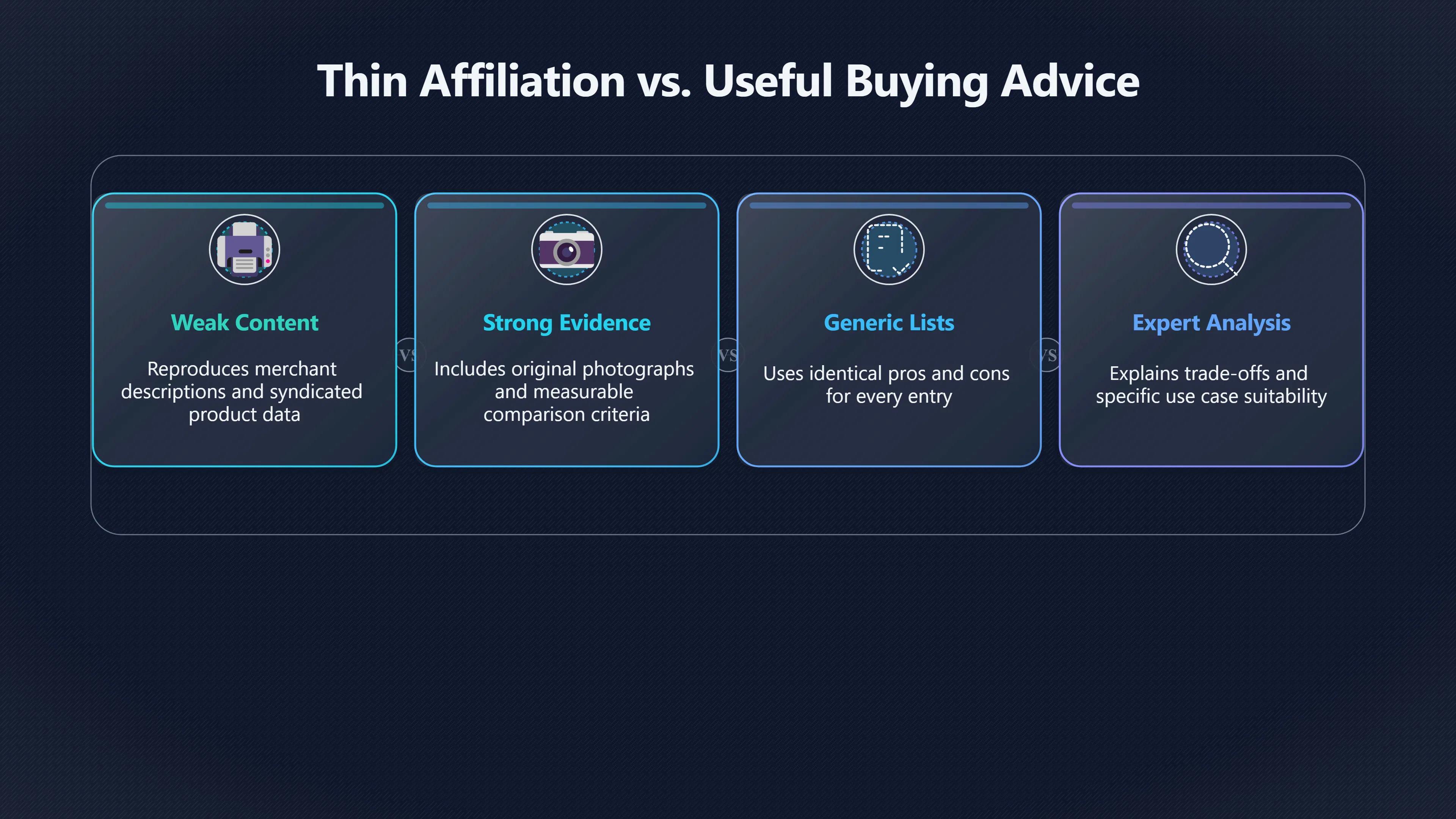
 For publishers who rely on affiliate commissions, generic “Top 10” pages are therefore one of the weakest content formats if they lack visible evidence. Readers increasingly expect to understand not only which products are recommended, but why they deserve their position and who they are actually suitable for.
The Difference Between Ranking Products and Reviewing Them
Many affiliate lists look authoritative because they assign numerical rankings, badges such as “Best Overall”, or star ratings. Yet those labels alone do not demonstrate that any evaluation has taken place.
A genuine review or buying guide usually contains evidence that editorial decisions were made independently. For example, it explains:
- what criteria were used to compare products;
- which strengths and weaknesses influenced the ranking;
- which products narrowly missed inclusion;
- who each recommendation is intended for;
- situations where a lower-ranked option might actually be the better purchase.
Without these elements, a ranking becomes little more than an opinion without supporting evidence. Readers cannot judge whether the recommendations reflect real experience, careful research, commercial incentives, or simply the order that generates the highest affiliate commission.
Google’s own examples of valuable affiliate content consistently emphasise original reviews, rigorous testing, product comparisons and additional information that cannot simply be found on the merchant’s page.[Google for Developers]developers.google.comGoogle for DevelopersSpam Policies for Google Web SearchThin affiliation is the practice of publishing content with product affiliate lin…
What Readers and Google Can Inspect as Evidence
Neither human readers nor search engines can directly observe whether a publisher physically tested every product. Instead, they assess the evidence presented on the page.
Strong evidence signals include:
- original photographs showing products in use rather than only manufacturer images;
- explanations of the testing process or research methodology;
- measurable comparison criteria, such as battery life, weight, durability or ease of use;
- discussion of trade-offs instead of claiming every product is excellent;
- comparisons based on specific use cases rather than marketing slogans;
- updates showing when recommendations were reviewed or revised.
These signals allow readers to understand how conclusions were reached. Even when first-hand testing is not possible, transparent explanations of research methods, consultation with expert sources, examination of technical documentation, or long-term ownership experience are substantially more credible than anonymous rankings with no visible basis.
By contrast, pages that simply reproduce specifications, manufacturer claims and affiliate buttons offer little evidence that the publisher contributed meaningful analysis beyond reorganising publicly available information. Google specifically identifies copied product descriptions and reviews without added value as examples of thin affiliation.[Google for Developers]developers.google.comGoogle for DevelopersSpam Policies for Google Web SearchThin affiliation is the practice of publishing content with product affiliate lin…
Why Generic “Best” Lists Lose Trust
Generic affiliate lists often follow an almost identical pattern:
- a short introductory paragraph;
- ten products with similar descriptions;
- copied specification tables;
- identical “Pros” and “Cons” structures;
- affiliate links after every entry;
- no explanation of ranking methodology.
Although these pages may appear comprehensive, they frequently fail to answer the questions buyers actually have.
For example, a visitor searching for the best office chair may care about posture support, seat depth, long-term comfort, adjustment range, warranty quality or suitability for different body sizes. A generic list that repeats manufacturer features without discussing these practical differences does not reduce uncertainty for the buyer.
The absence of trade-offs is another warning sign. Real products almost always involve compromises. When every recommendation receives glowing praise with minimal criticism, readers have little reason to believe the rankings reflect independent judgement rather than commercial incentives.
How to Turn a List Into Useful Buying Advice
A useful buying guide does more than identify products. It helps readers understand which product matches their circumstances.
Instead of writing:
Product A is the best overall.
A stronger recommendation explains:
- why it outperformed competitors;
- which buyers benefit most;
- situations where another option is preferable;
- any meaningful drawbacks that should influence purchasing decisions.
Similarly, rather than assigning arbitrary scores such as “9.8/10”, publishers should explain the evaluation criteria behind those numbers. If comfort counts for 40%, durability for 30% and price for 30%, readers can understand how rankings were produced and decide whether those priorities match their own.
Practical comparisons also increase usefulness. Examples include:
- comparing value rather than simply price;
- identifying products for beginners versus professionals;
- explaining when older models remain good purchases;
- highlighting maintenance costs or accessory compatibility;
- discussing reliability over extended ownership.
These additions transform an affiliate page from a collection of links into a decision-making resource.
Editorial Transparency Builds Credibility
Readers increasingly expect publishers to disclose how recommendations are produced.
Simple editorial information can significantly improve credibility, such as:
- whether products were personally tested;
- whether testing was limited to certain models;
- whether recommendations are based on research rather than ownership;
- when the comparison was last reviewed;
- whether manufacturers influenced product selection.
Transparency does not require claiming more experience than actually exists. In fact, accurately describing research limitations is generally more trustworthy than implying exhaustive testing that never occurred.
This aligns with Google’s broader emphasis on original, people-first content that demonstrates genuine expertise and usefulness rather than content created primarily to capture search traffic.[blog.google]blog.googlegoogle search update march 2024New ways we're tackling spammy, low-quality content on…5 Mar 2024 — We're making several updates to our spam policies to better addres…

The Affiliate Risk of Weak Best Lists
A weak “best” list is rarely problematic because of affiliate links alone. The greater risk is that the page contributes little beyond information already available from retailers, manufacturers and dozens of competing affiliate sites.
When multiple websites publish near-identical rankings supported only by lightly rewritten product descriptions, they become difficult to distinguish from one another. Google’s spam policies specifically describe thin affiliate pages as those that distribute substantially similar content without providing additional value, while Google’s guidance on manual actions similarly recommends improving pages so they provide significant added value rather than superficial affiliate summaries.[Google for Developers]developers.google.comGoogle for DevelopersSpam Policies for Google Web SearchThin affiliation is the practice of publishing content with product affiliate lin…
For affiliate publishers seeking sustainable search visibility, the goal is therefore not simply to compile a list of products. It is to produce evidence-based buying advice that helps readers make a better decision than they could by visiting the merchant directly.
Amazon book picks
Further Reading
Books and field guides related to Why Generic Best Lists Lose Search Trust. Use these as the next step if you want deeper reading beyond the article.
Everybody Writes
Explains how to create genuinely useful, reader-first content rather than superficial listicles.
Product-Led SEO
Focuses on creating genuinely valuable pages that satisfy users rather than relying on thin optimization.
They Ask, You Answer
Emphasizes answering real buyer questions with transparent, trustworthy editorial content.
Content Chemistry
Covers evidence-based content creation, quality signals, and building pages that earn trust.
eBay marketplace picks
Marketplace Samples
Live-tested eBay searches with available results related to this page.



Endnotes
1.
Source: developers.google.com
Link:https://developers.google.com/search/docs/essentials/spam-policies
Source snippet
Google for DevelopersSpam Policies for Google Web SearchThin affiliation is the practice of publishing content with product affiliate lin...
2.
Source: blog.google
Title: google search update march 2024
Link:https://blog.google/products-and-platforms/products/search/google-search-update-march-2024/
Source snippet
New ways we're tackling spammy, low-quality content on...5 Mar 2024 — We're making several [updates]({{ 'updates/' | relative_url }}) to our spam policies to better addres...
Published: march 2024
3.
Source: support.google.com
Title: Help Manual actions report
Link:https://support.google.com/webmasters/answer/9044175?hl=en
Source snippet
Google HelpManual actions report - Search Console HelpFirst, review Google's link spam policy. Next, follow the steps below to... Check...
4.
Source: support.google.com
Link:https://support.google.com/webmasters/thread/302446608/provide-details-about-the-affiliate-products-review-guidelines-and-can-we-used-more-than-ads-network?hl=en
Source snippet
For example a website used a ad network...
Additional References
5.
Source: reddit.com
Link:https://www.reddit.com/r/SEO/comments/18w07x6/specific_google_spam_penalties_list_google_spam/
Source snippet
Specific Google Spam Penalties listThin affiliate pages. Thin affiliate pages are pages with product affiliate links on which the product...
6.
Source: yellowgrape.io
Title: de toekomst van affiliate marketing na googles helpful content updates
Link:https://www.yellowgrape.io/en/insights/de-toekomst-van-affiliate-marketing-na-googles-helpful-content-updates
Source snippet
The future of affiliate marketing after Google's Helpful...24 Oct 2024 — As a result of these so-called Helpful Content updates, many af...
7.
Source: seroundtable.com
Title: google merchant center policy ai generated reviews are spam 35785
Link:https://www.seroundtable.com/google-merchant-center-policy-ai-generated-reviews-are-spam-35785.html
Source snippet
New Google Merchant Center Policy Says AI Generated...28 Jul 2023 — Google has posted a new policy saying AI-generated reviews are again...
8.
Source: youtube.com
Title: How To Get Non Indexed Pages Indexed FAST (SEO Fixes That Work)
Link:https://www.youtube.com/watch?v=6i7CnZVJRsk
Source snippet
This curated list of videos explains how Google's ranking systems target affiliate websites that assemble "best" [roundups]({{ 'roundups/' | relative_url }}) or product list...
9.
Source: linkedin.com
Link:https://www.linkedin.com/pulse/10-google-spam-policies-every-website-owner-should-know-bilal-izqhe
Source snippet
s don't offer reviews, insights, or comparisons. Google...
10.
Source: guides.freshstore.com
Title: 185 avoiding google penalties
Link:https://guides.freshstore.com/article/185-avoiding-google-penalties
Source snippet
Google penalties - FreshStore Guides31 Mar 2026 — A "Thin Affiliate" is a term coined by Google and refers to websites that promote affil...
11.
Source: keygrow.co
Title: do affiliate links hurt seo
Link:https://keygrow.co/blog/do-affiliate-links-hurt-seo
Source snippet
? The Real Risk17 Jun 2026 — Google names "thin affiliation" in its spam policies because it gives users nothing they could not get from...
12.
Source: loganix.com
Title: What Is Thin Content?
Link:https://loganix.com/what-is-thin-content/
Source snippet
Unpacked by Google's Spam Policies3 Jan 2024 — Thin content—sometimes known as shallow content—refers to web pages containing content tha...
13.
Source: ethanlazuk.com
Title: Does Google Search Really Have a Spam Problem?
Link:https://ethanlazuk.com/blog/google-spam-problem/
Source snippet
affiliate pages – affiliate links go to product pages and earn [commissions]({{ 'commissions/' | relative_url }}), but when those pages offer little unique value, th...
14.
Source: youtube.com
Title: Google announced a product review algorithm update! What I’m doing TODAY!
Link:https://www.youtube.com/watch?v=XYXACNW4BMw
Source snippet
Google Algorithm Update April 2023 - Google Review System Update...
Published: April 2023
Topic Tree