Within Affiliate Pages
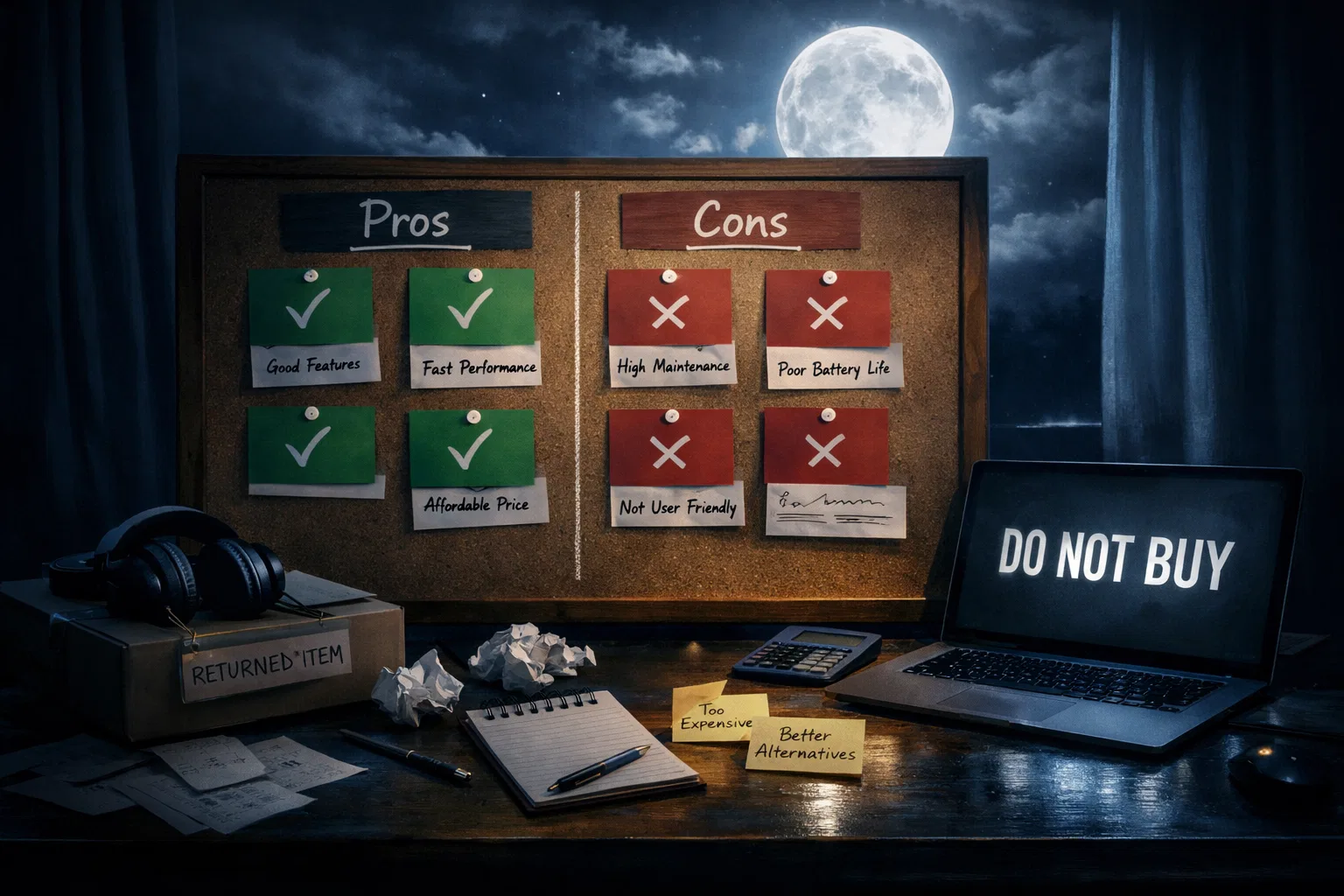
Why Honest Affiliate Reviews Say Do Not Buy
Saying who should avoid a product can make affiliate content more useful and more believable.
On this page
- Disqualifying use cases
- Bad fits and cheaper options
- How honesty improves credibility
Page outline Jump by section
Introduction
A good affiliate review does not only say “buy this”. It also says who should walk away. “Who should not buy” recommendations make product pages more useful because they protect readers from a poor fit, show that the reviewer understands real trade-offs, and reduce the sense that every paragraph exists only to earn a commission. In affiliate marketing, that matters commercially as well as ethically: trust is the asset that turns search traffic into clicks, repeat visits, newsletter sign-ups, and long-term revenue.
This is not just a nice editorial habit. Google’s guidance for high-quality reviews asks publishers to evaluate products from a user’s perspective, explain benefits and drawbacks, show evidence of real experience, compare alternatives, and describe how a product differs from competitors. Reviews that only repeat merchant claims or push every reader towards the highest-commission option look thin by comparison.[Google for Developers]developers.google.comGoogle for DevelopersWrite high quality reviewsWrite high quality reviews · Evaluate from a user's perspective. · Demonstrate that you ar…
Why “Do Not Buy” Advice Belongs in Affiliate Reviews
Affiliate pages often fail because they treat every visitor as the same person. A runner with knee pain, a student on a tight budget, a landlord buying ten appliances, and a hobbyist willing to pay for premium materials may all land on the same “best product” article, but they do not need the same recommendation. A “who should not buy” section makes the page behave more like a real adviser.
The mechanism is simple: it narrows the match between the product and the reader. Instead of asking “is this product good?”, the review asks “good for whom, under what constraints, and compared with what?” That framing helps readers self-select. It also gives the publisher room to recommend cheaper, simpler, safer, or more appropriate alternatives without pretending that the top affiliate product is universally right.
This is especially important because online review ecosystems are full of trust problems. The US Federal Trade Commission introduced a final rule against fake reviews and testimonials in 2024, covering practices such as buying fake positive or negative reviews, insider reviews without disclosure, review suppression, and company-controlled review sites that falsely present themselves as independent.[Federal Trade Commission]ftc.govFederal Trade CommissionFederal Trade Commission Announces Final Rule Banning…August 14, 2024 — 14 Aug 2024 — The Federal Trade Commis… In the UK, the Competition and Markets Authority has also treated fake and misleading reviews as a consumer-law priority, publishing guidance and securing undertakings from Amazon over fake reviews and catalogue abuse.[GOV.UK]GOV.UKOnline reviewsOnline reviews
Against that backdrop, an affiliate site that openly names bad fits stands out. It tells the reader that the page is not just a sales funnel. It is a buying filter.
Disqualifying Use Cases
The strongest “do not buy” advice is not vague negativity. It is specific, testable, and tied to real usage. The goal is not to make a product look bad; it is to stop the wrong person buying it for the wrong job.
A useful disqualifying use case usually falls into one of five categories:
- The product cannot handle the workload. A budget cordless drill may be fine for flat-pack furniture but wrong for masonry, daily trade use, or long screws into hardwood.
- The buyer needs a feature the product lacks. A cheap printer without automatic duplex printing may be a poor fit for a home office that prints long documents every week.
- The running costs change the real price. A low-cost coffee machine, razor, printer, or water filter may become expensive if capsules, blades, ink, or cartridges are locked to one ecosystem.
- The product creates avoidable friction. A technically capable software tool may be wrong for beginners if setup, support, migration, or billing is too complex.
- The risk profile is wrong. In categories such as finance, health, childcare, electrical goods, and personal data tools, a product can be unsuitable because the consequences of a bad choice are high, not merely because it is inconvenient.
Google’s review guidance rewards exactly this kind of differentiated judgement: original research, evidence of use, quantitative measurements, and clear explanation of what sets one option apart from another. A “not for” paragraph gives those signals a natural place to live.[Google for Developers]developers.google.comGoogle for DevelopersWrite high quality reviewsWrite high quality reviews · Evaluate from a user's perspective. · Demonstrate that you ar…
The best format is plain and direct. For example: “Do not buy this if you need to edit 4K video daily; the fan noise and export times make it a poor value next to the higher-spec model.” That sentence is more useful than “not ideal for power users” because it names the workload, the failure point, and the comparison.
Bad Fits and Cheaper Options
Many affiliate pages quietly avoid cheaper alternatives because lower-priced products often mean lower commissions. That is a short-term way to think. If the reader can solve their problem with a cheaper item, saying so can make the whole site more believable.
A “bad fit and cheaper option” section works best when it separates three ideas:
Overkill: The recommended product is good, but the reader does not need it. A premium mesh Wi-Fi system may be unnecessary for a small flat with one or two users. A simpler router could be the better recommendation.
Wrong trade-off: The product optimises for one thing while the reader needs another. A lightweight travel tripod may be poor for studio stability. A heavy-duty model may be poor for backpacking. Neither is “bad”; each is wrong for a different buyer.
False economy: The cheaper product looks like the bargain but becomes costly through repairs, accessories, subscriptions, consumables, or replacement. In this case, “do not buy the cheapest one” is still a reader-first recommendation.
The important commercial point is that honest disqualification does not necessarily reduce earnings. It can increase the quality of clicks. A reader who clicks after being warned about drawbacks is more likely to understand what they are buying. That can mean fewer disappointed purchases, fewer returns, and stronger trust in future recommendations. Some affiliate policies also make returns relevant because commission may be lost if the purchase is refunded; TIME’s affiliate policy, for instance, notes that it may earn commission when readers buy through links, but not if items are returned.[Time]time.coms Affiliate Link Policys Affiliate Link Policy
Cheaper alternatives also help pages serve more search intents. A reader who searches “best standing desk” may not yet know whether they need a £700 electric desk, a manual frame, a desk converter, or simply a better chair and monitor arm. A credible affiliate review helps them avoid the wrong level of spend.
How Honesty Improves Credibility
Negative detail can make positive recommendations more persuasive because it gives the reader something to test against their own situation. A page that says every product is “excellent”, “premium”, and “great value” provides no decision-making help. A page that says “this is our pick for renters, but not for homeowners planning permanent installation” gives the reader a reason to trust the judgement.
Research and regulatory activity around reviews show why this matters. Baymard Institute’s e-commerce research has found that users rely heavily on reviews when evaluating products, and that ratings distribution and negative-review handling affect how shoppers assess both the product and the site.[Baymard Institute]baymard.comInstitute5 Requirements for the 'Ratings DistributionInstitute5 Requirements for the 'Ratings Distribution That finding has a direct lesson for affiliate publishers: readers do not only want praise. They want signals that help them judge suitability.
Affiliate disclosures are part of the same trust equation, but disclosure alone is not enough. The FTC’s endorsement guidance says material connections should be disclosed where they could affect the weight or credibility consumers give to an endorsement.[Federal Trade Commission]ftc.govFederal Trade Commission FTC's Endorsement Guides: What People Are AskingFederal Trade Commission FTC's Endorsement Guides: What People Are Asking The UK Advertising Standards Authority similarly describes affiliate marketing as advertising when an affiliate is rewarded for customer referrals, and says marketing communications must be obviously identifiable.[ASA]asa.org.ukaffiliate marketingaffiliate marketing
A clear affiliate disclosure tells the reader how the site may be paid. A clear “do not buy” section shows how the site protects the reader despite that incentive. The two work together.
What a Good “Who Should Not Buy” Section Looks Like
A strong section is short, specific, and decision-oriented. It should not feel like a legal disclaimer or a token paragraph added for search engines. It should feel like the moment a knowledgeable friend says, “This is good, but not for you if…”
A practical structure is:
- Name the buyer who should avoid it. “Do not buy this if you live in a hard-water area and want low maintenance.”
- Explain the reason. “The tank needs frequent descaling and the replacement filters cost more than competing systems.”
- Offer the better route. “Choose the larger-filter model or a cheaper manual option if you only use it occasionally.”
- Tie it to evidence. Use test notes, specifications, user-review patterns, repair data, warranty terms, price history, or side-by-side comparisons.
For affiliate websites, this section is also a defence against thin content. Google’s spam policies warn against thin affiliate pages that duplicate merchant or network content without adding meaningful value.[Google for Developers]developers.google.comOpen source on google.com. “Who should not buy” advice is hard to produce well without real judgement. It pushes the publisher towards original testing, practical comparison, and clearer user segmentation.
The wording should be confident but not theatrical. “Avoid this if you need X” is better than “this product is a disaster”. The first helps a reader decide. The second may be unfair, especially if the product is good for a different audience.
Common Mistakes That Make “Do Not Buy” Advice Look Fake
The weakest version of this tactic is performative honesty: a review adds a few harmless negatives while still pushing everyone towards the same product. Readers notice.
Common mistakes include:
- Listing trivial drawbacks. “Only comes in two colours” is not meaningful unless colour is central to the buying decision.
- Hiding the real trade-off. If the main issue is subscription cost, repairability, noise, data privacy, or poor support, say that directly.
- Using the same warning everywhere. Repeating “not for professionals” across dozens of reviews looks templated and untested.
- Recommending only high-commission alternatives. If the best alternative is a cheaper non-affiliate option, naming it can strengthen the entire page.
- Confusing personal preference with disqualification. “I do not like the design” is weaker than “the glossy surface shows fingerprints and scratches quickly in shared workspaces.”
The wider review market makes this especially important. Studies of affiliate and endorsement disclosures have found that many consumers do not reliably recognise affiliate content when disclosures are absent, unclear, or too abbreviated. One large study of YouTube and Pinterest affiliate content found disclosure rates were low and that short, unexplained disclosures were often poorly understood by users.[arXiv]arxiv.orgOpen source on arxiv.org. A review page that combines weak disclosure with suspiciously universal praise gives readers several reasons to doubt it.

The Commercial Value of Saying No
For affiliate site owners, the fear is obvious: if a page tells some readers not to buy, will it lose money? In the short term, possibly on that one click. In the long term, the better question is whether the site is building an audience or merely harvesting one-off traffic.
Honest exclusion can help revenue in several ways. It improves reader satisfaction because people are less likely to feel misled. It supports stronger internal linking because a “do not buy this if…” paragraph naturally points to a better alternative guide. It can improve conversion quality because readers who remain interested after seeing the drawbacks are more qualified. It also helps distinguish a review from merchant copy, especially in competitive search results where many pages recommend the same products.
There is also a reputation advantage. WIRED’s affiliate policy says affiliate schemes do not determine which products its editors cover or recommend, and that affiliate links are one way it funds journalism.[WIRED]wired.coms editorial policy on affiliate linkss editorial policy on affiliate links Consumer Reports has long built its public identity around independent testing and strict limits on commercial use of its ratings, even as its licensing approach has evolved.[Consumer Reports]consumerreports.orgno commercial use policyno commercial use policy Smaller affiliate publishers cannot simply borrow that credibility, but they can adopt the reader-facing discipline behind it: explain the trade-offs, disclose incentives, and refuse to recommend products to people they do not suit.
That is the real mechanism. “Who should not buy” advice turns an affiliate review from a sales page into a decision page. The site can still earn from affiliate links, but the recommendation is framed around fit rather than pressure. For readers, that means fewer bad purchases. For publishers, it means a brand that can survive beyond the next algorithm update, commission change, or product launch.
Amazon book picks
Further Reading
Books and field guides related to Why Honest Affiliate Reviews Say Do Not Buy. Use these as the next step if you want deeper reading beyond the article.
Everybody Writes
Covers writing persuasive, useful content that earns reader trust through clarity and honesty.
Trust Me, I'm Lying
Explains why credibility and honest communication matter more than short-term promotion.
The Copywriter's Handbook
Rating: 4.0/5 from 5 Google Books ratings
Helps writers communicate product strengths and weaknesses clearly while improving conversion through better copy.
Content Inc
Focuses on growing an audience by delivering genuine value before monetization.
eBay marketplace picks
Marketplace Samples
Live-tested eBay searches with available results related to this page.


Endnotes
1.
Source: developers.google.com
Link:https://developers.google.com/search/docs/specialty/ecommerce/write-high-quality-reviews
Source snippet
Google for DevelopersWrite high quality reviewsWrite high quality reviews · Evaluate from a user's perspective. · Demonstrate that you ar...
2.
Source: developers.google.com
Link:https://developers.google.com/search/docs/appearance/reviews-system
Source snippet
Google for DevelopersGoogle Search's Reviews SystemThe reviews system aims to better reward high quality reviews, which is content that p...
3.
Source: ftc.gov
Link:https://www.ftc.gov/news-events/news/press-releases/2024/08/federal-trade-commission-announces-final-rule-banning-fake-reviews-testimonials
Source snippet
Federal Trade CommissionFederal Trade Commission Announces Final Rule Banning...August 14, 2024 — 14 Aug 2024 — The Federal Trade Commis...
Published: August 14, 2024
4.
Source: GOV.UK
Title: Online reviews
Link:https://www.gov.uk/cma-cases/online-reviews
5.
Source: GOV.UK
Title: amazon gives undertakings to cma to curb fake reviews
Link:https://www.gov.uk/government/news/amazon-gives-undertakings-to-cma-to-curb-fake-reviews
6.
Source: time.com
Title: ‘s Affiliate Link Policy
Link:https://time.com/4605406/time-affiliate-link-policy/
7.
Source: baymard.com
Title: Institute5 Requirements for the ‘Ratings Distribution
Link:https://baymard.com/blog/user-ratings-distribution-summary
8.
Source: baymard.com
Title: respond to negative user reviews
Link:https://baymard.com/blog/respond-to-negative-user-reviews
9.
Source: ftc.gov
Title: Federal Trade Commission FTC’s Endorsement Guides: What People Are Asking
10.
Source: asa.org.uk
Title: affiliate marketing
Link:https://www.asa.org.uk/advice-online/affiliate-marketing.html
11.
Source: developers.google.com
Link:https://developers.google.com/search/docs/fundamentals/creating-helpful-content
12.
Source: arxiv.org
Link:https://arxiv.org/abs/1809.00620
13.
Source: wired.com
Title: ‘s editorial policy on affiliate links
Link:https://www.wired.com/story/affiliate-link-policy
14.
Source: support.google.com
Link:https://support.google.com/merchants/answer/14549080?hl=en-GB
15.
Source: developers.google.com
Link:https://developers.google.com/search/docs/appearance/structured-data/product
16.
Source: google.com
Link:https://www.google.com/
17.
Source: support.google.com
Title: critic review schema on product pages
Link:https://support.google.com/webmasters/thread/162081066/critic-review-schema-on-product-pages?hl=en
18.
Source: support.google.com
Title: low traffic affiliate site what can i do better
Link:https://support.google.com/webmasters/thread/112211009/low-traffic-affiliate-site-what-can-i-do-better?hl=en
19.
Source: support.google.com
Link:https://support.google.com/webmasters/thread/302446608/provide-details-about-the-affiliate-products-review-guidelines-and-can-we-used-more-than-ads-network?hl=en
20.
Source: support.google.com
Link:https://support.google.com/webmasters/answer/9044175?hl=en
21.
Source: developers.google.com
Title: product reviews update
Link:https://developers.google.com/search/blog/2021/04/product-reviews-update
22.
Source: support.google.com
Link:https://support.google.com/merchants/answer/14620705?hl=en
23.
Source: baymard.com
Title: user reviews dtc
Link:https://baymard.com/blog/user-reviews-dtc
24.
Source: baymard.com
Title: user perception of product ratings
Link:https://baymard.com/blog/user-perception-of-product-ratings
25.
Source: GOV.UK
Title: social media endorsements being transparent with your followers
Link:https://www.gov.uk/government/publications/social-media-endorsements-guidance-for-content-creators/social-media-endorsements-being-transparent-with-your-followers
26.
Source: GOV.UK
Title: online consumer reviews
Link:https://www.gov.uk/cma-cases/online-consumer-reviews
28.
Source: ftc.gov
Title: consumer reviews testimonials rule questions answers
Link:https://www.ftc.gov/business-guidance/resources/consumer-reviews-testimonials-rule-questions-answers
29.
Source: ftc.gov
Link:https://www.ftc.gov/legal-library/browse/rules/rulemaking-use-consumer-reviews-testimonials
30.
Source: assets.publishing.service.gov.uk
Link:https://assets.publishing.service.gov.uk/media/67eeb64fe9c76fa33048c790/CMA208_-_Fake_reviews_guidance.pdf
31.
Source: youtube.com
Link:https://www.youtube.com/watch?v=KPfjzL9oPiE
32.
Source: youtube.com
Link:https://www.youtube.com/watch?v=Knu_nlcoP3g
33.
Source: youtube.com
Link:https://www.youtube.com/watch?v=aX2IOJT15vY
34.
Source: youtube.com
Title: Google Product Reviews Update Explained
Link:https://www.youtube.com/watch?v=0CR9Nbn6L7o
Source snippet
Google Product Reviews Update 2.0 Analysis (December 2021)...
Published: December 2021
35.
Source: youtube.com
Link:https://www.youtube.com/watch?v=gX9W0io6mpo
Source snippet
Best Product Review Sites...
Published: December 2021
36.
Source: youtube.com
Title: Best Product Review Sites
Link:https://www.youtube.com/watch?v=v9x0koBEAO4
Source snippet
Tips for Writing Compelling Affiliate Product Reviews...
37.
Source: youtube.com
Title: Tips for Writing Compelling Affiliate Product Reviews
Link:https://www.youtube.com/watch?v=ilQ0RuQD2wo
Source snippet
How To Add Pros Cons Box In WordPress? Create Amazon Pros Cons Box Table...
38.
Source: youtube.com
Title: How To Add Pros Cons Box In Word Press? Create Amazon Pros Cons Box Table
Link:https://www.youtube.com/watch?v=easVMRhfJHU
39.
Source: blog.google
Title: more helpful product reviews
Link:https://blog.google/products-and-platforms/products/search/more-helpful-product-reviews/
40.
Source: consumerreports.org
Title: no commercial use policy
Link:https://www.consumerreports.org/about-us/policies-and-financials/no-commercial-use-policy/
41.
Source: consumerreports.org
Link:https://www.consumerreports.org/
42.
Source: consumerreports.org
Title: brand licensing
Link:https://www.consumerreports.org/brand-licensing/
43.
Source: consumerreports.org
Link:https://www.consumerreports.org/cro/magazine/2014/05/a-user-s-guide-to-user-reviews/index.htm
44.
Source: consumerreports.org
Title: cr recommended
Link:https://www.consumerreports.org/cr-recommended/
45.
Source: trustpilot.com
Link:https://www.trustpilot.com/review/baymard.com
46.
Source: linkedin.com
Link:https://www.linkedin.com/posts/baymard-institute_product-page-ux-2025-15-pitfalls-and-best-activity-7285002885770182656-N_YX
47.
Source: asa.org.uk
Title: get yourself affiliated with the rules on affiliate marketing
Link:https://www.asa.org.uk/news/get-yourself-affiliated-with-the-rules-on-affiliate-marketing.html
Additional References
48.
Source: federalregister.gov
Title: trade regulation rule on the use of consumer reviews and testimonials
Link:https://www.federalregister.gov/documents/2024/08/22/2024-18519/trade-regulation-rule-on-the-use-of-consumer-reviews-and-testimonials
Source snippet
Federal RegisterTrade Regulation Rule on the Use of Consumer Reviews...22 Aug 2024 — This final rule, among other things, prohibits sell...
49.
Source: ecfr.gov
Link:https://www.ecfr.gov/current/title-16/chapter-I/subchapter-B/part-255
50.
Source: federalregister.gov
Title: guides concerning the use of endorsements and testimonials in advertising
Link:https://www.federalregister.gov/documents/2023/07/26/2023-14795/guides-concerning-the-use-of-endorsements-and-testimonials-in-advertising
51.
Source: linkedin.com
Link:https://www.linkedin.com/posts/gearoidbuckley_92-of-consumers-trust-peer-recommendations-activity-7416532059055128576-0y_v
52.
Source: bakerbotts.com
Link:https://www.bakerbotts.com/thought-leadership/publications/2023/december/ftc-new-guidelines-for-endorsements-and-testimonials
53.
Source: geniuslink.com
Link:https://geniuslink.com/blog/amazon-affiliate-disclosure-guide/
54.
Source: medium.com
Link:https://medium.com/design-bootcamp/baymard-cliff-notes-user-reviews-3e425d52c250
55.
Source: edelman.com
Link:https://www.edelman.com/sites/g/files/aatuss191/files/2024-06/Top10_Edelman_2024BrandTrust.pdf
56.
Source: dwt.com
Link:https://www.dwt.com/insights/2024/08/ftc-finalizes-rule-banning-fake-consumer-reviews
57.
Source: termly.io
Link:https://termly.io/resources/articles/ftc-requirements-for-influencers/
Topic Tree
Follow this branch
Parent topic
Affiliate PagesRelated pages 29
- Amazon Is Amazon Associates Still Good for Beginners?
- Appliances What Kitchen Appliance Reviews Often Miss
- Authority Can Expertise Beat Bigger Affiliate Sites?
- Baby Travel Why Baby Travel Gear Reviews Need More Trust
- Business Tools Can Small Business Software Be a Better Affiliate Niche?
- +24 more in sidebar