Within Niche Choice
Do the Affiliate Numbers Work?
A rough revenue model can prevent choosing a niche with exciting commissions but too little realistic earning potential.
On this page
- Traffic share and click through assumptions
- Conversion rates and average commission
- Red flags in attractive looking payout claims
Page outline Jump by section
Introduction
Choosing an affiliate niche without estimating its earning potential is a common and expensive mistake. Attractive commission percentages or popular products can create the illusion of a profitable opportunity, yet many niches fail because too few visitors click affiliate links, too few buyers convert, or the average commission is simply too small to support the amount of content required. A simple revenue model built before creating a website helps expose these weaknesses early.
 The aim is not to predict future income precisely. Instead, it is to test whether a niche has a realistic path to meaningful earnings by combining assumptions about traffic, affiliate link clicks, merchant conversion rates, average order values, and commission structures. Even rough estimates are far more useful than choosing a niche based on headline commission rates alone.
Traffic Alone Does Not Predict Revenue
Affiliate income is the result of several multiplying factors rather than a single metric. A niche with lower search volume but strong commercial intent can outperform a much larger informational niche because more visitors are ready to buy.
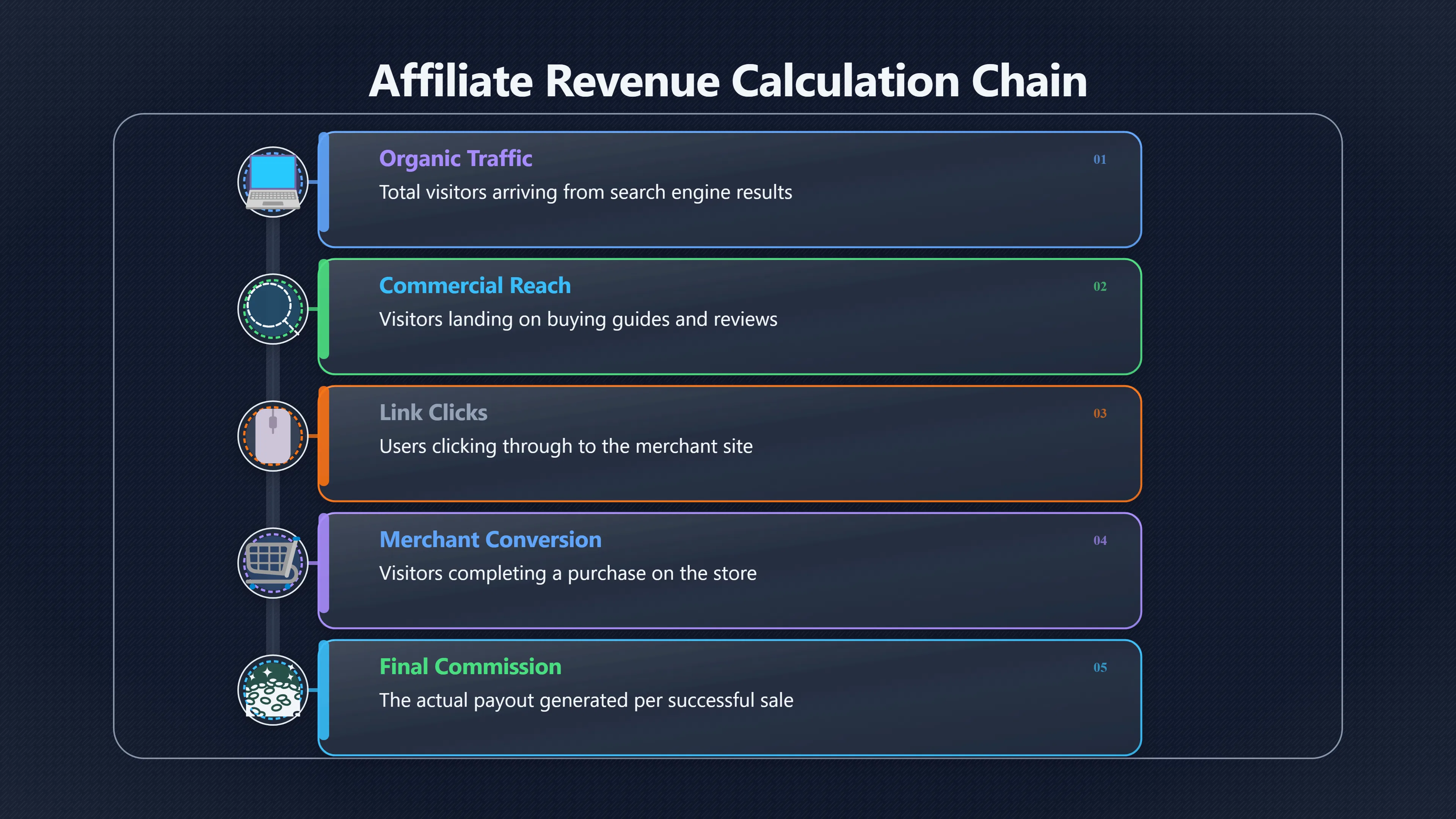
A practical pre-launch revenue estimate follows this basic chain:
Organic visitors × percentage reaching commercial pages × affiliate link click rate × merchant conversion rate × average commission = estimated monthly affiliate revenue.
This approach immediately shifts attention away from vanity metrics such as total keyword volume and towards the behaviour that actually generates commissions.
For example, consider two hypothetical niches:
MetricInformational nicheBuyer-intent nicheMonthly visitors40,00012,000Visitors reaching commercial pages10%70%Affiliate link click rate8%25%Merchant conversion rate1.5%4%Average commission£4£35
Although the informational site attracts over three times as many visitors, the buyer-intent niche can generate substantially higher revenue because every stage of the funnel performs better.
Build Conservative Traffic Assumptions
The largest forecasting error usually occurs at the traffic stage. New affiliate sites rarely rank for competitive commercial keywords immediately, and organic growth often takes months rather than weeks.
Instead of forecasting total search volume, estimate:
- the number of commercial keywords you expect to rank for
- realistic ranking positions rather than assuming first place
- likely click-through from search results
- the proportion of visitors landing on pages containing affiliate recommendations.
Many affiliate sites contain a mixture of informational and commercial content. If only 30% of projected traffic will arrive on buying guides, comparisons and reviews, only that portion should feed into the revenue calculation.
Conservative assumptions produce more reliable decisions. It is generally safer to underestimate rankings and overestimate the effort required than to assume ideal SEO performance from launch.
Estimate Link Clicks Rather Than Assuming Every Visitor Buys
Visitors do not purchase simply because they read an article.
Before a merchant ever records a sale, several events must occur:
- The visitor reaches a commercial page.
- They trust the recommendation.
- They click an affiliate link.
- They complete a purchase on the merchant’s website.
This means affiliate link click-through rate deserves its own estimate rather than being hidden inside a conversion assumption.
Industry benchmarks vary widely depending on content quality, page design and user intent. Some affiliate resources suggest average affiliate link click-through rates around 0.5% to 1% across programmes as a broad benchmark, while highly targeted buying guides and comparison pages can perform substantially better.[partnero.com]partnero.comAnything above 1% is excellent21 Affiliate Marketing Benchmarks & KPIs - PartneroAugust 12, 2024 — A good CTR can vary by industry, even in affiliate marketing, but ge…
The important lesson is not the exact percentage but the sensitivity of the model. If your estimate only works when 40% of readers click affiliate links, the niche may require unrealistic assumptions.
Conversion Rates and Average Commission Matter Together
Many beginners focus almost entirely on commission percentage.
In reality, expected earnings depend on three variables working together:
- merchant conversion rate[shopify.com]shopify.comUse this formula to find conversion rate: Conversion rate20 Affiliate Marketing Metrics Worth Tracking in 2026November 25, 2025 — 25 Nov 2025 — The average conversion rate range is betwee… * average order value[wecantrack.com]wecantrack.comAffiliate Program Performance StatisticsThe average click-through rate (CTR) for affiliate links is 0.09%.1; Conversion rates for affilia…
- commission paid per sale.
For example:
- A 50% commission on a £20 digital product produces £10 per sale.
- A 5% commission on a £1,000 product produces £50 per sale.
Neither offer is automatically better because expensive products often convert less frequently, while cheaper purchases can convert much more easily.
Many affiliate programmes report conversion rates between roughly 1% and 3%, although well-matched traffic and strong commercial intent can perform better. Industry benchmark discussions commonly place successful programmes above 5%, but these should not be assumed during niche selection.[Shopify]shopify.comUse this formula to find conversion rate: Conversion rate20 Affiliate Marketing Metrics Worth Tracking in 2026November 25, 2025 — 25 Nov 2025 — The average conversion rate range is betwee…
Where possible, research:
- typical product prices
- published commission schedules
- cookie duration
- whether commissions are one-off or recurring
- refund rates where disclosed.
Recurring commissions, common in some software and subscription services, can dramatically alter long-term revenue even when first-sale commissions appear modest.
Use Earnings Per Click as a Reality Check
Many established affiliate programmes publish or discuss Earnings Per Click (EPC), sometimes called Revenue Per Click (RPC). This metric estimates how much commission is generated, on average, for each affiliate click.
Although EPC varies enormously by programme and traffic quality, it provides a useful shortcut for comparing offers because it combines conversion rate and commission into a single figure.
If one merchant consistently produces twice the EPC of another serving the same audience, that may indicate:
- stronger product-market fit
- higher conversion rates[wecantrack.com]wecantrack.comAffiliate Program Performance StatisticsThe average click-through rate (CTR) for affiliate links is 0.09%.1; Conversion rates for affilia…
- better checkout experience
- larger average order values[wecantrack.com]wecantrack.comAffiliate Program Performance StatisticsThe average click-through rate (CTR) for affiliate links is 0.09%.1; Conversion rates for affilia…
- more generous commission structures.
Where EPC is unavailable, your own estimated revenue formula performs the same role by revealing expected value at each stage of the funnel.
Stress-Test the Model Before Choosing the Niche
Revenue estimates should survive pessimistic assumptions.
Instead of building a single forecast, prepare three scenarios:
ScenarioTrafficConversionCommissionConservativeLower rankingsLower merchant conversionBase commissionExpectedReasonable SEO growthTypical conversionStandard commissionOptimisticStrong rankingsAbove-average conversionHigher-value products
If the niche only becomes attractive under optimistic assumptions, the business case is weak.
Conversely, if the conservative forecast still produces worthwhile revenue, the niche is likely to have stronger commercial fundamentals.
Red Flags Behind Attractive Commission Claims
Large commission percentages frequently distract new affiliates from more important economics.
Watch for warning signs such as:
- Very high commission on very low-priced products. Fifty percent sounds impressive until the average commission is only a few pounds.
- Little evidence of buyer intent. Large search volumes centred on education rather than purchasing often produce weak affiliate earnings.
- Tiny product catalogues. A niche with only a handful of products limits future content and repeat recommendations.
- Unknown merchants with poor conversion potential. A generous commission means little if visitors do not trust the retailer.
- One-off purchases with long replacement cycles. Expensive products may produce excellent commissions but generate little repeat revenue.
- Dependence on unrealistic search rankings. Forecasts requiring first-page rankings across dozens of highly competitive keywords deserve scepticism.
- Ignoring merchant quality. Checkout experience, shipping costs, customer reviews and brand reputation all influence conversions that affiliates cannot directly control.
Another common mistake is confusing programme advertising with actual affiliate performance. Published commission rates describe what is possible per sale, not what publishers typically earn after accounting for click-through rates, conversion losses and search competition.

Revenue Estimates Are Decision Tools, Not Predictions
No spreadsheet can forecast affiliate income with precision before a website exists. Search rankings, algorithm updates, competition and merchant performance all introduce uncertainty.
The purpose of a revenue estimate is therefore comparative rather than predictive. It helps answer practical questions before investing months in content creation:
- Can realistic traffic produce meaningful commissions?
- Does the niche depend on exceptional conversion rates?
- Are commissions high enough to justify content production costs?
- Would another niche with similar effort likely generate higher earnings?
Treating affiliate niche selection as a financial model rather than an emotional choice greatly reduces the risk of building a site around impressive-looking commissions that cannot translate into sustainable income.
Amazon book picks
Further Reading
Books and field guides related to Do the Affiliate Numbers Work?. Use these as the next step if you want deeper reading beyond the article.
Affiliate Program Management
Directly covers affiliate economics, commissions, conversions, and program performance.
Dotcom Secrets
Covers funnels, conversions, and customer value that underpin affiliate revenue calculations.
From Nothing
Helps readers understand realistic affiliate income models and niche selection.
The Art of SEO
Explains how qualified search traffic influences affiliate revenue and commercial intent.
eBay marketplace picks
Marketplace Samples
Live-tested eBay searches with available results related to this page.



Endnotes
1.
Source: partnero.com
Title: Anything above 1% is excellent
Link:https://www.partnero.com/articles/21-essential-affiliate-marketing-benchmarks
Source snippet
21 Affiliate Marketing Benchmarks & KPIs - PartneroAugust 12, 2024 — A good CTR can vary by industry, even in affiliate marketing, but ge...
Published: August 12, 2024
2.
Source: shopify.com
Title: Use this formula to find conversion rate: Conversion rate
Link:https://www.shopify.com/ie/blog/affiliate-marketing-metrics
Source snippet
20 Affiliate Marketing Metrics Worth Tracking in 2026November 25, 2025 — 25 Nov 2025 — The average conversion rate range is betwee...
Published: November 25, 2025
Additional References
3.
Source: wecantrack.com
Link:https://wecantrack.com/insights/affiliate-program-performance-statistics/
Source snippet
Affiliate Program Performance StatisticsThe average click-through rate (CTR) for affiliate links is 0.09%.1; Conversion rates for affilia...
4.
Source: facebook.com
Link:https://www.facebook.com/AffiliateWorldConferences/posts/we-get-this-question-all-the-time-so-what-happens-in-the-affiliate-world-marketp/1437559698410644/
Source snippet
Affiliate World ConferencesAnd that's just the tip of the iceberg because the affiliate marketing market is anticipated to register a "co...
5.
Source: themarketingstream.com
Link:https://themarketingstream.com/resources/marketing-calculators/affiliate-marketing-revenue-calculator/
Source snippet
Higher traffic quality and strong content relevance can improve this percentage. How do...
6.
Source: sqmagazine.co.uk
Title: affiliate marketing statistics
Link:https://sqmagazine.co.uk/affiliate-marketing-statistics/
Source snippet
2026: Biggest Niches & Networks25 Jun 2025 — Discover key affiliate marketing statistics, including revenue trends, conversion rates, pla...
7.
Source: ahrefs.com
Title: affiliate marketing statistics
Link:https://ahrefs.com/blog/affiliate-marketing-statistics/
Source snippet
58 Affiliate Marketing Statistics for 202429 Oct 2024 — 81.2% of affiliate marketers make more than $20,000 annually (AffiliateWP) · The...
8.
Source: azonpress.com
Title: measure affiliate marketing
Link:https://azonpress.com/measure-affiliate-marketing/
Source snippet
11 Metrics To Measure Affiliate Marketing Success28 Jul 2025 — Key indicators include click-through rate (CTR), conversion rate, average...
9.
Source: youtube.com
Title: How to Find the Perfect Niche for an Affiliate Marketing Site
Link:https://www.youtube.com/watch?v=iccsLJmylJQ
Source snippet
How to Find a Niche for an Affiliate Website (my EXACT method)...
10.
Source: youtube.com
Title: How to Find the Best Niche for Affiliate Marketing (5 Simple Steps)
Link:https://www.youtube.com/watch?v=K3X-AQyzMGM
Source snippet
How to Calculate Projected Niche Website Earnings...
11.
Source: youtube.com
Title: Keys to Choosing the Right Affiliate Marketing Niche
Link:https://www.youtube.com/watch?v=nAvXcDnKRdU
Source snippet
How to Find the Best Niche for Affiliate Marketing (5 Simple Steps)...
12.
Source: youtube.com
Title: How to Calculate Projected Niche Website Earnings
Link:https://www.youtube.com/watch?v=3YOlSb_0imI
Source snippet
How to Find the Perfect Niche for an Affiliate Marketing Site...
Topic Tree