Within Spam Risk
When Affiliate Scale Starts Looking Like Spam
Large affiliate content libraries are risky when thousands of pages are made mainly to capture search variations instead of answering distinct reader needs.
On this page
- Why scale is not the same as usefulness
- Risk patterns in automated comparisons and location pages
- Editorial checks before publishing large page batches
Page outline Jump by section
Introduction
Building a large affiliate website is not, by itself, a violation of Google’s search policies. The risk begins when scale becomes the goal rather than a by-product of serving readers. Google’s spam policy on scaled content abuse targets situations where publishers generate large numbers of pages primarily to manipulate search rankings instead of providing genuinely useful information. Importantly, the policy applies regardless of whether the pages are written by artificial intelligence, human writers, templates, or a combination of all three.[Google for Developers]developers.google.comThis abusive practice is typically focused on creating large amounts of unoriginal…Read more…
 For affiliate publishers, this distinction matters because many successful businesses naturally expand into hundreds or thousands of product, comparison and location pages. The challenge is ensuring that every page earns its place through unique value rather than existing merely to capture another search variation. A large affiliate library is sustainable only if its growth reflects editorial coverage of distinct user needs instead of industrial-scale duplication.
Why Scale Is Not the Same as Usefulness
Google’s current policy deliberately avoids setting a numerical threshold. There is no published limit on how many pages an affiliate site may publish. Instead, Google’s focus is on the purpose and originality of those pages.
Under Google’s spam policy, scaled content abuse occurs when many pages are created primarily to manipulate search rankings while providing little or no unique value. The policy explicitly states that the production method is irrelevant. Whether pages are generated through automation, outsourced writing teams or manual editing, the same principle applies if the content exists mainly for search visibility rather than readers.[Google for Developers]developers.google.comThis abusive practice is typically focused on creating large amounts of unoriginal…Read more…
This represents an important shift from older discussions that often centred on automated content. Google’s March 2024 policy broadened the definition so that large-scale production itself is not the issue; mass production without meaningful originality is.[blog.google]blog.googleNew ways we're tackling spammy, low-quality content on…5 Mar 2024 — We're making several updates to our spam policies to better addres…
For affiliate publishers, this means that growth should come from expanding editorial coverage, not multiplying similar pages.
Consider two contrasting examples:
- A camping website publishes 600 buying guides because it reviews equipment across different activities, climates, budgets and experience levels using original testing and comparison.
- Another site publishes 6,000 pages by swapping product names, cities or keywords into the same template while offering almost identical advice and affiliate links.
Both websites have scale. Only one demonstrates why each page deserves to exist.
Risk Patterns in Automated Comparisons and Location Pages
Large affiliate libraries often develop around repeatable templates. Templates themselves are not prohibited—they are common across news sites, ecommerce catalogues and documentation. The problem arises when the template becomes almost the entire page.
Several patterns create particular risk.
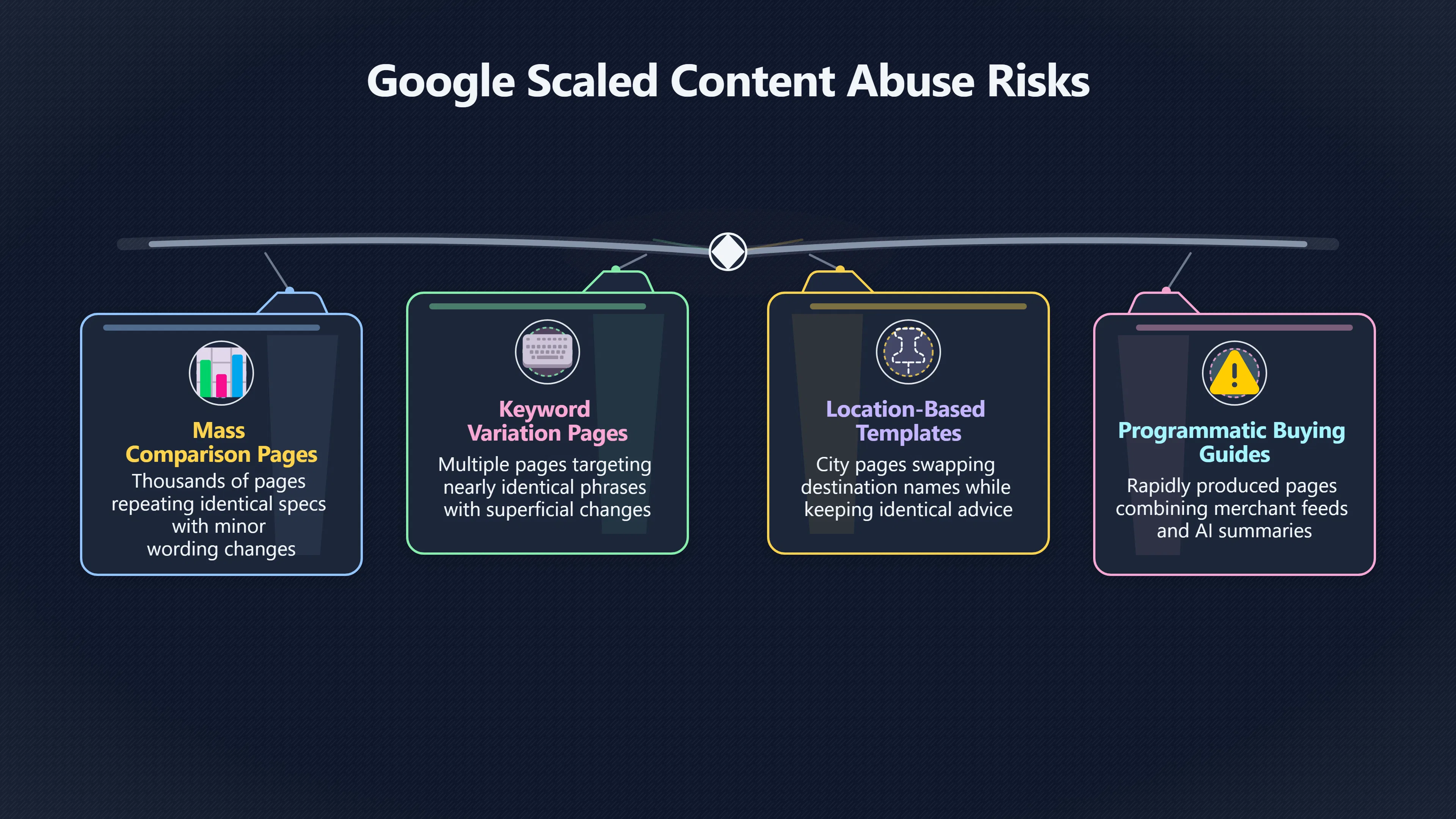
Mass comparison pages. A publisher may automatically create thousands of pages such as “Product A vs Product B”, “Product A vs Product C”, and every possible combination between hundreds of products. If most comparisons repeat identical specifications with only minor wording changes, users gain little that could not be found elsewhere.
Keyword variation pages. Pages targeting phrases like:
- best laptop for students
- best laptop for college students
- best laptop for university students
- best laptop for studying
may become problematic if each contains effectively the same recommendations with only superficial keyword changes.
Location-based affiliate pages. Travel and local affiliate sites frequently generate pages such as:
- best hotels in Manchester
- best hotels in Liverpool
- best hotels in Bristol
If every city page follows the same template while changing only destination names, prices and affiliate booking links, Google may view the collection as largely unoriginal unless each page demonstrates genuine local expertise, independent recommendations or location-specific guidance.
Programmatic buying guides. Modern publishing systems can combine merchant feeds, AI-generated summaries and affiliate links to produce thousands of pages rapidly. Google’s guidance makes clear that using generative AI is not inherently against policy, but generating many pages without adding value may violate the scaled content abuse policy.[Google for Developers]developers.google.comGoogle for DevelopersGoogle Search's guidance on using generative AI content…Using generative AI tools or other similar tools to gener…
The common characteristic is not automation itself. It is the absence of meaningful editorial differentiation between pages.

What Makes One Affiliate Page Distinct From the Next?
Large sites naturally reuse layouts, navigation and formatting. What Google increasingly evaluates is whether the main content changes in ways that help readers make different decisions.
A genuinely distinct affiliate page usually includes several elements that cannot be reproduced by changing a few variables:
- Different buying considerations for different audiences.
- Independent explanations of trade-offs.
- Original comparisons rather than copied specifications.
- Evidence of first-hand research, testing or specialist knowledge where appropriate.
- Context that reflects the specific search intent behind that page.
For example, “best hiking boots for winter mountain use” should not simply be a renamed version of “best hiking boots”. Cold-weather grip, insulation, waterproofing, crampon compatibility and safety considerations create a genuinely different editorial problem for the reader.
The more unique questions a page answers, the easier it is to justify its existence as part of a large library.
Editorial Checks Before Publishing Large Page Batches
Publishing hundreds of pages at once increases the chance that duplication will become systematic rather than accidental. Editorial review before publication is therefore more important than after indexing.
Useful checks include:
- Purpose test: Does this page answer a question that another page on the site does not already answer?
- Originality test: Would removing product names leave behind largely identical text?
- Evidence test: Does the page contain original analysis rather than merchant information rewritten in different words?
- Search intent test: Is the content tailored to the specific query, or is it simply another route to the same affiliate links?
- Consolidation test: Would users benefit more from one stronger page instead of ten narrowly differentiated pages?
These checks become increasingly valuable when pages are produced through editorial workflows involving AI assistance, databases or large writing teams, because duplication often emerges gradually across hundreds of entries rather than through one obviously poor page.
Why Site-Wide Patterns Matter
Google’s spam documentation and broader guidance increasingly assess behaviour across collections of pages rather than judging every URL in isolation. A single thin comparison page may simply fail to rank. Thousands of near-identical pages, however, can signal a systematic attempt to capture search traffic at scale.[Google for Developers]developers.google.comThis abusive practice is typically focused on creating large amounts of unoriginal…Read more…
This is particularly relevant for affiliate businesses because programmatic publishing often creates repeated structures across entire directories. Search systems can evaluate similarities in wording, page purpose, internal linking, and commercial intent across the library rather than treating every page as an entirely independent document.
Consequently, improving a handful of pages may not fully address broader quality issues if the publishing model itself continues producing largely interchangeable content.
The Practical Threshold for Affiliate Publishers
There is no evidence that Google penalises affiliate sites simply because they contain thousands of pages. Many large review publishers, specialist buying-guide websites and ecommerce businesses maintain extensive indexed libraries.
The practical threshold is editorial justification. Every additional page should exist because it helps users solve a distinct problem, not because it captures another search phrase.
For affiliate publishers, the safest scaling strategy is therefore to expand coverage by expanding expertise. As page numbers increase, the standard for originality becomes more important, not less. A growing library should demonstrate broader knowledge, deeper comparisons and richer guidance—not merely more URLs targeting slightly different keywords.
Amazon book picks
Further Reading
Books and field guides related to When Affiliate Scale Starts Looking Like Spam. Use these as the next step if you want deeper reading beyond the article.
Product-Led SEO
Directly addresses building large search-driven websites that prioritize user value over low-quality scaled content.
They Ask, You Answer
Encourages publishing content that solves real user problems, reinforcing the principles behind sustainable affiliate scaling.
Content Chemistry
Emphasizes creating genuinely useful content and editorial quality instead of producing pages solely for rankings.
The Art of SEO
Covers search quality, technical SEO and content strategy that align with avoiding spam-like publishing practices.
eBay marketplace picks
Marketplace Samples
Live-tested eBay searches with available results related to this page.



Endnotes
1.
Source: developers.google.com
Link:https://developers.google.com/search/docs/essentials/spam-policies
Source snippet
This abusive practice is typically focused on creating large amounts of unoriginal...Read more...
2.
Source: developers.google.com
Title: core update spam policies
Link:https://developers.google.com/search/blog/2024/03/core-update-spam-policies
Source snippet
Google for Developersour March 2024 core update5 Mar 2024 — We're announcing three new spam policies against bad practices we've seen gro...
Published: March 2024
3.
Source: developers.google.com
Link:https://developers.google.com/search/docs/fundamentals/using-gen-ai-content
Source snippet
Google for DevelopersGoogle Search's guidance on using generative AI content...Using generative AI tools or other similar tools to gener...
4.
Source: blog.google
Link:https://blog.google/products-and-platforms/products/search/google-search-update-march-2024/
Source snippet
New ways we're tackling spammy, low-quality content on...5 Mar 2024 — We're making several [updates]({{ 'updates/' | relative_url }}) to our spam policies to better addres...
5.
Source: developers.google.com
Link:https://developers.google.com/search/docs/fundamentals/creating-helpful-content
Source snippet
Helpful, Reliable, People-First ContentGoogle's ranking systems are designed to present helpful, reliable information that's created to b...
6.
Source: developers.google.com
Title: site reputation abuse
Link:https://developers.google.com/search/blog/2024/11/site-reputation-abuse
Source snippet
our site reputation abuse policyIt is only a violation if there is ALSO an attempt to abuse search rankings by taking advantage of the ho...
7.
Source: developers.google.com
Link:https://developers.google.com/search/updates
Source snippet
We added 3 new spam policies: expired domain abuse, scaled content abuse, and site reputation abuse. Also added a new FAQ on helpful cont...
8.
Source: support.google.com
Title: low traffic affiliate site what can i do better
Link:https://support.google.com/webmasters/thread/112211009/low-traffic-affiliate-site-what-can-i-do-better?hl=en
Source snippet
Traffic Affiliate Site - What Can I Do Better?3 Jun 2021 — My feeling (backed up by user feedback) is that it genuinely helps people choo...
9.
Source: support.google.com
Link:https://support.google.com/webmasters/thread/361483450/major-spam-problems-is-there-any-way-to-solve-it?hl=en
Source snippet
google.com"Major spam problems" - is there any way to solve it?29 Jul 2025 — * no need to mentioned that we're not scaled content abuse...
10.
Source: support.google.com
Link:https://support.google.com/webmasters/answer/9044175?hl=en
Source snippet
actions report - Search Console HelpThe site appears to use aggressive spam techniques such as scaled content abuse... Review Google's s...
11.
Source: support.google.com
Link:https://support.google.com/websearch/answer/10622781?hl=en
Source snippet
policies for Google SearchWe block search results that lead to child sexual abuse imagery or material that appears to victimize, endanger...
12.
Source: support.google.com
Link:https://support.google.com/webmasters/thread/302446608/provide-details-about-the-affiliate-products-review-guidelines-and-can-we-used-more-than-ads-network?hl=en
Source snippet
For example a website used a ad network...
13.
Source: developers.google.com
Title: helpful content update
Link:https://developers.google.com/search/blog/2022/08/helpful-content-update
Source snippet
creators should know about Google's August 2022...The helpful content update aims to better reward content where visitors feel they've h...
Published: August 2022
14.
Source: leadflask.com
Title: google search update march 2024
Link:https://leadflask.com/blog/google-search-update-march-2024
Source snippet
Google Search Core Update, March 2024: Summary &...Google's March 2024 update to its search algorithm punishes a handful of spam and abu...
Published: march 2024
Additional References
15.
Source: geniuslink.com
Link:https://geniuslink.com/blog/how-to-create-affiliate-product-reviews/
Source snippet
Creating Affiliate Product Reviews (With Help From ChatGPT)In this guide, we'll go over how to create an affiliate product review and how...
16.
Source: uberall.com
Link:https://uberall.com/en-us/resources/blog/a-comprehensive-guide-to-reputation-management
Source snippet
Google Review Guidelines: What They Mean for YouLearn how to manage Google business reviews alongside your location marketing. Expert Kry...
17.
Source: qualia-academy.co.uk
Link:https://qualia-academy.co.uk/google-e-e-a-t-guidelines/
Source snippet
Google's E-E-A-T Important GuidelinesWith this update, Google now prioritises content that demonstrates real-world experience, particular...
18.
Source: de.linkedin.com
Link:https://de.linkedin.com/posts/sebastian-hertlein_scaled-content-abuse-klingt-nach-spam-farmen-activity-7465748815380115456-AyR8
Source snippet
von Sebastian Hertlein"Scaled Content Abuse" klingt nach Spam-Farmen. Google's eigene Definition (Search Central Documentation): "Produci...
19.
Source: impactmedia.co.uk
Title: google updates their spam policies to include back button hijacking
Link:https://www.impactmedia.co.uk/insights/google-updates-their-spam-policies-to-include-back-button-hijacking/
Source snippet
abuse, scaled content abuse, and site reputation abuse. The consistent thread running through all of these updates is Google's focus on user...
20.
Source: bondedagency.com
Title: google releases march 2024 core update along with multiple spam updates
Link:https://bondedagency.com/google-releases-march-2024-core-update-along-with-multiple-spam-updates/
Source snippet
The policy targets the generation of many pages, of which their primary purpose is to manipulate search rankings. This...Read more...
Published: march 2024
21.
Source: linkedin.com
Title: googles march 2024 core updates new spam policies explained rhehe
Link:https://www.linkedin.com/pulse/googles-march-2024-core-updates-new-spam-policies-explained-rhehe
Source snippet
Google's March 2024 Core Updates & New Spam Policies...New Google Spam Policies 2024. Google introduces three spam policies: expired dom...
Published: march 2024
22.
Source: thirdmarblemarketing.com
Link:https://www.thirdmarblemarketing.com/googles-algorithm-and-helpful-content
Source snippet
Google's Algorithm and Helpful ContentDiscover how our SEO packages can help you navigate Google's evolving search algorithm & create hig...
23.
Source: ecomranker.com
Title: Discover expert strategies to create high-quality, user-focused
Link:https://ecomranker.com/google-helpful-content-update-2026-guide/
Source snippet
Google Helpful Content Update: Complete Guide to SEO...21 May 2026 — Learn how Google's Helpful Content System impacts SEO rankings in...
Published: May 2026
24.
Source: transparency.google
Link:https://transparency.google/intl/en-GB_ALL/our-policies/product-terms/google-sites
Source snippet
Google Sites Policies and Guidelines - Transparency CentreIf you believe that someone is violating the policies found below, report abuse...
Topic Tree